
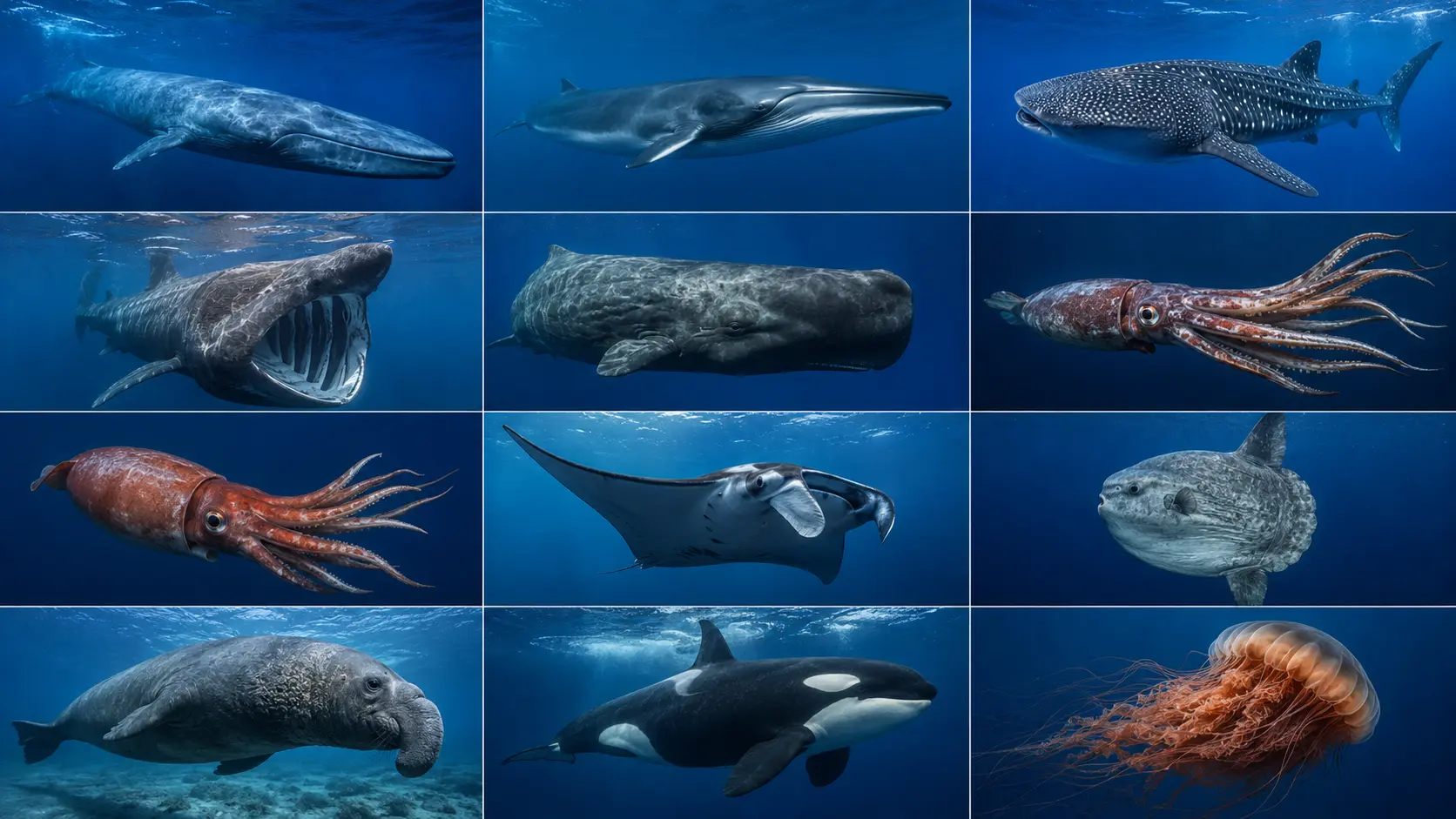
The ocean covers more than 70 percent of our planet, and beneath its surface lurks a world of staggering proportions. While the African bush elephant—the largest land animal—stands roughly four metres tall and weighs around six tonnes, it is a pipsqueak compared to the giants that roam the deep. With water to support their immense weight, marine creatures can reach sizes that defy imagination.
From the largest animal ever known to exist to invertebrates with tentacles longer than a blue whale, here are the top 12 biggest creatures that call the oceans and seas their home.
1. Blue Whale (Balaenoptera musculus)
The undisputed heavyweight champion of all time.
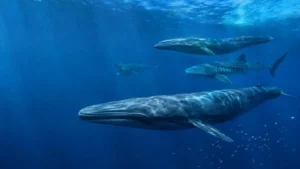
The blue whale is not just the largest animal in the ocean today—it is the largest creature ever to have lived on Earth. Reaching epic lengths of up to 33 metres (110 feet) and weighing around 150 to 190 tonnes, these gentle giants dwarf even the biggest dinosaurs that ever walked the planet.
Despite their colossal size, blue whales feed on some of the smallest organisms in the sea: tiny shrimp-like creatures called krill. To sustain their massive bodies, they consume as many as 40 million krill each day, taking huge gulps of water and straining out their prey through baleen plates. A newborn blue whale calf is already about seven metres long and weighs approximately 2.5 tonnes.
Blue whales can be found in all the world’s oceans except the Arctic Ocean. Their populations were decimated by commercial whaling, and they remain classified as endangered.
2. Fin Whale (Balaenoptera physalus)
The second-largest whale—and the second-largest animal ever—barely gets the attention it deserves.
The fin whale is the second-largest whale species alive today, reaching lengths of up to 27 metres (about 85 to 90 feet) and weighing as much as 80 tonnes. It is only a few metres shorter than the blue whale, yet it receives far less recognition.
Fin whales can be found in all the world’s oceans but prefer cooler waters and are not typically seen in the tropics. They can live between 80 and 90 years and are distinguishable by the prominent fin on their backs near the tail. Like their larger cousins, fin whales are also classified as endangered.
3. Whale Shark (Rhincodon typus)
The largest fish in the ocean—and it’s not even close.
Despite the word “whale” in its name, the whale shark is every bit a fish. It is the largest fish alive today and the largest non-mammalian vertebrate on the planet. The largest accurately measured whale shark reached 61.7 feet (about 18.8 metres) in length, though unconfirmed reports suggest even larger individuals. They can weigh up to 21.5 tonnes.
These gentle giants drift through warm open oceans, feeding almost exclusively on plankton and small fish. They are harmless to humans, despite their intimidating size. Whale sharks can live around 70 years, but they are listed as Endangered by the IUCN, threatened by bycatch, vessel strikes, and their slow reproductive rate.
4. Basking Shark (Cetorhinus maximus)
The silver medalist among fish—and another gentle giant.
The basking shark commonly reaches about 26 feet (8 metres), with the largest reliably measured specimens approaching 12 metres (about 40 feet) in length. The heaviest can approach 19 tonnes.
Like the whale shark, the basking shark is a filter feeder, cruising the ocean surface with its cavernous mouth gaping open as if it were sunbathing—which is how it got its name. It is one of only three filter-feeding shark species on Earth. A century of hunting for its meat, fins, and liver oil, compounded by bycatch and ship strikes, has severely reduced populations. In 2019, the IUCN reassessed its status from Vulnerable to Endangered.
5. Sperm Whale (Physeter macrocephalus)
The largest of the toothed whales—and the loudest animal on Earth.
Sperm whales are the biggest of the toothed whales (odontocetes). Males can reach lengths of 20 to 21 metres (about 67 feet) and weigh over 57 tonnes. Females are significantly smaller, growing to about 40 feet and weighing around 30,000 pounds.
Named for the waxy substance called spermaceti found in their enormous heads, these deep-diving titans were severely impacted by commercial whaling. They are famous for their powerful echolocation and produce the loudest animal sounds on Earth. Sperm whales have one of the widest global distributions of any marine mammal species and are known to hunt giant squid in the ocean’s darkest depths.
6. Colossal Squid (Mesonychoteuthis hamiltoni)
The heaviest invertebrate on Earth—and one of the ocean’s greatest mysteries.
The colossal squid is the largest (heaviest) living invertebrate on the planet. Adult colossal squids can grow to lengths of up to 10 metres (about 23 feet) and weigh as much as 500 kilograms (approximately 1,100 pounds)—making them even bigger than the famed giant squid immortalised by Jules Verne’s “20,000 Leagues Under the Sea”.
Found circumpolar around Antarctica in the Southern Ocean, these elusive creatures spend most of their lives in the deep meso- and bathypelagic realms. In 2025, scientists captured the first-ever video of a live colossal squid in its natural habitat, proving that the sea still holds many big mysteries.
7. Right Whale (Eubalaena spp.)
Named because they were the “right” whales to hunt—a tragic distinction.
Right whales grow to around 18 to 18.5 metres (about 60 feet) in length and can weigh up to 100 tonnes. They are among the biggest animals in the sea.
These animals got their name because whalers considered them the “right whales” to hunt: they swam slowly, making them easy to kill, and floated after death, allowing whalers to recover the carcass. Today, they are critically endangered. There are fewer than 400 North Atlantic right whales remaining, making them one of the most endangered whale species on the planet.
8. Lion’s Mane Jellyfish (Cyanea capillata)
The longest animal in the world—and it’s not even a vertebrate.
When measuring by length, the lion’s mane jellyfish takes the crown. While its bell (the umbrella-shaped body) typically measures only 1.5 to 1.8 metres (5 to 6 feet) across, its tentacles can trail an astonishing 36.6 metres (120 feet) behind it. That is longer than a blue whale.
The largest recorded specimen, found off the coast of Massachusetts in 1865, had a bell diameter of 2.3 metres (7 feet) and tentacles stretching 36.6 metres. According to Guinness World Records, the lion’s mane jellyfish is also the heaviest jellyfish in the sea, weighing up to 998 kilograms (2,200 pounds). Its 800 tentacles contain millions of stinging cells (nematocysts) used to capture prey.
9. Ocean Sunfish (Mola mola)
The heaviest bony fish in the world—and it looks like a swimming dinner plate.
The ocean sunfish is the heaviest bony fish in the world. In 2022, a specimen found in Portugal weighed an incredible 6,049.48 pounds (about 2.7 tonnes) and measured 11.8 by 10.7 feet. These bizarre-looking fish have a flattened, disc-like body and can reach impressive sizes while drifting near the ocean surface.
Despite their enormous weight, ocean sunfish feed primarily on jellyfish and other small marine organisms. They are found in tropical and temperate oceans worldwide and are known to bask on their sides at the surface—hence their name.
10. Giant Pacific Octopus (Enteroctopus dofleini)
The largest octopus species—and one of the most intelligent invertebrates.
The giant Pacific octopus is the largest species of octopus in the world. Adults typically weigh about 50 kilograms and span nearly 5 metres across. The largest recorded specimen reportedly measured 9.75 metres long and weighed 272 kilograms (about 600 pounds).
Found in the Pacific Ocean from southern Baja California to Alaska and across to Japan, these intelligent predators use camouflage, problem-solving skills, and a sharp beak to hunt. They can squeeze through spaces smaller than their own bodies and have been known to hunt sharks at night.
11. Leatherback Sea Turtle (Dermochelys coriacea)
The largest turtle on Earth—and one of the most ancient reptiles.
The leatherback sea turtle is the largest living turtle species and one of the largest living reptiles. Adults can grow to more than 6.5 feet (2 metres) in length and weigh up to 2,000 pounds (about 900 kilograms). The largest leatherback ever recorded was nearly 10 feet in length and weighed 2,019 pounds.
Named for its unique shell composed of a layer of thin, tough, rubbery skin strengthened by thousands of tiny bone plates, the leatherback has the greatest migratory distribution of any reptile on the planet. These ancient creatures travel vast distances while feeding primarily on jellyfish in the open seas.
12. Japanese Spider Crab (Macrocheira kaempferi)
The arthropod with the longest legs on Earth.
The Japanese spider crab has the greatest leg span of any known arthropod, reaching up to 3.7 metres (about 12 feet) from claw to claw. The body can grow to 40 centimetres in carapace width, and the whole crab can weigh up to 19 kilograms (42 pounds)—making it second in mass only to the American lobster among all living arthropod species.
Found in the waters around Japan at depths of up to several hundred metres, these ocean floor crawlers resemble monster-like creatures with their extremely long, spindly legs. Despite their fearsome appearance, they are scavengers that feed on dead animals and plant matter.
Honourable Mentions
Several other marine giants deserve recognition. The orca (killer whale) can reach 9.8 metres in length and is the ocean’s apex predator. The giant manta ray has a wingspan of up to 7 metres. The Greenland shark can grow to 6.4 metres and is one of the longest-living vertebrates on Earth. The oarfish, the world’s longest bony fish, has been reliably documented at 8 metres with unconfirmed reports of specimens up to 17 metres. And the saltwater crocodile, the largest living reptile, can reach up to 7 metres in length and weigh over 1,000 kilograms.
–
Conclusion
The ocean is a realm of superlatives. From the 33-metre blue whale—the largest animal ever to exist—to the 36-metre tentacles of the lion’s mane jellyfish, the seas contain creatures that stretch the limits of what we thought possible. What makes these giants even more remarkable is that many of them, from the whale shark to the colossal squid, remain shrouded in mystery. We have explored less than five percent of the ocean, and new discoveries are made every year.
As we continue to explore the depths, we may yet find creatures that surpass even these titans. But for now, these 12 giants stand as the undisputed champions of the underwater world—a testament to the extraordinary scale of life that thrives beneath the waves.