
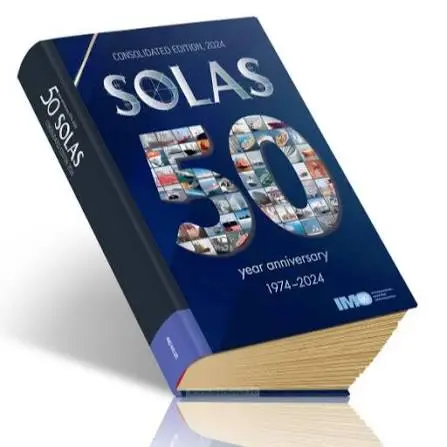
A practical overview of recent and upcoming SOLAS amendments, covering fire safety, emergency towing, pilot transfer arrangements, GMDSS, VDES and lifeboat drills.
The International Convention for the Safety of Life at Sea (SOLAS) sets minimum international standards for ship construction, equipment and operation. Its requirements are updated through amendments, codes and IMO interpretations. For shipowners, operators, masters and technical managers, keeping track of those changes is essential: some requirements are already in force, while others have been adopted but will apply only from a later date.
This article summarises the SOLAS developments highlighted in the supplied regulatory report, with a focus on changes from 2024 to 2026 and requirements scheduled to take effect in 2028 or later. It distinguishes mandatory amendments from unified interpretations and guidance, since these do not all have the same legal status or application date.
Important: An amendment’s entry-into-force date does not always mean that every ship must comply in the same way on that date. Application can depend on a vessel’s type, construction date, gross tonnage, voyage and flag Administration. Always check the relevant IMO instrument and flag-State instructions.
At a glance: key SOLAS dates
| Date | Development | What it concerns |
|---|---|---|
| 2024–2025 | Unified interpretations and revised guidance | Clarifications on fire safety, propulsion, piping, valves, lifting appliances, PFOS and emergency towing |
| 1 January 2026 | Amendments to SOLAS Chapters II-2 and V | Fire safety, fuel-related provisions and reporting lost containers |
| May 2026 | Revised escape-trunk interpretation | Clarifies how “lower part of the space” is understood in specified escape requirements |
| 2026, adopted for later entry into force | SOLAS Chapters IV and V amendments | Enhanced Group Call information services and VDES |
| 1 January 2028 | Several amendments scheduled to apply | Pilot transfer arrangements, emergency towing on certain new ships, fire-safety clarifications and VDES |
| 1 January 2031 | Specific free-fall lifeboat arrangements | Requirements for simulated-launch testing arrangements on new free-fall lifeboats |
SOLAS amendments in force from 1 January 2026
Several amendments adopted earlier entered into force on 1 January 2026. They address fire hazards, fuel safety and navigational reporting.
Fire safety in vehicle and ro-ro spaces
Amendments to SOLAS Chapter II-2 strengthen fire-safety measures in vehicle, special-category and ro-ro spaces, including specified weather decks used to carry vehicles. Depending on the space and applicable requirements, measures include fixed fire detection and alarm systems, effective fire patrols in special-category spaces, and video monitoring designed to help crews identify a fire quickly. Cameras must be positioned to provide useful coverage after vehicles or cargo have been loaded. www.imo.org
These requirements respond to the particular difficulty of detecting and fighting fires in spaces where vehicles and cargo can obstruct access and visibility. Ship operators should review the relevant arrangements, procedures and crew familiarisation for each applicable space.
Fuel safety and flashpoint documentation
Amendments to SOLAS Chapter II-2 address the risk of receiving oil fuel that does not meet the applicable flashpoint requirements. Before bunkering, the ship must receive a declaration from the fuel supplier’s representative confirming that the supplied fuel complies with the relevant SOLAS requirements and stating the test method used to determine its flashpoint. www.imo.org
This places added importance on bunker documentation and on checking that fuel supplied to the vessel is accompanied by the required declaration.
Prohibition of PFOS in fire-extinguishing media
SOLAS amendments prohibit the use or storage of fire-extinguishing media containing perfluorooctane sulfonic acid (PFOS). The implementation dates distinguish between ships constructed on or after 1 January 2026 and existing ships, which must comply no later than the date of their first survey on or after that date. The amendments also address disposal of prohibited media through appropriate shore-based reception facilities. www.imo.org
A related unified interpretation adopted in 2025 explains how PFOS content should be sampled, tested and verified. Operators should therefore consider both the prohibition itself and the procedures used to demonstrate compliance.
Electronic inclinometers on certain new ships
From 1 January 2026, containerships and bulk carriers of 3,000 gross tonnage and above, constructed on or after that date, are required to carry an electronic inclinometer or another means of determining, displaying and recording the ship’s roll motion. The requirement has defined scope and exceptions, so the applicable SOLAS text should be consulted when assessing an individual vessel. www.imo.org
Reporting lost containers
Amendments to SOLAS Chapter V require the loss of freight containers at sea, or the observation of containers drifting at sea, to be reported as a danger message. Prompt reporting helps alert other ships and relevant authorities to a navigational hazard. This requirement entered into force on 1 January 2026. www.imo.org
Other fire-safety amendments
The 2026 changes also include provisions that extend fire-detection requirements to control stations and cargo-control rooms, and strengthen fire-safety arrangements on certain ro-ro passenger ships. These changes form part of the wider amendments to SOLAS Chapters II-2 and V adopted under resolution MSC.550(108). imo.org
Changes adopted in 2026 for entry into force in 2028
At its 111th session in May 2026, the IMO Maritime Safety Committee adopted amendments to SOLAS Chapters IV and V concerning maritime safety information and the VHF Data Exchange System (VDES). These amendments are scheduled to enter into force on 1 January 2028. They have been adopted, but are not yet in force as of October 2026. IMSML
VDES and the development of ship-to-shore communications
The amendments establish VDES within the IMO regulatory framework and permit it as an alternative to AIS for ships covered by the relevant requirements. They also update provisions for the dissemination of maritime safety information and search-and-rescue information through operational recognised mobile satellite services. Related IMO work includes revised VDES performance standards and guidance for its onboard operational use. IMSML
VDES is intended to support the exchange of more digital data between ships and shore-based services than AIS alone. The amendments also clarify how references to AIS are to be understood in relevant IMO instruments in relation to the AIS component of VDES. Ship operators should follow the 2028 implementation provisions and any applicable flag-State guidance before treating VDES as a replacement for AIS.
Pilot transfer arrangements: new requirements from 2028
SOLAS Chapter V, regulation 23, has been replaced to introduce more detailed requirements for pilot transfer arrangements. The provisions cover the design, manufacture, construction, securing, installation, inspection, stowage, maintenance and familiarisation associated with pilot ladders and related equipment. Mechanical pilot hoists are not to be used. wwwcdn.imo.org
The revised requirements are scheduled to take effect on 1 January 2028. Arrangements installed on or after that date must comply with the new performance standards. For arrangements installed earlier, ships subject to SOLAS Chapter I must comply by the first survey on or after 1 January 2029; ships outside Chapter I must comply no later than 1 January 2030. Inspection, stowage, maintenance, replacement and familiarisation requirements apply to all arrangements from 1 January 2028, regardless of installation date. wwwcdn.imo.org
The IMO has also issued updated illustrations to help pilots, seafarers and operators understand the required arrangements. These should be used alongside the regulation and performance standards, not as a substitute for them. wwwcdn.imo.org
Emergency towing arrangements for certain new ships
SOLAS Chapter II-1, regulation 3-4, has been amended to require emergency towing arrangements on ships other than tankers of 20,000 gross tonnage and above, constructed on or after 1 January 2028. The arrangements are intended to allow rapid deployment even if the ship being towed has lost its main power, and to facilitate connection to the towing ship. wwwcdn.imo.org
The IMO approved interim guidelines in 2025 to provide a standardised approach to the design, deployment and stowage of emergency towing equipment for ships other than tankers. The guidelines support implementation of the SOLAS requirement; operators planning newbuildings should consider the arrangement early in the design and equipment-selection process. imo.org
Fire-safety clarification for ship structures
An amendment to SOLAS Chapter II-2, regulation 11, is scheduled to enter into force on 1 January 2028. It clarifies structural-integrity and insulation requirements, including the application of fire-integrity tables and insulation arrangements for superstructures, bulkheads, decks, deckhouses and specified machinery-space boundaries. The purpose is to clarify how the existing fire-safety provisions apply to particular structures and spaces. imo.org
A separate 2024 set of unified interpretations addresses matters including tanker cargo and vapour piping, the meaning of “crown” in certain machinery spaces, ventilation of cargo tanks and propulsion arrangements on passenger ships. Some interpretations apply from 2024, while others apply from 1 January 2026. Ship designers and operators should check the circular relevant to the specific arrangement. ww2.eagle.org
Lifeboat drills and free-fall lifeboat testing
Amendments adopted in 2026 update SOLAS Chapter III provisions on emergency training and abandon-ship drills involving lifeboats. Related amendments to the LSA Code and to the requirements for maintenance and testing of lifeboats address arrangements for testing free-fall lifeboat release systems under load without launching the lifeboat into the water.
The general amendments are scheduled to enter into force on 1 January 2028. The LSA Code’s specific design requirements for simulated-launch arrangements apply to free-fall lifeboats installed on or after 1 January 2031. Among other provisions, the arrangement must be designed to withstand the specified test load, with a safety factor of at least six based on the maximum working load. highlights
The staged dates matter: the 2028 entry into force and the 2031 application date for new free-fall lifeboat installations refer to different parts of the requirements.
Other interpretations and guidance from 2024 and 2025
Not every SOLAS-related development is an amendment to the Convention. IMO unified interpretations and circulars help promote consistent application of existing requirements. The report also highlights several such clarifications.
Escape arrangements from the lower part of machinery spaces
A revised circular issued in 2026 clarifies that the “lower part of the space” in specified SOLAS Chapter II-2 escape provisions may refer to either the lowest deck level or a platform or passageway. The circular also advises port State control officers, in principle, to accept arrangements approved by the flag State and to consult the flag Administration where appropriate. This was a clarification of interpretation; it did not create a new SOLAS design requirement. imo.org
Remotely controlled valves
A unified interpretation approved in June 2025 clarifies the meaning of a remotely controlled valve fitted on a pipe passing through a collision bulkhead. It explains the permitted valve arrangements and the conditions for a fail-close arrangement, including the location from which any additional manual-closing function must be activated. ww2.eagle.org
Lifting appliances
A 2025 unified interpretation clarifies documentation requirements for load testing and thorough examination of existing non-certified lifting appliances. Owners and operators should check that the documentation available onboard matches the applicable interpretation and the appliance’s certification status. ww2.eagle.org
GMDSS radio installations in sea area A3
A revised circular addresses inconsistent application of SOLAS Chapter IV requirements for medium-frequency and MF/HF radio installations on ships operating in sea area A3. The clarification allows a duplicated MF/HF installation to meet the relevant arrangement without requiring a separate MF installation in addition, where the circular’s conditions are met. www.imo.org
What ship operators should do
The amendments have different application dates and do not all affect the same ships. A practical review should identify:
- Which ships are in scope based on vessel type, gross tonnage, construction date, service and voyage.
- Which requirements are already in force and which have been adopted for a future date.
- Whether the change is a Convention amendment, a mandatory code requirement, a unified interpretation or guidance.
- What needs to change onboard, such as equipment, design arrangements, procedures, certificates, records or crew familiarisation.
- Which deadlines apply, including survey-based deadlines for existing ships.
- What the flag Administration or recognised organisation requires to demonstrate compliance.
A compliance register that records the instrument, resolution or circular, application date, affected ships and responsible person can help prevent future requirements from being overlooked. For significant design changes—such as pilot transfer equipment, emergency towing arrangements or fire-protection systems—early review is especially useful.
Conclusion
The SOLAS developments adopted or implemented from 2024 to 2026 address practical safety concerns: fire detection and response, fuel documentation, lost-container reporting, pilot transfers, emergency towing, lifeboat drills and digital maritime communications. Some are already in force; others, including the VDES framework and several ship-design requirements, are scheduled for 2028 or later.
The key is to distinguish the status and scope of each update. An adopted amendment with a future entry-into-force date should not be treated as already in force, while a unified interpretation can affect how an existing requirement is applied. Operators should use the current IMO instruments and confirm ship-specific application with the relevant Administration.
Official IMO references
- SOLAS Convention overview and chapter summaries
- IMO summary of shipping rules in force from 1 January 2026
- MSC 111 highlights, including VDES
- SOLAS amendments to pilot transfer arrangements, resolution MSC.572(110)
- SOLAS amendments on emergency towing arrangements, resolution MSC.549(108)
- IMO amendments to instruments and entry-into-force dates
This article is an editorial summary of the supplied report and relevant IMO materials. It is not a substitute for the applicable SOLAS text, flag-State requirements or vessel-specific compliance advice.