
07/02/2026
The Climate Resilience Framework evaluates how exposed individual ships are to a wide range of plausible regulatory and market futures, addressing a gap left by today’s backward-looking assessment tools
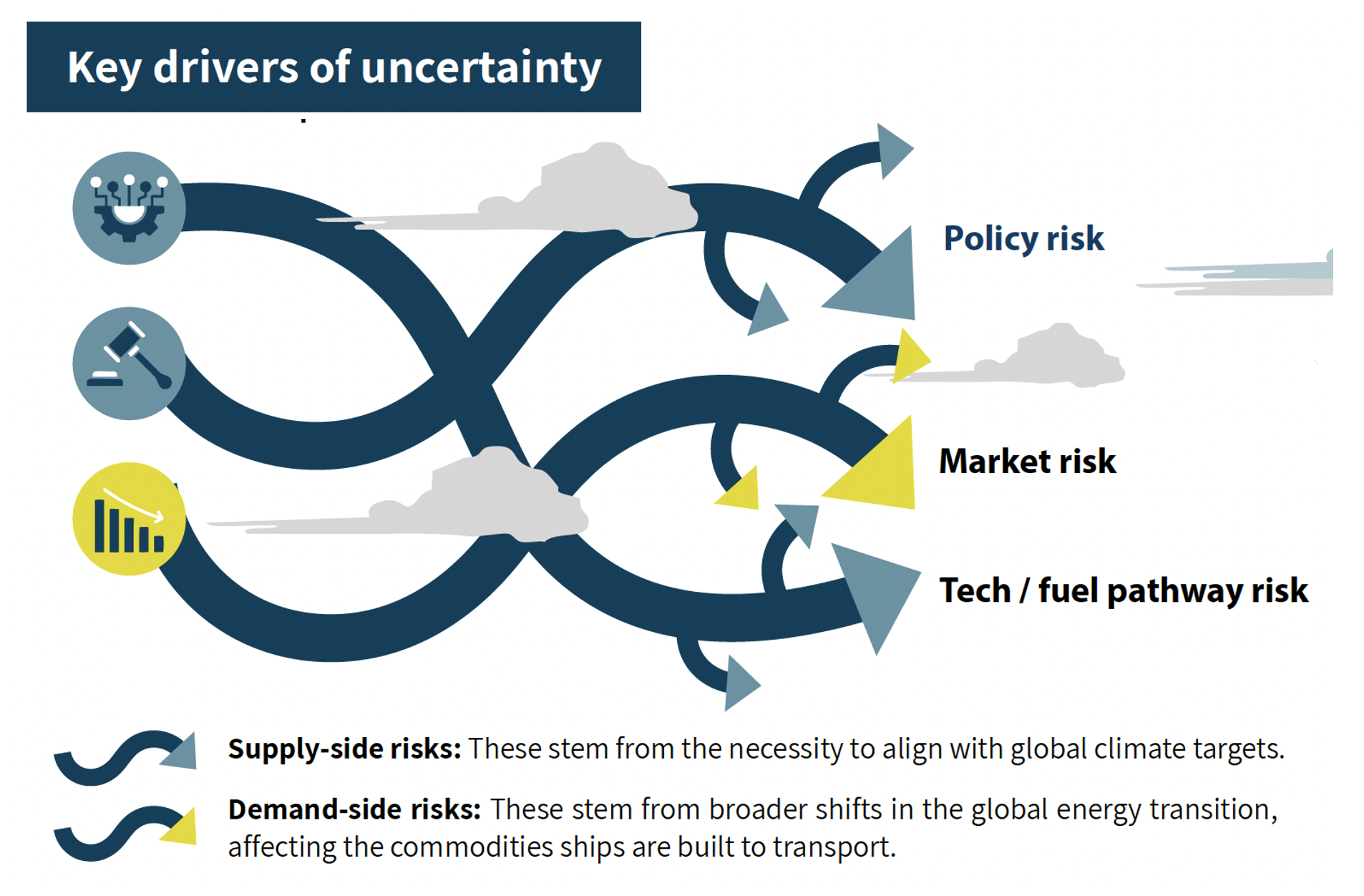
LONDON, 2nd July 2026 – When a bank or investor assesses a ship’s climate risk today, the tools available largely look backward: historic emissions, current compliance status, or a snapshot of where a vessel stands right now. None offer a public, forward-looking view of how that same ship might fare across the range of regulatory and market scenarios shipping could plausibly take over the next decade.
Researchers at UCL’s Shipping and Oceans Research Group have developed a framework to close that gap. Rather than evaluating a vessel against a single forecast or a handful of illustrative scenarios, the approach evaluates each ship against 384 internally consistent combinations of regulatory, fuel price, and technology cost assumptions, drawing on initial work on a sample of more than 2,000 commercial vessels from the Clarksons World Fleet Register.
The result is a risk score that reflects a ship’s range of expected costs and competitiveness in those different scenarios, and therefore how it is exposed to a range of foreseeable plausible futures.
Evolution of stranded-asset thinking
The framework builds on existing stranded-asset analysis but applies real option theory, treating a vessel’s ability to adapt – through fuel switching, retrofitting, or deferring investment – as a source of economic value in its own right, not just a hedge.
“Existing assessments typically rely on a limited set of scenarios and don’t capture the value of flexibility under uncertainty,” said Dr. Marie Fricaudet, Senior Research Fellow at UCL Shipping and Oceans Research Group and lead author. “Until now, the industry hasn’t had a consistent way to compare transition risk across individual vessels or portfolios. We wanted to build something owners, charterers and financiers could actually use, as a way to identify which assets are exposed, and which characteristics make a ship more resilient.”
Industry reaction
Sophie-Kim Chapman, VP of Decarbonisation and Energy Security at DFDS, commented: “As a ferry operator, we need to be confident that the vessels we order today will remain commercially viable across a wide range of regulatory and market conditions. The UCL framework offers something we haven’t seen before: a consistent, transparent basis for comparing how different design and fuel choices perform across the full range of plausible futures. This kind of forward-looking analysis is exactly what we need to inform decisions we’re making now.”
Key findings
The risk index shows that under current IMO policy outcome uncertainty, older tonnage that is efficient – in particular equipped with wind propulsion – and either conventional or LNG dual-fuel, currently represent a lower climate-risk investment.
Existing ship orders already show some signs consistent with that finding. The recent shift toward conventional and LNG dual-fuel vessels, even as zero-carbon fuels attract attention, is consistent with owners responding rationally to the absence of clear policy signals, preserving flexibility while regulatory uncertainty – including the future shape of the IMO’s proposed Net Zero Framework – remains unresolved.
Retrofitting is assumed to be viable with conservative estimates of how much this would cost for each fuel option. A conventional vessel that cannot be converted ranks among the riskiest assets the framework evaluates, underscoring why retrofit readiness is the protective factor.
Why this matters for financiers
Existing frameworks used by major shipping lenders are built on historical and current snapshot emissions data. They are not designed to answer a forward-looking question: how exposed is this asset or portfolio to outcomes resulting from governments and industry taking climate action?
Michael Parker, former Chairman of the Poseidon Principles Association, said: “Banks will want to be able to look across their shipping portfolios and identify where transition risk is concentrating. Until now, the forward-looking tools to achieve this have been limited. The UCL Climate Resilience Framework offers a new method for evaluating individual vessels against various plausible future scenarios, aiding in informed decisions regarding where additional capital for retrofits may be necessary to maintain asset competitiveness long-term.”
Looking ahead
Applying the framework at fleet scale already surfaces findings that researchers plan to test further with industry and finance stakeholders over the coming months, including the relative importance of vessel age, energy efficiency, and retrofit flexibility, as well as the consistently strong performance of technologies such as wind-assisted propulsion in determining resilience and how those rankings shift under different assumptions about future IMO policy.
The concept of the framework and its methods were discussed and received positively at a roundtable with shipowners, charterers and financiers held during London Climate Action Week. The work has also received positive feedback from initial consultation with the industry and is undergoing further review. Interested stakeholders are requested to get in touch to get a preview of the tool and provide feedback during this next phase of development before eventual release of the tool in the next few months.
“This isn’t about predicting winners,” said Professor Tristan Smith, Professor of Energy and Transport at UCL Shipping and Oceans Research Group. “It’s about giving the industry access to simple, transparent and repeatable ways to compare risk across asset and design choices and demystifying the crucial evidence-based conversations that are needed across shipping’s value chain.”
Reference: This article is based on the announcement published by UCL’s Shipping and Oceans Research Group on 2nd July 2026. For more information and to access the accompanying infographic, visit: https://www.shippingandoceans.com/post/new-climate-resilience-framework-for-shipping