
Most deep-sea merchant ships use large, low-speed, two-stroke crosshead diesel engines directly coupled to the propeller. These engines are turbocharged and uniflow-scavenged, typically with a single hydraulically operated exhaust valve per cylinder. Their long stroke gives more time and space for combustion, which makes them well suited to burning heavy fuel oil (HFO)—the cheaper refinery residue—while marine diesel oil (MDO) or marine gas oil (MGO) is used in emission control areas, manoeuvring, or where distillate fuel is required.
The fuel system is therefore built for HFO treatment and viscosity control, with settling tanks, centrifugal separators, service/day tanks, booster pumps, heaters, a viscometer, and fine filters. HFO is heated so that its viscosity at the fuel pumps is normally about 10–20 cSt; distillate fuels are much thinner and may instead need cooling to keep viscosity above about 2 cSt and avoid pump leakage or seizure.
For HFO/MDO/MGO changeover, the system usually includes a three-way valve or automatic changeover unit between service tanks, plus temperature/viscosity monitoring and sometimes a distillate cooler. Changeover must be done gradually while the engine is running, usually with reduced load and a fuel-temperature gradient of no more than about 2 °C per minute, to avoid thermal shock and sticking of fuel-pump plungers. Automatic systems such as MAN’s Diesel Switch monitor temperature versus time and halt the changeover if the gradient is exceeded. Operators must also watch for fuel incompatibility, since mixing HFO and distillate can precipitate asphaltenes and clog filters.

Marine engines must operate successfully on heavy residual fuel oils which may vary in quality and analysis depending upon the source of their crude and the refinery processes. Fuels from different sources may be incompatible and not mix successfully: it is therefore advisable to store ships’ bunkers from different ports in separate tanks to avoid the risk of stratification and formation of heavy sludges.
Accurate and complete analyses are difficult to obtain but specifications should confirm that certain parameters are not exceeded. Samples of the oil delivered should be kept for reference.
Density of the oil must be given (usually measured at 15°C), since the consignment will be measured by weight. It will also be necessary to know this to adjust centrifuges to give efficient purification.
Viscosity is required, to calculate temperatures at which the fuel is treated and injected into the engine.
Flash point for the fuel must not be below 60°C, although the actual value need not be stated. This minimum is for safety reasons.
All residual fuels will contain contaminants, and to protect the engine some of these must be removed or reduced. Solid contaminants may consist of rust, sand, dust and refinery catalysts (catalytic fines), all of which are abrasives and will cause wear in fuel pumps, injectors, cylinder liners, piston rings and exhaust valve seats. Liquid contaminants will be salt or fresh water, which may also contain other soluble substances; all of these are corrosive.
Fuel to be used is first transferred from storage tanks to a settling tank in which it is heated to allow some water and sludge to settle out by gravity and be drained off. The fuel is then passed through the purification system and discharged to a daily tank. There are usually two daily tanks, used alternately, one in use while the other is being recharged. Settling and service tanks are lagged to conserve heat.
A recommended standard of treatment for residual fuel to be used in a large engine requires two centrifuges of adequate capacity, operating in series. The first acts as a purifier to remove water, solubles, sludge etc while the second acts as a clarifier to remove solids. The purifier must be fitted with the correct disc or dam to match the oil density. The oil is heated before purification (max. temp. 98°C) and the rate of throughput is limited to assist efficient separation. Both centrifuges must be cleaned frequently. Such systems can operate effectively on oils of densities up to 0.99.
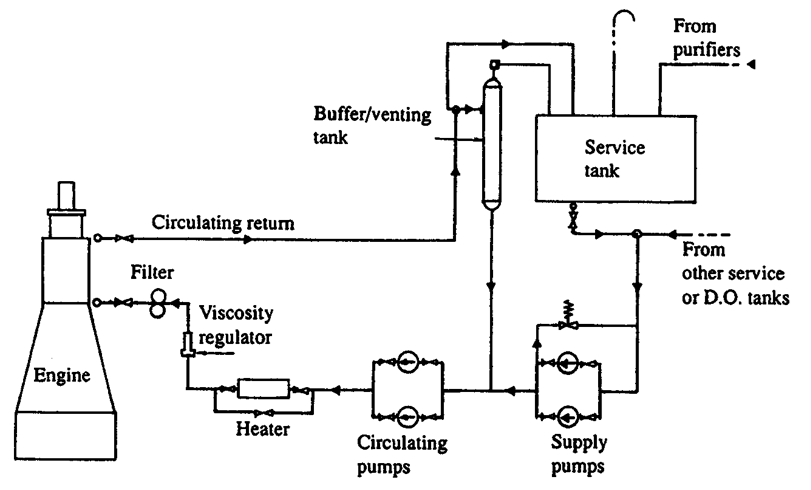
From the service tanks the treated oil is pumped through a pressurised fuel system to the engine. With the oil temperatures necessary for high viscosity fuel, and the possibility that a trace of water may still be present, it is necessary to maintain the engine pump suctions and circulating connections under pressure to inhibit boiling, gasification and cavitation.
The oil first passes to the primary or supply pump which raises its pressure to about 4 bar; this pressure is maintained in the circulating returns. The circulating or booster pump draws oil from the primary discharge, raising its pressure to 10/12 bar and delivering it through the heater, viscosity regulator and fine filter to the main engine fuel pumps. The heater reduces the oil’s viscosity (see below) for efficient combustion. The temperature required will depend upon the oil quality, but to avoid fouling it should not exceed 150°C. The fine filter is of stainless steel mesh to filter out particles larger than 50 microns (0.05 mm), or less for smaller engines. Filters must be changed over and cleaned regularly.
In large two-stroke engines the fuel injectors will circulate fuel during the periods they are not actually injecting it to the cylinder. This ensures the system remains fully primed and at uniform temperature. The circulated oil is returned to a buffer or venting tank from which it passes either back to the low pressure part of the system before the circulating pump suction, or into the service tank. The fuel oil system is shown in Fig.
All pumps are in duplicate and have safe pressure relief valves fitted. All pipes carrying hot oil must be well lagged and fitted with trace heating if necessary. Fuel pipes must be clipped and supported to reduce stress from vibration.
A tank containing diesel oil may be connected to the main heavy fuel system. This will allow flushing with light oil before stopping the engine for long periods or for maintenance.
Various safety devices must be included in the system with alarms to detect loss in oil pressure, low tank level etc. Quick closing valves which can be operated from outside the machinery space must be fitted to all tanks and to the main inlet to the engine. Fuel pumps must have remote switches by which they can be stopped in an emergency.
There must be arrangements for venting and draining the system, cleaning strainers etc, but utmost care must be taken. Drain trays and save-alls, where fitted, must be kept clean; all joints must be kept tight with safeguards to prevent the possibility of hot oil spraying on to heated surfaces.
Oil contained in tanks with open drains should not normally exceed a temperature of 50°C or, if this is lower, may not exceed a temperature 20°C below the flashpoint of the oil.