
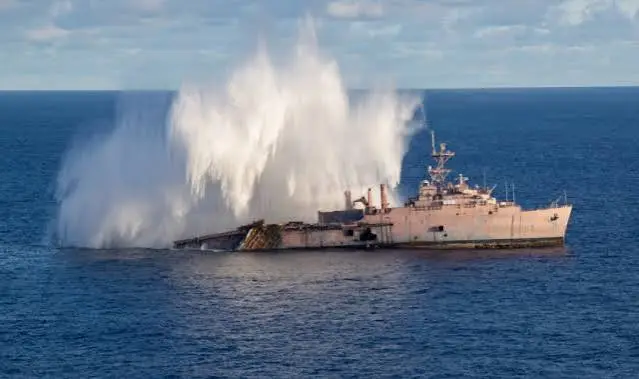
A missile impact creates the dramatic moment, but blast alone does not necessarily sink a ship. A vessel goes down when flooding, loss of stability, structural damage or a combination of these effects overwhelms its ability to remain afloat.
That is one reason navies conduct SINKEX exercises. Short for “sinking exercise,” a SINKEX uses a decommissioned vessel as an unmanned target during controlled live-fire training. The exercise allows crews to practise detecting, tracking and engaging a realistic maritime target while engineers collect data about weapons effects and ship survivability.
The target is a retired hulk, however—not an active warship fighting back. Understanding that difference is essential when interpreting spectacular footage of missile strikes at sea.
What Is a SINKEX Exercise?
A SINKEX is a planned naval exercise in which forces fire live weapons at a retired vessel and ultimately sink it in an approved offshore area. Depending on the exercise, participating units may include surface ships, submarines, fixed-wing aircraft, helicopters and shore-based forces.
The objectives can include:
- Practising the full sequence from target detection to engagement
- Testing weapon and sensor performance in realistic conditions
- Training forces from different services or countries to operate together
- Assessing impact location, internal damage, fire and progressive flooding
- Comparing real results with engineering models and simulations
- Disposing of a prepared decommissioned vessel under the applicable permit
Not every SINKEX follows the same sequence or uses the same weapons. Missiles may be only one part of the event. Naval gunfire, precision-guided bombs or torpedoes can also be used when they support the exercise objectives.
Why Use a Retired Warship as the Target?
A full-size ship presents challenges that a range target or computer simulation cannot reproduce completely. It moves with the sea, has real steel structures and contains decks, frames, bulkheads, machinery spaces and internal compartments that influence how damage spreads.
Using a former warship lets participants evaluate more than whether a weapon reaches a set of coordinates. They can study the complete engagement process and observe how a complex hull responds after impact.
Official accounts of SINKEX events commonly describe three broad benefits:
Realistic weapons employment
Crews must coordinate sensors, communications, identification, firing authority and weapon release within a controlled range. This tests an operational chain rather than a single component in isolation.
Combined-force training
Aircraft, ships, submarines and allied units may attack the same target during one planned event. This helps participants practise timing, communication and shared situational awareness.
Full-scale engineering data
The target can carry cameras and sensors that report heel, trim, flooding, fire or impact effects. Engineers then compare these observations with stability and survivability predictions.
Did You Know? During Atlantic Thunder 2022, U.S. Navy engineers monitored the target’s orientation, flooding and fire through a satellite-linked sensor system. They also updated a flooding and stability model during the event and used drone imagery to build a three-dimensional record of the damaged ship.[3]
How a Retired Warship Is Prepared for SINKEX
Preparation can take far longer than the live-fire phase. The vessel must be safe to tow, suitable for the planned trial and prepared in accordance with the environmental and range rules that apply to the exercise.
1. Decommissioning and equipment removal
Before becoming a target, the ship has already left operational service. Reusable, sensitive or valuable equipment may be removed during the disposal process. The vessel is then treated as a target hulk rather than as a commissioned combatant.
2. Environmental cleaning
For the U.S. Navy’s SINKEX programme, federal regulations require qualified personnel to remove, to the maximum extent practicable, materials that may degrade the marine environment. Fuel tanks and lines must be emptied and flushed so they are essentially free of petroleum. Pollutants and readily detachable materials that could become debris must also be removed.[1][2]
The U.S. Navy has described this work as including the removal of trash, floatable materials, mercury- or fluorocarbon-containing items and relevant materials containing polychlorinated biphenyls, or PCBs.[5]
These are U.S. permit conditions, not universal distance or preparation rules for every navy. Other countries conduct exercises under their own laws, environmental approvals and range procedures.
3. Tow and stability planning
The hulk must remain stable during transfer to the exercise area. Naval architects or salvage specialists can assess watertight condition, ballast, tow loading, weather limits and emergency arrangements. A target that founders before the test would create a safety problem and prevent the planned training.
4. Instrumentation and observation
Depending on the trial, technicians may install tracking units, cameras or sensors. Aircraft, drones, ships and shore facilities can also collect imagery and telemetry from outside the target.
5. Range clearance
The exercise area must be controlled before live firing begins. Published U.S. Navy accounts describe surveys for people, vessels, aircraft and protected marine species, with exercises conducted under the relevant permits and authorisations.[5]
How a Live-Fire SINKEX Is Conducted
The exact procedure is not normally visible in an edited video, but a SINKEX generally involves several controlled phases.
| Phase | What happens | Why it matters |
| Planning | Organisers define training goals, weapons, firing order, safety areas and environmental requirements. | Keeps the event controlled and measurable. |
| Target preparation | The hulk is cleaned, inspected, stabilised, instrumented and towed to the range. | Protects the environment and ensures the target survives until the exercise. |
| Range clearance | The area is checked and access is controlled before weapons release. | Reduces risks to people, other traffic and marine life. |
| Detection and tracking | Participating units locate, identify and track the target. | Exercises sensors, communications and the engagement chain. |
| Live-fire sequence | Approved weapons are fired in a planned order, often with pauses for assessment. | Allows safe coordination and separates useful test events. |
| Battle-damage assessment | Observers evaluate impact points, fire, flooding, list, trim and structural response. | Provides training feedback and engineering evidence. |
| Final sinking and reporting | The hulk sinks at the approved location, and required records are completed. | Confirms disposal and preserves data from the event. |
The order may change as the target’s condition changes. If flooding develops faster than predicted, planners may delay, advance or cancel later firings. A backup scuttling plan may also be available if the damaged hulk does not sink as required.
–
What Happens When a Missile Hits the Ship?
An anti-ship missile can damage a target through impact energy, warhead detonation, blast pressure, fragments and fire. The exact result depends on the weapon, fuze, impact point, hull structure and condition of the target.
Impact and local structural damage
The missile can penetrate or tear shell plating and damage frames, decks or bulkheads near the impact point. Fragments and blast may affect a much larger internal area than the visible opening suggests.
Fire and internal damage
A detonation can ignite remaining combustible material and damage electrical, control or piping systems. On an operational ship, these effects may reduce combat capability even if the hull remains afloat.
Flooding
Damage at or below the waterline allows seawater to enter. Flooding can spread if watertight boundaries fail or openings have not been secured. As more compartments fill, the ship loses reserve buoyancy—the volume that keeps part of the hull above water.
List, trim and free-surface effect
Uneven flooding can make the ship heel to one side or settle by the bow or stern. Water moving across a partly flooded compartment creates free-surface effect, which reduces stability. Additional openings may then become submerged, accelerating the flooding.
Progressive loss of buoyancy or structural failure
The ship finally sinks when it can no longer support its weight or maintain a stable floating position. In some cases, the hull may also suffer major structural failure. The final loss is often cumulative rather than the result of one visually dramatic strike.
–
Why One Missile Does Not Always Sink a Warship
A large naval vessel is divided by decks and watertight bulkheads. This subdivision limits the spread of flooding when boundaries remain effective. Warship designs may also include redundant systems, structural reinforcement and arrangements for firefighting, pumping and damage control.
Weapon damage can still produce a mission kill without sinking the ship. A mission kill means the vessel can no longer perform its assigned combat role. Loss of propulsion is sometimes described as a mobility kill. Neither term necessarily means the hull has lost all buoyancy.
For the same reason, the number of hits in a SINKEX is not a simple score of ship strength or missile quality. Results depend on where weapons strike, the order of attacks, the target’s material condition, sea state and the amount of progressive flooding already present.
What SINKEX Footage Shows—and What It Does Not
| The footage may show | The footage alone does not prove |
| The visible impact point and external blast | The complete pattern of internal damage |
| Fire, smoke, list, trim and the final sinking | Which individual weapon caused the decisive loss of buoyancy |
| A real weapon engaging a full-size hull at sea | How an operational ship with a trained crew would respond |
| The target absorbing several planned strikes | That every strike was intended to sink the ship immediately |
| A coordinated live-fire event | The classified performance limits of the weapons or sensors involved |
The target normally has no crew conducting firefighting, shoring, isolation, counter-flooding or dewatering. It also does not manoeuvre defensively or operate a functioning combat system against the attackers. A SINKEX therefore provides valuable evidence, but it is not a direct recreation of combat between fully operational warships.
–
Case Example: Atlantic Thunder 2022
Atlantic Thunder 2022 shows how much more a SINKEX can involve than a single missile shot. On 7 September 2022, U.S. and U.K. forces used the decommissioned frigate ex-USS Boone as a target in the North Atlantic.[4]
According to the U.S. Navy, participating forces employed several weapon types from ships and aircraft. Engineers from Naval Surface Warfare Center Carderock supported battle-damage assessment, monitored flooding and orientation, modelled stability and used aerial imagery to record the ship’s condition.[3][4]
The example illustrates three important features of modern SINKEX planning:
- Multiple platforms can take part. The event tests communication and coordination across a force.
- Damage is assessed between attacks. Planners monitor the target rather than simply firing continuously.
- The data continues to have value afterwards. Observations can help validate modelling tools and improve future training.
This does not mean that every published SINKEX video depicts Atlantic Thunder or ex-USS Boone. A ship, date, location and weapon should be identified only when the footage or an authoritative source confirms them.
Environmental and Safety Controls
Sinking a steel ship permanently at sea raises legitimate environmental questions. Regulations aim to reduce the risk, but they do not make the physical footprint disappear.
Under the current U.S. general permit in 40 CFR 229.2, target vessels must be sunk at least 50 nautical miles from land in water at least 1,000 fathoms—6,000 feet, or about 1,829 metres—deep. The vessel must sink rapidly and permanently without impairing navigation, and the Navy must report the vessel’s name, approximate tonnage, sinking date and location to the U.S. Environmental Protection Agency.[1]
The EPA also requires preparation to remove petroleum, pollutants and detachable debris to the maximum extent practicable. A 2014 EPA–Navy agreement added clarification and documentation relating to PCB-containing materials.[2]
Safety management also includes range control, weather assessment, firing procedures, communications and clearance of the danger area. In published U.S. events, organisers have reported monitoring for ships, aircraft, people and marine species before firing.[5]
The 50-nautical-mile and 6,000-foot figures should not be presented as worldwide SINKEX rules. They are conditions of the U.S. permit. International readers should consult the responsible navy, coastal state and range authority for the rules governing a particular event.
Suggested infographic: “From Decommissioned Ship to SINKEX Target”—show decommissioning, pollutant removal, inspection, tow preparation, range clearance, live firing, damage assessment and final reporting.
Suggested ALT text: “Diagram showing the stages used to prepare and sink a retired warship during a controlled SINKEX exercise.”
Why SINKEX Exercises Remain Controversial
Supporters argue that full-scale live firing provides training and engineering data that simulations cannot fully reproduce. It can exercise complete weapon and command chains under realistic maritime conditions.
Critics question whether sinking is the best end-of-life option for a ship, particularly because contaminants may remain despite extensive cleaning. They may favour recycling, preservation or other disposal methods where practical.
A balanced assessment should recognise both points. SINKEX has genuine training value, but it also requires strict environmental preparation, transparent oversight and careful consideration of alternatives.
Watch the video here:
Frequently Asked Questions
What does SINKEX stand for?
SINKEX means “sinking exercise.” It is a controlled live-fire event in which a prepared, decommissioned vessel is used as a naval target and ultimately sunk.
Are people aboard the target ship during a SINKEX?
No crew remains aboard during the live-fire engagement. The target is remotely observed from aircraft, ships, sensors or range-control facilities.
Does one anti-ship missile always sink a warship?
No. One hit may cause serious structural, fire or systems damage without producing enough flooding to sink the vessel. Location, warhead effect, subdivision, stability and damage control all influence the outcome.
Why can a target ship survive several hits?
Large ships contain many compartments and have substantial reserve buoyancy. Some hits may occur well above the waterline, while others may cause local rather than progressive flooding. The firing sequence may also be designed to collect data from several weapons before the final sinking.
Is a SINKEX an accurate simulation of naval combat?
It is realistic in weapon employment and full-scale hull response, but it has limits. The retired target does not fight back, manoeuvre defensively or benefit from an operational crew conducting damage control.
Are SINKEX vessels cleaned before they are sunk?
They must be prepared under the rules that apply to the exercise. In the United States, the permit requires petroleum, pollutants and detachable debris to be removed to the maximum extent practicable, with additional Navy–EPA requirements covering preparation and documentation.[1][2]
Conclusion
A live-fire SINKEX is more than the destruction shown in a short video. It is a carefully planned sequence involving target preparation, environmental controls, range safety, weapons employment, battle-damage assessment and final disposal.
Missiles can inflict severe damage through impact, blast, fragments and fire, but the ship sinks only when damage leads to overwhelming flooding, loss of buoyancy, instability or structural failure. The dramatic final plunge is therefore the last stage of a much larger naval and engineering exercise.
For more clear explanations of warship design, naval technology, ship stability, maritime safety and marine engineering, explore MaritimEducation and subscribe to our latest educational videos and articles.
About the Authors — MaritimEducation Team
MaritimEducation Team creates clear, practical and research-informed content about ships, marine engineering, maritime education, shipping, ports, technology, safety and sustainability.
References
- Electronic Code of Federal Regulations. 40 CFR § 229.2—Transport of target vessels. Current regulation accessed August 2026.
- U.S. Environmental Protection Agency. Transport of Target Vessels for Ocean Disposal. SINKEX permit requirements and 2014 EPA–Navy clarification.
- Naval Sea Systems Command, Naval Surface Warfare Center Carderock Division. Carderock Supports Atlantic Thunder 2022. 20 December 2022.
- U.S. Navy. U.K. and U.S. Conduct SINKEX During Atlantic Thunder 22. 23 September 2022.
- U.S. Navy. U.S. and Partner Nations Conduct Multiple SINKEXs as Part of RIMPAC 2024. 23 July 2024.