
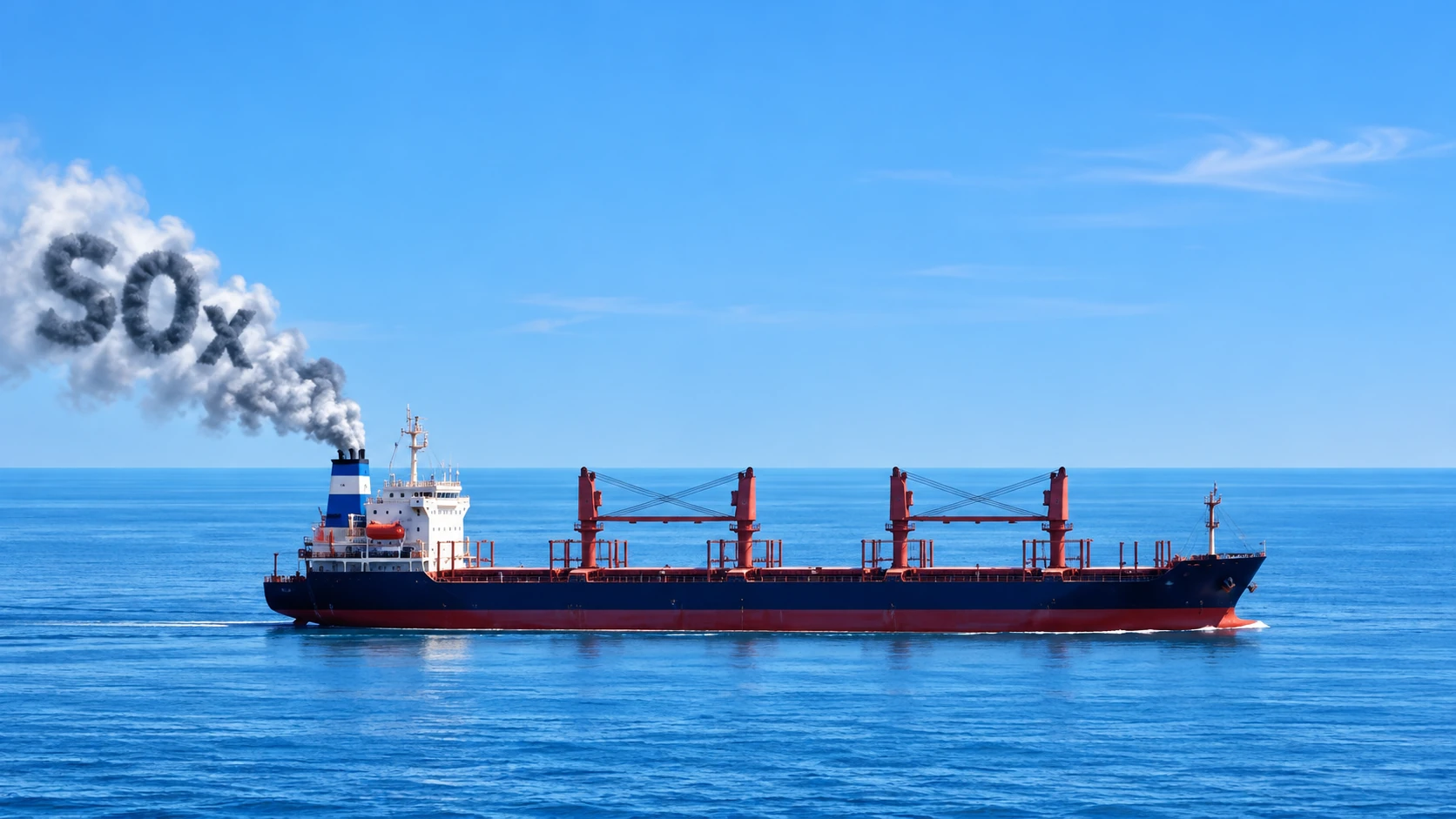
A practical learning guide for ship cadets, ship officers, and maritime professionals.
Regulatory position checked to 20 October 2026, including adopted changes scheduled for 2027 and 2028.
Reducing sulphur oxide emissions is an everyday engineering and operational responsibility. A ship can have compliant fuel in its bunker tanks and still breach the rules if contaminated fuel reaches an engine, a changeover finishes too late, or an exhaust gas cleaning system is operated incorrectly. Effective compliance connects fuel purchasing, machinery operation, passage planning, maintenance, documentation and crew competence.
This guide explains three practical approaches: using low-sulphur fuel, cleaning the exhaust while using higher-sulphur fuel, and using suitable alternative fuels. These are useful teaching categories, rather than three technologies that IMO requires every ship to install. MARPOL sets the applicable sulphur limit and permits approved equivalent methods. Operators select an arrangement that suits their ships and trades.
By the end, learners should be able to identify the applicable limit, explain the available solutions, prepare for an emission control area, recognise failures, and show an inspector credible evidence of compliance. The central lesson is that controlling SOx, controlling NOx and reducing greenhouse gases are connected but different tasks.
What SOx are and why ships produce them
Sulphur in the fuel becomes sulphur oxides in the exhaust
SOx is a collective name for sulphur oxides, principally sulphur dioxide, SO2, and smaller quantities of sulphur trioxide, SO3. Crude petroleum naturally contains sulphur compounds. Their concentration varies with the crude source and refinery processing. Residual fuels have historically retained substantial amounts of these compounds, although residual fuel is not necessarily high in sulphur.
When sulphur-containing fuel burns in an engine or boiler, sulphur reacts with oxygen. The main simplified reaction is:
S + O2 → SO2
Some SO2 is further oxidised to SO3. Reactions involving water and atmospheric constituents produce sulphuric acid and sulphate particles. Thus, part of the pollution develops after the exhaust has left the funnel. A clear-looking exhaust plume does not prove low SOx emissions.
For a given amount of fuel burned, SOx formation depends primarily on its sulphur content. Better combustion can reduce smoke and unburned fuel, but cannot make the sulphur disappear. A purifier removes water and some solid contaminants; it does not materially remove the chemically bound sulphur in marine fuel. The practical choices are to reduce sulphur entering combustion or remove sulphur compounds from the exhaust.
Effects on people and the environment
SO2 irritates the respiratory system and can worsen asthma, particularly during physical activity. Sulphate particles contribute to fine particulate matter, including PM2.5, which can penetrate deeply into the lungs. Coastal communities, port workers and people living close to busy shipping routes are particularly relevant exposure groups. Children, older people and those with existing respiratory disease can be more vulnerable.
Atmospheric sulphur compounds also contribute to acid deposition, damage vegetation, affect soils and freshwater ecosystems, reduce visibility and accelerate deterioration of buildings. Sulphur deposition can contribute to acidification; this should not be confused with the much wider ocean-acidification problem caused by increasing atmospheric CO2. These mechanisms are explained in the US EPA explanation of sulphur dioxide effects.
A simple calculation that makes the limits meaningful
The expression % m/m means percentage by mass. A fuel containing 0.50% sulphur contains 5 kg of sulphur per tonne. Because SO2 contains one sulphur atom and two oxygen atoms, complete conversion gives approximately 2 kg of SO2 for every kilogram of sulphur burned.
| Fuel sulphur content | Sulphur in 1 tonne | Approximate SO2 formed without cleaning |
|---|---|---|
| 3.50% m/m | 35 kg | 70 kg |
| 0.50% m/m | 5 kg | 10 kg |
| 0.10% m/m | 1 kg | 2 kg |
This is a teaching mass balance, assuming sulphur becomes SO2 and ignoring smaller sulphur pathways. At equal fuel consumption, moving from 3.50% to 0.50% reduces potential SO2 by about 85.7%; moving from 0.50% to 0.10% reduces it by 80%. These calculated percentages are not measured fleet-wide emission reductions.
The MARPOL framework
The International Convention for the Prevention of Pollution from Ships, known as MARPOL, addresses air pollution through Annex VI. The principal provisions for this topic are:
| Provision | Practical meaning |
|---|---|
| Regulation 14 | Sulphur and particulate-matter requirements, ECA fuel limits, changeover and sampling provisions. |
| Regulation 4 | Flag Administration approval of equivalent compliance methods, including suitable EGCS arrangements. |
| Regulation 18 | Fuel quality and availability, supplier documentation and applicable delivered-fuel samples. |
| Regulations 5 and 6 | Surveys and International Air Pollution Prevention certification where applicable. |
| Regulations 10 and 11 | Port State control, detection of violations and enforcement cooperation. |
| Regulation 13 | Separate requirements for NOx from applicable marine diesel engines. |
The 2021 revised MARPOL Annex VI provides the underlying framework and must be read with subsequent amendments.
Since 1 January 2020, the worldwide fuel sulphur limit outside applicable SOx emission control areas has been 0.50% m/m. Inside an applicable SOx ECA it is 0.10% m/m. An approved equivalent may be used. These requirements cover fuel used in relevant shipboard combustion equipment, including main engines, generators and boilers; they are not confined to propulsion or international voyages. See IMO sulphur-cap overview and IMO guidance on regulation 14.
Since 1 March 2020, fuel exceeding 0.50% sulphur generally cannot be carried for use aboard a ship without an approved equivalent arrangement. High-sulphur oil transported as cargo is a different matter. An approved scrubber allows its associated machinery to use suitable higher-sulphur fuel; it does not automatically cover every combustion unit aboard.
Convention requirements are mandatory when applicable. IMO guidelines and circulars explain implementation, approval or recommended practice; some become conditions of a ship’s flag approval. Company procedures may impose additional controls. Learners should distinguish these legal levels instead of describing every recommendation as a separate MARPOL obligation.
ECAs and SECAs through 2028
An Emission Control Area, or ECA, is a sea area designated under MARPOL Annex VI for additional emission controls. SECA is the commonly used term for an area controlling sulphur oxides and particulate matter. An ECA may also control NOx, but sulphur designation does not automatically introduce NOx Tier III requirements.
| Area | 0.10% sulphur requirement | NOx position |
|---|---|---|
| Baltic Sea | Applies; 0.10% since 1 January 2015 | Tier III for applicable newer ships |
| North Sea | Applies; 0.10% since 1 January 2015 | Tier III for applicable newer ships |
| North American ECA | Applies; 0.10% since 1 January 2015 | Tier III for applicable newer ships |
| United States Caribbean Sea ECA | Applies; 0.10% since 1 January 2015 | Tier III for applicable newer ships |
| Mediterranean Sea | Applies from 1 May 2025 | SOx/PM designation; not a NOx ECA under this designation |
| Canadian Arctic | Designation in force 1 March 2026; 0.10% applies from 1 March 2027 | Separate construction-date criteria apply |
| Norwegian Sea | Designation in force 1 March 2026; 0.10% applies from 1 March 2027 | Separate construction-date criteria apply |
| North-East Atlantic | Adopted in 2026; amendment enters into force 1 September 2027; 0.10% applies from 1 September 2028 | Designation also includes NOx, with separate applicability criteria |
The Canadian Arctic and Norwegian Sea designations are established by resolution MEPC.392(82). Their sulphur implementation follows the 12-month transition provided for newly designated SOx ECAs. The North-East Atlantic designation was adopted at MEPC 84 in April–May 2026 under MEPC.407(84). It covers defined waters associated with Greenland, Iceland, the Faroe Islands, Ireland, and the mainland United Kingdom, France, Spain and Portugal. Use the legal boundaries and current navigational information, rather than treating a regional description as a navigation chart.
For NOx, the North American and US Caribbean construction threshold is generally 1 January 2016, and the Baltic/North Sea threshold is 1 January 2021. The Canadian Arctic threshold is 1 January 2025. The Norwegian Sea uses contract, keel-laying and delivery criteria beginning with contracts placed on or after 1 March 2026. These are construction applicability tests, not the dates on which all existing engines must be replaced. Refer to IMO explanation of regulation 13 and the relevant amendment for individual ships.
Three dates therefore deserve attention: adoption, entry into force, and application of the operational requirement. They are not interchangeable. Also check national and port requirements: local discharge restrictions or fuel rules may apply independently of an IMO ECA.
Solution (A): Using low and ultra-low sulphur marine fuels
Understanding fuel names
This is the most direct approach: purchase fuel whose sulphur content meets the limit wherever it will be burned. The common commercial terms need careful interpretation.
| Term | Usual meaning | Important qualification |
|---|---|---|
| VLSFO | Very-low-sulphur fuel oil, normally marketed at maximum 0.50% sulphur | May be a residual or blended product; not automatically ECA-compliant. |
| ULSFO | Ultra-low-sulphur fuel oil, commonly maximum 0.10% | Check the contracted specification and actual sulphur result. |
| MGO | Marine gas oil, a distillate fuel | Its name alone does not guarantee 0.10% sulphur. |
| MDO | Marine diesel oil, a commercial fuel description | Confirm the actual ISO grade, composition and sulphur limit. |
| HSFO | High-sulphur fuel oil | Requires an approved equivalent when exceeding the applicable fuel limit. |
HFO means heavy fuel oil. It describes a residual-type fuel and its handling characteristics, not a guaranteed sulphur concentration. A heavy residual fuel can be low-sulphur. Conversely, a product sold as a biofuel blend may still contain substantial sulphur from its fossil component.
Use a defined specification such as ISO 8217:2024, an explicit sulphur maximum and engine-maker requirements when purchasing. ISO 8217 is a fuel specification standard, not the source of the MARPOL sulphur cap. Commercial labels such as VLSFO are not substitutes for a defined grade and laboratory properties. The CIMAC guidance on ISO 8217:2024 explains this distinction.
Advantages and limitations
Low-sulphur fuel generally requires less additional equipment than installing an EGCS or converting to a new fuel system. Existing ships can often comply through appropriate fuel selection and handling. Conventional compliant fuels also benefit from an established bunker supply network, although the exact grade and delivery quantity still require confirmation at each port.
The main commercial disadvantage is exposure to fuel-price differences. VLSFO and distillates may cost more than HSFO; prices and spreads vary. A shipowner also pays for segregation, testing, tank preparation and occasionally extra fuel-treatment capacity. The chief engineer needs sufficient usable compliant fuel for the voyage, expected delays and the company’s contingency margin.
Reducing sulphur strongly reduces SOx and sulphate-related particles. It does not guarantee the elimination of soot, black carbon or all particulate matter. Nor does it establish NOx Tier III compliance or a predictable CO2 reduction. The engine still burns carbon-containing fuel, and refining and distribution also have an environmental footprint.
Handling problems that cadets should recognise
Different compliant fuels may be incompatible when mixed. Two individually acceptable fuels can form sludge when blended, blocking filters and affecting fuel supply. Stability concerns the behaviour of a fuel itself; compatibility concerns the behaviour of a mixture. These are different questions, as explained by CIMAC guidance on fuel stability and compatibility.
Recommended shipboard practice includes keeping new deliveries segregated where practicable, obtaining analysis before use, checking compatibility before unavoidable mixing, and monitoring filters and purifier performance. Treatment settings must match the actual fuel. Water, catalytic fines, sediment and poor cold-flow properties remain important even when sulphur is compliant. See CIMAC guidance on fuel-cleaning systems.
Temperature and viscosity are especially important during changeover. Fuel that becomes too thin can affect injection equipment and leakage; fuel that becomes too cold may cause wax or flow problems. Follow maker limits for temperature-change rate and minimum viscosity. On low-speed two-stroke engines, review cylinder-oil selection and feed rate against fuel sulphur, engine condition and maker guidance; there is no universal setting suitable for every low-sulphur fuel.
Completing a changeover before ECA entry
Moving a selector valve does not instantly replace the fuel already circulating through mixing tanks, heaters, filters, piping and engines. A written changeover procedure is required when separate fuels are used to meet the different limits. The system must be sufficiently flushed before entry, and changeback begins only after leaving the area. Regulation 14.6 requires records of the relevant low-sulphur fuel volumes, date, time and position.
A useful operational sequence is:
- Confirm the boundary and entry time with the bridge.
- Identify every affected consumer, including generators and boilers.
- Check fuel analysis, available quantities and the intended valve arrangement.
- Calculate flushing time for the actual system and operating load, with the approved margin.
- Carry out the changeover while monitoring temperatures, pressure, viscosity and engine behaviour.
- Confirm completion and make records consistent with the bridge log and voyage track.
IMO’s 2019 implementation guidelines, MEPC.320(74) support planning and implementation. Simply calculating tank capacity divided by consumption can underestimate the time needed in a recirculating, mixing system.
Industry example: Hapag-Lloyd publicly documented extensive use of compliant low-sulphur fuel during the IMO 2020 transition. Its 2020 sustainability report announcement is an example of this route, not a claim that every present-day ship in its fleet uses one identical compliance strategy.
Bunker delivery notes and fuel samples
The BDN connects the delivery to the ship’s records
A Bunker Delivery Note, or BDN, provides statutory information about the fuel supplied. For conventional oil fuels, Appendix V includes ship identity, supply details, product name, quantity, density, sulphur content and the supplier’s declaration. Check that the declared intended use is appropriate where higher-sulphur fuel is supplied for an approved equivalent.
BDNs must generally remain aboard, readily available for inspection, for at least three years. The representative delivered sample remains under the ship’s control until the fuel is substantially consumed, and for at least 12 months after delivery. These shipboard requirements apply within the survey/certification scope specified by regulation 18; the sulphur-use limit itself has wider application. See IMO guidance on regulation 18.
Since 1 May 2024, the applicable BDN information includes the measured flashpoint or a statement that it was measured at or above 70°C, under MEPC.362(79). This does not change the normal SOLAS minimum flashpoint into 70°C. Conventional oil-fuel use is generally subject to a 60°C minimum, with specified exceptions and approved low-flashpoint arrangements.
The SOLAS amendments in MSC.520(106), effective 1 January 2026, also require a supplier’s signed conformity declaration before bunkering. Sulphur compliance does not establish that fuel is safe: flashpoint, contamination and suitability for the machinery require their own checks.
Three samples with different purposes
| Sample | What it represents | Why it matters |
|---|---|---|
| MARPOL delivered sample | The delivered bunker batch | Supports verification of what the supplier delivered. |
| In-use sample | Fuel being used by the ship | Can reveal contamination or incorrect operation after delivery. |
| On-board sample | Fuel intended or carried for use | Supports checks of fuel available in the ship’s tanks. |
The current delivered-fuel sampling guidance is MSC-MEPC.2/Circ.18, issued in July 2024, which replaced MEPC.182(59). It provides for continuous representative sampling at the receiving ship’s inlet bunker manifold, with proper witnessing, sealing and identification. The retained quantity should be not less than 600 mL, sufficient for the required tests. It covers MARPOL sulphur and relevant SOLAS flashpoint verification. See MSC-MEPC.2/Circ.18.
Sampling personnel should protect sample integrity and themselves. Use the designated equipment, control hot-fuel exposure, avoid contamination, cross-reference seal identification and store retained samples safely outside accommodation. A supplier’s isolated bottle handed over after delivery is not equivalent to a properly witnessed continuous sample.
For in-use and on-board sampling, the relevant references are MEPC.1/Circ.864/Rev.1 and MEPC.1/Circ.889, together with Annex VI verification procedures. Do not treat a test-method allowance as permission to buy or operate above the legal limit. Sampling and verification rules distinguish between sample categories. See the IMO explanation of fuel-sampling and testing amendments.
The alternative-fuel documentation exception
Since 1 August 2025, MEPC.385(81) requires specific BDN information for low-flashpoint and gas fuels, including appropriate density information and documented sulphur content. With the competent supply-port authority’s agreement, the supplier may state sulphur is below 0.001% m/m instead of giving an actual test value.
These fuels are exempt from the conventional MARPOL delivered-sample provisions in regulations 18.8.1 and 18.8.2, and their service systems are exempt from the sampling-point requirements specified in regulation 14.12. This is not an exemption from documentation or sulphur compliance. Conventional pilot and backup fuel remains subject to its applicable requirements.
Solution (B): Higher-sulphur fuel with an exhaust gas cleaning system
What a marine scrubber does
An Exhaust Gas Cleaning System, or EGCS, commonly called a scrubber, contacts exhaust with a cleaning medium. In a wet scrubber, water absorbs sulphur compounds and alkalinity neutralises the resulting acidity. The exhaust leaving the system can meet an approved equivalent sulphur-emission level while the engine burns HSFO.
The fuel may be conventional residual HFO, but the approved system has a maximum fuel-sulphur capability and an operating envelope. Higher sulphur increases the treatment duty. Engineers must respect the approved combinations of fuel, exhaust flow, engine load and cleaning-water conditions.
| Wet-scrubber type | How it works | Main operational issue |
|---|---|---|
| Open loop | Uses seawater and its natural alkalinity; treated exhaust leaves the funnel and washwater is discharged subject to applicable conditions. | Large water flow; performance depends on water conditions; local discharge restrictions. |
| Closed loop | Recirculates cleaning water with alkaline reagent, commonly sodium hydroxide; separates residues and manages bleed-off. | Chemical supply, cooling, treatment, waste storage and reception arrangements. |
| Hybrid | Can operate in open or closed mode. | Correct mode selection and sufficient storage during discharge restrictions. |
Closed loop does not automatically mean zero discharge throughout a voyage. Bleed-off and residues still require management. A specifically designed zero-discharge operating period depends on holding capacity and the approved arrangement. Wärtsilä technical overview provides technical descriptions of the three systems.
Approval and evidence of performance
Regulation 4 equivalence requires flag Administration approval. The principal modern reference is MEPC.340(77), the 2021 EGCS Guidelines. Older approved installations may remain governed by their applicable earlier approval basis; every ship should identify its own requirements.
Scheme A uses system certification, continuous monitoring of operating parameters and periodic emission checks. Scheme B uses approved continuous emission monitoring with periodic operating-parameter checks. These schemes describe how performance is verified; they do not mean open-loop and closed-loop operation.
For petroleum-derived fuels, the guideline SO2-to-CO2 ratio limits are 21.7 for equivalence to 0.50% sulphur and 4.3 for equivalence to 0.10%. SO2 is expressed in ppm and CO2 in percent by volume. These are ratios, not standalone SO2 concentration limits. Other fuel compositions require appropriate Administration-approved treatment of the ratio method.
Washwater and residue management
A scrubber transfers captured pollutants into a water and residue-management system. Consequently, cleaner exhaust must be considered alongside discharges to the sea. Relevant controls include pH, polycyclic aromatic hydrocarbons, turbidity and nitrate criteria. Equipment condition, sensor calibration and actual discharge permission all matter; IMO discussion of EGCS discharge-water controls explains the environmental parameters.
Some jurisdictions prohibit open-loop washwater discharge. Singapore is one example: its port requirements distinguish compliant fuel use and permitted EGCS operation. An internationally approved scrubber does not override these local rules. Check current restrictions before arrival and allow enough time to change fuel or operating mode. See MPA guidance on Singapore compliance inspections.
Collected EGCS residues should go to suitable reception facilities; they must not be discharged to sea or incinerated aboard. Arrange reception before storage capacity becomes critical and retain disposal evidence. MEPC.1/Circ.900 provides relevant guidance. Residue generation, chemical deliveries and reception costs belong in the operating plan.
A separate Arctic issue is MARPOL Annex I regulation 43A, restricting use and carriage for use of specified heavy oils from July 2024, with defined exceptions and transitional provisions extending to 2029. A scrubber does not override an applicable HFO prohibition. The IMO polar-waters guidance explains this separate regulatory layer.
Does a SOx scrubber also remove NOx or CO2
A conventional SOx scrubber is not a substitute for a NOx control system. Much engine NOx is nitric oxide, which is poorly removed by ordinary wet SOx scrubbing. Applicable engines may need selective catalytic reduction (SCR), exhaust gas recirculation (EGR) or another certified solution. An EGR system may itself include a gas-cleaning component, but that does not make a conventional funnel SOx scrubber a NOx Tier III system.
Scrubbers can capture some particulate matter, with performance depending on particle characteristics and equipment. They do not guarantee removal of all fine particles or black carbon. They also do not normally capture meaningful quantities of CO2 as an approved carbon-capture process. Pumps and treatment equipment consume power and can increase onboard fuel use. Any overall lifecycle comparison with low-sulphur fuels needs an explicit boundary and assumptions.
Failures and operational risks
Watchkeepers should recognise abnormal emissions, low washwater flow, excessive backpressure, water-treatment faults, high tank levels and unreliable instruments. Maintenance introduces additional hazards: corrosive liquids, caustic chemicals, hot surfaces, confined spaces and the possibility of water entering exhaust arrangements. Approved isolation and maintenance procedures are essential.
Under MEPC.1/Circ.883/Rev.1, investigate a malfunction promptly. If compliant operation cannot be restored within a maximum of one hour, change to compliant fuel. Record the event; malfunctions exceeding one hour or repetitive malfunctions should be reported to the flag and port State authorities. If adequate compliant fuel is unavailable, agree a proposed course of action with the relevant authorities. This guidance is not permission to deliberately operate non-compliantly for an hour.
A single failed sensor and an actual treatment failure are not necessarily the same situation. The guidance permits documented interim evidence from other relevant parameters in appropriate cases, while the failed instrument is repaired. Crew must follow the approved procedure rather than simply silence an alarm.
Industry examples: Carnival Corporation documents extensive use of scrubbers, marketed as Advanced Air Quality Systems. Wärtsilä’s Finnlines case study describes installations across its ferry operations. These illustrate commercial deployment; company environmental claims should not be treated as universal performance guarantees.
Solution (C): Alternative fuels
Many alternative fuels contain little or no sulphur and therefore prevent SOx formation at source. However, the delivered specification, pilot fuel, backup fuel and other operating machinery determine the ship’s actual emissions. Installing a dual-fuel engine does not guarantee that the vessel always operates on its cleaner fuel.
LNG and other methane-based fuels
Liquefied natural gas, or LNG, is predominantly methane, CH4, stored at cryogenic temperature. A dual-fuel installation can operate in gas mode or on a liquid fuel, often using a small pilot-fuel quantity to ignite the gas. Gas mode normally gives very low SOx and substantially lower soot-related emissions than residual oil.
NOx performance depends on combustion technology. Low-pressure lean-burn engines can achieve low NOx in gas mode; high-pressure diesel-cycle gas engines may need additional NOx treatment. Always check the engine’s certification and operating mode. The Wärtsilä dual-fuel engine information and MAN B&W ME-GI technical information illustrate why different gas-engine technologies should not be grouped under one fixed reduction percentage.
Methane has less carbon per unit of fuel energy than conventional oil, but methane slip means some fuel escapes unburned. Upstream leakage also matters. Both can erode or reverse a climate advantage, depending on engine, load, fuel supply chain and assessment method. Wärtsilä’s 2025 methane-slip development update demonstrates that slip reduction remains an active engineering task.
Bio-LNG and renewable synthetic methane can use compatible methane infrastructure, but their lifecycle benefit requires verified production pathways. Their chemical similarity to fossil LNG means that combustion slip still needs control.
Operational challenges include tank space, cryogenic handling, pressure management, gas detection, ventilation, ignition control and emergency shutdown systems. LNG bunkering is established at a growing range of ports, but availability and delivery compatibility must be confirmed. CMA CGM is a prominent operator of LNG dual-fuel ships, including the CMA CGM Jacques Saadé; its 2025 annual-results announcement also records continuing fleet development.
Liquid biofuels
Examples include FAME, fatty acid methyl esters, and HVO, hydrotreated vegetable oil, alongside other approved renewable fuel products. Some can be used as drop-in fuels or blends in existing machinery, subject to specification, maker acceptance and statutory requirements.
Many suitable biofuel components have very low sulphur, but the whole blend must comply. For a teaching example, mixing 30% sulphur-free biofuel with 70% fuel containing 0.50% sulphur, on a mass basis, gives approximately 0.35% sulphur. That would meet the global limit but would still exceed 0.10% in an ECA. Commercial blend percentages may use a different basis; use the supplied composition and test result.
FAME-related concerns include oxidation stability, water management, microbial growth, material compatibility and cold-flow behaviour. These are not identical for every biofuel; HVO and FAME have different properties. Follow maker advice and the CIMAC guidance on marine fuels containing FAME rather than assuming that all renewable liquids behave like MGO.
Biofuels still emit CO2 when burned. Their potential climate benefit comes from lifecycle accounting, feedstock sustainability and production pathways. NOx effects depend on fuel and engine operation. Sustainable feedstock supply, certification and price premiums can constrain uptake.
Wallenius Wilhelmsen has documented B100 use and verification. Its separate HSFO-biofuel blend trial is a useful reminder that adding a bio-component does not necessarily remove the need for a scrubber.
Methanol and ethanol
Methanol, CH3OH, and ethanol, C2H5OH, are alcohol fuels with inherently sulphur-free molecules. Suitable fuel quality and compliant pilot fuel can deliver very low SOx. Carbon-containing alcohols still produce CO2 during combustion; fossil methanol should not automatically be described as a low-carbon fuel.
Renewable methanol or ethanol may reduce lifecycle greenhouse gases when produced through a suitable, verified pathway. NOx depends on combustion conditions and the approved engine arrangement. PM is usually low relative to residual fuels, but incomplete combustion can introduce other pollutants, including aldehydes. Engine-specific evidence is needed.
Liquid storage at ordinary ambient conditions is an advantage compared with cryogenic fuels. However, their lower volumetric energy content requires more tank volume for a similar energy supply. Both are low-flashpoint fuels; methanol is particularly toxic and requires careful exposure prevention, leak control and emergency arrangements. Fires can be difficult to see, requiring suitable detection and firefighting procedures.
Maersk has deployed methanol dual-fuel vessels, including Adrian Mærsk. Its December 2025 ethanol-trial announcement reported testing on Laura Mærsk. A trial demonstrates development work; it does not mean ethanol can be substituted in every methanol engine without approval.
Hydrogen and ammonia
Hydrogen, H2, contains neither carbon nor sulphur. A hydrogen fuel cell produces electricity electrochemically, with water and heat as principal outputs at the point of use. Hydrogen combustion can create thermal NOx because the combustion air contains nitrogen; a fuel-cell arrangement therefore has a different emission profile from a hydrogen engine.
Hydrogen requires demanding storage and safety arrangements, including compressed or cryogenic containment, leak detection, ventilation and ignition control. Limited volumetric energy density and bunkering infrastructure constrain many applications. MF Hydra, operated by Norled, is an established ferry example of liquid-hydrogen fuel-cell deployment, not evidence of universal deep-sea readiness.
Ammonia, NH3, also contains no carbon or sulphur. Its use can nevertheless introduce NOx, nitrous oxide, N2O, and unburned ammonia emissions. N2O is a powerful greenhouse gas, and ammonia is acutely toxic. Pilot fuel can add CO2 and SOx. Ammonia therefore needs fuel-specific containment, detection, ventilation, exposure protection and emergency planning.
For both fuels, production determines much of the lifecycle climate result. Hydrogen or ammonia made using unabated fossil energy is not automatically a low-GHG option. The same principle applies to LPG, synthetic fuels and other emerging candidates: a fuel name does not establish its full environmental performance.
Safety and lifecycle references for alternative fuels
The International Code of Safety for Ships Using Gases or Other Low-flashpoint Fuels, or IGF Code, is mandatory through SOLAS within its scope. Its detailed prescriptive requirements focus on natural gas. Other fuels use the relevant approval framework and fuel-specific guidance; gas carriers may instead fall under the International Code for the Construction and Equipment of Ships Carrying Liquefied Gases in Bulk, or IGC Code.
Key IMO references include MSC.1/Circ.1621 for methyl/ethyl alcohol, MSC.1/Circ.1647 for fuel cells, MSC.1/Circ.1666 for LPG, MSC.1/Circ.1687 for ammonia and MSC.1/Circ.1701 for hydrogen, the latter approved in 2026. The IMO alternative-fuel safety directory links current instruments. Interim guidelines do not amount to unrestricted permission to use a fuel.
For greenhouse gases, distinguish tank-to-wake emissions on the ship from well-to-tank emissions in production and delivery. Together they form well-to-wake emissions. IMO’s lifecycle GHG assessment framework provides this framework, including CO2, methane and N2O. Low SOx should never be presented as proof of low lifecycle greenhouse gases.
One further 2026 development is MEPC.1/Circ.905/Rev.1, issued in June 2026 for application from 1 January 2027. It revises biofuel treatment under the IMO fuel-consumption and carbon-intensity arrangements and requires supporting sustainability evidence for the preferential treatment described. This concerns GHG accounting; it does not replace sulphur testing or regulation 14.
Comparing the emission outcomes
The following comparison describes general tendencies, not guaranteed numerical performance. Consider the fuel actually consumed, engine type, operating load, pilot fuel and treatment equipment.
| Approach | SOx and particulate matter | NOx and climate implications |
|---|---|---|
| Low-sulphur petroleum fuel | Strong SOx reduction; fewer sulphate particles; soot can remain. | No automatic NOx or major CO2 reduction. |
| HSFO with approved EGCS | SOx equivalence; some PM capture; washwater and residues require control. | Not normal NOx or CO2 treatment; additional power demand. |
| LNG in gas mode | Very low SOx; generally low soot; pilot contribution remains. | NOx is technology-dependent; methane emissions affect lifecycle benefits. |
| Suitable liquid biofuel or blend | Depends on total blend sulphur and combustion properties. | NOx can vary; lifecycle GHG benefit needs verified sustainability. |
| Methanol or ethanol | Very low fuel-derived SOx; generally low PM. | CO2 at combustion; NOx and lifecycle benefits depend on technology and production. |
| Hydrogen fuel cell | No fuel-derived SOx; no combustion soot from the cell. | No direct CO2 or combustion NOx from the cell; upstream emissions remain relevant. |
| Ammonia engine | No sulphur from ammonia; pilot fuel must be considered. | NOx, N2O and ammonia slip require control; production pathway matters. |
Energy efficiency supports every route. Cleaner hulls, efficient machinery, suitable speed, voyage planning and reduced auxiliary demand lower fuel consumption and therefore the quantity of pollutants generated. Shore power can avoid emissions from generators that are shut down at berth, while boilers or other running equipment may still emit. These measures supplement, rather than replace, the applicable fuel or equivalent-emission requirement.
What Port State Control checks
Port State Control, or PSC, looks for agreement between certificates, records, the physical installation and actual operation. The current general reference is Procedures for Port State Control 2025, adopted by resolution A.1206(34), including its MARPOL Annex VI guidance.
An inspector may compare BDNs with tank contents, examine seals and samples, inspect the fuel system, check changeover times against the voyage, review EGCS records and question the crew. Initial checks can lead to more detailed inspection or sampling where there are clear grounds. A valid certificate is important evidence but does not prove continuous compliant operation.
| Compliance route | Evidence normally relevant |
|---|---|
| Low-sulphur fuel | BDNs, applicable retained samples, fuel analysis, tank and consumption records, written changeover procedure and required changeover entries. |
| Higher-sulphur fuel with EGCS | Approved equivalence, IAPP supplement, approved manuals, operating and emission records, calibration evidence, malfunction records and residue-disposal evidence. |
| Alternative fuel | Applicable BDN and fuel-quality records, approved fuel installation, pilot/backup fuel evidence, actual operating-mode records and relevant crew qualifications. |
Certificates and manuals to recognise
The International Air Pollution Prevention Certificate, or IAPP Certificate, and its supplement apply to ships within the relevant certification scope, generally ships of 400 GT and above on applicable international voyages, with provisions for platforms and drilling rigs. Smaller ships are not thereby exempt from sulphur requirements.
For an EGCS, identify the approved SOx Emissions Compliance Plan, the applicable technical manual, the Onboard Monitoring Manual and the EGCS Record Book or approved recording arrangement. Scheme A also involves the applicable SOx Emission Compliance Certificate. The IMO EGCS documentation framework illustrates the documentation structure established by IMO approval guidance.
An Engine International Air Pollution Prevention Certificate, or EIAPP Certificate, and NOx Technical File concern an engine’s applicable NOx requirements. They are not a ship’s sulphur-compliance certificate. Similarly, the Ship Energy Efficiency Management Plan (SEEMP) and carbon-intensity documentation serve different purposes. A sustainability certificate for biofuel does not demonstrate that its sulphur content meets the ECA limit.
For alternative fuels, expect the applicable statutory safety certification and flag/class approval documentation for the installation, together with operating and emergency manuals. There is no single universal IMO certificate called an “alternative-fuel SOx certificate” that replaces this evidence.
If compliant fuel cannot be obtained
A Fuel Oil Non-Availability Report, or FONAR, records a genuine inability to obtain compliant fuel despite reasonable efforts. Preserve supplier communications, voyage planning, dates, quantities and steps taken to find alternatives. Notify the flag Administration and destination competent authority as required.
A FONAR is not an exemption or automatic permission to use non-compliant fuel. Authorities assess the circumstances and may require corrective measures. A higher purchase price alone does not establish non-availability. The 2019 implementation guidelines, MEPC.320(74) and regulation 18 provide the relevant framework. Keeping a realistic procurement and contingency plan reduces the likelihood of reaching this position.
Training and onboard competence
For conventional fuel and scrubber operations, the International Convention on Standards of Training, Certification and Watchkeeping for Seafarers (STCW) and the ship’s Safety Management System should translate into practical, ship-specific competence. There is no universal separate IMO “SOx certificate” required of every engineer. Company familiarisation, documented instruction, maintenance competence and emergency exercises must fit the equipment and assigned duties.
Cadets should learn to trace the fuel from bunker tank to consumer, identify the ECA boundary, interpret a BDN, explain the sampling arrangement and recognise which machinery is connected to an EGCS. Junior officers should practise communicating changeover status between bridge and engine room, particularly when arrival times change.
Personnel serving on ships subject to the IGF Code have specific requirements under STCW regulation V/3 and section A-V/3. Assigned fuel-related safety duties determine basic-training requirements; masters, engineer officers and personnel with immediate responsibility for fuel and fuel systems require the applicable advanced training. Familiarisation remains necessary. IMO model courses 7.13 and 7.14 support delivery of this training.
The October 2026 training picture also includes STCW.7/Circ.25, generic interim guidance issued in 2025, and STCW.7/Circ.26 and Circ.27, issued in July 2026 for methyl/ethyl alcohol and ammonia respectively. These interim guidelines support developing competence; they should not be described as a new universal STCW certification requirement for every ship. See IMO update on seafarer training for the energy transition.
Useful practical exercises include a late changeover request, an EGCS emission alarm, a full residue tank, a gas-system trip to liquid fuel, and a bunkering emergency. Assessment should test whether trainees recognise the compliance consequence and communicate the response, not merely whether they can recite the sulphur percentages.
Costs availability and green shipping corridors
The best option depends on the vessel’s age, fuel consumption, remaining service life, route and access to infrastructure. For low-sulphur fuels, the main recurring exposure is fuel cost and quality management. An EGCS adds investment, installation downtime, maintenance, power demand and sometimes chemical and disposal costs. Alternative fuels may require new tanks, machinery, safety systems, training and long-term supply agreements.
For a preliminary EGCS comparison, an owner can estimate annual avoided fuel expenditure from the usable fuel-price spread and consumption, then deduct added energy, maintenance, chemicals and waste costs. A simple payback calculation must also allow for off-hire, financing, restricted operating areas and periods when compliant fuel is still necessary. Quoting one payback period for all ships is misleading.
Alternative fuels should be compared by delivered useful energy, rather than price per tonne alone. Lower heating value, engine efficiency, tank volume, pilot consumption and voyage range can change the result. Availability also means more than a port appearing on a supply map: the required grade, quantity, delivery method, connection compatibility, authorisations and date must all be confirmed.
A green shipping corridor is a coordinated route-based initiative involving ports, operators, fuel suppliers and other partners to support low- or zero-GHG shipping. It is not a MARPOL ECA and does not itself create a new sulphur limit or waive existing requirements.
The Rotterdam–Singapore Green and Digital Shipping Corridor supports alternative-fuel deployment and common operational arrangements. The Singapore–Los Angeles–Long Beach corridor agreement was renewed in 2026. Such partnerships can improve supply confidence, bunkering procedures, training and demand aggregation.
Low-sulphur fuels and scrubbers remain useful for air-quality compliance on these routes, but neither automatically makes a voyage low-carbon. Credible corridor claims need evidence of the fuel pathway and emissions outcome. A dual-fuel vessel’s technical capability and its actual fuel use should be reported separately.
Applying the knowledge on board
Case 1 Entering the Mediterranean with VLSFO
A ship approaches Gibraltar in October 2026 using fuel containing 0.48% sulphur. It has no EGCS. The junior engineer says the fuel is compliant because it is below 0.50%.
Assessment: It meets the global sulphur limit but not the Mediterranean ECA requirement. Before crossing the defined boundary, the ship must complete changeover to fuel meeting 0.10%, including flushing affected consumers. The response also requires checking available fuel, the actual machinery configuration and the required records.
Case 2 A hybrid scrubber approaching a restricted port
The vessel burns HSFO and the EGCS emission ratio is satisfactory. Open-loop discharge is prohibited in the destination port, and the closed-loop holding tank is nearly full.
Assessment: Air-emission performance alone is insufficient. Determine whether an approved permitted mode can be maintained with available capacity; otherwise change to compliant fuel before the restriction applies. Arrange reception and investigate why the storage margin was lost. Do not assume that “hybrid” means unlimited zero-discharge operation.
Case 3 A dual-fuel engine trips out of gas mode
An LNG dual-fuel engine switches automatically to liquid fuel while operating in a sulphur ECA. The liquid fuel available to it contains 0.50% sulphur and no approved EGCS covers that engine.
Assessment: Propulsion continuity and environmental compliance must both be managed. Follow the approved emergency and changeover procedures, establish compliant fuel operation, communicate with the bridge and record the event. The gas-mode capability does not make the liquid-mode fuel compliant. This scenario should be addressed in advance when selecting backup fuel.
Case 4 A biofuel label creates false confidence
A delivery is marketed as B30 and comes with sustainability evidence. The cadet proposes using it in an ECA without checking sulphur.
Assessment: Obtain the BDN and appropriate quality information for the finished blend. Sustainability evidence concerns a different question. Check sulphur, fuel suitability, maker acceptance and applicable NOx certification conditions before use. A low-carbon claim cannot substitute for a sulphur result.
A watchkeeper’s final check
Before taking over the watch, be able to answer: Where are we operating? What limit applies? What is each consumer burning? Which equipment provides compliance? What could change that condition? Where is the evidence? Those questions turn MARPOL knowledge into reliable shipboard practice.
Reference guide for further study
The links throughout this material lead to IMO instruments, public authorities, technical guidance and documented operator examples. For a specific ship, use the current consolidated conventions and amendments, flag instructions, approved manuals and the latest requirements of the ports on its route.
| Subject | Key instruments to locate |
|---|---|
| Sulphur compliance | MARPOL Annex VI regulations 4, 14 and 18; MEPC.320(74). |
| Fuel samples | MSC-MEPC.2/Circ.18; MEPC.1/Circ.864/Rev.1; MEPC.1/Circ.889; Annex VI Appendix VI. |
| BDN amendments | MEPC.362(79); MEPC.385(81); SOLAS amendment MSC.520(106). |
| EGCS approval and response | MEPC.340(77), or applicable earlier approval basis; MEPC.1/Circ.883/Rev.1. |
| EGCS environmental management | MEPC.1/Circ.899 and MEPC.1/Circ.900. |
| New ECAs | MEPC.361(79); MEPC.392(82); MEPC.407(84). |
| Inspection | A.1206(34), Procedures for Port State Control 2025. |
| Alternative-fuel competence | STCW V/3 and A-V/3; STCW.7/Circ.25, Circ.26 and Circ.27; applicable fuel safety guidance. |
| Fuel lifecycle and biofuel accounting | MEPC.391(81); MEPC.1/Circ.905 and the revised guidance MEPC.1/Circ.905/Rev.1 for application from January 2027. |