
Large yachts can reduce emissions most effectively when their owners and technical teams understand how energy is actually used on board. That understanding should guide efficiency improvements, machinery upgrades and the selection of alternative fuels. Choosing a fuel first, without measuring demand, can produce an expensive installation that is poorly matched to the yacht’s operating pattern.
The challenge extends well beyond propulsion. Accommodation, air conditioning, refrigeration, water production, ventilation and other services can remain active while a yacht is berthed or anchored. These loads accumulate over long periods and deserve the same engineering attention as the main engines.
This report explains how to build a credible emissions reduction programme for large yachts, combining operational measurement, regulatory assessment, demand reduction, integrated power systems and fuel evaluation. It covers existing vessels and newbuilds, with particular attention to the fleet above 30 metres. Regulatory developments are discussed as at 2 October 2026; proposals are distinguished from adopted requirements.
1. Start with the energy demand
A useful programme follows a clear order: establish the yacht’s operating profile, measure or predict its energy consumption, remove avoidable demand, improve conversion efficiency, and then evaluate the energy sources needed to supply the remaining load. Performance monitoring continues throughout the yacht’s life.
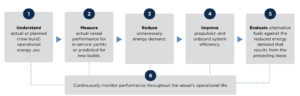
Figure 1. The recommended sequence begins with understanding and measurement, followed by demand reduction, efficiency improvements and fuel evaluation. Continuous monitoring supports every stage.
This sequence matters because lower demand changes the size of subsequent investments. A reduction in electrical consumption can reduce the energy required from generators, batteries, fuel cells and shore connections. Lower propulsion demand can reduce fuel consumption or increase range for a given usable tank capacity.
Equipment ratings still need to satisfy peak loads, redundancy and safety requirements, so lower annual consumption does not automatically justify smaller machinery.
For an existing yacht, the first opportunities may involve control settings, maintenance and generator dispatch. A newbuild offers greater freedom to change hull form, machinery arrangements, insulation, electrical architecture and tank locations. Both benefit from a verified energy budget before committing to a fuel strategy.
2. The size and diversity of the large yacht sector
There is no universally accepted definition of a superyacht. In this report, large yachts generally include motor and sailing yachts of 24 metres and above used for sport or pleasure, privately or commercially. Most of the supporting market and operational evidence concerns yachts above 30 metres.
The 2025 market figures cited in the source material indicate more than 6,000 yachts above 30 metres in operation and 588 under construction. Motor yachts represented approximately 85% of the operating fleet and 93% of the newbuild fleet.
Over the preceding five years, about 184 yachts in this size range were completed annually, with an estimated annual newbuild value of €4.5 billion. More than 2,000 were reportedly available for charter. These are a dated market snapshot, rather than live fleet totals.
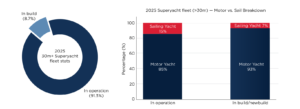
Figure 2. The operating and construction fleet above 30 metres in 2025, showing the predominance of motor yachts. Underlying data: SuperYacht Times and the Monaco Yacht Show Market Report 2025.
The sector includes privately used motor yachts, charter yachts, sailing yachts, expedition vessels and support vessels. Their energy needs vary with climate, speed, itinerary, occupancy, equipment and shore access. A vessel used for short Mediterranean trips faces a different engineering problem from an explorer yacht intended for remote operation.
The focus here is operational energy and greenhouse gas emissions, including the upstream effects of supplying that energy. Wastewater, underwater noise, anchoring damage, antifouling impacts and biodiversity require separate assessments. Improving energy performance does not, by itself, establish that a yacht has low overall environmental impact.
3. Why yacht energy use differs from merchant shipping
Most of the year may be spent stationary
Many merchant vessels operate primarily to move cargo or passengers over long distances. Their efficiency is often assessed using transport work. Pleasure yachts have a different purpose, and the relationship between distance travelled, service delivered and energy consumed is less straightforward.
The source report compares the Fourth IMO GHG Study’s 2018 fleet analysis with a yacht-specific operational profile. Large containerships averaged about 261 days at sea annually, while the largest bulk carriers averaged approximately 252–258 days.
The IMO yacht category, covering vessels of 100 GT and above, averaged 78 days at sea. The large-yacht profile used in yacht benchmarking allocates approximately 36.5 days, or 10% of the year, to underway operation.
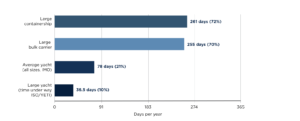
Figure 3. Illustrative annual utilisation from the underlying IMO and yacht benchmarking datasets. The measures have different populations and definitions: days at sea and yacht underway time are not directly interchangeable.
The comparison supports a practical conclusion: an annual assessment must include stationary operation. It does not establish an identical utilisation rate for every yacht or a precise energy split between propulsion and hotel services.
The yacht operating profile
The profile developed through yacht industry benchmarking used AIS information from 130 yachts. After removing incomplete or unrepresentative records, the refined dataset contained 109 yachts over 35 metres and 297 yacht-years covering 2015–2020.
| Operating condition | Share of a full year | Approximate equivalent days |
|---|---|---|
| In port | 56% | 204.4 |
| At anchor | 34% | 124.1 |
| Underway | 10% | 36.5 |
| Total | 100% | 365.0 |
The underway allocation is further divided into slow cruising at 7.6% of the full year, manoeuvring at 1.5%, fast cruising at 0.8%, and maximum-speed operation at 0.1%.
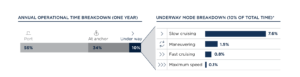
Figure 4. The reference profile allocates 90% of annual time to port and anchor operation. The four underway modes are percentages of the full year and together total 10%. Underlying methodology: Water Revolution Foundation operational profile.
These percentages describe time, not fuel use. A short period at high propulsion power can consume substantial energy, while a long period alongside may involve a lower continuous load. Shore electricity, reduced occupancy or periods of partial shutdown also affect consumption.
The reported standard deviations are about five percentage points for underway time and 18 percentage points for time in port. Anchor time is calculated as the remainder. Owners should use the reference profile as an initial comparison and replace it with vessel-specific observations when making investment decisions.
Hotel loads can be significant without dominating every yacht
ISO/TS 23099 discusses an approximate annual division of energy between propulsion and hotel power, while recognising uncertainty in hotel-load calculations. The source report explicitly notes that a measured fleet-wide split has not been established.
The appropriate response is to measure both. A high-speed yacht with frequent passages may need to prioritise propulsion. A yacht spending long periods at anchor in a warm climate may obtain greater benefit from air conditioning, electrical generation and stationary power improvements.
4. Build a baseline that explains consumption
An annual fuel total provides an incomplete account of performance. A yacht may consume little because it is rarely used; another may consume more while delivering the same services more efficiently. Energy records need the operational context that makes comparisons meaningful.
Measure by operating mode and system
Separate records should cover port operation on shore power, port operation on generators, anchor operation, manoeuvring, cruising, and maintenance or lay-up. Where possible, distinguish occupied and unoccupied periods and record relevant environmental conditions.
| Data group | Useful records | Decision supported |
|---|---|---|
| Fuel | Delivered quantities, tank reconciliation, fuel type, main-engine and generator consumption | Energy and emissions accounting |
| Electricity | Generator output, shore imports, battery charging and discharge | Electrical demand and conversion losses |
| Propulsion | Speed, distance, operating hours, power or load, sea conditions | Comparison of passage performance |
| Hotel services | HVAC, refrigeration, pumps, ventilation, water production and other major consumers | Identification of persistent demand |
| Operating context | Occupancy, climate, itinerary, operating mode, maintenance condition | Comparison under equivalent conditions |
| Evidence quality | Meter calibration, missing data, estimation methods, fuel sustainability documents | Reliability of results and claims |
Fuel and electricity must be accounted for consistently. Adding a generator’s fuel energy to the electricity it produces would count the same energy twice. Similarly, battery discharge is an internal transfer when the charging energy has already entered the system boundary.
A baseline should distinguish energy supplied to the yacht from useful energy delivered to equipment.
For an operating yacht, records should cover representative seasonal conditions and patterns of use. A full year is a useful initial target, although specific interventions may be evaluated over shorter controlled periods. A single charter or yard visit rarely represents annual operation.
For a newbuild, demand is predicted from the intended itinerary, load balance, equipment characteristics and comparable vessels. Assumptions and uncertainty should be recorded, then checked through commissioning, sea trials and the first year of operation.
Keep energy and emissions boundaries clear
Energy use and greenhouse gas emissions are related but different. Fuel consumption must be linked to fuel properties and the applicable emission factors. Shore electricity requires an electricity emission factor. Comparing energy carriers also requires consistent treatment of conversion efficiency.
Tank-to-wake emissions arise during onboard use. Well-to-tank emissions arise from production, processing and delivery. Well-to-wake accounting combines the two.
Whole-vessel life-cycle assessment goes further by considering construction, equipment manufacture, maintenance, refit and end-of-life treatment.
5. Establish which regulations apply to the yacht
Regulatory applicability cannot be resolved through the label “superyacht”. Gross tonnage, statutory ship type, operational purpose and geographical scope must be evaluated together.
Private operation does not generally remove a yacht from MARPOL Annex VI, while commercial registration does not automatically establish that every EU maritime climate instrument applies.
Four facts guide the assessment
| Screening factor | Question to resolve |
|---|---|
| Statutory ship type | How is the vessel recorded on its certificates, and does it meet the definitions used by the particular instrument? |
| Gross tonnage | Which tonnage thresholds does it meet? GT describes enclosed volume, not vessel weight. |
| Nature of operation | Is the yacht privately used, commercially chartered, or transporting cargo or passengers for commercial purposes? |
| Geographical scope | Does it operate internationally, solely in flag-State waters, within ECAs, or on relevant EU/EEA voyages? |
Carrying more than 12 passengers is relevant to the SOLAS passenger-ship definition, subject to convention applicability. It does not automatically settle the vessel’s category for every MARPOL efficiency measure or EU instrument.
The assessment should identify the legal definition involved and retain the supporting decision.
IMO air pollution and energy requirements
MARPOL Annex VI includes air-pollution controls and separate energy-efficiency provisions. The 400 GT threshold is important for survey and certification and for the broad application of Chapter 4, but individual measures have additional conditions.
| Instrument | Purpose | Principal yacht screening point |
|---|---|---|
| MARPOL Annex VI air-pollution provisions | Control fuel-related and engine emissions, including SOx and NOx | Substantive controls may apply below 400 GT. IAPP survey and certification requirements generally concern ships of 400 GT and above on relevant international voyages. |
| SEEMP Part I | Establish an energy-efficiency management process | Generally relevant from 400 GT where Chapter 4 applies. |
| IMO DCS and SEEMP Part II | Collect and report annual fuel consumption data | Generally relevant from 5,000 GT where Chapter 4 applies; yacht status alone is not a ship-type exemption. |
| EEDI and EEXI | Assess technical energy efficiency | Apply to specified ship categories and conditions; yacht is not itself a listed category. |
| CII and SEEMP Part III | Rate annual operational carbon intensity and manage improvement | CII applies from 5,000 GT to specified categories. There is no separate yacht reference line; applicability requires a ship-type assessment. |
The Chapter 4 exclusions must also be checked, including those concerning vessels operating solely within their flag State’s waters and ships not mechanically propelled.
Some non-conventional propulsion arrangements have specific EEDI/EEXI provisions and exceptions. Diesel-electric or hybrid propulsion should therefore not be treated as an automatic exemption from all energy requirements.
The practical distinction is that an applicable yacht may need air-pollution certification and an energy-management plan while remaining outside an efficiency index. Conversely, a large vessel meeting a listed ship definition may require further assessment. Final determinations should be documented with the flag Administration and its recognised organisation, using the current text of MARPOL Annex VI. imo.org
EU monitoring, carbon pricing and fuel intensity
The EU instruments regulate different things. MRV creates verified emissions records, the EU ETS requires allowances for covered emissions, and FuelEU Maritime regulates the greenhouse gas intensity of onboard energy.
| Instrument | Main function | Principal scope considerations |
|---|---|---|
| EU MRV | Monitor, report and verify greenhouse gas emissions | Generally covers ships of 5,000 GT and above carrying cargo or passengers for commercial purposes on relevant EU/EEA voyages. From 2025, specified general cargo and offshore ships from 400 GT are also included. |
| EU ETS maritime provisions | Put a carbon price on covered emissions | Covers relevant cargo and passenger ships of 5,000 GT and above. Ordinarily includes all covered intra-EU/EEA and port emissions and half of covered extra-EU/EEA voyage emissions, with defined exceptions. |
| FuelEU Maritime | Reduce the well-to-wake greenhouse gas intensity of energy used on board | Applies to ships above 5,000 GT transporting passengers or cargo for commercial purposes on covered voyages, with exclusions and specific geographical provisions. |
These scope distinctions are reflected in the European Commission’s implementation guidance. Climate Action
For yachts, the commercial activity and ship-definition tests need particular care. A charter label alone should not replace examination of the actual activity against the regulation. A private yacht’s position should likewise be documented rather than inferred from size.
From the 2026 emissions year, maritime EU ETS coverage includes methane and nitrous oxide alongside carbon dioxide. For ship categories already within the phase-in, allowances cover 100% of covered 2026 emissions and are surrendered in 2027. The 70% requirement associated with surrender in 2026 concerns 2025 emissions. Climate Action
European proposals concerning smaller ships must remain separate from current obligations. A 2026 proposal to amend the maritime reporting framework is relevant to future planning, but it should not be described as an already applicable requirement for every yacht between 400 and 4,999 GT. EUR-Lex
Emission Control Areas require immediate operational planning
Sulphur limits are distinct from carbon regulation. The global MARPOL fuel sulphur limit is 0.50% by mass, while applicable sulphur ECAs require 0.10%, unless an approved equivalent method is used.
| Area or development | Relevant date | Planning implication |
|---|---|---|
| Mediterranean sulphur ECA | 0.10% sulphur requirement applies from 1 May 2025 | Plan compliant fuel or an approved equivalent, associated records and any necessary changeover. |
| Canadian Arctic and Norwegian Sea ECAs | Designating amendments entered into force on 1 March 2026; sulphur requirements apply from 1 March 2027 | Distinguish legal entry into force from the end of the sulphur transition period. |
| North-East Atlantic ECA | Adopted at MEPC 84; amendments enter into force on 1 September 2027, with ECA implementation 12 months later | Account for the 2028 implementation date in route, fuel and newbuild planning. |
The distinction between amendment entry into force and operational implementation is essential when preparing compliance schedules. imo.org
NOx Tier III requirements have separate construction-date and engine applicability criteria. They should not be assigned to all yachts merely because they enter an ECA.
For example, the Canadian Arctic provisions refer to ships constructed on or after 1 January 2025, while the Norwegian Sea provisions use contract, keel-laying and delivery criteria. wwwcdn.imo.org
Future carbon measures remain a planning issue
The 2023 IMO GHG Strategy sets ambitions for international shipping as a sector. It does not require an individual yacht to achieve each sector-wide target directly.
The draft IMO Net-Zero Framework combines a fuel greenhouse gas intensity mechanism with emissions pricing. The draft approved in April 2025 uses a scope of 5,000 GT and above, subject to exclusions.
Adoption discussions were adjourned in October 2025 for one year. As at 2 October 2026, the draft should be treated as a pending framework, rather than a compliance obligation already in force. imo.org
Regulatory readiness means maintaining usable data, confirmed vessel particulars, machinery records and a practical ability to adapt. It does not require committing to a fuel before the vessel’s needs and likely supply conditions are understood.
6. Reduce avoidable energy demand
HVAC and hotel services
Heating, ventilation and air conditioning can be a major electrical consumer, particularly in warm climates. Occupancy, solar heat gain, humidity, ventilation and equipment condition all influence demand.
Useful measures include zoning unoccupied spaces, improving temperature and ventilation controls, maintaining heat exchangers, selecting efficient chillers, and using variable-speed pumps and fans.
Insulation and glazing decisions can reduce heating and cooling requirements where they are feasible within the vessel’s design and refit constraints.
Lighting, refrigeration, water production and other auxiliaries should be reviewed alongside HVAC. A modest continuous reduction can accumulate into a meaningful annual saving. Changes must preserve air quality, humidity control, hygiene and the safety of machinery and accommodation.
Hull and propulsion condition
Hull fouling, coating deterioration and propeller roughness can increase the energy needed to maintain speed. Regular condition assessment and appropriate maintenance can recover performance without changing the yacht’s intended capability.
Trials before and after an intervention should be compared under sufficiently similar speed, displacement, sea and weather conditions.
Hull-form changes and substantial hydrodynamic retrofits require a more detailed feasibility study, while routine condition management is relevant to both existing and new vessels.
Generator dispatch and part-load efficiency
Reliable power and redundancy are essential, but running several generators at low loads may increase fuel use per delivered kilowatt-hour. Technical teams should examine measured generator load distributions and manufacturer performance curves.
Power-management settings, appropriate generator combinations and battery buffering may improve dispatch.
Generator shutdown decisions must still satisfy spinning reserve, fault recovery, blackout prevention and essential-service requirements. Annual savings should be assessed across the actual duty cycle rather than a single favourable operating point.
Shore power
Shore power can replace onboard generator operation when a suitable connection is available. It reduces local exhaust emissions and can also reduce generator hours, noise and maintenance.
Its greenhouse gas benefit depends on the electricity supplied and the conversion and connection losses.
Port operation normally offers the clearest connection opportunity. A yacht at anchor needs a specific electrical supply arrangement; an ordinary quay connection does not provide electricity to every anchorage.
Readiness should cover electrical capacity, voltage and frequency compatibility, connectors, cable handling, protection, earthing and power quality. Installing suitable provisions during construction or major refit can be easier than adding them later, although cost and disruption depend on the vessel.
| Measure | Suitable opportunity | Verification approach |
|---|---|---|
| HVAC controls and zoning | Existing vessels and newbuilds | Compare electricity demand with occupancy and climate recorded. |
| Efficient pumps, fans and lighting | Maintenance, replacement and refit | Measure consumption at comparable service levels. |
| Hull and propeller maintenance | Routine maintenance and docking | Compare speed–power or fuel–speed performance under controlled conditions. |
| Generator dispatch improvements | Operational review and control upgrades | Compare fuel per generated kWh and generator load distributions. |
| Shore-power integration | Existing vessels where feasible; preferably considered early in design | Record delivered kWh, displaced generator operation and electricity emission factors. |
| Heat recovery | Vessel-specific refit or design study | Measure useful heat supplied, auxiliary demand and system interactions. |
7. Evaluate alternative fuels using the reduced demand
Alternative fuels affect more than the engine room. They influence tank volume, usable range, weight, stability, safety arrangements, bunkering, maintenance and available accommodation.
A fuel comparison should begin with the energy needed for the yacht’s intended service.
Energy density affects space
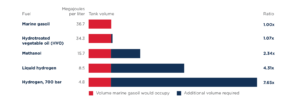
Figure 5. Illustrative fuel energy density and volume needed to store equivalent fuel energy. Values are reproduced from the supplied report and exclude tank structure, insulation, safety spaces and conversion-efficiency differences.
| Fuel or storage condition | Illustrative energy density | Relative fuel volume for equal stored energy |
|---|---|---|
| Marine gasoil | 36.7 MJ/litre | 1.00 |
| HVO | 34.3 MJ/litre | About 1.07 |
| Methanol | 15.7 MJ/litre | About 2.34 |
| Liquid hydrogen | 8.5 MJ/litre | About 4.31 |
| Hydrogen at 700 bar | 4.8 MJ/litre | About 7.65 |
These are indicative energy-storage comparisons. Hydrogen density depends on storage conditions, and actual installation envelopes can be substantially larger.
The hydrogen-to-diesel ratios do not directly predict tank size for equal propulsion range or electrical output: fuel-cell and engine efficiencies, reserve policy, auxiliary losses and usable fuel quantities also matter.
Production pathway determines the climate result
The same chemical fuel can have different upstream emissions depending on how it is produced. Fossil-derived methanol, biomethanol and renewable e-methanol should not be assigned the same greenhouse gas performance.
Hydrogen produced through renewable electrolysis differs from hydrogen produced using unabated fossil processes.
For biofuels, feedstock, processing, transport, land-use effects and sustainability certification matter. For electricity, the generation mix and the basis of the electricity claim matter.
A proposal should identify the physical energy carrier, production route, emission factors, certification and supply-chain evidence.
Fuel-ready design describes an ability to convert or operate with a fuel. It does not establish an emissions reduction until the relevant fuel is actually supplied and used within a documented accounting boundary.
8. Assess the candidate pathways
HVO for compatible existing diesel installations
Hydrotreated vegetable oil, also called renewable diesel, is a paraffinic fuel produced by hydrotreating suitable oils and fats. It can offer a comparatively low-disruption option where the installed engines and fuel systems are approved for the selected product.
Compatibility must be confirmed rather than assumed from the term “drop-in”. Procurement should identify the fuel specification, engine-maker acceptance, operational conditions, fuel-treatment arrangements and required class or flag review.
ISO 8217:2024 includes marine fuels from petroleum, synthetic and renewable sources, but the grade and applicable limits still need to be specified.
A credible greenhouse gas claim also requires sustainable fuel evidence. The revised IMO biofuel guidance, MEPC.1/Circ.905/Rev.1, applies from 1 January 2027 for the relevant DCS/CII accounting. Maritime
Fuel that does not satisfy its certification and emissions criteria cannot simply be assigned a favourable biofuel factor. This accounting treatment should be distinguished from an assessment of physical engine compatibility.
Methanol for combustion or reformed fuel-cell power
Methanol is stored as a liquid at ambient conditions. This makes containment less demanding thermally than liquid hydrogen, but its lower volumetric energy density increases the fuel-space requirement.
Toxicity and its low flash point, around 11°C, require dedicated safety provisions.
An installation may involve segregation, barriers, leak detection, ventilation, isolation and protected fuel piping. The applicable IMO interim guidelines for methyl and ethyl alcohol fuels are set out in MSC.1/Circ.1621. Fuel quality is addressed by ISO 6583:2024.
Methanol can fuel a suitable combustion engine or be reformed into hydrogen for a fuel cell. Many dual-fuel combustion arrangements retain a pilot-fuel requirement.
A reformed fuel-cell installation includes additional processing equipment, heat management and controls; reforming also produces direct emissions.
For some yacht profiles, supplying electrical loads at anchor may be a more suitable initial application than replacing all propulsion energy. That conclusion requires measured demand and a complete installation assessment.
Renewable methanol’s climate benefit also depends on certified supply, rather than the presence of a methanol system alone.
Hydrogen for fuel-cell power
Pure hydrogen used in a fuel cell produces electricity, water and heat without carbon dioxide, NOx or particulate exhaust from the electrochemical conversion itself. This can support quiet operation with low local pollution.
Other running equipment and the upstream fuel supply must still be included in the overall assessment.
Storage is a major constraint. Compressed hydrogen requires high-pressure tanks; liquid hydrogen requires cryogenic containment at about −253°C. Tanks, insulation, ventilation, gas detection, pressure management and safety spaces must be considered alongside the fuel volume.
MSC 111 approved interim guidelines for ships using hydrogen as fuel in May 2026. Fuel-cell installations also have separate IMO guidance, including MSC.1/Circ.1647. Projects need early engagement with class and flag on the applicable approval route and safety case. highlights
Hydrogen may be suitable for defined hotel-load or coastal operating duties where the storage and supply arrangements are credible. Long-range use requires particularly careful assessment of storage, bunkering availability and the complete energy system.
Batteries and hybrid systems
Batteries store energy supplied from shore or generated on board. Their potential benefits include peak shaving, generator load optimisation, short periods with engines stopped, and stored power for manoeuvring or hotel services.
They do not create energy, and charging and discharge incur losses. The greenhouse gas result depends on the charging source and on whether system operation actually reduces fuel use.
Battery mass and volume generally constrain full battery propulsion for long-range large yachts.
Sizing should consider average demand, peaks, usable capacity, reserve, degradation, charging opportunities and intended operating duration.
Integration also requires battery-management, power-management and energy-management systems, cooling, ventilation, protection and appropriate fire-safety arrangements.
| Pathway | Likely assessment focus | Main constraints |
|---|---|---|
| HVO | Compatible existing diesel machinery and documented fuel use | Engine acceptance, specification, certified feedstock, price and supply |
| Methanol | Newbuild or substantial refit; combustion or reformed fuel-cell power | Tank volume, toxicity, low-flashpoint safety, integration and renewable supply |
| Hydrogen | Defined fuel-cell duties and low-local-emission operation | Storage envelope, safety, bunkering and production pathway |
| Battery hybrid | Peak shaving, dispatch improvement and limited-duration electric operation | Usable energy capacity, weight, charging source, degradation and safety |
| Shore electricity | Generator replacement during connected port operation | Infrastructure, capacity, compatibility and electricity emissions |
9. Design the power system as an integrated arrangement
Individual components need to work together. A battery may absorb a demand peak while a generator operates steadily. A fuel cell may supply a persistent electrical load while other sources provide reserve or propulsion.
Shore electricity may support hotel services and recharge batteries during a port stay.
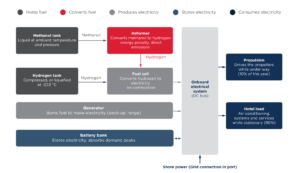
Figure 6. A simplified arrangement showing direct hydrogen or methanol-reformed hydrogen feeding a fuel cell, alongside generators, batteries and shore power. The depicted operating-time shares are reference values, not energy shares. A DC bus is one possible architecture rather than a universal requirement.
A complete assessment includes conversion losses, cooling, ventilation, redundancy, emergency operation and controls.
It should test the expected annual duty cycle and demanding operating situations, including peak loads, loss of a power source and restricted charging opportunities.
For a newbuild, future conversion provisions may include reserved space, structural capacity, cable routes and suitable electrical interfaces. Those provisions should be tied to a credible conversion concept.
Generic labels such as “hydrogen ready” need a clear description of what has been installed, what remains to be added and which approvals will be required.
10. Implement a six-stage roadmap
The roadmap provides a repeatable process for converting technical opportunities into verified improvements.
Low-cost work may begin while the baseline is being refined, and a newbuild may need early fuel decisions because arrangement choices cannot wait until delivery.
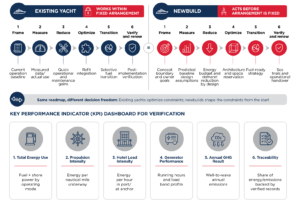
Figure 7. Six stages connect scope, measurement, demand reduction, optimisation, transition and continuing verification.
| Stage | Core activity | Required outcome |
|---|---|---|
| 1. Frame | Define scope, operating horizon, objectives, decision authority and emissions boundary | An agreed project brief with a named accountable owner |
| 2. Measure | Establish mode-based demand, data quality and regulatory position | A measured or predicted baseline with uncertainty recorded |
| 3. Reduce | Address controls, maintenance, hotel services and avoidable demand | A prioritised action plan with a savings verification method |
| 4. Optimise | Assess integrated machinery, electrical and heat-recovery packages | A technically feasible concept, cost assessment and verification plan |
| 5. Transition | Compare fuels, storage, supply evidence and conversion options | A fuel and power strategy with fallback arrangements |
| 6. Verify and renew | Reconcile records, test performance and review changes | Verified results, an updated baseline and a rolling improvement plan |
Investment assessment should consider capital cost, installation and downtime, maintenance, fuel or electricity cost, usable range, service life and operational flexibility.
Supplier savings should be tested against the yacht’s demand profile. A small efficiency improvement achieved across much of the year may be more valuable than a larger improvement confined to rarely used operation.
Existing vessels and newbuilds need different inputs
Existing yachts begin with measured operation and a largely fixed arrangement. Priorities often include operational improvements, condition maintenance and integration with planned refit periods.
Fuel conversion must be evaluated against access, available space and remaining service life.
Newbuilds begin with predicted demand and have greater freedom to shape the constraints. Decisions on hull design, energy budgets, insulation, machinery sizing and future tank spaces should be made early, with explicit assumptions.
Commissioning and initial operation then test those predictions.
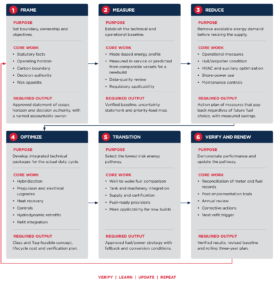
Figure 8. Existing vessels and newbuilds share a roadmap but differ in available evidence and freedom to change the arrangement. The six indicators shown provide a compact verification dashboard.
11. Verify results and support environmental claims
Commissioning demonstrates that equipment operates as intended. Operational verification establishes whether it achieves the expected savings in service.
The verification plan should therefore be agreed before purchase and installation.
| Indicator | Recommended expression | Interpretation |
|---|---|---|
| Total supplied energy | Fuel energy and shore electricity by operating mode | Tracks the whole energy boundary without counting internal transfers twice. |
| Propulsion intensity | Energy per nautical mile, with speed and conditions recorded | Enables comparisons between sufficiently similar passages. |
| Stationary hotel demand | Electrical energy per hour in port or at anchor, separated by occupancy and climate | Identifies persistent loads and changes in service demand. |
| Generator performance | Fuel per generated kWh, running hours and load distributions | Tests conversion efficiency and dispatch improvements. |
| Annual greenhouse gas emissions | Well-to-wake CO₂-equivalent within a stated boundary | Measures the climate result of energy quantity and supply pathway together. |
| Traceability | Share of energy and emissions supported by verified records | Shows the reliability of the reported outcome. |
Absolute emissions and efficiency indicators should be reported together. Improved efficiency can coexist with higher annual emissions if the yacht is used more. Lower annual emissions can also result from less use, without an efficiency improvement.
Performance reviews should account for itinerary, occupancy, weather, hull condition, charging source and the energy service delivered.
Material changes in flag, operation, machinery or fuel should trigger a regulatory and baseline review.
Voluntary tools can support comparison. ISO/TS 23099:2026 provides a methodology for assessing operational energy impacts of large yachts against a defined baseline fleet. iso.org
The YETI initiative supported the development of yacht-specific benchmarking. The SEA Index provides yacht-focused assessment and certification tools.
These should be described according to their actual scope; they do not replace statutory compliance or automatically represent a complete vessel life-cycle assessment.
12. What a credible low-emission yacht programme delivers
The evidence supports a vessel-specific approach. There is no single best fuel for every large yacht, and available reference profiles should not replace measured onboard performance.
Important evidence gaps remain. The source report identifies the absence of an authoritative, regularly updated global yacht emissions inventory, a measured fleet-wide propulsion–hotel energy split, and a harmonised basis for deciding whether refit or replacement produces the lower whole-life impact in every case.
These gaps should remain explicit in sector-wide claims.
Owners and technical teams can nevertheless act now. A credible programme establishes a dependable baseline, reduces avoidable demand, improves system operation, assesses fuels against the remaining energy requirement, and verifies the result.
It also preserves the safety, comfort, reliability and range for which the yacht was designed.
Success is demonstrated through reduced consumption and substantiated emissions results in service. The fuel system, certification label or installed technology is only part of that outcome.
Sources and further reading
This article is adapted and expanded from From Compliance to Performance: A Practical Low-Emission Framework for Large Yachts (American Bureau of Shipping, 2026). The eight figures are reproduced from the supplied report; their original source data are identified where relevant. Implementation guidance has been expanded and regulatory dates and distinctions clarified.
- Monaco Yacht Show Market Report 2025.
- Water Revolution Foundation average operational profile of large yachts.
- Fourth IMO GHG Study 2020.
- ISO/TS 23099:2026, environmental performance methodology for large yachts.
- IMO EEXI and CII information and MARPOL Annex VI resolution and guidance index.
- European Commission maritime MRV guidance.
- European Commission maritime EU ETS guidance.
- FuelEU Maritime Regulation (EU) 2023/1805 and implementation questions and answers.
- 2026 proposal concerning maritime MRV and FuelEU amendments, COM(2026) 620, a proposal rather than an adopted obligation.
- IMO greenhouse gas reduction work and Net-Zero Framework status.
- MEPC 84 meeting summary and Resolution MEPC.392(82) for ECA developments.
- IMO life-cycle GHG intensity guidelines.
- Revised biofuel guidance MEPC.1/Circ.905/Rev.1.
- ISO 8217:2024, marine fuel specifications, and ISO 6583:2024, methanol fuel specifications.
- IMO alternative-fuel safety guidance and MSC 111 meeting highlights.
- IMO GreenVoyage2050 hybridisation guidance.
- YETI and SEA Index assessment tools.