
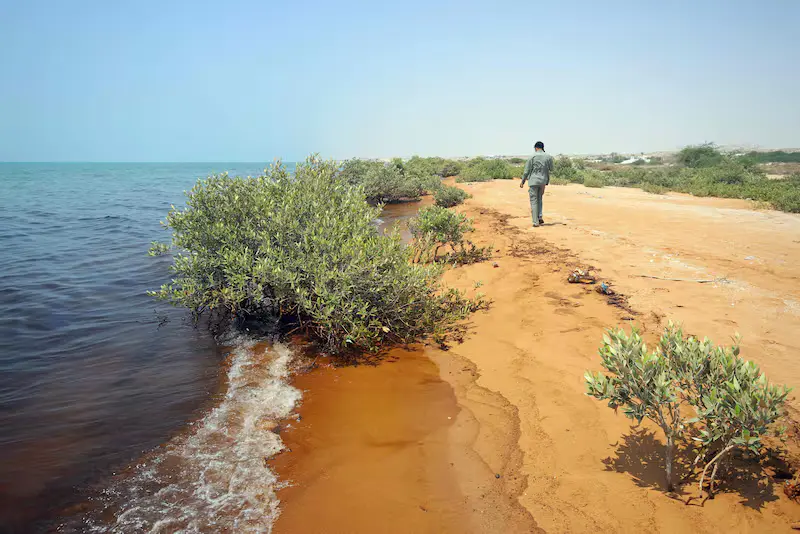
Efforts to safeguard mangroves, seagrass and corals are needed, scientists say, as conflict leaves lasting scars on region’s fragile ecosystems
Persian Gulf nations have been urged to form an environmental task force to address what a new study describes as “unprecedented” ecological disruption across the region caused by the Iran war.
The research, which considered the environmental effects of tanker strikes, port attacks and refinery explosions, said the Persian Gulf’s “sensitive ecosystems” had been “severely impacted”, leaving fewer species in some areas and threatening the delicate balance of marine life that has sustained the region for millennia.
The UAE’s marine habitats face threats from toxic debris and oil spills, while noise may have disturbed marine life, according to Dr Devaraj Asir Ramesh of Anna University in Chennai, India, who compiled the analysis. However, the environmental consequences extend far beyond the Emirates’ borders, affecting the entire Persian Gulf region from Kuwait in the north to Oman in the south.
A region under environmental siege
The conflict, which began at the end of February when the US and Israel launched strikes on Iran, has transformed the Persian Gulf into what environmental scientists are calling an “ecological sacrifice zone.” Iranian strikes on the Emirates, according to Dr Ramesh, were likely to have contaminated seagrass beds with hydrocarbons and caused auditory damage to cetaceans – marine mammals such as dolphins and porpoises – which are sensitive to loud noise that travels through the sea.
He also said oil released by attacks on tankers at Fujairah could have caused ecological harm that will persist for decades.
“Oil spills, chemical leaks, and acoustic disturbances have impaired biodiversity, fisheries, aquaculture, desalination, and eco-tourism,” Dr Ramesh wrote in the International Journal of Research and Innovation in Social Sciences. “The interconnected nature of the Persian Gulf’s ecosystems means that damage in one area inevitably affects neighbouring waters and coastlines.”
The Persian Gulf is home to some of the world’s most biologically productive marine environments, despite its relatively small size. The region’s unique geography – a shallow, semi-enclosed sea with limited water exchange with the open ocean – makes it particularly vulnerable to pollution and environmental degradation. Water in the Persian Gulf takes approximately three to five years to completely renew, compared to the weeks or months required in more open marine systems.
Critical ecosystems under threat
The region’s mangrove forests, which line the coastlines of the UAE, Iran, Saudi Arabia, Qatar, Bahrain, Kuwait and Oman, serve as critical nurseries for fish species and natural barriers against coastal erosion and storm surges. These salt-tolerant trees, adapted to survive in some of the harshest conditions on Earth, now face an uncertain future as oil contamination and chemical pollution seep into their root systems.
Seagrass meadows, which carpet the shallow waters of the Persian Gulf and provide food for endangered species such as dugongs and green sea turtles, have been particularly hard hit. These underwater flowering plants, which evolved from land plants millions of years ago, are among the most productive ecosystems on the planet, capable of sequestering carbon at rates comparable to tropical rainforests. However, they are also extremely sensitive to changes in water quality, light availability and chemical contamination.
Coral reefs, the rainforests of the sea, have suffered extensive damage. The Persian Gulf’s coral communities are among the most heat-tolerant in the world, having adapted to summer water temperatures that regularly exceed 35 degrees Celsius. These corals represent a unique genetic resource that scientists believe could be crucial for reef restoration efforts globally as climate change warms the world’s oceans. Yet even these resilient organisms have limits, and the combination of oil pollution, chemical contamination and physical damage from military activities may have pushed some reefs past their breaking point.
The oil pollution crisis
Dr Manjula Nair, an associate professor of chemistry in the school of engineering and physical sciences at Heriot-Watt University Dubai, said a significant concern was oil leaks that infiltrated Iran’s Siri and Qeshm islands, which have “vast coral reefs, mangrove forests and beautiful sandy beaches.”
Qeshm Island, the largest island in the Persian Gulf, is home to the Hara Marine Forests, a UNESCO Biosphere Reserve that hosts extensive mangrove forests and supports a rich diversity of marine life. The island’s coral reefs, which fringe its shores, are among the most biodiverse in the region, providing habitat for hundreds of fish species, sea turtles and marine mammals.
“Ongoing military activities have made it difficult to contain these spills,” Dr Nair added. “The consequences of oil pollution extend beyond marine ecosystems to water security. In the Persian Gulf, where desalination is vital for meeting water needs, contamination of the raw seawater can compromise desalination plant performance and potentially disrupt freshwater production.”
The Persian Gulf region is home to some of the world’s largest and most advanced desalination facilities, which provide the majority of drinking water for countries such as Kuwait, Bahrain, Qatar and the UAE. These facilities are highly sensitive to oil contamination, which can foul membranes and reduce efficiency. A major oil spill could force desalination plants to shut down for weeks or months, creating a water crisis in a region where alternative freshwater sources are virtually non-existent.
“When oil pollutes the sea, it doesn’t just threaten marine life, it puts every drop of clean water at risk,” Dr Nair warned. “The interconnectedness of water and energy systems in the Persian Gulf means that environmental damage can quickly cascade into economic and social crises.”
The Siri Island oil terminal, located about 200 kilometres north of Dubai, has been a focal point of environmental concern. Satellite imagery has shown visible oil slicks emanating from the island’s vicinity, though the exact volume of oil released remains unknown. Environmental groups have expressed frustration at the lack of transparency regarding the scale of the spills and the effectiveness of containment efforts.
Air quality and atmospheric contamination
Damage from the latest conflict has not been confined to the land and sea. There has also been “serious” air pollution, according to Dr Diana Francis, head of the Environmental and Geophysical Sciences Laboratory at Khalifa University in Abu Dhabi.
She said the impacts “have been significant” and the consequences in some areas could be long-lasting.
Although local smoke concentrations “can fall relatively quickly” once emissions stop, airborne particles can travel and persist for days or weeks, affecting air quality across national borders.
“The environmental consequences can last much longer,” Dr Francis added. “Rain removes some pollution from the atmosphere, but transfers it to land and water. Persistent contaminants can remain for years, and contaminated dust can become airborne again. A clearer sky therefore does not necessarily mean the environmental damage has ended.”
The burning of oil wells, refinery explosions and attacks on petrochemical facilities have released a cocktail of toxic substances into the atmosphere, including sulphur dioxide, nitrogen oxides, particulate matter and volatile organic compounds. These pollutants can cause respiratory problems, cardiovascular disease and cancer in exposed populations, while also contributing to acid rain and the acidification of marine ecosystems.
Dr Francis said published satellite observations “have detected a clear signal attributed to specific events during the war,” including spikes in sulphur dioxide concentrations. Sulphur dioxide, a colourless gas with a pungent smell, is released when sulphur-containing fossil fuels are burned. It can cause breathing difficulties, particularly in people with asthma, and contributes to the formation of acid rain.
In her laboratory, Dr Francis and her colleagues are comparing pollution levels for months since the conflict began to the same months before the war to gain a more detailed understanding of the conflict’s effects. This research is crucial for quantifying the environmental impact and informing remediation efforts.
The challenge of assessment
Doug Weir, director of the Conflict and Environment Observatory, a UK-based non-profit organisation, indicated that the scale of the damage had been poorly recorded compared to other conflicts.
There have been few reports from civil society, international organisations or national governments, and continued hostilities have hampered assessments, he said. This lack of documentation is particularly concerning because it means the full extent of the environmental damage may never be known.
“Moreover, remote assessments based on satellite imagery have been hampered by restricted access to high-resolution satellite imagery,” Weir said. “The Persian Gulf is a strategically sensitive region, and commercial satellite providers have been reluctant to provide imagery that could reveal military positions or movements.”
Weir said that, although a wide range of techniques were available to rehabilitate damaged areas, conflict-linked environmental harm often went unaddressed because, for example, affected countries lacked funds or did not prioritise efforts. This is particularly true in regions where immediate humanitarian needs compete with longer-term environmental concerns.
“In some cases, nature can recover relatively quickly – although what comes back may be very different to what was there before – but in many cases, particularly those involving landscape damage, or serious pollution, harm can last decades without often costly interventions,” he said.
The experience of Kuwait offers a sobering precedent. In 1991, retreating Iraqi forces set fire to more than 600 oil wells, creating an environmental catastrophe that took months to extinguish and years to remediate. The clean-up work was heavily delayed and continues today, more than three decades later. Oil lakes formed in the desert, killing vegetation and creating hazards for wildlife and humans. The smoke from the fires created a pall over the region that affected air quality for months.
Historical context and lessons learned
The environmental consequences of the Iran war must be understood within the broader context of the Persian Gulf’s environmental history. The region has experienced multiple environmental crises over the past several decades, from the 1983 Nowruz oil field spill during the Iran-Iraq War to the 1991 Gulf War oil spills, which released an estimated 6 to 8 million barrels of oil into the Persian Gulf – the largest oil spill in history.
These previous events have left lasting marks on the region’s ecosystems. Some coral reefs damaged during the 1991 spill have never fully recovered. Mangrove forests that were destroyed have been slow to regenerate. Marine wildlife populations, including dugongs and sea turtles, have struggled to rebound.
However, the current conflict presents unprecedented challenges. Unlike previous incidents, which were relatively discrete events, the current war involves multiple, ongoing sources of pollution across a wide geographic area. The combination of tanker strikes, port attacks, refinery explosions and the deliberate release of oil into the sea has created what scientists describe as a “continuous assault” on the marine environment.
Biodiversity loss and ecosystem collapse
The Persian Gulf’s biodiversity is uniquely adapted to extreme conditions. The region’s marine species have evolved to tolerate water temperatures that would be lethal to most marine life, high salinity levels, and low oxygen concentrations. This adaptation has created a unique genetic reservoir that scientists believe could be valuable for understanding how marine life might cope with climate change.
However, the conflict threatens to unravel this evolutionary heritage. Fish populations have declined in areas affected by oil pollution, with traditional fishing communities reporting significant reductions in catch sizes. Shrimp fisheries, which are economically important in Iran, Kuwait, Saudi Arabia and Bahrain, have been particularly hard hit, as shrimp larvae are highly sensitive to water pollution.
Sea turtles, which nest on the beaches of Oman, the UAE, Qatar and Iran, face multiple threats. Adult turtles can become coated in oil, which affects their ability to swim, feed and regulate their body temperature. Hatchlings may be unable to reach the sea if beaches are contaminated. The beaches of Ras Al Hadd in Oman, which host one of the world’s largest green turtle nesting populations, are of particular concern.
Dugongs, large marine mammals that feed on seagrass, are among the most vulnerable species in the region. The Persian Gulf is home to the world’s second-largest dugong population, after Australia. These gentle creatures, which can live for more than 70 years, reproduce slowly, making them particularly vulnerable to environmental disruptions. Loss of seagrass meadows, combined with direct mortality from oil exposure, could cause dugong populations to decline rapidly.
Cetaceans, including dolphins, porpoises and whales, face threats from both pollution and acoustic disturbance. The Persian Gulf is home to several cetacean species, including the endangered Arabian humpback whale, a genetically distinct population that is found nowhere else on Earth. Underwater noise from explosions, sonar and vessel traffic can cause hearing damage, disrupt communication and drive animals away from critical habitat.
The economic dimension
The environmental damage has significant economic implications for the entire Persian Gulf region. Fisheries and aquaculture, which provide livelihoods for hundreds of thousands of people, have been disrupted. Desalination plants, which supply drinking water to millions, face increased operational costs and potential shutdowns. Tourism, particularly eco-tourism focused on coral reefs and marine wildlife, has been devastated in affected areas.
The Persian Gulf’s economies are heavily dependent on the marine environment. Saudi Arabia’s Red Sea coast, which is outside the immediate conflict zone but connected through ocean currents, could also be affected. Oman’s tourism industry, which has been growing rapidly in recent years, relies heavily on its pristine beaches and marine wildlife.
In the longer term, the environmental damage could affect the region’s ability to attract foreign investment and skilled workers, as concerns about environmental quality and quality of life increase. Companies are increasingly considering environmental factors when making investment decisions, and regions with significant environmental problems may find it harder to compete for global capital.
The path forward: Restoration and resilience
In the face of damage from conflict, Dr Ramesh called for widespread efforts to strengthen natural environments across the Persian Gulf through measures such as coral reef regeneration – which typically involves transplanting coral fragments on to the sea floor – at Musandam.
Other measures should include increased mangrove planting at Ras Al Khor in Dubai and the restoration of seagrass meadows off Abu Dhabi, Dr Ramesh said. However, he emphasised that restoration efforts must be coordinated across the entire region to be effective.
He suggested Persian Gulf nations form an “ecological union” to co-ordinate efforts to restore their natural environments harmed by the conflict. Such a union would facilitate the sharing of scientific expertise, the pooling of resources and the development of common standards for environmental protection and restoration.
The concept of an ecological union draws on the success of existing regional cooperation frameworks, such as the Regional Organization for the Protection of the Marine Environment (ROPME), which coordinates environmental protection efforts among Persian Gulf states. However, the proposed union would have a broader mandate and greater resources, reflecting the unprecedented scale of the current environmental crisis.
Scientific research and monitoring
Scientists are calling for increased investment in environmental monitoring and research to better understand the full extent of the damage and inform restoration efforts. This includes:
Satellite-based monitoring: Advanced remote sensing technologies can detect oil slicks, measure water quality parameters and track changes in coastal ecosystems. However, access to high-resolution imagery remains a challenge.
Marine biodiversity surveys: Systematic surveys of fish, coral, seagrass and mangrove populations are needed to establish baselines and track recovery. These surveys require significant resources and expertise.
Toxicological studies: Research is needed to understand how marine organisms respond to exposure to oil, dispersants and other chemicals released during the conflict. This includes studies of acute toxicity, chronic effects and bioaccumulation.
Oceanographic modelling: Computer models can help predict how pollutants will spread through the Persian Gulf and identify areas at greatest risk. These models require accurate data on currents, winds and water temperatures.
Socio-economic assessments: Understanding the economic and social impacts of environmental damage is essential for developing appropriate policy responses and compensation mechanisms.
International cooperation and legal frameworks
The environmental damage from the Iran war raises important questions about international law and accountability. Under international humanitarian law, parties to a conflict are prohibited from causing widespread, long-term and severe damage to the natural environment. The deliberate release of oil into the sea, attacks on industrial facilities and other actions that cause environmental harm may constitute war crimes.
However, enforcing these prohibitions is challenging. The International Criminal Court has jurisdiction over environmental crimes in certain circumstances, but prosecutions are rare and often politically complicated. Civil lawsuits against governments or corporations responsible for environmental damage face significant legal hurdles, including sovereign immunity and questions of causation.
International environmental agreements, such as the UN Convention on the Law of the Sea and the International Convention for the Prevention of Pollution from Ships, provide frameworks for addressing marine pollution. However, these agreements were not designed with armed conflict in mind and may not provide adequate tools for addressing conflict-related environmental damage.
The role of civil society and the private sector
While governments bear primary responsibility for environmental protection and restoration, civil society organisations and the private sector also have important roles to play. Environmental NGOs can monitor compliance with environmental regulations, advocate for stronger protections and implement restoration projects.
The private sector, particularly companies operating in the oil and gas industry, has a responsibility to minimise environmental damage from their operations and to contribute to restoration efforts. Some companies have already begun investing in environmental projects in the region, recognising that a healthy environment is essential for long-term business success.
Building resilience for the future
The current crisis has highlighted the need for the Persian Gulf region to build greater environmental resilience. This includes:
Diversifying water sources: Over-reliance on desalination makes the region vulnerable to marine pollution. Investment in alternative water sources, such as treated wastewater and groundwater recharge, could reduce this vulnerability.
Protecting critical habitats: Identifying and protecting the region’s most important marine habitats, including coral reefs, seagrass meadows and mangrove forests, is essential for maintaining biodiversity and ecosystem services.
Developing early warning systems: Systems for detecting and responding to oil spills and other environmental emergencies can help minimise damage and speed recovery.
Promoting sustainable development: Ensuring that economic development is compatible with environmental protection is essential for long-term sustainability.
Enhancing regional cooperation: No single country can address the environmental challenges facing the Persian Gulf alone. Regional cooperation is essential for effective action.
Conclusion: A call to action
The environmental damage caused by the Iran war represents an unprecedented challenge for the Persian Gulf region. The scale of the damage, the complexity of the issues and the ongoing nature of the conflict make this one of the most serious environmental crises the region has ever faced.
However, the crisis also presents an opportunity. By working together to address environmental damage, Persian Gulf nations can build stronger relationships, develop shared expertise and create institutions that will serve the region well in the future.
The scientists and experts quoted in this article are united in their call for action. They urge Persian Gulf nations to form an environmental task force, to invest in restoration and monitoring, and to work together to protect the region’s unique and irreplaceable natural heritage.
The alternative – continued environmental degradation – would have profound consequences for the region’s economies, societies and ecosystems. It would undermine food security, water security and economic development. It would damage the region’s reputation and its ability to attract investment and talent. And it would represent a betrayal of future generations, who deserve to inherit a healthy and vibrant Persian Gulf.
The time for action is now. The Persian Gulf’s ecosystems are resilient, but they are not indestructible. With the right interventions, they can recover. Without them, the damage may be irreversible.