
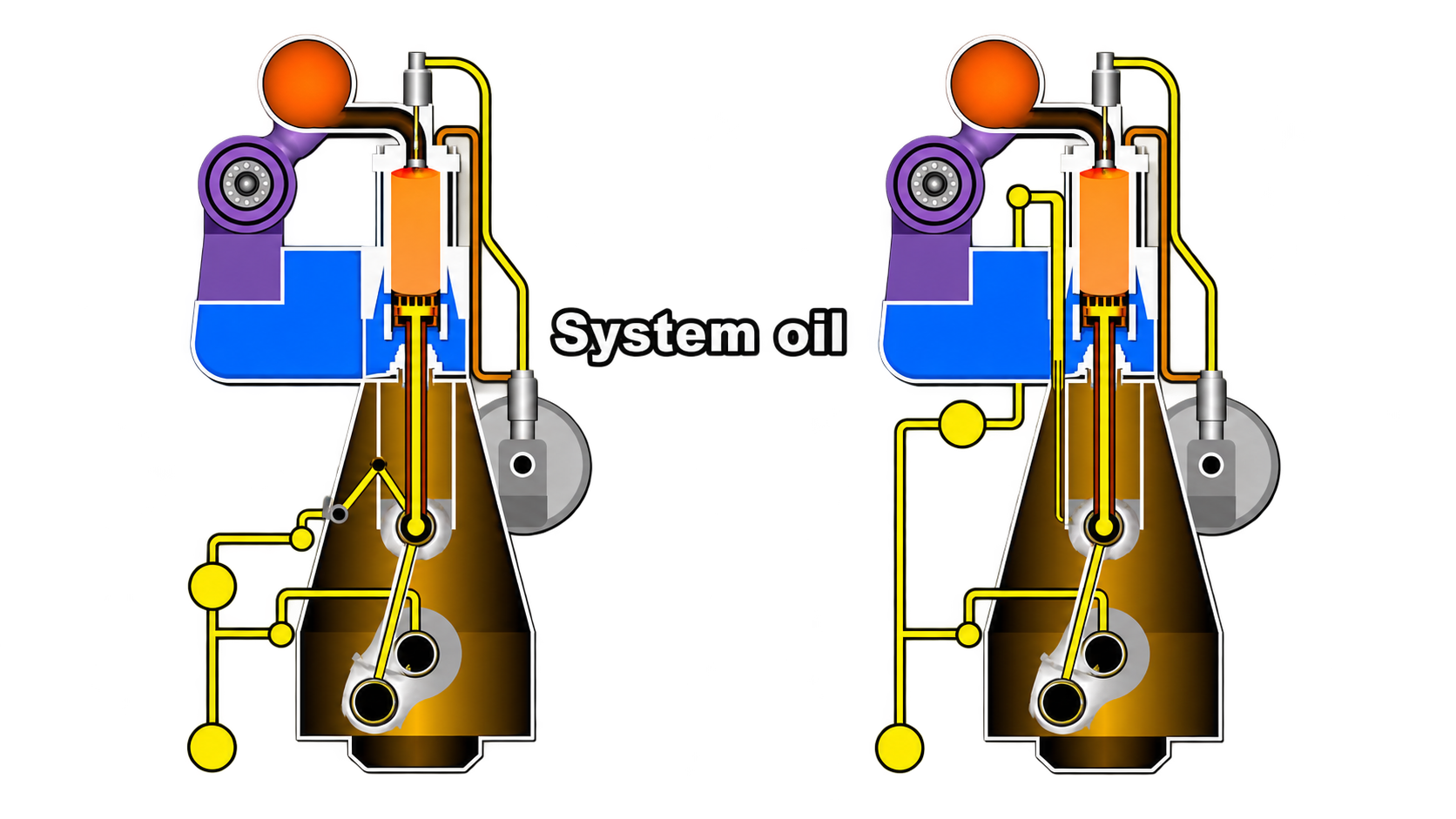
In a large marine main engine, lubricating oil is far more than a bearing lubricant. It is a cooling medium, a hydraulic fluid, a corrosion-control agent and a cleaning and neutralizing medium—all at the same time. The reliability of the whole engine therefore depends on a lubricating oil system that can circulate, cool, filter and treat oil continuously, even when individual components are duplicated for standby service.
This post provides a practical overview of that system. It explains how oil is drawn from the drain tank through suction strainers, pumped at pressure through the oil cooler and fine filters, and then distributed to bearings, piston cooling, sprayers, exhaust valve actuators and control systems. It also highlights design details that matter in service: duplicate pumps and filters, typical 50-micron filtration, cooler pressure arrangements that prevent seawater ingress, drain-tank coffer dams, submerged returns, alarms and bypass centrifuge purification.
Below Figure shows a lubricating oil system for a large main engine. Pressure pumps, strainers and fine filters are in duplicate, one set being used while the other acts as standby. Fine filters should be capable of being cleaned without interruption of the oil flow. Mesh size will depend upon the bearing materials and clearances: in most large engines it is 50 microns. Capacity of the system must be adequate for the type of installation. If the engine has oil-cooled pistons the capacity and throughput will be increased accordingly.
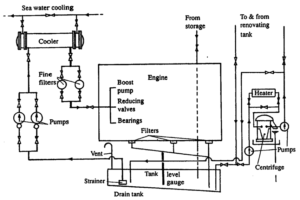
Lubricating oil pressure pumps draw oil from the engine drain tank through suction strainers, the tank suction being clear of the lowest point to avoid picking up any water or sludge which may have settled. The pumps discharge at pressure through the oil cooler, ensuring that sea water at its lower pressure cannot leak into the oil system in the event of a fault in the cooler. The oil then passes through the fine filters to the engine. It will be distributed to all bearings, piston cooling, sprayers, exhaust valve actuators, control systems etc.
Various sections of the lubricating system may require different pressures and to accommodate this engine driven booster pumps may raise the supply pressure, while pressure reducing valves and restricted orifices may reduce pressure or flow to other parts.
Used oil drains to the bottom of the crankcase and passes through strainers by gravity to the drain tank. Drain returns are kept remote from the pump suction and must be submerged to reduce aeration and to make a safe seal. With oil-cooled pistons
each piston oil return has its temperature monitored and it then passes through a sight glass before returning to the crankcase.
The oil drain tank is usually built into the ship’s double bottom but it must be surrounded by a coffer dam to prevent any contamination from leakages. It is fitted with an air vent, level measuring gauge and sounding pipe. Central positioning of the level gauge will reduce fluctuation in readings due to pitching and rolling at sea. The tank must be of sufficient size to accommodate the full charge of oil. Its interior surfaces may be coated to prevent rusting due to condensation on its non-flooded surfaces. The system should also have low pressure, high temperature and low tank level alarms fitted.
A bypass centrifuge system is fitted to purify oil from the drain tank to remove water, sludge and insolubles. This should be operated continuously at sea with a slow throughput, the oil being preheated to 70-90°C to assist separation.
When the engine is not in use batch purification of the whole charge may be carried out. It is most important that water content in the oil is eliminated or kept to a minimum.
CRANKCASE OILS
Extensive demands are made on oils for lubricating systems and their specifications may differ according to the type of engine and the fuel used. In addition to lubricating and cooling the bearings, the same oil may be required to lubricate piston rings and cylinder liners, and neutralise acids entering the crankcase in trunk piston engines. It may be required to act as the cooling medium for hot surfaces within pistons, and must
tolerate high pressures in gear or chain drives and cams, and even high-speed bearings in turbochargers. The oil may be used as a hydraulic fluid in exhaust valve actuators, pressure control systems and servomotors.
System oils must inevitably contain additives to improve their properties and prolong their life. Additives are chemical compounds which mix with the oil’s molecular structure so that they do not separate out during storage, use or treatment in purifiers and filters. Their properties will be depleted with use, however, and to minimise this it is necessary to limit maximum temperatures, thermal cycling and contamination in the system. Topping-up with fresh oil to replace that consumed will help to maintain a stable crankcase oil condition.
Oil for engines operating on residual fuels must be alkaline. For crosshead engines 10 to 15 TBN (SAE 30) oils should be adequate, but for trunk piston engines up to 40 TBN (SAE 40) is used depending upon the sulphur content of the fuel.
Besides correct alkalinity and viscosity, oils require rust and oxidation inhibitors, a high viscosity index, detergent/dispersant properties, water repellants, and must resist foaming and emulsification.
To monitor its condition, oil samples must be taken from the working system at regular intervals and sent to an oil laboratory for detailed analysis, which will give information on oil condition and depletion of additives. It may also assist in diagnosing engine faults and advice on any remedial measures may be given. General trends in condition are important, but any sudden changes or losses must be investigated immediately.
A number of simple oil condition tests may be carried out on board ship with portable equipment. A flashpoint test will warn of possible fuel oil contamination. Colour titration tests can indicate loss in alkalinity. A variety of viscosity tests are available. Water present can be detected, but special equipment is required if actual percentages are to be measured. Inspection of the sludge/water discharge at the purifier will give a good indication of condition. In blotter tests the slow migration of a drop of oil on blotting paper will indicate the oxidation, carbon present and dispersive properties when compared with similar drops of fresh oil.
MICROBIAL DEGRADATION OF OIL
is the possible infection of an oil system by micro-organisms. These live by consuming hydrocarbons in the base oil together with nitrogen, sulphur and phosphorus from additives. If water is present they will multiply rapidly in the warm, agitated conditions in the oil system. Contamination may occur from cooling water leaks, condensation in humid climates or accidental entry of dirt and water during overhaul.
Infection by micro-organisms will form organic acids and more water while depleting the additives. This will cause corrosion and wear of metal surfaces (particularly bearing metals), and will create sludge and slime that choke oil filters. The oil may be prone to emulsification and saponification.
Tests for microbial infection make use of a special gel which is either dipped in the oil or has oil poured over it and is then incubated to develop a growth or culture. The appearance of this culture is then compared visually with a standard coloured chart, to indicate the degree of contamination if any. If the oil does not wet the gel, it may be necessary to mix the sample with a small quantity of sterile water.
Contamination does not commonly occur if cleanliness and care are exercised and water is eliminated from the system. Recommendations are that a maximum of 0.2% of water content must not be exceeded when using detergent oils.