
10/20/2026 – An educational guide for maritime students, cadets, and shipboard personnel
Ship maintenance is sometimes seen as a list of jobs: change a filter, inspect a pump, test an alarm, or repair a leak. Under the International Safety Management (ISM) Code, maintenance has a wider purpose. It helps keep the ship fit for safe operation, protects people and the marine environment, and makes sure that equipment needed in an emergency will work when called upon.
Section 10 of the ISM Code places responsibility on the Company to arrange and manage maintenance. In the Code, the Company is the owner or another organisation or person that has taken responsibility for operating the ship. A maintenance task may be carried out by crew, a shore workshop, a contractor, or a service provider, but the Company still needs an effective system for overseeing the work.
What Section 10 requires
| Paragraph | Requirement in practice |
|---|---|
| 10.1 | Maintain the ship in line with applicable rules and regulations and any additional requirements established by the Company. |
| 10.2 | Inspect at appropriate intervals; report defects and their possible causes; take corrective action; and keep records. |
| 10.3 | Identify equipment whose sudden failure could create a hazardous situation and put measures in place to improve its reliability, including regular testing of standby arrangements and equipment not in continuous use. |
| 10.4 | Include the inspections and reliability measures described above in the ship’s operational maintenance routine. |
These paragraphs form a cycle: set maintenance requirements, carry out inspections, report problems, take action, test important backup arrangements, and record what happened.
10.1 — Maintain the ship to the required standard
The ship must be maintained in accordance with the rules and regulations that apply to it. These may include requirements under SOLAS, MARPOL, flag State legislation, class rules, and other instruments that apply to the vessel. The Company may also establish additional maintenance requirements.
This means that maintenance planning must reflect the ship’s actual equipment, operating profile, condition, and applicable certification. A tanker’s cargo pumps, for example, present different operating and pollution risks from a passenger ship’s fire doors or a cargo vessel’s emergency generator.
Company requirements may add safeguards, but they cannot replace or weaken mandatory requirements. When the ship’s condition, equipment, or intended operation changes, the Company should consider whether the maintenance arrangements still fit the risks.
Section 10 does not prescribe one maintenance technique for every component. A company may use planned maintenance, condition monitoring, running-hour tasks, inspections, overhauls, or a combination of these, subject to statutory requirements and maker instructions where relevant.
10.2 — Inspect, report, correct, and keep records
Inspections at appropriate intervals
“Appropriate intervals” means the inspection schedule should suit the equipment and its risks. Some inspections are set by regulations, class, approved documentation, or a service contract. Others are scheduled by the Company based on maker recommendations, machinery running hours, operating conditions, equipment history, and the consequences of failure.
For example, a cooling-water filter may need regular inspection because fouling can affect equipment temperatures. A fire door needs checks that confirm it closes and latches correctly. An emergency generator requires tests under the ship’s approved procedures and applicable requirements.
Section 10 does not set one universal interval for every item of equipment. Where a particular SOLAS rule or approved maintenance schedule specifies an interval or test, the ship must follow the requirement that applies to it.
Report defects clearly
When a defect is found, report it through the ship’s SMS and record enough detail for someone else to understand the problem. A useful report identifies the equipment, symptoms, operating conditions, alarms or measurements, immediate controls, and the time the problem was discovered. Include a possible cause if it is known; do not present a guess as a confirmed cause.
For example, “No. 2 seawater pump failed” gives little information. “No. 2 seawater pump tripped during the standby test; suction pressure was normal, but the motor overload operated; No. 1 pump remains in service” is more useful to the engineer assessing the risk and arranging follow-up.
Take corrective action
Corrective action should deal with the defect and, where possible, its cause. Replacing a damaged bearing may restore a pump, while checking alignment, lubrication, vibration, operating history, and installation may help prevent another failure.
The person responsible should follow the defect through to completion. This may involve repair, a replacement part, shore assistance, a temporary control approved through company procedures, and a post-maintenance test. Defects affecting safety, statutory compliance, or the ship’s ability to operate must be escalated through the SMS. Required notifications and any limits on operation should be determined under applicable flag, class, and company procedures.
Keep reliable maintenance records
Records help the ship and Company confirm what was inspected, what condition was found, what work was done, who carried it out, what parts were used, and whether the equipment was tested afterwards. They also help identify repeat failures and support audits, surveys, troubleshooting, and handovers between crew.
A maintenance entry should reflect work actually completed. If a test could not be completed, or a defect remains, record that accurately and make sure the outstanding item remains visible to the people who need to manage it. A closed work order should not hide unresolved problems.
10.3 — Identify equipment whose failure could be hazardous
Paragraph 10.3 focuses attention on equipment and technical systems whose sudden operational failure could result in a hazardous situation. The Company must identify such equipment and provide measures to promote its reliability. The Code specifically includes regular testing of standby arrangements and equipment or systems that are not in continuous use. See ISM Code Section 10.3. wwwcdn.imo.org
The potential consequences matter. A small component can be safety-critical if its failure removes an essential safeguard. Conversely, equipment that is large or expensive is not automatically critical if its failure would not create a hazardous situation.
Companies often manage this requirement with a critical-equipment list or register linked to the planned maintenance system. That is a practical way to make responsibilities and test schedules visible; Section 10 does not prescribe one required register format or one universal method for classifying equipment. The Company should be able to show how it identified the equipment and how its safeguards are maintained.
Depending on a ship’s design and risk assessment, examples may include:
- Emergency electrical power: the generator or battery arrangements, starting system, fuel supply, changeover, alarms, and essential loads.
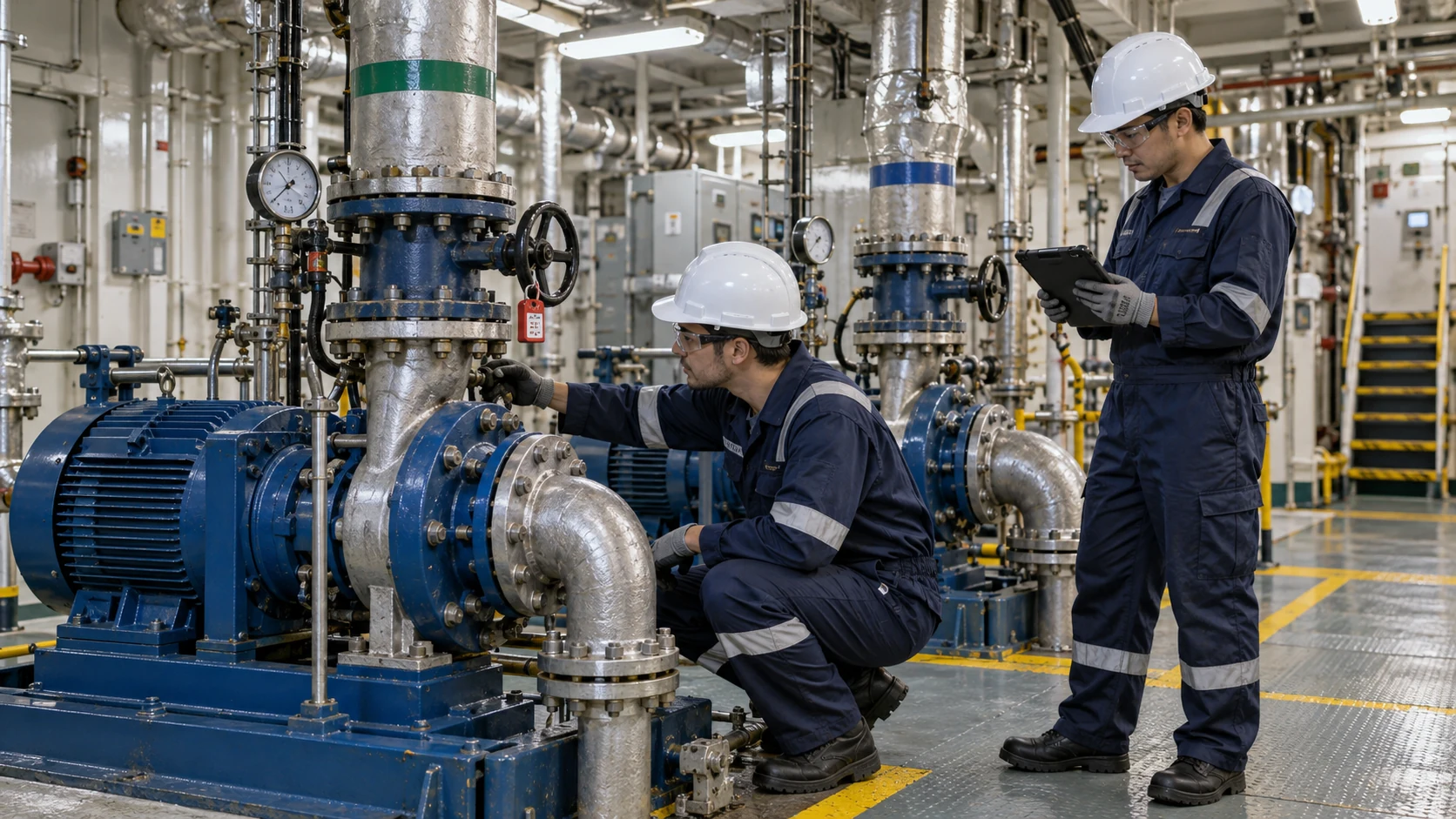
- Standby pumps: emergency fire, bilge, cooling-water, or other pumps where their availability is necessary for safe operation.
- Steering arrangements: main and auxiliary steering equipment, control systems, power units, alarms, and communication arrangements.
- Fire protection: fire pumps, fixed firefighting systems, fire doors, detection, and alarm arrangements.
- Propulsion and machinery safeguards: essential lubrication, cooling, control, shutdown, and alarm systems.
- Life-saving appliances: boats, launching appliances, release gear, and other equipment that must function in an emergency.
These examples are not a universal list. The equipment requiring special attention depends on the ship’s layout, machinery, service, safety analysis, and applicable rules.
Why standby equipment needs testing
Standby equipment can appear ready while having a hidden defect. A pump that has not been started for months may have a seized shaft, a closed valve, a faulty starter, or an alarm that does not operate. An emergency generator may have a depleted starting battery, contaminated fuel, or a cooling problem. A steering control may fail to transfer correctly between operating positions.
Regular testing helps expose these faults before an emergency. The test should show whether the complete arrangement works, including the relevant controls, power supply, alarms, changeover, and output. Testing only a local indicator may not demonstrate that the system can perform its intended function.
The test method and interval should follow the applicable regulations, approved documentation, maker instructions, and the ship’s SMS. Tests must be planned so they do not create an uncontrolled risk or accidentally disable the equipment that is currently protecting the ship.
Examples of practical checks
Emergency generator: A ship’s procedure may include checks of starting arrangements, fuel, lubricating oil, cooling, alarms, automatic starting, changeover, and the supply of designated loads, as required by the ship’s approved arrangements. Record the test result and any limitations. Do not assume that an engine start alone proves the emergency power arrangement works under load.
Standby pump: Confirm that the pump is available for use, the required valves and suction are correctly arranged, the motor or prime mover starts, pressure or flow is achieved, and alarms or indicators respond as designed. Restore the system to its required operating condition after the test.
Steering gear: Before departure, applicable SOLAS requirements call for the ship’s crew to check and test the steering gear within the required pre-departure period. The check includes relevant operating arrangements, controls, alarms, and communications as applicable to the ship. The test should follow the ship’s procedure and be recorded. See SOLAS steering-gear testing provisions. SOLAS CHAPTER V.doc
Fire safety equipment: SOLAS Chapter II-2 includes operational readiness and maintenance requirements for the ship’s fire-safety measures. Inspections and tests should follow the applicable rules and the ship’s approved arrangements. See the IMO summary of SOLAS Chapter II-2. imo.org
10.4 — Make maintenance part of daily operations
Section 10.4 connects formal inspections and critical-equipment reliability measures with the ship’s operational maintenance routine. Maintenance should therefore be planned alongside the ship’s normal work, watchkeeping, and operating schedule.
Before a job, personnel should understand the task, hazards, isolation requirements, permits, tools, spare parts, and communications needed. After the work, the equipment should be tested as appropriate, protections restored, temporary arrangements removed or recorded, and the maintenance record updated. A handover should identify any outstanding defects or restrictions.
This is particularly important when maintenance involves systems that must remain available. If work requires isolating a fire pump, emergency power source, steering component, or alarm, the responsible officers need to understand what protection will be unavailable, what alternative controls are required, and when the system will be restored. The ship’s procedures and applicable rules govern whether operations can continue.

–
A practical maintenance process
An SMS and planned maintenance system can connect the Section 10 requirements through a straightforward sequence:
- Identify the equipment and applicable requirements. Check the ship’s documents, regulations, class requirements, maker guidance, and Company instructions.
- Assess the consequences of failure. Consider who could be harmed, what essential function could be lost, and whether a backup is available.
- Set inspection and test arrangements. Assign a responsible person, interval, method, acceptance criteria, and record.
- Carry out and record the work. Follow approved procedures and keep defects visible.
- Correct the problem and verify the result. Repair or replace as needed, test the system, and record outstanding limitations.
- Review repeat failures. Use defect history, near misses, test results, and operating experience to improve the maintenance plan.
This sequence helps the ship move from “the job is scheduled” to “the equipment has been checked, any defect has been managed, and the result is known.”
Maintenance, pollution prevention, and energy efficiency
Section 10 directly supports pollution prevention because leaks, defective seals, damaged piping, and malfunctioning treatment equipment can cause pollution or make required environmental systems unavailable. Timely inspection and repair help the crew identify these conditions before they worsen.
Good maintenance can also support energy efficiency. Fouled heat exchangers, dirty filters, leaking compressed-air lines, poor combustion, damaged insulation, and excessive friction can increase machinery workload or fuel consumption. Cleaning, adjustment, and repair can restore equipment closer to its intended performance.
Energy savings do not replace safety or statutory maintenance requirements. They are an additional benefit of maintaining equipment in good condition and measuring its performance after work.
Digital equipment and maintenance in 2026
Modern ships depend on computer-based systems to monitor and control machinery, propulsion, power, cargo, and other operations. Maintenance may involve software, configuration files, passwords, backups, and connections made by service providers, as well as physical components.
The IMO’s latest maritime cyber risk guidance checked for this article, MSC-FAL.1/Circ.3/Rev.4, was approved in May 2026. It identifies operational technology and ship systems such as propulsion, machinery management, power control, cargo, bunkering, lubrication, and pumping as relevant to cyber risk management. This guidance complements the SMS; it does not replace the requirements of ISM Code Section 10. See the IMO maritime cyber risk management guidelines. wwwcdn.imo.org
When work affects a connected control system, the ship should follow its approved procedures for access, change control, backups, testing, and return to service. An unplanned software change or poorly managed service connection can affect safe operation just as a physical defect can.
Common weaknesses to avoid
- Treating maintenance as paperwork. A completed form is useful only when it reflects a real inspection or test.
- Testing only the component. A component may work while the complete system, including its power, control, alarms, or changeover, does not.
- Leaving defects open without clear ownership. Assign responsibility, track the status, and make restrictions known at handover.
- Using “critical” as a label without extra safeguards. Identification should lead to meaningful reliability measures and tests.
- Closing a defect after repair without verification. Confirm the equipment operates as intended and record the result.
- Repeating repairs without investigating causes. Recurrence may point to a deeper problem in operation, installation, training, or maintenance planning.
- Allowing maintenance to disable safeguards without controls. Follow the SMS, assess the risk, communicate the limitation, and restore protection promptly.
What cadets and junior officers should understand
Cadets and junior officers are not expected to make every technical decision independently. They should understand how to recognise abnormal conditions, use the ship’s reporting system, follow instructions, and ask for guidance when a test or repair is outside their competence.
If a standby pump fails to start, a useful response is to report the result promptly, keep the defect visible, and follow the responsible engineer’s instructions. If an emergency generator test is incomplete, record what was and was not demonstrated rather than marking the full arrangement as satisfactory.
Every accurate defect report, properly completed inspection, and verified repair helps the ship’s SMS work as intended. Section 10 turns maintenance from a list of jobs into a continuous safeguard for the ship, the people on board, and the marine environment.