
10/12/2026
New guidance will help governments evaluate marine geoengineering research proposals to ensure they are safe for the environment.
The International Maritime Organization has adopted new guidance aimed at ensuring marine geoengineering research avoids unacceptable impacts, amid growing interest in climate change mitigation technologies. Marine geoengineering involves methods to increase the ocean’s capacity to absorb carbon dioxide from the atmosphere or store carbon for long periods. However, their potential impacts on marine ecosystems are not yet fully understood.
Meeting at IMO Headquarters in London, Parties to the 1972 Convention on the Prevention of Marine Pollution by Dumping of Wastes and Other Matter (London Convention) and 1996 Protocol to the Convention (London Protocol), adopted a resolution establishing assessment frameworks for ocean fertilization, ocean alkalinity enhancement and ocean sinking biomass. The frameworks will help governments determine, on a case-by-case basis, whether proposed activities constitute legitimate scientific research and whether they can proceed without unacceptable risks to the marine environment.
Welcoming the achievement, IMO Secretary-General Mr. Arsenio Dominguez said:
“At a time when marine geoengineering is attracting increasing scientific, commercial and public attention, they provide regulators and researchers with rigorous and transparent tools for assessing proposed activities and protecting the marine environment.”
A precautionary approach to marine geoengineering
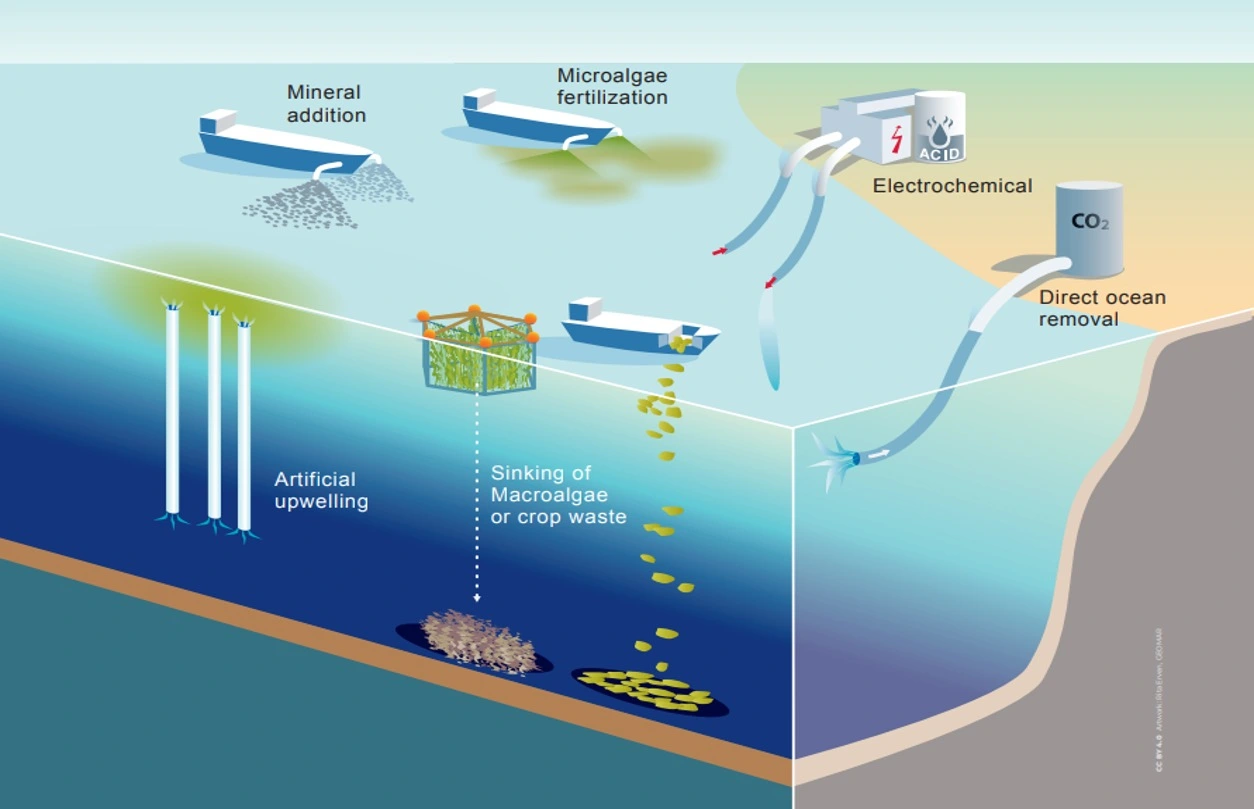
The frameworks provide a common structure for a precautionary approach for the following three marine geoengineering methods:
-
Ocean fertilization
Stimulating primary productivity in the ocean by adding nutrients to seawater to encourage phytoplankton growth, which absorbs carbon dioxide from the atmosphere;
-
Ocean alkalinity enhancement
Adding alkaline substances to seawater to increase the ocean’s capacity to absorb atmospheric carbon dioxide and counteract ocean acidification.
-
Ocean sinking of biomass
Deliberately placing biological material, such as marine or terrestrial plant matter, into the ocean to store carbon.
Each framework covers initial screening, environmental assessment, risk management, decision-making and post-project review. Assessments can be revisited as new information becomes available.
Under the frameworks, all proposals must demonstrate a legitimate scientific purpose, thoroughly assess environmental risks, ensure proper stakeholder consultation and peer review, and include rigorous monitoring and transparent reporting.
The Parties emphasized that scientific knowledge remains limited, and that research should proceed cautiously, with environmental protection as the top priority. Further scientific research is needed before any activities beyond the research stage can be considered.
The adoption of these frameworks reaffirms the essential role of the London Convention and London Protocol in responding to new and rapidly evolving human activities in the ocean.
Other key decisions
The Parties also approved guidance on the end-of-life management of fibreglass reinforced (FRP) vessels and alternatives to at-sea disposal developed in cooperation with UNEP. They agreed on intersessional work to consider the relationship between the London Convention and London Protocol and the Agreement on Marine Biological Diversity of Areas beyond National Jurisdiction (BBNJ Agreement).
The 48th Consultative Meeting of Contracting Parties to the London Convention and the 21st Meeting of Contracting Parties to the London Protocol (LC 48/LP 21) took place at IMO Headquarters in London from 5 to 9 October 2026, chaired by Ms. Radia Razack (South Africa).
————————————————————————————————————————————————————–
Onboard Carbon Capture Technologies and Discharge to Sea: What the Science Says
Onboard Carbon Capture and Storage (OCCS) Technologies
Onboard carbon capture systems are categorized by where in the fuel-use process the CO₂ is separated. Post-combustion capture removes CO₂ from engine exhaust gases and is the most widely piloted approach, with over 15 installations globally. Pre-combustion capture processes fuel before combustion to produce a hydrogen-rich stream and a concentrated CO₂ stream. Oxy-fuel combustion burns fuel in pure oxygen, producing an exhaust of nearly pure CO₂ and water vapor. Among these, chemical absorption (typically amine-based) is the most mature and widely deployed onboard technology, while membrane separation and mineralization are also being tested in pilot projects.
Onboard CO₂ Storage Options
Once captured, CO₂ must be stored onboard until offloading. The main storage pathways differ significantly in space requirements and operational practicality:
Compressed CO₂ storage is the simplest but has low density, requiring disproportionately large and heavy pressure vessels. It is generally viable only for small vessels or short voyages with modest capture volumes.
Liquefied CO₂ (LCO₂) storage is the dominant and most mature pathway. By cooling CO₂ to cryogenic temperatures (approximately -55°C to -35°C) at 6-20 bar, it achieves densities exceeding 1,050-1,100 kg/m³, enabling compact storage. LCO₂ interfaces with emerging port infrastructure for ship-to-shore offloading and is considered the baseline configuration for large vessels.
Solid carbon from pre-combustion pathways like methane pyrolysis avoids storing CO₂ directly, producing solid carbon instead. However, the volume generated is substantial and bulk density is low, limiting applicability to vessels with ample space or frequent offloading. Post-voyage handling chains for solid carbon remain underdeveloped.
Mineralized CO₂ converts captured CO₂ into stable carbonates such as calcium carbonate, providing permanent storage and potentially usable products. This pathway is at an earlier stage of commercial maturity.
Discharge to Sea: Ocean Alkalinity Enhancement (OAE)
OAE involves adding alkaline substances to seawater to increase its capacity to absorb atmospheric CO₂ and counteract acidification. The ecological effects depend critically on how the material is discharged.
Ship-based dispersal spreads alkaline material over a broad surface area while the vessel is in motion, leading to rapid lateral dilution and relatively short-lived, less intense perturbations to the carbonate system.
Point-source deployment (e.g., from a pipeline or factory outfall) produces slower dilution and more localized but intensified, prolonged exposure. This can amplify ecological responses, with effects potentially cascading through the food web.
Mesocosm experiments in the North Sea identified a critical threshold at alkalinity additions of ~700–900 µmol kg⁻¹. Below this level, the ecosystem remained largely unaffected; above it, significant delays in phytoplankton bloom development and lower concentrations of particulate organic matter occurred. Even at equivalent post-mixing alkalinity, delayed dilution produced more pronounced ecological responses than immediate dilution, underscoring the importance of minimizing prolonged exposure.
Alkalinity and Bioproduct Disposal: Effects on Oceans
The ecological risks of OAE materials depend on the specific substances used. Quicklime and brucite are being tested, but a major concern is the sheer quantity of minerals required for meaningful impact. More fundamentally, abiotic carbonate precipitation can occur when alkalinity enhancement pushes the seawater’s aragonite saturation state too high. Experimental work suggests that substantial precipitation risk emerges at Ω_aragonite values above approximately 7, with a conservative reference level around 5 approaching the risk range. Excessive alkalinization can therefore trigger precipitation that negatively affects benthic colonization and calcifying organisms.
For biomass sinking—deliberately placing plant matter into the deep ocean for carbon storage—direct observations in a Northeast Pacific oxygen minimum zone revealed rapid kelp degradation. This limits the carbon sequestration potential and alters benthic ecosystems, as the decomposing material creates bacterial mats and changes the local habitat.
A separate but related concern is that hydrostatic pressure during sinking causes marine snow particles to leak dissolved organic matter. Experiments simulating descent to 1,000 meters depth showed that pressure-induced leakage of proteins, carbohydrates, and other organic compounds occurs at depths beyond approximately 400-600 meters, with the leaked material becoming available to deep microbial communities. This fundamentally alters the carbon transfer efficiency to the deep sea.
–
Regulatory Status
The IMO has adopted assessment frameworks for ocean fertilization, ocean alkalinity enhancement, and ocean sinking of biomass under the London Convention and London Protocol. These frameworks require proposals to demonstrate legitimate scientific purpose, thorough environmental risk assessment, stakeholder consultation, and transparent reporting. The Parties emphasized that scientific knowledge remains limited and that research should proceed cautiously, with environmental protection as the top priority. Further scientific research is needed before any activities beyond the research stage can be considered.