
The remarkably preserved ship beneath Terror Bay
When HMS Terror vanished with Sir John Franklin’s Northwest Passage expedition, its name seemed made for legend. For 168 years, no one could say with certainty where the ship had sunk or what happened after its crew abandoned it in April 1848. Then, in September 2016, a research vessel followed an Inuit account into a sheltered bay on King William Island. Sonar revealed a three-masted ship standing upright on the seabed. Its bell, deck openings and distinctive construction confirmed an extraordinary discovery: HMS Terror.
The wreck is so well preserved that closed doors, glass panes, shelves and equipment survive inside. Its wheel remains in place. The propeller and rudder appear to have been prepared for operation rather than protected against ice. These clues have forced historians to reconsider the expedition’s final movements. The official note left at Victory Point said both ships were deserted in the ice northwest of King William Island. HMS Terror rests far to the south in a bay now bearing its name.
The frozen mystery is therefore no longer where the ship lies. It is how it reached that location, who may have sailed it there and what evidence survives behind the closed door of Captain Francis Crozier’s cabin.
A warship built to absorb punishment
HMS Terror was launched in 1813 at Topsham, England, as a bomb vessel. Its heavy internal framing was designed to withstand the recoil of large mortars. It saw combat during the War of 1812 and participated in the bombardment of Fort McHenry at Baltimore in 1814—the attack that inspired the American national anthem.
After military service, the ship’s powerful hull made it suitable for polar exploration. It joined George Back’s difficult Arctic expedition in 1836, where severe ice damaged and nearly destroyed it. Under Captain Francis Crozier, Terror later sailed with HMS Erebus on James Clark Ross’s Antarctic expedition from 1839 to 1843. The vessels endured ice, storms and long isolation while conducting magnetic observations and geographic exploration.
This history is essential. Terror was not an experimental ship entering polar waters for the first time. Crozier knew the vessel and the demands of high-latitude command intimately.
Conversion for the Northwest Passage
Before the 1845 voyage, the Admiralty reinforced both ships, installed heating and added auxiliary steam machinery. A converted locomotive engine drove a screw propeller. Iron sheathing protected the bows, while the rudder and propeller could be withdrawn to reduce ice damage. The expedition carried several years of provisions, scientific instruments, libraries and small boats.
The modifications represented the best available combination of established hull strength and new technology. They also reveal the expedition’s operating assumptions. Steam could assist in narrow leads but not turn either ship into an icebreaker. Coal supplies were limited, and the engines were weak compared with the vessels’ displacement. Once heavy ice closed around the hulls, the expedition depended on wind, seasonal thaw and ice drift.
The command structure placed Franklin aboard Erebus as expedition leader, with James Fitzjames as captain. Crozier commanded Terror and served as second-in-command. After Franklin’s death in June 1847, Crozier assumed leadership of the entire expedition.
Trapped northwest of King William Island
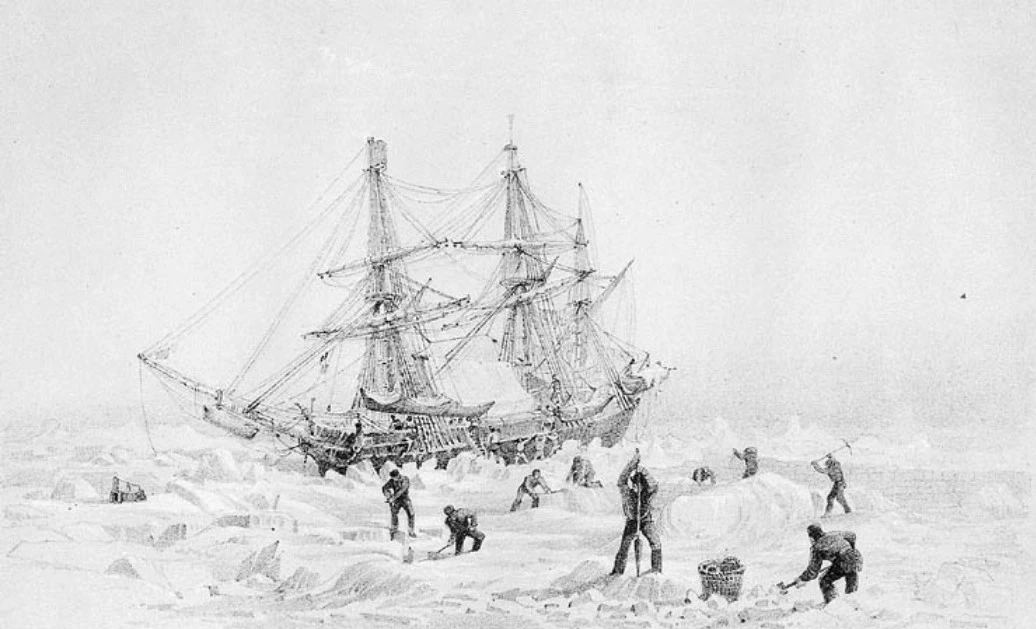
The ships wintered at Beechey Island in 1845–1846 and then sailed south through Peel Sound. They became beset in September 1846. A brief note deposited in a cairn in May 1847 initially reported that all was well. Eleven months later, Crozier and Fitzjames added the terrible update: Franklin was dead; 24 members of the expedition had died; the ships had been deserted on 22 April 1848; and 105 survivors would start for the Back River.
The decision to leave shipboard shelter must have reflected a severe assessment. After two winters trapped, health and provisions were deteriorating. Yet abandoning a ship for a long overland journey also exposed exhausted men to hauling, cold and scarce food. Archaeological sites and Inuit accounts show that parties moved south along the west and south coasts of King William Island.
For many years, historians assumed both ships sank or were crushed near the abandonment area. Inuit testimony preserved a more complicated picture, including accounts of a ship farther south and signs that people had returned to a vessel.
The Inuit account that led to HMS Terror
The 2016 discovery was closely connected to testimony from the late Sammy Kogvik of Gjoa Haven. Years earlier, while traveling near the western entrance of Terror Bay, Kogvik had seen a wooden mast protruding through sea ice. His account encouraged the Arctic Research Foundation vessel Martin Bergmann to investigate the bay.
On 3 September 2016, sonar operator Paul Watson detected a wreck in about 24 meters of water. An remotely operated vehicle showed a vessel with remarkable structural integrity. Parks Canada later confirmed the identification through dimensions, deck layout and features unique to Terror.
The location was astonishing: roughly 50 to 60 miles south of the ships’ reported abandonment position and away from the most heavily searched corridors. It again demonstrated that Inuit geographical knowledge and oral history had preserved critical evidence that formal expeditions overlooked.
What the wreck’s condition may reveal
HMS Terror sits upright with its hull largely intact. Masts are broken, but many deck structures remain. Cold, dark water and protective sediment slowed decay. The ship’s depth also shields it from some of the severe storm damage affecting the shallower Erebus site.
In 2019, Parks Canada conducted extensive remotely operated vehicle exploration of the interior. Images showed dishes and bottles still on shelves, furniture, scientific equipment and orderly cabins. Numerous doors were open, allowing the camera to move through passageways. One important exception was Captain Crozier’s cabin, which remained closed.
The preservation raises the possibility that paper records survive in drawers, cabinets or sediment. Cold water and low biological activity can preserve organic material, but recovery must be carefully planned. Opening a cabin changes water flow and could damage fragile objects. Archaeology proceeds slowly because context cannot be replaced once disturbed.
Was HMS Terror sailed after the abandonment?
The ship’s southern position strongly suggests movement after April 1848, but the mechanism remains debated. Ice drift could have carried an unmanned vessel before it sank. However, the wreck’s configuration offers reasons to consider human operation. The propeller is deployed, and the rudder is in place. Anchors and hatches may reflect deliberate actions.
Inuit accounts recorded a ship with people aboard in the southern region. If survivors remanned Terror, they may have attempted to sail toward the mainland, obtain game or find a route eastward. The vessel could then have been anchored or maneuvered into the bay before being abandoned again.
None of these clues yet proves exactly who returned or when. Equipment positions can have multiple explanations, and ice can move ships unpredictably. Still, the discovery makes the old linear narrative—abandon ship, march south, die—less adequate. The final phase may have included separation into groups, returns to the ships and additional voyages.
Captain Crozier and the closed cabin
Francis Rawdon Moira Crozier was one of the most experienced polar officers of his generation. An Irish naval officer, he had explored the Arctic with William Edward Parry and James Clark Ross and commanded Terror in Antarctica. He was a skilled navigator and magnetic observer.
Crozier’s fate after the Victory Point note is unknown. Inuit accounts described senior-looking officers among later survivor groups, and some traditions have been interpreted as possible references to him. No verified body or written record establishes where he died.
His cabin is consequently one of the most compelling archaeological spaces in the world. It might hold logs, charts, correspondence or nothing that survived. The appeal should not become a license for sensational excavation. A shipwreck is both an evidence site and a grave connected to real families and Inuit communities.
Disease, food and environmental pressure
The Franklin disaster has attracted single-cause explanations, particularly lead poisoning from canned food or water systems. Lead exposure likely occurred, but studies of remains and historical baselines have produced competing interpretations. Scurvy, respiratory disease, tuberculosis, starvation and zinc deficiency may also have weakened the men.
The most persuasive framework is cumulative. The expedition endured multiple winters, deaths among leadership, immobility, isolation and diminishing capacity to hunt or haul supplies. The physical effort of pulling heavily loaded sledges would increase caloric needs just as food availability and health declined.
HMS Terror may eventually clarify shipboard decisions, but it cannot turn a systemic disaster into a simple detective story. Even a preserved log would describe events from an officer’s perspective, not every experience among the expedition or the Inuit families who encountered its aftermath.
Protection and joint stewardship
The wreck forms part of the Wrecks of HMS Erebus and HMS Terror National Historic Site, cooperatively managed by Parks Canada and Inuit partners. Access is controlled to protect fragile archaeology and respect the sites’ cultural significance. Inuit Guardians help monitor the area and support interpretation.
Ownership agreements transferred most wreck artifacts from the United Kingdom to Canada, creating a framework for conservation and display. The long-term goal is not merely to remove attractive objects but to learn from the site while preserving as much as possible.
Climate change complicates the work. Longer open-water seasons can improve survey access while also changing storms, ice movement and biological activity. Archaeologists must balance urgency against the risks of intervention.
Why Terror is not a conventional ghost ship
HMS Terror is sometimes grouped with ghost ships because it disappeared and was found without its people. Yet it differs from an unmanned derelict discovered soon after abandonment. Its crew’s broad fate is known: all members of the expedition died during a prolonged Arctic catastrophe. The mysteries concern sequence, movement and individual experience.
The ship’s name and preservation encourage gothic imagery, but the evidence points toward endurance rather than the paranormal. Sailors maintained complex machinery and shipboard order through years of ice. Some may have returned after the official abandonment. Inuit witnesses observed and remembered the consequences.
HMS Terror matters because it is both remarkably intact and historically disruptive. Its position proves that the expedition’s final chapter unfolded farther south than the written naval record indicated. Its cabins may preserve more information, but the greatest lesson is already visible: solving maritime history requires listening to the people whose knowledge remained in the landscape.
Frequently asked questions
When and where was HMS Terror found?
The wreck was located in September 2016 in Terror Bay, off King William Island in Nunavut, Canada.
Why is the wreck so well preserved?
Cold water, limited biological activity, protective sediment, sheltered depth and the ship’s strong construction have preserved much of the hull and interior.
Could documents survive aboard HMS Terror?
Possibly. Paper can survive in cold, low-oxygen sediment or enclosed spaces, but no discovery of a complete expedition journal has yet been announced.
Did the crew sail the ship after abandoning it?
The wreck’s location and configuration make remanning plausible, and Inuit accounts support post-abandonment ship activity. The exact movement remains unproven.
Sources and further reading: Parks Canada archaeological reports and HMS Terror interior survey; Wrecks of HMS Erebus and HMS Terror National Historic Site; Royal Museums Greenwich; Arctic Research Foundation accounts; scholarship on Francis Crozier and Inuit testimony.