
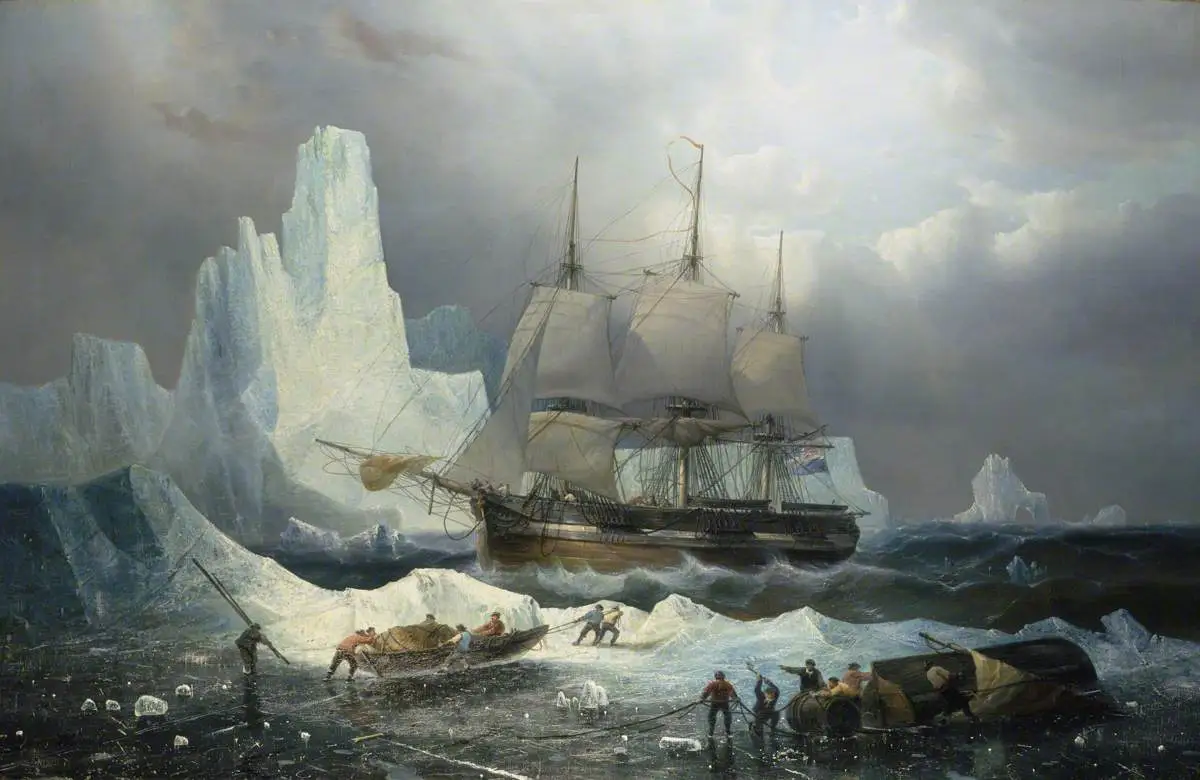
The ship at the center of the Franklin mystery
HMS Erebus occupies a unique place in polar history. It was a Royal Navy bomb vessel strengthened for demanding service, a veteran of Antarctic exploration and the flagship of Sir John Franklin’s 1845 attempt to navigate the Northwest Passage. The expedition vanished with 129 officers and men. For more than a century and a half, searches recovered graves, relics, human remains and one devastating written message—but not the ships themselves.
That changed on 2 September 2014, when a Parks Canada sonar team located the wreck of HMS Erebus in Wilmot and Crampton Bay, south of where many earlier searchers had concentrated. The discovery depended on modern hydrography and underwater archaeology, but it also confirmed the continuing value of Inuit oral histories describing where a ship had gone down and how survivors moved through the region.
The wreck has not delivered a single, simple answer to the Franklin expedition mystery. Instead, thousands of artifacts and the ship’s unexpected location are reshaping the final chapter. HMS Erebus is no longer only a lost ship. It is an archaeological site, a place of memory and a test of how polar history is researched and shared.
Built as a bomb vessel
HMS Erebus was launched in 1826 at Pembroke Dock in Wales. Bomb vessels were designed to carry heavy mortars and absorb the recoil of bombardment, giving them unusually strong internal construction. Their robust hulls later made vessels of this type attractive for polar exploration, where pressure from ice could crush ordinary ships.
The ship was named after Erebus, the dark region of the underworld in Greek mythology. Before Franklin’s voyage, it achieved fame under Captain James Clark Ross during the British Antarctic expedition of 1839–1843. Together with HMS Terror, Erebus penetrated Antarctic waters, charted coastlines and helped identify major geographical features. Mount Erebus on Ross Island was named after the ship.
These achievements mattered in 1845. The two vessels and their crews were not embarking as fragile amateurs. They represented experienced naval exploration and had already survived extreme environments.
How Erebus was adapted for Arctic exploration
For the Northwest Passage attempt, Erebus and Terror were reinforced and fitted with steam propulsion. Instead of carrying conventional marine engines designed from scratch, they received converted railway locomotive engines driving screw propellers. The machinery provided only modest power, but it could assist maneuvering in calm conditions and broken ice.
The ships carried heating systems, preserved food, scientific instruments, libraries and supplies intended for a multi-year voyage. Iron plating and internal strengthening protected vulnerable hull areas. Retractable propellers and rudder arrangements were intended to reduce ice damage.
By the standards of the period, the expedition appeared exceptionally prepared. Yet technology added complexity. Steam machinery consumed coal, while canned provisions varied in quality. No amount of strengthening could guarantee release once sea ice held the ships through multiple seasons.
Franklin’s 1845 Northwest Passage expedition
HMS Erebus, commanded overall by Sir John Franklin with James Fitzjames as its captain, sailed from Greenhithe in May 1845. HMS Terror was commanded by Francis Crozier. After crossing the Atlantic and calling in Greenland, the expedition entered Baffin Bay. Whalers saw the ships in late July 1845; these were the last encounters with Europeans.
The known route was later reconstructed through search discoveries. The expedition spent the winter of 1845–1846 at Beechey Island, where three crew members died and were buried. The ships then traveled south through Peel Sound but became beset in ice northwest of King William Island in September 1846.
Franklin died on 11 June 1847. By April 1848, the ships had remained trapped for more than a year and a half. A message left in a stone cairn at Victory Point recorded that 24 officers and men were already dead and that the remaining 105 had abandoned Erebus and Terror under Crozier and Fitzjames. They intended to march toward the Back River on the Canadian mainland.
No one survived to provide a conventional written narrative. Inuit testimony and physical evidence indicate that groups moved south, hunted, camped and died across a wide area. Some accounts also suggested that at least one ship was remanned and moved after the formal abandonment.
Why the expedition failed
There was probably no single cause. Prolonged entrapment created a cascade of problems: declining health, reduced food quality, exhaustion, cold, isolation and the enormous labor required to haul boats and supplies over rough ice and land.
Lead exposure from soldered food cans and the ships’ water systems has received great attention. Elevated lead levels were found in some remains, but research questions whether poisoning alone explains the disaster. Illnesses such as tuberculosis, pneumonia, scurvy and zinc deficiency have also been proposed. The death toll before abandonment shows that health was deteriorating, yet surviving evidence cannot assign one diagnosis to the entire company.
Environmental conditions were critical. The ships entered a region where heavy multi-year ice could persist. Steam power was too limited to break free, and nineteenth-century forecasts could not predict multi-season ice movement. Once trapped, the expedition lost mobility and resupply.
Leadership decisions are debated, especially the route and the later overland march. Hindsight makes alternatives appear clearer than they would have been to officers facing incomplete charts, uncertain hunting prospects and a duty to seek help.
Inuit knowledge and the limits of earlier searches
European and North American searches began after the expedition became overdue. Over decades, explorers mapped enormous areas and repeatedly questioned Inuit witnesses. Inuit accounts described encounters with starving men, camps, bodies, objects and ships. Some searchers listened carefully; others filtered testimony through their own assumptions about where naval vessels “should” have been.
Accounts associated with the Queen Maud Gulf region and a ship near the Adelaide Peninsula became especially significant. An Inuk hunter’s discovery of a large wooden object on an island in 2014 helped redirect attention. Archaeologists identified it as part of a Royal Navy vessel-launching davit. Sonar survey soon revealed the remarkably intact outline of a ship below.
The discovery demonstrated that oral history was not an optional supplement to scientific search. It was essential evidence accumulated across generations.
Finding HMS Erebus in 2014
On 2 September 2014, Parks Canada underwater archaeologists Ryan Harris and Jonathan Moore saw the wreck appear clearly on a sonar display. Its features matched a nineteenth-century Royal Navy exploration vessel. Subsequent dives confirmed HMS Erebus.
The wreck lies in relatively shallow water in Wilmot and Crampton Bay. Its position, significantly south of the point where the ships were abandoned in 1848, suggests later movement. Whether the vessel drifted with ice, was navigated by a remnant crew or experienced both processes remains under investigation.
The discovery transformed the search problem into a complex archaeological project. Protecting the site, documenting unstable structures and recovering vulnerable artifacts require short operating seasons, specialized diving and close cooperation with Inuit guardians and communities.
What archaeologists have found inside the wreck
Underwater work has mapped the hull and examined cabins, storage areas and the upper deck. Cold water and sediment preserved wood, metal and organic materials that would have disappeared at warmer sites. Recovered objects include navigation instruments, firearms, footwear, bottles, plates, personal effects and items connected to officers and ordinary seamen.
One major focus is the captain’s cabin, where documents might have been stored. Sediment can preserve paper, but access is difficult and the wreck is changing. Archaeologists use careful excavation rather than treasure hunting because an object’s position may reveal as much as the object itself.
Artifacts associated with specific spaces can help reconstruct life aboard and the sequence of abandonment, reoccupation or sinking. A closed medicine bottle may illuminate treatment practices; a writing desk may indicate administrative activity; equipment on deck may show preparations for movement. None is likely to announce the cause in isolation.
Who owns HMS Erebus?
The wrecks are protected within the Wrecks of HMS Erebus and HMS Terror National Historic Site. Canada and the United Kingdom reached arrangements transferring ownership of most artifacts to Canada, while certain significant objects may remain associated with the UK. More importantly, management is cooperative.
The site is the first Canadian national historic site jointly managed by Inuit and Parks Canada. The Franklin Interim Advisory Committee and the Nattilik Heritage Society have helped shape research, protection and public interpretation. Inuit Guardians monitor the remote sites and connect archaeological practice with community knowledge.
This approach challenges older exploration narratives that treated the Arctic as an empty stage for British heroism. The ships are part of Royal Navy history, but they also lie within Inuit homelands, and Inuit people were witnesses, knowledge holders, rescuers and later partners in discovery.
Erebus, Terror and the changing final voyage
The discovery of HMS Terror in Terror Bay in 2016 added another surprise. It was also found south of the 1848 abandonment position and is exceptionally well preserved. The two locations strengthen the possibility that at least some expedition members returned to a ship and attempted to sail south.
Inuit testimony had long included accounts of a ship that sank in the region and of people aboard or near vessels after the abandonment. Archaeology now allows researchers to test possible sequences, but it has not resolved which ship moved when, who was aboard or how long they survived.
HMS Erebus appears more disturbed and vulnerable than Terror. Shallow water exposes it to storm forces and ice. Climate change may lengthen open-water seasons and increase damage, adding urgency to documentation while also affecting access and conservation.
Why HMS Erebus still matters
HMS Erebus is important not because it confirms a tale of supernatural disappearance but because it reveals how incomplete historical narratives can be corrected. For generations, the Franklin expedition was framed as a heroic British tragedy whose solution depended on finding a decisive written record. The modern project shows that answers may instead emerge from combining oral history, archaeology, environmental science and respectful local partnership.
The wreck also offers a rare material record of shipboard life in a mid-nineteenth-century polar expedition. It may eventually clarify whether the ship was remanned, how it was configured during its last movement and what occurred before it sank. Even if no captain’s journal survives, spatial evidence can speak.
The lost Arctic ship has been found, but the expedition remains a mystery in motion. Each recovered artifact narrows some possibilities and opens others. HMS Erebus now connects two histories: the ambition and failure of imperial exploration, and the enduring Inuit knowledge that helped bring the ship back into view.
Frequently asked questions
When was HMS Erebus found?
Parks Canada located the wreck on 2 September 2014 in Wilmot and Crampton Bay, Nunavut.
How many people were on the Franklin expedition?
The expedition sailed with 129 officers and men aboard HMS Erebus and HMS Terror. None returned home.
Did Franklin discover the Northwest Passage?
The expedition charted important sections, and its route helped establish the geography of a navigable passage. However, the ships did not complete a successful transit, and Franklin died in 1847.
Why is Inuit oral history important to the discovery?
Inuit accounts preserved information about ship locations, survivors and artifacts in the region. That knowledge helped guide modern searches and continues to shape interpretation of the sites.
Sources and further reading: Parks Canada, Wrecks of HMS Erebus and HMS Terror National Historic Site and “Finding HMS Erebus”; Royal Museums Greenwich, Franklin expedition collections; Government of Canada archaeological reports; scholarship on Inuit testimony and the Franklin searches.