
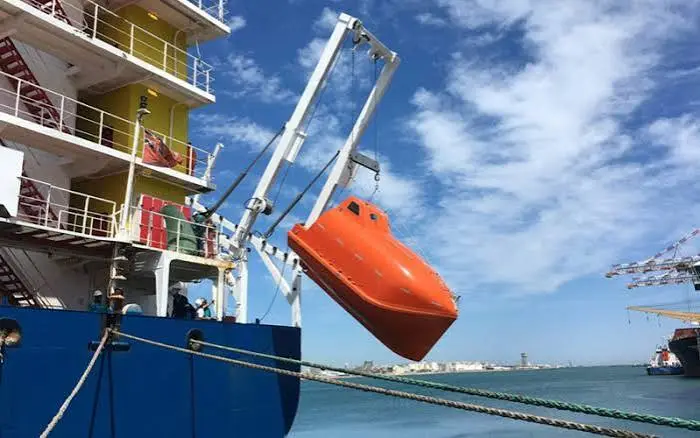
When a ship must be abandoned, the margin between survival and catastrophe is often measured in seconds. Among the tools designed to seize that margin is the freefall lifeboat—a survival craft that deliberately drops from a height of up to 30 metres or more, transforming gravitational potential energy into the kinetic energy needed to clear a stricken vessel and reach safe water. Unlike conventional davit-launched lifeboats, which are lowered by wires and winches, a freefall lifeboat slides down an inclined ramp and enters the sea in a controlled plunge. This article examines the engineering principles, operational procedures, regulatory framework, training demands, and safety record of a system that has reshaped maritime evacuation.
Historical Development: From Patent to Practical Necessity
The idea of launching a lifeboat by free fall is older than many assume. The first known reference is an 1897 patent issued to A. E. Falk of Sweden, whose drawing depicted an enclosed boat sliding off a ship’s stern from a height of roughly three metres. In 1939, Captain White of the Bay and River Navigation Company proposed a “non-sinkable submarine lifeboat” to the United States Bureau of Marine Inspection and Navigation, but the Bureau rejected the concept as “inadequate and dangerous,” warning that the boat would “strike the water at a terrific speed and would cause considerable shock to the passengers”.
The modern lineage began in the Netherlands. In 1959, sea captain Joost Verhoef designed an aluminium freefall lifeboat that looked, in his own description, much like a submarine; it entered service on a merchant ship in 1961 with a freefall height of about six metres. The concept then lay largely dormant until 1973, when two serious ship disasters prompted Nordic maritime authorities to commission the Norwegian Ship Research Institute to develop an improved launching system. That effort produced a 34-foot freefall lifeboat tested in Hardanger Fjord in 1976 at heights up to 20 metres, and the first manned launch from a ship’s stern followed in 1977. By the 1980s and 1990s, freefall lifeboats had become common on cargo ships, tankers, and offshore installations, with freefall heights ranging from about six metres on smaller vessels to over 30 metres on large oil production platforms. The system’s adoption was driven less by novelty than by a hard-eyed assessment of where conventional lifeboats fail.
Why Freefall? The Case Against the Davit
To understand the freefall lifeboat, one must first understand the vulnerabilities it was designed to eliminate. A conventional davit-launched lifeboat is lowered over the ship’s side by wires. This process exposes occupants to several hazards: the boat may swing and impact the ship’s side; if the engine fails after water entry, the boat may drift back toward the vessel; and launching from the high side of a listing ship can be difficult or impossible. The freefall lifeboat addresses each of these weaknesses through a different kinematic logic. Because it is not lowered but released, it generates kinetic energy during the fall that propels it away from the ship during and immediately after water entry. Even if the engine does not start, the boat moves clear of the danger zone. The freefall craft is typically mounted at the stern, where it is far less affected by list or trim, and it can be launched against a trim of up to 10 degrees and a list of up to 20 degrees either way.
The time advantage is equally significant. Once released, a freefall lifeboat falls to the water under gravity, whereas a conventional lifeboat is lowered by cable at a regulated speed. Studies of launch timing show that the freefall boat reaches the water far more quickly after release, reducing exposure to fire, explosion, or capsizing conditions. A single stern-mounted freefall lifeboat can sometimes replace the port and starboard pair required under conventional arrangements, simplifying ship design and evacuation logistics. These advantages do not come without costs—freefall lifeboats are heavier, more expensive, and more demanding to retrofit than davit-launched boats—but for tankers, bulk carriers, and offshore installations, the trade-off has been judged worthwhile.
Design and Construction: Engineering for a Controlled Crash
A freefall lifeboat is not simply a conventional lifeboat pushed off a ledge. Its hull, seating, and release systems are engineered around the violent accelerations of water entry. The life-saving appliance provisions of the International Maritime Organization’s LSA Code require that each freefall lifeboat make “positive headway immediately after water entry” and that it “shall not come into contact with the ship” after launch against the specified trim and list conditions when fully loaded. The boat must therefore be shaped and ballasted to deflect upward and forward on impact rather than plunge or overturn.
The hull form is typically slender at the bow, a geometry that reduces impact forces and encourages the boat to pierce the surface and rise. Structural strength is certified to withstand a freefall from at least 1.3 times the approved certification height with the full complement of persons and equipment, and each seat must sustain a 100-kilogram load under the same conditions. Seating is a critical interface between the boat and the human body. The LSA Code specifies seats that are non-folding and permanently secured, with at least 10 millimetres of cushioning over all contact areas to support the back, pelvis, and head. Seat pans must be at least 480 millimetres wide, backrests must extend at least 1,075 millimetres above the seat pan, and each seat must have a locking harness capable of quick release under tension. The passage between seats must be at least 480 millimetres wide and free of obstruction, allowing rapid embarkation in the ready-to-launch position.
The release mechanism is the most safety-critical component. The boat is held on its inclined ramp by a hook-and-ring arrangement, and the release must function reliably under load while remaining resistant to inadvertent activation. Modern systems incorporate hydraulic release pumps, mechanical interlocks, and, increasingly, arrangements for simulated launching that allow the release sequence to be tested without sending the boat into the water. The LSA Code also requires a secondary means of launching, so that the boat can be lowered by wire if the freefall release cannot be used or if conditions make a freefall launch imprudent. Inside the craft, occupants are protected by a fully enclosed canopy, a compressed-air supply system, a seawater spray system for fire protection, and watertight closure of skylights and ventilation before launch.
The Physics of the Plunge: Four Phases of Launch
A freefall launch is not a single undifferentiated drop. Engineers divide it into four distinct phases: the ramp phase, the rotation phase, the freefall phase, and the water-entry phase. Understanding these phases explains both the boat’s behaviour and the accelerations experienced by its occupants.
During the ramp phase, the boat slides down the inclined launch rail under gravity, accelerating from rest. The only forces acting on it are its weight and friction between the rail and the ramp. The velocity at the end of the ramp depends largely on the length of ramp ahead of the boat: a longer ramp produces greater speed and reduces the angular momentum imparted in the next phase.
The rotation phase begins when the boat’s centre of gravity passes the end of the ramp. The boat is no longer fully supported, and a couple formed by its weight and the reaction force at the ramp end causes it to rotate bow-downward. The amount of rotation depends on the weight of the boat, the distance between the centre of gravity and the after end of the rail, the launch angle, and the velocity at which rotation begins. A longer ramp reduces the rotation time and therefore the angular momentum; a shorter ramp or a centre of gravity positioned farther aft increases it.
Once the boat leaves the ramp entirely, the freefall phase begins. The boat falls freely through the air, continuing to rotate at a constant angular velocity until it contacts the water. The geometry at impact is decisive. A couple formed by fluid forces and the boat’s weight reverses the angular momentum induced during rotation and brings the boat back to even keel. If the entry angle is too steep, or if the centre of gravity is too far forward, the line of action of the fluid force can pass beneath the centre of gravity, producing an overturning moment instead of a righting moment; in an extreme case, the boat could over-rotate and become inverted. This is why hull shape, mass distribution, and ramp geometry are tested and certified as an integrated system rather than as independent components.
The water-entry phase runs from first contact until the boat has returned to the surface and is behaving as a boat. The kinetic energy developed during the fall not only carries the boat away from the ship but also produces the peak accelerations that the seating and restraint systems must attenuate. Cushioning, harness design, and seat geometry are therefore not comfort features; they are injury-prevention measures calibrated to the physics of the plunge.
Operational Procedure: From Alarm to Clear Water
The operational sequence of a freefall lifeboat launch is short but densely procedural. Training models based on the STCW Code describe a progression that begins with recognising the abandon-ship alarm and preparing the crew, then moves through embarkation, engine start, seawater spray activation, verification of watertight integrity, and compressed-air system checks. Once occupants are seated with body and head restraints securely fastened, the door is secured watertight, the rudder is placed amidships, and the manufacturer’s instructions determine when the engine is started and whether the gear is engaged at the moment of launch.
The coxswain then operates the release. In some systems, a hand-operated hydraulic pump actuates an on-load release; in others, a safety handle or lever initiates the sequence. The boat slides down the ramp, rotates, falls, and enters the water. Immediately after water entry, the coxswain steers away from the danger zone and communicates with rescue craft or helicopters as required. The entire sequence from release to water entry is measured in seconds, not minutes—a fact that underlies both the system’s appeal and its unforgiving nature.
Recovery is a separate and arguably more hazardous operation. Freefall lifeboats are designed primarily for one-way deployment; recovering one requires a rescue boat and a crane or davit arrangement, and crew should not be inside the lifeboat during recovery. The boat is manoeuvred beneath the davit falls, the painter is secured, slings are connected, and the boat is hoisted clear of the water only after the hydrostatic interlock is confirmed engaged. This asymmetry—designed for rapid escape, not routine return—shapes both maintenance practices and drill design.
Training and Drills: Competence Before Confidence
The freefall lifeboat places unusual demands on crew competence. The STCW Code requires seafarers assigned to operate freefall lifeboats to have received training in embarkation, launching, and recovery, and to have participated in at least one freefall launch during training before serving on board. A model course for launching and taking charge of a freefall lifeboat covers preparation for abandoning ship, manning the boat properly, starting the engine, using the seawater spray and compressed-air systems, ensuring watertight integrity, launching, steering away from the danger zone, and communicating with rescue assets. Practical training may use a freefall lifeboat simulator equipped with instruments for magnetic course, rudder angle, fuel level, and the boat’s systems, and capable of mimicking the slide, freefall, and water impact phases.
Drills are governed by a tension between realism and risk. SOLAS requires that, at least once every three months, crew members secure themselves properly in their seats and carry out the launch procedure up to but not including the actual release of the lifeboat. Actual freefall launches during drills are permitted with only the required operating crew on board, or the boat may be lowered by secondary launching equipment without the operating crew and then manoeuvred in the water. Simulated launching—testing the release system under load without sending the boat into the water—must be carried out only with equipment designed for the procedure and in accordance with the manufacturer’s instructions, using restraining devices and maintenance pins to prevent accidental release. These provisions reflect a hard-learned lesson: the greatest danger to seafarers from lifeboats has not been the abandoning of ships in storms, but the drills, inspections, and maintenance that surround the equipment in port and at anchor.
Regulatory Framework: SOLAS, the LSA Code, and Beyond
Freefall lifeboats sit within a layered regulatory structure. SOLAS Chapter III establishes carriage and performance requirements, while the LSA Code provides the detailed technical standards for construction, seating, release systems, and launching performance. Type approval typically draws on SOLAS regulations III/4, III/21, III/31, and III/34, together with IMO resolutions and circulars addressing testing, maintenance, and simulated launching. The LSA Code’s freefall provisions address carrying capacity, seating geometry, positive headway after water entry, and the ability to withstand launch conditions with the centre of gravity in its most forward and most aft positions.
The regulatory agenda continues to evolve. The IMO’s Ship Systems and Equipment Sub-Committee has finalised draft amendments to the LSA Code on design and prototype test requirements for arrangements used in operational testing of freefall release systems without launching the boat, with expected application in the early 2030s. The European Union’s implementing regulations for marine equipment likewise reference freefall lifeboats alongside SOLAS and LSA Code requirements, tying type approval to a growing body of IMO instruments. This layered approach—convention, code, resolution, circular, and regional regulation—creates a dense but necessary framework for equipment that must work first time, every time.
The Safety Record: Successes and Sobering Lessons
The freefall lifeboat’s safety case rests on a paradox. On one hand, the system has an enviable operational record in the scenarios for which it was designed. By the mid-1990s, more than 15,000 people had been launched in freefall lifeboats during training exercises without a reported injury, and freefall boats had been used successfully in two offshore rescues. The kinetic-energy principle has been validated in service: the boat clears the ship even without engine power, and it can launch under list and trim conditions that would defeat a davit system.
On the other hand, the broader record of lifeboat operations—including freefall boats—is stained by accidents during drills, maintenance, and inspection. An InterManager study covering 1981–2023 recorded approximately 419–420 deaths, 346 serious injuries, and 116 minor injuries from lifeboat accidents. A UK MAIB study of 1989–2000 identified 115 incidents with 12 fatalities and 87 injuries. Critically, more than 98 percent of lifeboat-related incidents occur during drills, maintenance, inspections, or training rather than during actual emergencies. In three major European ship abandonment incidents—Express Samina (2000), Sea Diamond (2007), and Costa Concordia (2012)—no casualties were reported from lifeboat use, even though the vessels carried thousands of persons. The danger, in other words, is concentrated in the routines that surround the equipment, not only in the catastrophe it is meant to answer.
A 2023 incident illustrates the point. A crew member on the bulk carrier Golden Zhejiang was seriously injured when a freefall lifeboat fell into the water during a weekly safety check. Investigators found that the wires securing the lifeboat in its launching position were not designed and certified for that purpose, and that a hydraulic leak had prevented required drills for months. The boat was approximately 19 metres above the water, with a mass of 4,400 kilograms and a capacity of 30 persons; the fall was described as “an accident waiting to happen”. The case underscores that the freefall lifeboat’s engineering sophistication cannot compensate for inadequate maintenance, uncertified securing arrangements, or deferred repairs.
Maintenance and Inspection: The Unseen Work of Survival
Because freefall lifeboats are dormant for most of their service life, maintenance is the discipline that keeps the promise of the design intact. SOLAS and the LSA Code require weekly and monthly inspections, annual thorough examinations and operational tests, and periodic testing of release gear under load or by simulated launching. The annual examination covers hull structure and void spaces, engine and propulsion, sprinkler and air-supply systems, manoeuvring and power supplies, bailing systems, fender and skate arrangements, and release-gear activation devices, free play, hydrostatic interlocks, and hook fastening. No maintenance or adjustment of release gear may be undertaken while the hooks are under load, and the setting and maintenance of release gear are explicitly identified as critical operations requiring utmost care.
The challenge is not merely technical but organisational. Crews must conduct inspections from a position of physical risk, often at height and in confined spaces; the Golden Zhejiang case shows how a persistent hydraulic defect can erode the drill regime and leave the boat in a degraded state. Best practice therefore emphasises certified equipment, inspection at required intervals, tests in accordance with manufacturer instructions, fall preventers where applicable, comprehensive on-board training, risk assessment before any lifeboat operation, and records maintained under the safety management system.
Freefall Versus Conventional: A Comparative Assessment
The choice between freefall and davit-launched lifeboats is not a matter of one system being universally superior. Freefall boats offer faster deployment, greater tolerance of list and trim, the ability to clear the ship without engine power, and the elimination of several davit-related hazards such as swinging against the hull and the need to unlatch hooks at the water’s edge. They are widely accepted by maritime regulators, who have developed design and certification criteria for them, and they are used on cargo ships, tankers, and offshore facilities where stern mounting is practical.
Conventional lifeboats, by contrast, remain dominant on passenger ships, where large numbers of boats must be distributed along both sides of the vessel and where passenger training in freefall launch is not practical. Davit-launched boats are also lighter, less expensive, and easier to retrofit, though they carry their own risks during lowering and recovery. The freefall boat’s stern-mounted geometry is a strength on a tanker or bulk carrier but a constraint on a cruise ship with thousands of passengers and limited stern space. The regulatory framework accommodates both systems because the operational context, not an abstract ranking of technologies, determines which is appropriate.
Future Directions: Simulation, Regulation, and the Human Factor
The next decade of freefall lifeboat development is likely to be shaped less by radical changes in hull form than by improvements in how the system is tested, maintained, and trained. The IMO’s work on simulated launching arrangements—allowing release systems to be tested under load without launching the boat—promises to reduce the risk of drills while improving assurance that the release will function when needed. Simulators that replicate the slide, freefall, and impact phases offer a way to build coxswain competence without exposing trainees to the full physical risk of every launch. Regulatory attention is also converging on the human factors that dominate accident statistics: the certification of securing arrangements, the management of maintenance defects, the competence of persons performing release-gear inspections, and the quality of risk assessment before any lifeboat operation.
The freefall lifeboat is, in the end, a machine for converting height into distance—from danger to safety, from a stricken ship to open water. Its engineering is elegant, its operational sequence is brief, and its regulatory framework is dense. But its safety record depends less on the elegance of the plunge than on the unglamorous disciplines of maintenance, training, and inspection. The boats that save lives in an emergency are the ones that have been cared for in the long uneventful months before it.
thanks!