
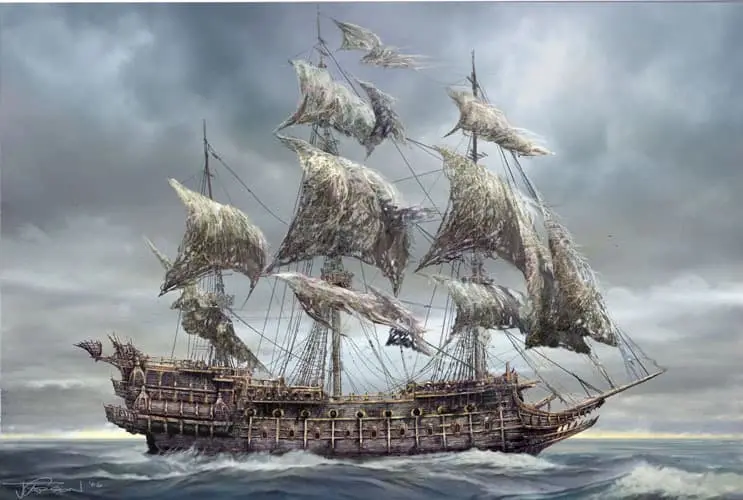
A ship condemned to sail forever
The Flying Dutchman is the most famous phantom ship in maritime folklore: a spectral vessel unable to reach port, condemned to cross storm-driven seas until the end of time. Sailors who see it are said to receive a warning of disaster. In some versions, its dead crew attempt to pass letters to the living; accepting them brings misfortune because the intended recipients have long since died. In others, the captain is allowed ashore periodically in search of a faithful woman whose love can break the curse.
There is no single historical ship called the Flying Dutchman. The legend developed gradually from sailors’ superstition, travel writing, poetry, popular theatre and opera. Its supposed captain acquired different names—Hendrick van der Decken, Willem van der Decken, Bernard Fokke or simply “the Dutchman”—and the crime that caused his punishment changed with each retelling.
That fluidity is not a weakness in the story. It is the reason the Flying Dutchman legend survived. Each generation refitted the phantom ship for its own fears: divine punishment, dangerous ambition, isolation, colonial trade, forbidden knowledge or love that arrives too late.
Why the Cape of Good Hope shaped the legend
Many familiar versions place the ship near the Cape of Good Hope. Before the Suez Canal, the cape route connected Europe with Asian markets and colonies. It was commercially vital and physically demanding. Strong winds, large waves and rapidly changing conditions could delay sailing vessels for weeks or drive them back from the coast.
Dutch maritime power was at its height during the seventeenth-century era of the Dutch East India Company, or VOC. Its ships traveled long, hazardous routes between the Netherlands, southern Africa and Asia. Disease, shipwreck, violence and separation from home were common realities. A cursed Dutch captain attempting to round the cape “even if it takes until Judgment Day” therefore emerged from a recognizable maritime world.
The legend is sometimes projected back into that golden age as though sailors were already telling the complete story. The documentary record is later. Known printed references appear near the end of the eighteenth century, and the recognizable narrative took shape during the early nineteenth century.
The earliest printed Flying Dutchman accounts
One of the earliest surviving references appears in John MacDonald’s Travels in Various Parts of Europe, Asia and Africa, published in 1790. George Barrington’s A Voyage to Botany Bay followed in 1795 with an account of a supposed phantom Dutch man-of-war encountered during heavy weather. These sources show that the idea of a Dutch ghost ship was circulating by the 1790s, even though its details were not yet fixed.
In 1803, Scottish poet John Leyden connected the phantom vessel with punishment for wrongdoing. Thomas Moore referred to a ghost ship called the Flying Dutchman in a poem inspired by a maritime superstition. Sir Walter Scott later described the apparition as a ship associated with murder, piracy and wealth, while also treating it as an omen feared by mariners.
A decisive version appeared in Blackwood’s Edinburgh Magazine in 1821. The story placed the action near the Cape of Good Hope, named the captain Hendrick van der Decken and included the oath to round the cape despite divine or natural opposition. It also developed the disturbing motif of letters addressed to people who were already dead.
These texts did not merely record a stable oral legend. They actively created and circulated it. Maritime folklore and literary invention fed each other until the phantom ship appeared ancient and universal.
Who was the captain of the Flying Dutchman?
Hendrick van der Decken is the name most often attached to the captain, but no reliable evidence identifies him as the master of a real doomed ship. The name became prominent through nineteenth-century storytelling. Willem van der Decken is a common variant.
Another candidate is Bernard Fokke, a seventeenth-century Dutch captain known for unusually fast voyages between Europe and Java. His speed generated rumors that he had made a pact with the Devil. Fokke was a real mariner, but linking him directly to the Flying Dutchman is speculative. He functions better as an example of how extraordinary seamanship could acquire supernatural explanations.
The captain’s identity matters less than his defining character: he refuses limits. He challenges the weather, God, fate or human compassion. This stubbornness transforms professional determination into destructive obsession. For seafarers dependent on judgment and respect for the sea, the moral would have been clear. Courage keeps a ship moving; arrogance can destroy it.
The curse and its changing meanings
In the best-known cape version, van der Decken meets a storm that blocks his passage. He swears that he will round the cape even if he must sail until Judgment Day. The oath is answered literally: he and his ship must remain at sea forever.
Other accounts give the curse a different origin. The captain commits murder, engages in piracy, sails on a holy day or defies a divine warning. Some stories associate the ship with the history of enslavement and colonial violence. These changes reveal the concerns of the writers who preserved them.
The letters carried by the dead crew introduce another powerful theme. A vessel meets the phantom ship, and spectral sailors ask the living to deliver messages home. The addressees have long been dead, collapsing ordinary time at sea. Refusing the letters may anger the ghosts; accepting them may doom the recipient ship. The mariner is trapped between duty and fear.
Wagner and the romantic transformation
The legend achieved international cultural status through Richard Wagner’s opera Der fliegende Holländer, first performed in Dresden in 1843. Wagner drew partly on Heinrich Heine, who had introduced the idea that the Dutchman could be redeemed by a faithful woman. In the opera, the cursed captain may come ashore once every seven years. Senta’s sacrificial devotion offers release.
This romantic version shifted the center of the story. The phantom ship was no longer only a warning seen at a distance; its captain became a tragic protagonist. The curse could be broken not by seamanship or repentance alone but by redemptive love.
Wagner’s powerful music and theatrical imagery fixed many modern associations with the Dutchman: storm, repetition, longing and a dark vessel emerging from the sea. Later films and novels adapted the concept further, often loosening it from its Dutch and cape origins.
Were sightings caused by a real optical phenomenon?
Some reported ghost-ship sightings may be explained by a superior mirage known as Fata Morgana. Temperature inversions can bend light so that a distant vessel appears elevated, stretched, duplicated or suspended above the horizon. Layers of distorted images may change rapidly, giving an ordinary ship an unnatural silhouette.
At sea, where distance is difficult to judge and horizons can merge with haze, such an apparition would be striking. A vessel beyond normal visual range could seem to float in the sky. The effect does not prove the origin of the Flying Dutchman legend, but it offers a plausible explanation for some experiences later interpreted through it.
Bioluminescence, lightning, fog and unusual cloud illumination could add to the impression. Fatigue and expectation also matter. Sailors who already know a story are more likely to fit an ambiguous sight into its familiar pattern.
The royal sighting of 1881
One often-repeated sighting occurred in July 1881 during the voyage of HMS Bacchante, on which the future King George V served as a young naval cadet. The published cruise journal described a strange red light resembling a phantom ship. A lookout reportedly died after falling from a mast later that day, reinforcing the apparition’s reputation as an omen.
The account is historically interesting but not proof of a supernatural vessel. The published journal was edited, and a dramatic narrative could combine an optical observation with an unrelated accident. Nevertheless, royal association gave the story authority and ensured that it would be repeated.
From maritime warning to popular-culture icon
The Flying Dutchman moved easily across media. Painters including Albert Pinkham Ryder and Howard Pyle created influential images. Theatre, opera, novels and radio kept the legend alive. Modern audiences may know the name from Pirates of the Caribbean, where the Dutchman is captained by Davy Jones, or from SpongeBob SquarePants, games and fantasy fiction.
These adaptations borrow the promise of a ship operating beyond the laws of ordinary life. They do not preserve a single canonical legend, because no such version exists. Davy Jones, the Kraken, undersea crews and a captain who steps ashore once every ten years belong to newer fictional worlds rather than the earliest Dutchman tradition.
The phrase “Flying Dutchman” has also become a metaphor for a person who never rests or a vessel seemingly destined to wander. That flexibility keeps the name recognizable even when the original cape setting is forgotten.
What the legend reveals about seafaring
Ghost ship stories gave sailors language for hazards that could not always be measured or controlled. A missing ship left no witnesses. A mirage looked real but could not be reached. A voyage could separate a mariner from family for years, making letters arrive after the writer or recipient had died. The Flying Dutchman combines these realities in one unforgettable image.
It also dramatizes the ethics of command. The captain’s sin is often not fear but excessive determination. He ignores weather, religious obligation, crew welfare or the natural limits of his vessel. The sea punishes his refusal to turn back. In modern safety language, the legend warns against plan-continuation bias: pressing ahead because abandoning a plan feels like failure.
The Flying Dutchman therefore remains more than a haunted ship. It is a story about time, command and the cost of refusing reality. No wreck will solve its mystery because it is not a casualty waiting to be located. It is a cultural vessel, built from centuries of maritime experience and forever reconstructed by those who tell its story.
Frequently asked questions
Was the Flying Dutchman a real ship?
No verified historical vessel has been identified as the Flying Dutchman. It is a legendary phantom ship assembled from folklore and literary versions.
Where is the Flying Dutchman supposed to appear?
Many classic versions place it near the Cape of Good Hope, although later stories move it to other seas.
Who captained the Flying Dutchman?
Hendrick or Willem van der Decken is the usual legendary captain. The real Dutch mariner Bernard Fokke has also been proposed as an inspiration, but the connection is unproven.
Can a mirage look like a ghost ship?
Yes. A Fata Morgana can distort a distant vessel and make it appear to float above the horizon. Such phenomena may explain some reported phantom-ship sightings.
Sources and further reading: early references in John MacDonald (1790), George Barrington (1795), John Leyden (1803) and Blackwood’s Edinburgh Magazine (1821); Royal Museums Greenwich materials on maritime superstition; Encyclopaedia Britannica on The Flying Dutchman and Wagner’s opera.