
07/28/2026
A survey of European ports that, as of 2026, have not yet applied/used Shore-Side Electricity (SSE), Onshore Power Supply (OPS), Alternative Maritime Power (AMP), High-Voltage Shore Connection (HVSC), or “cold ironing” — but are planning, tendering, or building it.
1. Why this list exists now: the regulatory driver
Two overlapping EU laws are forcing the issue:
- AFIR (Alternative Fuels Infrastructure Regulation, EU 2023/1804) — requires TEN-T core and comprehensive maritime ports to install OPS at berths handling large container and passenger/cruise ships, largely by 31 December 2029.
- FuelEU Maritime (EU 2023/1805) — from 1 January 2030, container and passenger ships over 5,000 GT must connect to and use OPS (or an equivalent zero-emission technology) at quaysides in TEN-T ports; from 1 January 2035 this extends to any EU port that already has OPS installed.
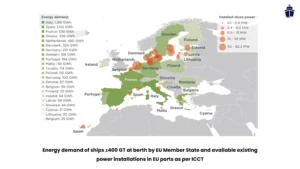
Independent audits (DNV for Transport & Environment, July 2025; TT Club, Jan 2026) found that only around 20% of the OPS connections required by 2030 are installed or contracted EU-wide, and that of 31 major ports studied, only four (Algeciras, Livorno, Świnoujście, Valletta) had more than half of what they need. Cruise terminals are further along (~38%) than container terminals (~11%). This means the great majority of European ports — including many very large ones — are still in the “planning/tendering/construction” phase rather than operating SSE.
The list below groups ports by sea region. For each, it gives: current status, what is planned, target dates, and funding source where known. “Comprehensive” here means as broad a cross-section as available reporting allows (major TEN-T ports plus notable secondary/island/cruise ports); it is not an exhaustive inventory of every harbour in Europe, since hundreds of small ports have no public OPS roadmap at all.
2. Western Mediterranean — Italy
Italy has probably the largest and most detailed national pipeline, backed by the National Recovery and Resilience Plan (PNRR): around €700 million (some sources cite €400m PNRR + a further ~€570m in EU-approved state aid running to 2033) targeting at least 15 cold-ironing installations across ~10–50 TEN-T ports.
| Port | Status (2026) | Plan / Target | Notes |
|---|---|---|---|
| Genoa | No operational SSE at cruise/ferry terminals | €26m project (with Savona) for cruise/ferry berths; executive design underway | Co-financed by EIB (~€300m loan across a €789m modernization package); contractor Nidec ASI |
| Savona | Not yet operational | Cold-ironing converter for cruise port, one ship at a time | Same contract/timeline as Genoa, ~2–3 years to completion |
| Naples | Partial/planned | Cavotec awarded ~€3m order (March 2026) for shore power systems | Part of wider PNRR cold-ironing rollout |
| Civitavecchia (Rome’s port) | Not yet operational | Included in national cold-ironing plan; feasibility/design phase | Major cruise hub, large XL-class ship traffic |
| Gioia Tauro | Early-stage | PNRR-funded electrification project launched | Italy’s largest transshipment container hub |
| La Spezia | Early-stage | PNRR-funded project launched | Also site of Muggiano shipyards test installations |
| Bari | Early-stage | PNRR-funded project launched; new cruise terminal also planned (~2026 Adriatic investment package) | |
| Taranto | Early-stage | PNRR-funded project launched | |
| Venice | Partial | One of few ports (per DNV/T&E study) with contracted connections for at least one ship segment, but not all | Further cold-ironing investment earmarked in 2026 Adriatic funding package (~€252m Italy-wide) |
| Ravenna | Not yet operational | Cold-ironing project included in 2026 Adriatic investment package |
Livorno is a partial exception — it already has 12–45 MW of shore-power capacity for cruise ships (since 2015/2018) — but its Darsena Europa expansion (due late 2026) is adding a third berth with new shore-power capability, so it remains a live “planning/expansion” case relevant to this list.
3. Western Mediterranean — Spain
Spain’s state port authority (Puertos del Estado) has approved roughly €950 million–€1.6 billion for dock electrification/OPS across the national port system, with €280 million earmarked in the 2026 budget alone (up from 13% to 17.5% of investment share).
| Port | Status (2026) | Plan / Target | Notes |
|---|---|---|---|
| Algeciras | Partial — largest single OPS deployment planned in the state system | Passenger-terminal OPS tendered (~€150,000, Next Generation EU funded); part of broader €40m electrical-supply upgrade | Already a leader in installed capacity for some segments, but full cruise/container coverage still pending |
| Valencia | Not yet operational | Project under execution | One of Spain’s “big three” ports by tonnage |
| Bilbao | Not yet operational | Project under execution | |
| Pasaia | Not yet operational | Project under execution | |
| Vigo | Not yet operational | Project under execution | |
| Alicante | Not yet operational | Project under execution | |
| Balearic Islands ports (various) | Not yet operational | Multiple projects under execution | Palma de Mallorca already has 2 ferry connections operational; other Balearic ports still pending |
| Tarragona | Not yet operational | Sustainability-linked investment approved for 2026 | |
| Ceuta | Not yet operational | No dedicated OPS project publicly confirmed yet |
Barcelona and Cádiz (Bay of Cádiz) have made real progress (Barcelona: 219 ferry OPS connections completed by April 2026, container-terminal OPS at BEST terminal; Cádiz: Spain’s first state-system cruise-ship OPS connection, inaugurated March 2026) but both are flagged by the DNV/T&E study as still lagging behind their 2030 targets for the cruise segment specifically — i.e., partially electrified, not yet fully compliant.
4. Western Mediterranean — France
| Port | Status (2026) | Plan / Target | Notes |
|---|---|---|---|
| Dunkerque | Not yet operational (per DNV/T&E study) | No confirmed installation/contract found in study | Flagged among ports “lagging” on 2030 targets |
| Le Havre | Partial | Enough connection points contracted for at least one ship segment (cruise), not all; new terminals 2 & 3 OPS due mid/late 2026 | Studies began 2018, ahead of regulation |
| Rouen | Not yet operational for the maritime OPS mandate (exempt under current AFIR scope) but has cruise OPS in progress | Enough connection points for cruise segment per DNV data | One of 3 ports (with Ghent, Terneuzen) not covered by the maritime OPS mandate itself |
Marseille-Fos is a rare full success story (three simultaneous cruise-ship OPS connections activated April 2026, 108 MW capacity, 100% renewable) and is included here only for contrast — it is not on the “still needs to build it” list.
5. Eastern Mediterranean / Adriatic — Greece
Greece’s Ministry of Maritime Affairs, working with HEDNO (grid operator) and funded partly via the Connecting Europe Facility (CEF), has a €585 million Port Upgrade Plan targeting cold ironing at 23 ports by 2029. Virtually the entire Greek port system is currently without OPS and in the feasibility/tender stage.
| Port | Status (2026) | Plan / Target | Notes |
|---|---|---|---|
| Piraeus | Not yet operational | Nine berths identified as suitable; FEED studies underway (CIPORT project) for four cruise-vessel OPS positions | Aim: transform into a “Green Cruise Hub”; target by end of decade |
| Thessaloniki | Not yet operational | Feasibility study completed; progress/barriers outlined Feb 2026 | Greece’s second major port |
| Igoumenitsa | Not yet operational | €8.9m tender for 3 shore-power points (2×3MW, 1×0.5MW); completion targeted December 2026 | One of the more mature pilot projects |
| Rafina | Not yet operational | 4 supply points (1.5 MW each) planned; tender expected | Early pilot alongside Igoumenitsa |
| Lavrio | Not yet operational | Advanced plans presented at a February 2026 conference | |
| Volos | Not yet operational | Feasibility study completed | |
| Heraklion (Crete) | Not yet operational | Feasibility study completed | |
| Patras | Not yet operational | Targeted for cold ironing by 2029 | |
| Elefsina | Not yet operational | Targeted for cold ironing by 2029 | |
| Kavala | Not yet operational | Feasibility study in preparation | |
| Kalamata | Not yet operational | Targeted for cold ironing by 2029 | |
| Katakolo | Not yet operational | Targeted for cold ironing by 2029 | |
| Corfu | Not yet operational | Feasibility study in preparation | |
| Mykonos | Not yet operational | Targeted by 2029; major cruise/tourism destination | |
| Mytilene (Lesbos) | Not yet operational | Targeted by 2029 | |
| Naxos | Not yet operational | Targeted by 2029 | |
| Paros | Not yet operational | Targeted by 2029 | |
| Skyros | Not yet operational | Targeted by 2029 | |
| Syros | Not yet operational | Targeted by 2029 | |
| Chios | Not yet operational | Targeted by 2029 | |
| Chania (Crete) | Not yet operational | Targeted by 2029 | |
| Santorini | Not yet operational | Named in the twelve-port electrification initiative | Extremely high cruise-call volumes; strong candidate for early priority |
| Rhodes | Not yet operational | Named in the twelve-port electrification initiative |
Note: Killini is the exception — the EU-funded Elemed project (with Cyprus’s Limassol and Slovenia’s Koper) delivered the first operational Eastern-Mediterranean OPS connection there.
6. Adriatic — Croatia
Academic case studies (2023) found no concrete cold-ironing implementation plans yet existed for Croatia’s state-owned ports, though experts confirmed strong future feasibility and shipowner interest.
| Port | Status (2026) | Plan / Target | Notes |
|---|---|---|---|
| Dubrovnik | Not operational | No confirmed installation date; studied for HVSC feasibility (15 MVA required) | High cruise-ship interest (excursion boats, nautical tourism vessels) |
| Split | Not operational | €17m ferry-terminal expansion investment (2026); interest from RoPax/RoRo and cruise segments | |
| Rijeka | Not operational | Feasibility studied (7.5 MVA required); Croatia positioning itself as an energy/goods transit hub | |
| Šibenik | Not operational | €8m cruise-hub terminal upgrade allocated (2026); cruise-line interest confirmed | |
| Zadar | Not operational | Interest from excursion/nautical tourism vessel segment | |
| Ploče | Not operational | Interest from container-vessel operators; flagged in DNV/T&E study as a non-responding/lagging port |
7. Iberian Atlantic — Portugal
| Port | Status (2026) | Plan / Target | Notes |
|---|---|---|---|
| Lisbon | No investment made yet (confirmed by Reuters/T&E, July 2025) | Multi-million-euro cable-laying project to connect port to a power station; targeted for readiness by 2029 | One of Europe’s busiest cruise ports — a high-priority gap |
| Oporto–Leixões | Status unclear/non-responsive to DNV survey | No public OPS project confirmed | Flagged among ports that did not respond to the 2025 EU-wide survey |
8. North Sea / Low Countries
| Port | Status (2026) | Plan / Target | Notes |
|---|---|---|---|
| Antwerp (Antwerp-Bruges) | No investment made yet in seagoing-vessel OPS (per T&E, July 2025), though RoRo short-sea berths have shore power | Antwerp Euroterminal (AET) first seagoing-vessel shore-power connection expected operational 2026 | Pledged carbon neutrality by 2050; part of North Sea Ports alliance with Ghent/Zeeland |
| Ghent | Not covered by the maritime OPS mandate itself (like Rouen, Terneuzen) but developing infrastructure | New electric-truck charging hub opened March 2026; broader electrification program with Netherlands | |
| Rotterdam | Partial — flagged as “lagging” for 2030 targets despite a 2025 cruise-terminal shore-power opening | Shore Power Roadmap targets full coverage for deep-sea container and cruise terminals by 2028; €90m EIB loan (March 2026) for further development | Europe’s largest port by cargo volume |
9. Baltic Sea
| Port | Status (2026) | Plan / Target | Notes |
|---|---|---|---|
| Gdańsk (Poland) | No investment made yet (confirmed by T&E, July 2025) | No confirmed public timeline found | Major container/LNG hub |
| Gdynia (Poland) | Non-responsive to 2025 EU survey; no confirmed OPS project | Status unclear | |
| Tallinn (Estonia) | Non-responsive to 2025 EU survey | Status unclear | |
| Riga (Latvia) | Included in the DNV study’s detailed port sample; no OPS confirmed operational | Under review as part of EU-wide OPS gap analysis | |
| Helsinki (Finland) | Non-responsive to 2025 EU survey | Status unclear | |
| Copenhagen/Malmö (Denmark/Sweden, joint port) | Non-responsive to 2025 EU survey | Status unclear | |
| Helsingborg (Sweden) | Non-responsive to 2025 EU survey | Status unclear |
Świnoujście (Poland) is a partial exception — it is one of only four ports EU-wide with more than half its required OPS connections installed/contracted — but is listed for context, not as a “still to build” case. Klaipėda (Lithuania) similarly has partial coverage for at least one ship segment.
10. Black Sea
| Port | Status (2026) | Plan / Target | Notes |
|---|---|---|---|
| Constanța (Romania) | Not yet operational | Project to install cold ironing/OPS started (per Ports Europe, March 2026) | Romania’s principal Black Sea port |
| Varna (Bulgaria) | Non-responsive to 2025 EU survey; no confirmed OPS project | Status unclear | |
| Burgas (Bulgaria) | No confirmed public OPS project | Status unclear | Not directly surveyed but comparable profile to Varna |
11. Eastern Mediterranean islands / small states — Cyprus and Malta
| Port | Status (2026) | Plan / Target | Notes |
|---|---|---|---|
| Limassol (Cyprus) | Non-responsive to 2025 EU survey; had role in Elemed pilot project | Regulatory framework for cold ironing developed via Elemed, but full operational OPS not yet confirmed | |
| Marsaxlokk (Malta) | Non-responsive to 2025 EU survey | Status unclear | Major transshipment hub |
Valletta (Malta) is again a partial exception — one of the four EU ports with more than half its required connections installed/contracted — included here only for regional context.
12. United Kingdom (non-EU, but subject to comparable domestic pressure)
A dedicated DNV/T&E study of UK ports (2025) found that Southampton is the only UK port among those studied with any contracted/installed OPS, and even that installation (two high-voltage cruise connection points) can only serve one ship at a time due to National Grid capacity constraints, with no further connection points currently planned.
| Port | Status (2026) | Plan / Target | Notes |
|---|---|---|---|
| Dover | Not operational (only small-scale industrial plugs, outside OPS scope) | Mapping energy demand and grid-upgrade needs — an early planning step | |
| Belfast | Not operational | Mapping funding opportunities | |
| Thames ports (London Gateway/Tilbury area) | Not operational | Mapping energy demand | |
| Milford Haven | Not operational (small-scale industrial plugs only) | Mapping grid-upgrade needs | |
| Heysham | Not operational | Proposed as starting point for UK’s first green shipping corridor (NatPower Marine initiative) |
13. Ireland
| Port | Status (2026) | Plan / Target | Notes |
|---|---|---|---|
| Dublin | No investment made yet (confirmed by T&E, July 2025) | No confirmed public OPS timeline; port focus currently on Alexandra Basin redevelopment and offshore-wind readiness | |
| Cork (Ringaskiddy) | No confirmed OPS project | Redevelopment “on track to be offshore-renewable-ready in 2026,” but this refers to wind-energy logistics infrastructure, not ship-to-shore power | |
| Shannon Foynes | No confirmed OPS project | Under expansion, decarbonisation plans not yet OPS-specific |
14. Key caveats
- This list changes monthly. Several ports named here as “planning” (e.g., Marseille, Cádiz, parts of Barcelona) achieved partial operational status between the July 2025 audit and mid-2026 — underscoring how fast-moving this space is.
- “Not applied SSE” does not always mean zero electrification. Many ports have small-scale, low-voltage shore connections for repair yards, tugs, or fishing vessels; the gap discussed here is specifically the high-voltage OPS required for seagoing container, cruise, and passenger ships under AFIR/FuelEU Maritime.
- Grid capacity, not just port investment, is often the bottleneck. In the UK, Spain, and elsewhere, national electricity-grid upgrades (which can take 5–15 years for permitting and construction) are frequently cited as the limiting factor rather than port-side willingness.
- Costs are substantial: OPS installation runs roughly €200,000–€6 million per berth, excluding an estimated €584 billion in EU-wide grid upgrades needed to support full rollout.
Sources consulted (selected)
- Transport & Environment / DNV, European ports unplugged: The state of shore power infrastructure (July 2025) and underlying DNV study (incl. UK ports annex)
- TT Club shore-power analysis (via Bunker Index, Jan 2026)
- European Commission — AFIR (Regulation 2023/1804) and FuelEU Maritime (Regulation 2023/1805) official pages
- Ports Europe (PortSEurope) country/subject news feeds — Italy, Greece, Spain, Croatia, Romania, France, Belgium, Netherlands
- Port authority and national program announcements (Puertos del Estado, HEDNO/Greek Ministry of Maritime Affairs, Italian PNRR cold-ironing plan, Port of Barcelona/Rotterdam/Marseille-Fos)
- Academic case studies on Croatian ports (MDPI Sustainability, 2023) and Spanish legal framework (ResearchGate, 2025)