
Understanding EEXI and CII in theory is one thing — actually managing an existing fleet’s compliance day to day is another. Here’s a practical breakdown of what these regulations require operationally, and what genuinely improves a vessel’s compliance position.
Quick Recap: What Each Regulation Actually Requires
EEXI is a one-time, design-based certification confirming an existing vessel meets a minimum energy efficiency baseline — think of it as a technical pass/fail threshold, verified once and generally not requiring ongoing annual re-certification (though it must be maintained through the vessel’s technical file).
CII is an annual, operational rating based on actual real-world performance — fuel consumed relative to cargo carried and distance travelled — rated on an A-to-E scale, with the required improvement threshold increasing each year. Unlike EEXI, this is a continuous, evolving compliance obligation that genuinely depends on how a vessel is actually operated, not just how it’s technically designed.
Practical EEXI Compliance Options for Existing Vessels
For vessels that don’t naturally meet the EEXI baseline as built, common technical compliance routes include:
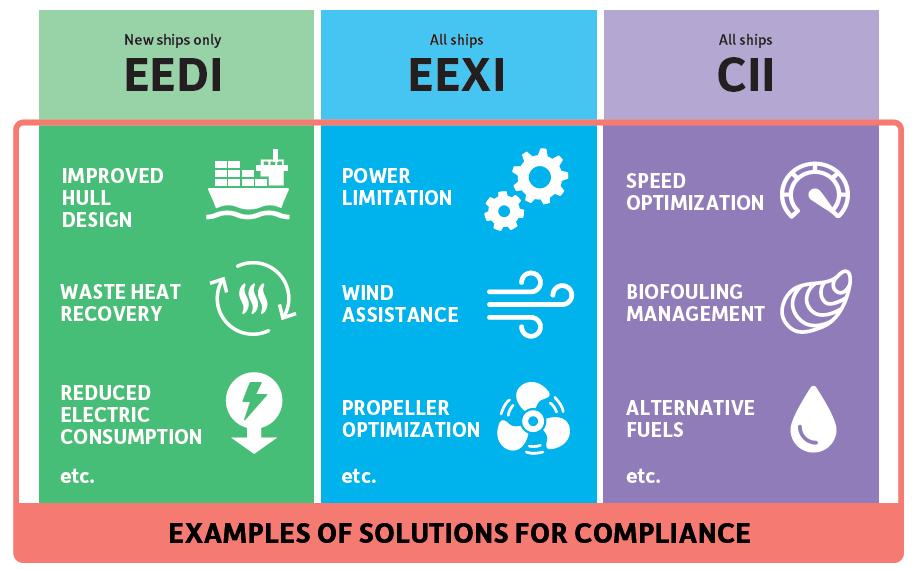
Engine Power Limitation (EPL). Restricting the maximum power a vessel’s main engine can deliver, directly reducing the theoretical maximum speed and associated emissions calculation — a relatively low-cost compliance route, though it does constrain a vessel’s operational speed flexibility, which matters for charter commitments and voyage scheduling.
Shaft Power Limitation (ShaPoLi), a similar concept applied at the propeller shaft rather than the engine itself.
Hull and propeller efficiency improvements, such as propeller upgrades, hull coating improvements, or air lubrication systems — generally a higher upfront cost than power limitation, but without the same speed/scheduling trade-off, and often delivering ongoing fuel savings that partially offset the investment.
Alternative fuel conversion, a more substantial capital investment generally considered for vessels with significant remaining service life, rather than older tonnage nearing retirement.
Practical CII Compliance Management
Since CII is based on actual operational performance, ongoing management matters more than a one-time technical fix:
Speed optimization and voyage planning. Since fuel consumption scales non-linearly with speed, even modest, deliberate speed reductions on non-time-critical voyage legs can meaningfully improve CII performance — this has become a genuine day-to-day voyage planning consideration, not just a design-stage concern.
Weather routing. Actively routing to avoid adverse weather and currents reduces fuel consumption for a given voyage, directly benefiting CII performance while also improving safety and schedule reliability.
Hull and propeller maintenance discipline. Fouling on the hull and propeller measurably increases fuel consumption for the same speed — regular cleaning and maintenance is one of the more cost-effective ongoing levers available to improve CII rating without major capital investment.
Just-in-time arrival practices. Reducing unnecessary high-speed steaming followed by extended port waiting time (a still-common industry pattern) in favor of adjusted speed to arrive precisely when a berth is actually available can meaningfully improve fuel efficiency and CII outcomes.
CII rating flexibility mechanisms. The regulatory framework provides for banking, borrowing, and pooling mechanisms across a fleet — allowing better-performing vessels to help offset a fleet’s overall compliance position, which makes fleet-level (not just vessel-by-vessel) CII strategy genuinely important for multi-vessel operators.
Why Ongoing Vigilance Matters More Than a One-Time Fix
Because the CII improvement threshold increases annually, a vessel that’s comfortably compliant today can fall out of compliance within a few years without continued proactive management — this is fundamentally different from a one-time technical certification like EEXI, and it’s a common point of confusion for operators newer to this framework. Compliance strategy needs to be treated as an ongoing operational discipline, not a project with a defined end date.
A Practical Compliance Checklist
- Is our EEXI technical file current and does it reflect any subsequent modifications (engine power limitation, retrofits) made to the vessel?
- Are we actively tracking each vessel’s CII trajectory against the annually tightening improvement threshold, not just its current-year rating?
- Have we evaluated speed optimization and just-in-time arrival practices as genuine operational levers, not just theoretical options?
- Is hull and propeller maintenance scheduling treated as a CII compliance lever, not purely a routine maintenance line item?
- For multi-vessel operators, are we actively using pooling or banking mechanisms to manage compliance at the fleet level rather than purely vessel-by-vessel?
EEXI and CII requirements, rating thresholds, and available compliance mechanisms are subject to ongoing IMO review and potential tightening. Always confirm current requirements and available compliance options with your classification society and flag state.