
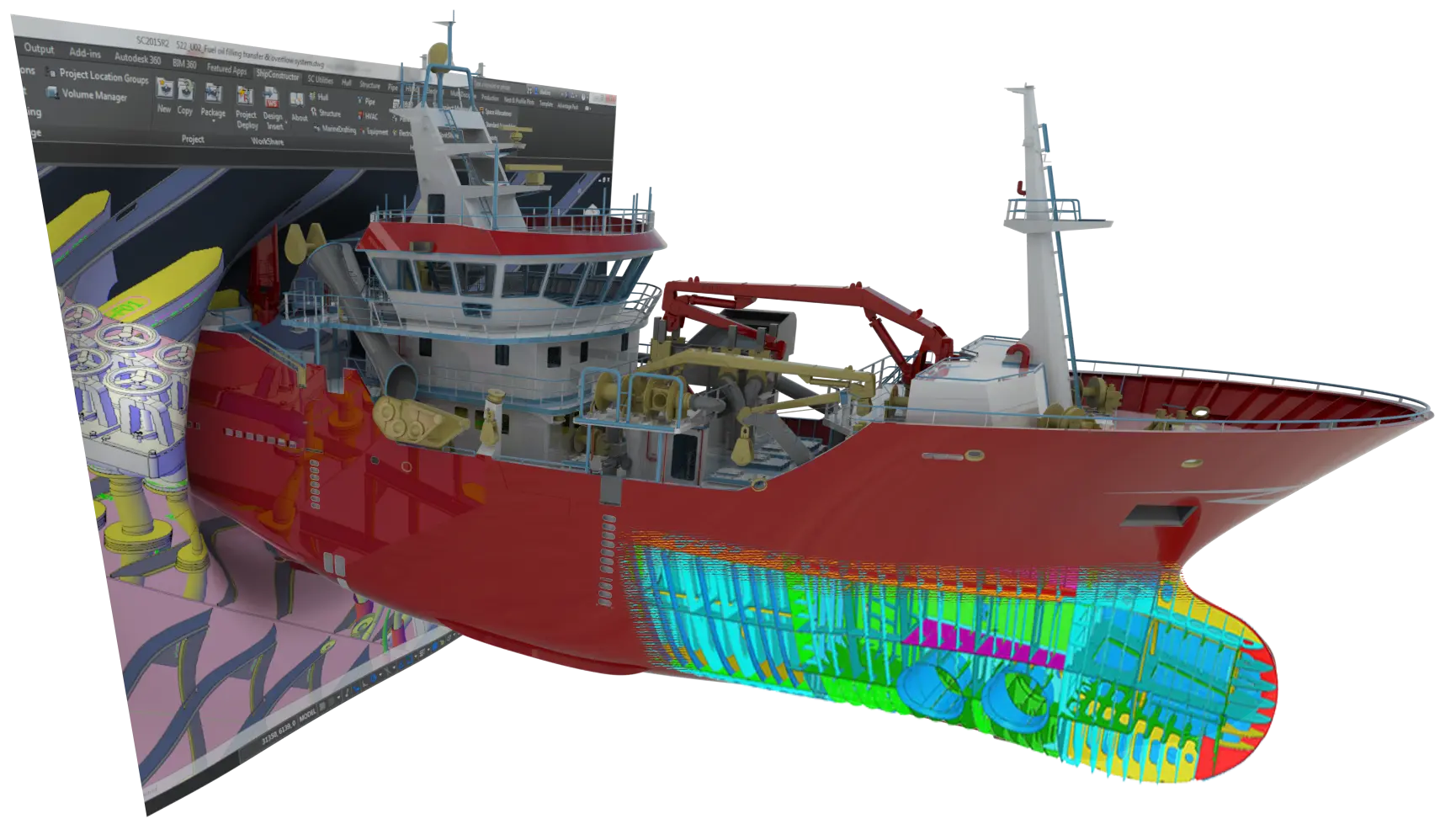
Behind every vessel that crosses an ocean, every offshore platform that extracts energy from the seabed, and every submarine that patrols the deep, there are highly trained engineers who transformed a concept into a seaworthy reality. Naval architects and marine engineers are the professionals responsible for designing, building, and supervising the construction of ships and offshore structures. Their work spans the entire lifecycle of marine assets—from the initial design spiral through to construction supervision, commissioning, and operation.
The maritime industry is in the midst of a profound transformation. Decarbonisation, digitalisation, and the expansion of offshore renewable energy are reshaping what it means to be a marine engineer. This article explores the university degrees, curricula, specialisations, and career pathways that prepare students for this dynamic and increasingly vital field.
What Naval Architects and Marine Engineers Do
Naval architecture and marine engineering are closely related but distinct disciplines. Naval architecture is fundamentally the science and art of designing ships, boats, submarines, and other marine vessels and structures. Naval architects focus on overall vessel and structure design—including hull shapes, stability, strength, hydrodynamics, and the arrangement of ships and offshore platforms. Marine engineering, by contrast, focuses on the systems and equipment that drive and operate marine vessels, primarily the design, maintenance, and operation of propulsion and auxiliary systems.
In practice, the two fields overlap considerably. A naval architect designing a ship must account for the weight and space requirements of the machinery that marine engineers specify, while marine engineers must ensure their systems fit within the structural constraints defined by the naval architect. Many university programmes combine both disciplines into a single degree, recognising that modern maritime projects demand professionals who understand the whole vessel as an integrated system.
The scope of the profession extends well beyond ships. Naval architects and marine engineers work on offshore drilling platforms, semi-submersibles, floating production storage and offloading units, offshore wind installations, subsea pipelines, and coastal defence structures. They are involved in ensuring that equipment, operations, and maintenance follow design and safety standards, and they advise on hull design, superstructures, and propulsion systems.
Core Curriculum: What Students Study
A typical undergraduate degree in naval architecture and marine engineering spans three to four years and combines a strong foundation in engineering science with specialised maritime subjects. The curriculum is designed to develop competence in mathematics, physics, mechanics, and materials science before progressing to ship-specific and offshore-specific topics.
Foundational Engineering Subjects
Students begin with engineering mathematics, covering calculus, linear algebra, differential equations, and statistics. These mathematical tools underpin everything from hydrodynamic analysis to structural calculations. General physics and mechanics follow, providing the principles of statics, dynamics, fluid mechanics, and thermodynamics that are essential for understanding how vessels and structures behave in the marine environment. Courses in engineering materials introduce the properties of steel, aluminium, composites, and other materials used in shipbuilding and offshore construction.
Naval Architecture Core
The naval architecture component of the degree introduces students to the fundamental principles of ship design and analysis. Key subjects include:
-
Hydrostatics and Stability: The study of buoyancy, intact and damage stability, and the conditions that keep a vessel upright and seaworthy. Students learn to calculate a ship’s displacement, centre of gravity, and metacentric height.
-
Ship Resistance and Propulsion: How hull forms affect drag, and how propellers and other propulsion systems generate thrust. Statistical prediction methods and propeller selection are covered.
-
Seakeeping and Manoeuvrability: How ships behave in waves and how they respond to control inputs. Principles of ship motions in six degrees of freedom are introduced.
-
Ship Structural Design: The analysis and design of hull structures, including longitudinal strength, transverse framing, and fatigue considerations.
-
Ship Design: The design spiral—a systematic process that begins with a statement of requirements and iterates through concept, preliminary, and detailed design phases. Students learn about ship geometry, weight estimation, stability assessment, and the selection of energy systems, with attention to alternative fuels and life-cycle cost evaluation.
Marine Engineering Core
The marine engineering component focuses on the machinery and systems that make a vessel operate. Core subjects include:
-
Marine Thermodynamics and Power Systems: The principles governing internal combustion engines, gas turbines, and steam plants used for ship propulsion.
-
Marine Power and Energy: Power generation, distribution, and energy efficiency on board vessels.
-
Auxiliary Systems: Pumps, HVAC, water treatment, and other systems essential for shipboard operations.
-
Marine Control Systems: Automation, monitoring, and control of machinery and systems.
Offshore and Ocean Engineering
As the offshore sector has grown in importance, many programmes now include dedicated courses in offshore engineering. These cover the dynamics and fluid mechanics associated with the design of fixed and floating offshore renewable energy devices, support structures, and moorings. Students learn about platform typologies, mooring systems, pipelines, environmental actions on offshore structures, and the finite element modelling of fixed-bottom platforms and fatigue assessment. Offshore infrastructure operations and maintenance—including transportation, installation, revamping, and decommissioning strategies—are also increasingly part of the curriculum.
Advanced and Emerging Topics
Upper-level courses often include advanced ship and offshore hydrodynamics, offshore renewables, computational fluid dynamics, structural optimisation, and the use of specialised design software. Programmes increasingly incorporate digital tools such as CAD, finite element analysis, and dynamic modelling and simulation. Sustainability and decarbonisation have also become integral themes, with modules on alternative fuels, emissions reduction, and green shipping technologies.
Specialisations and Degree Pathways
Naval architecture and marine engineering programmes typically offer specialisation tracks that allow students to focus on particular aspects of the field. At the University of Michigan, for example, students can choose between naval architecture, marine engineering, and offshore engineering streams. The University of Tasmania offers specialisations in naval architecture, ocean engineering, and maritime engineering, with the ocean engineering stream focusing on the design of offshore structures, subsea, and coastal installations for sustainable development.
At the postgraduate level, specialisation becomes even more pronounced. The Nordic Master Programme in Maritime Engineering, offered by a consortium of Nordic universities, allows students to specialise in ocean structures, passenger ships, ship design, ship operations, or small craft in their second year. The Erasmus Mundus International Master in Advanced Design of Sustainable Ships and Offshore Structures (EMship) provides a two-year programme taught across at least two European countries, with a focus on sustainable ship and offshore design.
Other programmes cater to specific segments of the industry. The University of Stavanger’s Master of Science in Marine and Offshore Technology covers marine and offshore structures, subsea production, offshore aquaculture, offshore renewable energy, and fjord crossings. Newcastle University’s MSc Marine Technology offers streams in naval architecture, marine engineering, offshore and subsea engineering, pipeline engineering, and offshore renewable energy.
Practical Training and Industry Experience
Marine engineering and naval architecture are applied disciplines, and universities place strong emphasis on practical experience. Laboratory work is a core component of most programmes, with students conducting experiments in hydrodynamics, structural testing, and marine propulsion. The use of computer simulations is intensive, and students gain proficiency in industry-standard software for structural analysis, computational fluid dynamics, and design modelling.
Internships and work placements provide students with exposure to real-world engineering practice. At the University of Michigan, the naval architecture and marine engineering programme partners with Fincantieri, one of the world’s largest shipbuilding groups, to offer eight-week summer internships at its shipyards and design offices. Many programmes include mandatory internships in shipyards, classification societies, consulting firms, or shipping companies. The University of Genoa, for instance, requires a curricular internship in the maritime sector as part of its BSc in Naval Architecture and Marine Engineering.
Some programmes go further, integrating extended work placements into the degree structure. Singapore Institute of Technology’s Bachelor of Engineering with Honours in Naval Architecture and Marine Engineering, offered jointly with Newcastle University, includes an eight-month Integrated Work Study Programme designed to be more in-depth than a traditional internship, allowing students to apply theory in actual practice. The programme also includes a three-week Overseas Immersion Programme at Newcastle University’s UK campus.
For students interested in construction supervision, specialised training courses are available both within degree programmes and as professional development. Organisations such as Lloyd’s Register, DNV, and the Indian Register of Shipping offer courses in newbuilding site supervision, covering shipyard practices, major inspections and tests, project control, and the roles and responsibilities of the owner’s site team. These courses prepare experienced marine engineers and naval architects to represent and safeguard ship owners’ interests during new construction projects.
Career Paths and Professional Opportunities
Graduates in naval architecture and marine engineering enjoy a wide range of career options. According to the U.S. Bureau of Labor Statistics, employment of marine engineers and naval architects is projected to grow 7 percent from 2025 to 2035, much faster than the average for all occupations, with about 500 openings projected each year. The median annual wage for these professionals was $112,230 in May 2025.
Job titles for graduates include naval architect, design and production engineer, field service engineer, offshore engineer, project engineer, hull and systems engineer, hydrostatics and weight engineer, and test and evaluation engineer. Naval architects may work on a variety of vessels and offshore structures, including offshore drilling platforms, semi-submersibles, and floating production storage and offloading units.
The industry is currently experiencing a significant talent shortage. A substantial percentage of the most experienced naval architects and marine engineers are approaching retirement age, while the number of young people entering the field has not kept pace with demand. In Italy alone, 43 percent of positions sought in shipbuilding remain unfilled, with naval engineers among the hardest roles to recruit. This scarcity is driving strong demand for graduates and creating excellent career prospects for those entering the profession.
Career paths extend beyond traditional shipbuilding and offshore oil and gas. The growing offshore renewable energy sector—including offshore wind, wave, and tidal energy—is creating new opportunities for engineers with expertise in marine structures and offshore installation. Classification societies, research institutes, consultancies, and regulatory bodies also employ naval architects and marine engineers. Some graduates pursue entrepreneurial paths, establishing their own naval architecture consultancies or marine technology startups.
Industry Trends Shaping the Curriculum
Several powerful trends are reshaping marine engineering and naval architecture education.
Decarbonisation is perhaps the most significant. The International Maritime Organization’s strategy to reduce greenhouse gas emissions from shipping has created urgent demand for engineers skilled in alternative fuels, energy efficiency, and zero-emission vessel design. Employers are actively seeking marine engineers specialised in new fuel systems and naval architects with a zero-emission focus. Universities have responded by integrating sustainability modules into their curricula and offering dedicated programmes such as the Master in Offshore Engineering for Energy Transition at the University of Bologna.
Digitalisation is another transformative force. Maritime data science, digital twins, and autonomous vessel technology are creating new roles and requiring new competencies. The LinkedIn skills demand analysis highlights software and hardware engineers, maritime data scientists, and systems integration experts as increasingly sought-after professionals. Programmes are incorporating courses in dynamic modelling and simulation, control systems, and digital design tools to prepare students for this digital future.
Offshore renewables represent a major growth area. The expansion of offshore wind, in particular, has created demand for engineers who understand the unique challenges of designing, installing, and maintaining structures in the marine environment. Courses in offshore renewables are now standard components of many naval architecture and marine engineering degrees.
Leading Programmes Worldwide
Prospective students have a wealth of options for studying naval architecture and marine engineering. In the United States, the University of Michigan’s Naval Architecture and Marine Engineering programme is highly regarded, with small class sizes, strong industry ties, and graduates receiving an average of three to four job offers. MIT, the University of California Berkeley, and the Webb Institute also offer notable programmes.
In Europe, the Technical University of Hamburg offers a Master of Science in Naval Architecture and Ocean Engineering. KTH Royal Institute of Technology in Sweden provides a two-year MSc in Naval Architecture with specialisations in lightweight structures, fluid mechanics, and management. The University of Genoa, the University of Trieste, and the University of Naples Federico II in Italy offer strong programmes with a tradition of excellence in ship design and marine engineering.
In Asia, the Singapore Institute of Technology–Newcastle University joint programme provides a three-year direct honours degree accredited by the Royal Institution of Naval Architects and the Institute of Marine Engineering, Science and Technology. Universities in China, Japan, and South Korea also offer comprehensive programmes, reflecting the region’s dominance in global shipbuilding.
Professional Accreditation and Registration
Professional accreditation is an important consideration for students choosing a programme. In the United Kingdom, the Institute of Marine Engineering, Science and Technology (IMarEST) is a licensed body of the Engineering Council and the Science Council, able to award professional qualifications including Chartered Engineer status. IMarEST accredits academic courses in marine engineering, science, and technology, and its accreditation is recognised worldwide.
The Royal Institution of Naval Architects (RINA) is another key professional body, accrediting naval architecture programmes and representing the profession internationally. Graduates from accredited programmes typically enjoy a streamlined pathway to professional registration, which can enhance career prospects and earning potential.
Conclusion
Marine engineering and naval architecture are disciplines at the intersection of creativity and rigorous engineering science. They offer the opportunity to design and build some of the largest and most complex structures ever created by humanity—vessels and platforms that operate in one of the most demanding environments on Earth. The university degrees that prepare students for this profession combine foundational engineering education with specialised maritime knowledge, practical training, and exposure to cutting-edge technologies.
The industry is undergoing a period of rapid change, driven by the imperatives of decarbonisation, digitalisation, and the transition to renewable energy. These changes are creating demand for engineers with new skills and fresh perspectives. For students drawn to the sea, to complex engineering challenges, and to the opportunity to make a tangible impact on the world, naval architecture and marine engineering offer a rewarding and increasingly vital career path. The ships and offshore structures of tomorrow are waiting to be designed—and the engineers who will design them are in high demand.