
The energy transition in shipping is usually discussed in terms of ships, fuels and emissions. Yet a less visible question may be just as important: where will the electricity come from to charge vessels at berth and produce future low-emission marine fuels?
A case study of the Democratic Republic of the Congo (DRC) examines whether demand created by the proposed International Maritime Organization (IMO) Net-Zero Framework could support renewable electricity investment linked to the Grand Inga hydropower project. It considers two routes: supplying ships with shore power while alongside, and using renewable electricity to make green ammonia.
The central finding is a difference in scale. Shore power could provide a practical early market at ports, while ammonia production could consume much more electricity and potentially act as a major industrial customer. Neither pathway is automatic: both depend on reliable policy, infrastructure, finance and safeguards that ensure local communities benefit.
First, what is the IMO Net-Zero Framework?
The IMO Net-Zero Framework is a proposed set of global rules intended to reduce greenhouse-gas emissions from international shipping. Its draft design combines a progressively stricter greenhouse-gas fuel-intensity (GFI) standard with an economic mechanism for ships that exceed or outperform the required limits. The accounting approach covers emissions across the fuel lifecycle, from production to use on board.
As of 16 October 2026, the framework has not been formally adopted. IMO discussions were adjourned in October 2025 and are continuing; the IMO stated in May 2026 that the second extraordinary session was scheduled to resume on 4 December 2026, subject to confirmation after MEPC 85. The case study therefore models a possible future policy signal. It should not be read as a statement that these rules are already binding or that the study’s projected compliance values are guaranteed.
Why the Grand Inga connection matters
The Inga site on the Congo River is associated with an exceptionally large hydropower resource. The full Grand Inga concept is often described as having a potential capacity of about 40 GW, while development is expected to proceed in phases. Turning that potential into dependable electricity supply requires far more than building generating equipment: transmission lines, grid connections, financing, governance, environmental assessment and durable customers all matter.
That last point is central to project finance. A power project is easier to finance when buyers commit to purchasing electricity over time. Maritime demand may create two kinds of customers. Ports can buy electricity for ships at berth, and industrial plants can use electricity to produce hydrogen and ammonia. The latter products can be stored, transported and sold to shipping, agriculture and other markets.
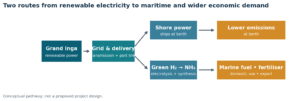
Figure 1. Two possible routes from renewable electricity to maritime and wider economic demand. This is a conceptual pathway, not a proposed project design.
Shore power: a modest but tangible port opportunity
Shore power, also known as cold ironing, allows a vessel to connect to a shore-side electrical supply and switch off some or all of its auxiliary engines and boilers while alongside. The equipment must be compatible with the ship, and the port needs suitable electrical capacity, connection systems, operating procedures and a reliable supply.
Using AIS-derived vessel activity for DRC ports in 2018, the case study estimates 352 annual vessel calls and approximately 22,770 berth-hours. If shore power displaced the relevant onboard fuel use during those stays, estimated demand would be about 20.99 GWh per year and avoided emissions about 18,600 tonnes of CO₂-equivalent annually on a well-to-wake basis.
| Case-study estimate for DRC ports | Value |
|---|---|
| Annual vessel calls | 352 |
| Total berth time | 22,770 hours |
| Electricity for shore power | 20.99 GWh/year |
| Estimated emissions avoided | ~18,600 tCO₂e/year |
This is meaningful for port operations and local air quality, but it is not a large anchor customer for a hydropower scheme measured in gigawatts. The study estimates an average load of roughly 2.4 MW across the year. In other ports and countries, where vessel traffic and berth time are higher or renewable projects are smaller, shore power could be a more important early customer for generation and grid upgrades.
Green ammonia: a much larger electricity customer
Green ammonia is produced by combining hydrogen made with renewable electricity and nitrogen separated from air. It can be considered as a marine fuel, but also has established uses in fertiliser and other industrial supply chains. A maritime market could add demand, although ammonia’s use on ships requires suitable engines or fuel cells, storage and bunkering arrangements, safety controls, trained crews and rules for handling a toxic substance.
The study models a representative facility producing 500,000 tonnes of ammonia each year. Its estimated electrolyser capacity is 580 MW; it would produce around 88,000 tonnes of hydrogen annually and consume about 4.576 TWh of electricity per year. That is more than 200 times the estimated shore-power demand at the DRC ports analysed.
Under the study’s assumptions, the modelled levelised cost is approximately US$508 per tonne at the factory gate, US$515/t at the dam and US$524/t at the coast. The estimate is driven primarily by electricity and hydrogen costs. It is a modelling result, not a firm sale price or a bankable project offer: financing costs, construction, transmission, water supply, storage, port facilities, certification, transport and market contracts could change the delivered cost substantially.
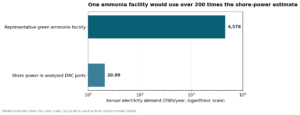
Figure 2. The ammonia facility’s modelled electricity use is over 200 times the estimated shore-power demand. Values are annual model estimates in the case study.
The gap in scale explains why ammonia could matter more to a very large generation project. Yet it also carries greater commercial and technical risk. The project would need committed buyers, a dependable electricity supply, large-scale electrolysis and ammonia synthesis, water and port infrastructure, and credible lifecycle emissions certification. If ammonia is to be used as a fuel, lifecycle emissions and engine performance—including potential nitrous oxide emissions—must be addressed in the fuel pathway and onboard technology.
How policy assumptions influence the economics
The case study applies a proposed IMO compliance framework to compare the modelled costs of shore power, green ammonia and fossil marine fuel. Under its central assumptions, shore power has a negative compliance-adjusted cost in the model for much of the period assessed, while green ammonia becomes cheaper than VLSFO on a compliance-adjusted basis by 2040. The study’s 2040 comparison is approximately US$165/MWh for green ammonia and US$180/MWh for VLSFO.
Those figures include assumed compliance costs and benefits; they are not simply the market price of electricity or fuel. Their result depends on the stringency of the GFI target, the price of compliance units, the availability and value of surplus units, and the treatment of rewards. If the final framework differs materially from the draft scenario—or if implementation is delayed or weakened—the projected demand signal and investment case could change.
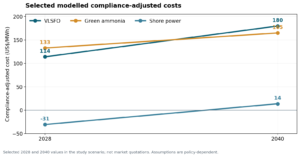
Figure 3. Selected 2028 and 2040 values from the study’s policy scenario. Costs are modelled compliance-adjusted values, not market quotations; they reflect the assumptions used in the analysis.
What this could mean for ports and energy planners
For ports, shore power may be a practical starting point where vessel calls, berth duration and electrical demand justify investment. Planning should begin with a vessel and berth audit: which ships can connect, what voltage and frequency they require, when they are alongside, how much load they draw, and whether the local grid can supply it. Tariffs, connection standards, metering, safety procedures and the allocation of infrastructure costs also need agreement between ports, utilities and ship operators.
For energy and industrial planners, ammonia should be evaluated as a wider value-chain project rather than a standalone maritime fuel scheme. Potential domestic fertiliser demand, export markets and bunkering could complement each other, but each market needs independent assessment. Long-term offtake contracts, credible certification, transport and storage infrastructure, and financeable power supply are essential.
Most importantly, electricity for exports and maritime fuels should complement—not displace—efforts to improve reliable and affordable electricity access in the DRC. Transmission investment, local distribution, public consultation, environmental and social safeguards, and transparent benefit-sharing should be built into project design from the start. A large renewable resource only becomes a development opportunity when its benefits reach people and businesses in the country where it is produced.
The opportunity—and the test
The case study suggests that shipping regulation could help create demand for renewable electricity beyond the ships themselves. Shore power could demonstrate a local port market and reduce emissions at berth. Green ammonia could create a much larger industrial load and connect hydropower to maritime fuel, fertiliser and export markets.
The main test is whether policy certainty and commercial contracts can turn these possibilities into investable projects while delivering local benefits. With the IMO framework still awaiting formal adoption, the figures should be treated as scenario analysis. They show how maritime demand might support electrification; they do not prove that a particular port, ammonia plant or Grand Inga phase is ready to proceed.
Key figures at a glance
| Indicator | Case-study estimate | What it means |
|---|---|---|
| Shore-power demand in analysed DRC ports | 20.99 GWh/year | Early port demand; modest relative to Grand Inga’s scale |
| Shore-power emissions reduction | ~18,600 tCO₂e/year | Modelled well-to-wake avoidance using 2018 activity data |
| Ammonia facility electricity demand | 4.576 TWh/year | More than 200 times the shore-power estimate |
| Modelled delivered ammonia cost | ~US$515/t at dam | Indicative model outcome under stated assumptions |
| IMO framework status on 16 October 2026 | Not formally adopted | Compliance economics remain scenario-dependent |
Sources and further reading
- Ralph-Gbobo, J., Shoaib, M. and Smith, T. (2026), Electrification investment from IMO’s Net Zero Framework – a case study on Grand Inga Hydropower project, publication date 15 October 2026.
- IMO: The Net-Zero Framework – FAQs.
- IMO: MEPC 84 progress and planned continuation of negotiations, 1 May 2026.
- DRC Presidency: Grand Inga strategic review, 9 October 2026.
Editorial note: all project cost and demand figures above are estimates from the referenced case study. They are not investment advice or confirmed project specifications. The article reflects the regulatory position checked on 16 October 2026.