
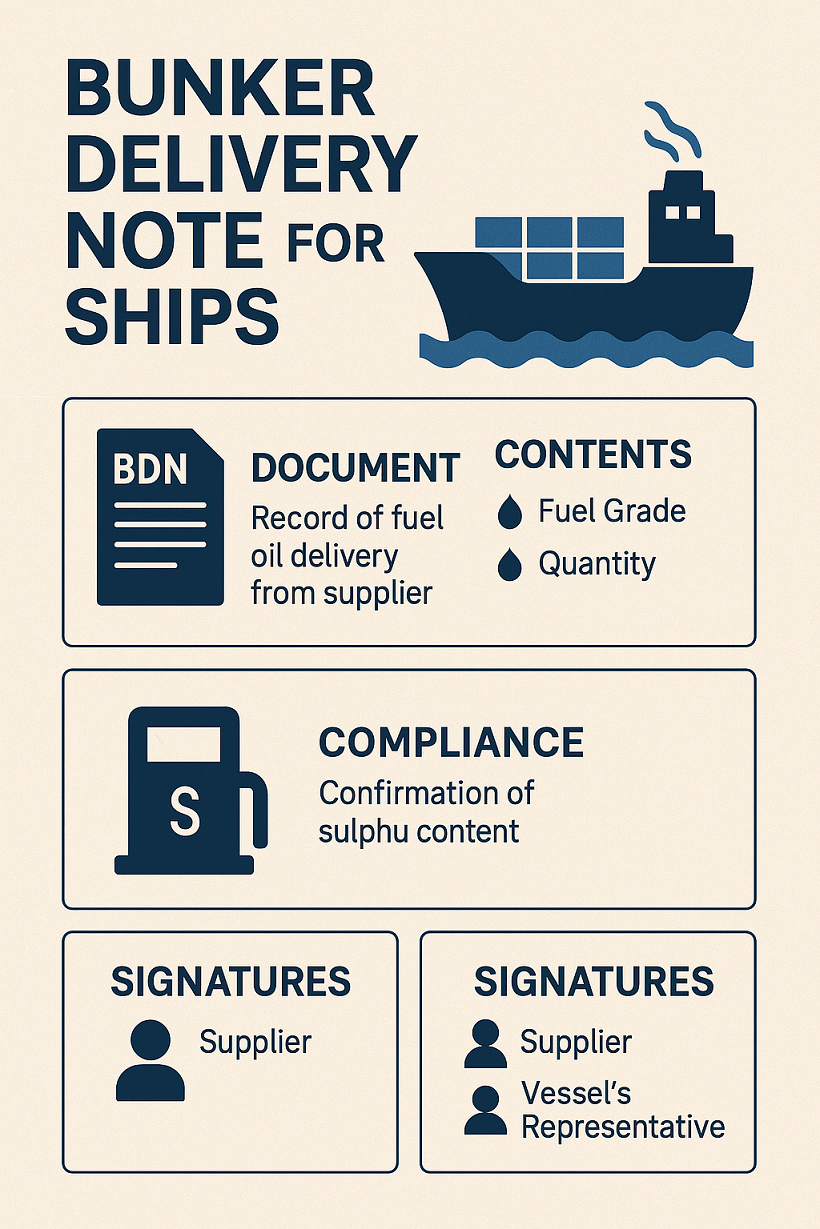
Learn everything about the Bunker Delivery Note (BDN) under MARPOL Annex VI. This comprehensive guide explains its legal requirements, real-world importance, compliance challenges, and future trends. Perfect for seafarers, students, and maritime professionals.
Bunker Delivery Notes for Ships: Understanding Their Structure and Contents
A Bunker Delivery Note (BDN) records the fuel supplied to a ship during bunkering. It brings together delivery details, declared fuel characteristics, supplied quantity, compliance declarations and, commonly, sample identification and receipt acknowledgements.
For marine engineers, the BDN connects the fuel ordered with the delivery operation and the fuel subsequently stored and used on board. Understanding its contents helps identify missing information, inconsistent units and discrepancies requiring clarification.
This guide explains the structure commonly used for conventional residual and distillate marine fuels. Low-flashpoint and gaseous fuels have adapted BDN requirements under amendments effective from August 2025.
1. Supplier and document identification
The top of a BDN normally contains the supplier’s name, address and contact details, together with a unique delivery-note number.
This reference connects the document with the bunker order, invoice, survey records and laboratory reports. Additional entries may include an order or nomination number, the supplying bunker tanker’s identification and its licence number.
These details provide traceability, particularly when several deliveries or different fuel grades are involved.
2. Receiving ship and delivery details
The next section identifies the recipient and establishes where and when the transfer occurred.
| Typical entry | Purpose |
|---|---|
| Receiving ship’s name and IMO number | Identifies the recipient |
| Owner or operator | Provides commercial and operational context |
| Gross tonnage | Records an additional ship particular |
| Port, berth or anchorage | Identifies the delivery location |
| Delivery date | Establishes the transaction date |
| Alongside, pumping-start and pumping-completion times | Records the operational timeline |
| Last port, next port or estimated departure | Provides voyage context where included |
These entries should agree with the ship’s bunkering records. Clear dates and times are especially useful when pumping crosses midnight or is interrupted.
Not every field printed on a supplier’s form is an international minimum requirement. Some provide additional commercial or operational information.
3. Product identification and fuel characteristics
The central section usually identifies the fuel product and lists selected properties.
Descriptions such as “low-sulphur fuel oil” indicate a broad product category. They do not fully define the ordered fuel. The purchase specification should identify the applicable grade, quality standard and agreed requirements.
| Property | Common unit or basis | Meaning |
|---|---|---|
| Kinematic viscosity | mm²/s, also called cSt, at a stated temperature | Resistance to flow; relevant to pumping, heating and injection |
| Density | kg/m³ at 15°C | Mass per unit volume at a reference temperature |
| Water content | % V/V | Water expressed as a percentage by volume |
| Flashpoint | °C | Temperature at which vapour can ignite under specified test conditions |
| Sulphur content | % m/m | Sulphur expressed as a percentage by mass |
| Observed fuel temperature | °C | Temperature associated with the delivery measurements |
Test-method references may appear beside the properties, such as ISO 3104 for viscosity and ISO 2719 for flashpoint.
The unit and reference temperature are part of the result. A viscosity stated at 40°C cannot be directly compared with one stated at 50°C.
Density also requires careful attention:
980 kg/m³ = 0.9800 kg/L = 0.9800 t/m³
A value of “0.9800” entered against a printed unit of “kg/m³” needs clarification. The intended unit should not be silently assumed.
The BDN does not replace a full Certificate of Quality (COQ) or an independent laboratory report. Its selected properties cannot establish compliance with every parameter in the purchase specification.
Flashpoint documentation
Since 1 May 2024, MARPOL requires the BDN to include either the flashpoint in degrees Celsius determined using an acceptable standard, or a statement that it was measured at or above 70°C. The 70°C statement is a reporting alternative, not a universal minimum flashpoint for marine fuels.
From 1 January 2026, applicable SOLAS provisions also require a signed and certified supplier declaration before bunkering, confirming conformity with the relevant oil-fuel requirements and identifying the flashpoint test method. A completed receipt after pumping does not, by itself, fulfil that pre-bunkering requirement.
4. Delivered quantity and conversion factors
Many BDNs place quantity information beside the fuel-property table.
| Entry | Meaning |
|---|---|
| Gross Observed Volume (GOV) | Volume at the observed measurement conditions |
| Gross Standard Volume (GSV) | Volume corrected to a stated standard reference condition |
| Quantity in metric tonnes | Reported mass delivered |
| Volume Correction Factor (VCF) | Converts observed volume to standard volume |
| Weight Conversion Factor (WCF) | Used in the applicable volume-to-mass calculation |
| Barrels at 60°F | An additional reporting unit used on some forms |
For a conventional volume-based calculation:
Observed volume × VCF = standard volume
The standard volume is then converted to mass using the agreed factor and measurement basis.
For illustration, a GOV of 1,000,000 litres multiplied by a VCF of 0.9900 gives a GSV of 990,000 litres, or 990 m³. If the applicable conversion factor is 0.9800 tonnes per standard cubic metre, the resulting quantity is 970.2 tonnes.
These are illustrative factors. Actual calculations depend on the measurement procedure, temperature, density, correction tables and mass basis. Where a mass flow meter determines the quantity, its records and the applicable metering procedure should be checked.
Quality density versus quantity-calculation density
Some BDN forms explicitly state that the COQ density is provided for fuel-specification purposes and must not be used to determine the transferred quantity.
A laboratory quality result and the density or conversion factor used for custody transfer may have different roles. The calculation must use the agreed delivery data and basis, including whether mass is expressed in air or in vacuum.
Do not automatically multiply the delivered volume by the density printed in the quality section.
5. Supplier’s compliance declaration
The supplier’s declaration addresses MARPOL Annex VI fuel-quality requirements and the applicable sulphur-compliance basis.
Checkboxes may identify:
- The general sulphur limit.
- The limit applicable within a sulphur emission control area.
- A purchaser-specified limit associated with an approved equivalent arrangement or permitted research exemption.
The selected option should reflect the actual compliance basis for the delivery. Supplier signatures, names and stamps identify who certified the declaration.
The general sulphur limit is 0.50% m/m outside sulphur emission control areas and 0.10% m/m within those areas, subject to permitted compliance arrangements.
A description such as “low sulphur” is therefore insufficient to establish suitability for an intended voyage. Engineers must consider the numerical sulphur result, the operating area and the ship’s approved arrangements.
6. Sample identification and distribution
The sample section connects the delivery paperwork with the retained fuel samples. It may record:
- Sampling location and method.
- Seal and counter-seal numbers.
- Samples allocated to the ship, supplier, surveyor or another party.
- Identification of the MARPOL-delivered sample.
- Acknowledgements by the supplier’s representative and receiving officer.
IMO guidance calls for a representative sample drawn continuously throughout delivery at the receiving ship’s inlet bunker manifold, with the relevant representatives witnessing the process. A single spot sample does not provide the same representation of the complete transfer.
Seal numbers on the BDN should match the sample bottles.
Several sample-allocation rows on a form do not mean that IMO universally requires that exact number of bottles. Statutory and commercial samples serve different purposes. The MARPOL-delivered sample should remain sealed for its statutory purpose; routine commercial testing should use the appropriate separate sample.
7. Receipt acknowledgement, remarks and protests
The receiving section commonly includes space for the master or chief engineer’s name, signature, ship’s stamp and acknowledgement time. It may also contain statements confirming the sampling arrangements.
The wording deserves careful attention. Receipt of fuel, agreement with the reported quantity and confirmation of sampling arrangements are separate matters, even when combined in one signature section.
Remarks can document discrepancies, interruptions, missing information or references to supporting records. Some forms also indicate whether a Note or Letter of Protest has been issued.
Unresolved discrepancies should be recorded and escalated through the ship’s procedures. A protest documents the concern; it does not replace measurements and supporting evidence.
8. Mandatory information versus additional fields
For conventional fuels covered by the standard MARPOL BDN provisions, the minimum information comprises:
- Receiving ship’s name and IMO number.
- Port.
- Date delivery commenced.
- Supplier’s name, address and telephone number.
- Product name or names.
- Quantity in metric tonnes.
- Density at 15°C in kg/m³.
- Sulphur content in % m/m.
- Required flashpoint information.
- Supplier’s signed and certified declaration.
Viscosity, water content, voyage details, pumping-completion time and conversion factors add operational value, but are not all part of that international minimum list. Contracts, local requirements and company procedures may require additional information.
9. Retention and supporting records
The BDN must be kept on board and readily available for inspection for at least three years. The MARPOL-delivered sample must remain under the ship’s control until the fuel is substantially consumed, and for at least 12 months.
For traceability, retain the BDN alongside the relevant bunker order, measurement or meter records, sampling records, COQ, laboratory reports and any protest correspondence.
Each document serves a different purpose: the BDN records the declared delivery, measurement records support quantity, and laboratory reports provide analytical findings.
Before signing: a practical checklist
- Confirm the ship identification, supplier, port, date and document reference.
- Match the product to the bunker order.
- Check property values, units and reference temperatures.
- Verify sulphur and flashpoint documentation.
- Reconcile the quantity with the applicable measurement records.
- Confirm which density and conversion factors were used.
- Match sample seal numbers and verify sampling statements.
- Read the declarations and acknowledgement wording.
- Record unresolved discrepancies and supporting document references.
- Obtain a complete, legible copy.
A carefully checked BDN supports fuel traceability, machinery operation and compliance. Its value depends on agreement between the written entries, delivery measurements, samples and supporting records.
–
Why the Bunker Delivery Note Matters in Modern Maritime Operations
Ensuring MARPOL Annex VI Compliance
MARPOL Annex VI sets strict limits on sulfur oxides (SOx) and nitrogen oxides (NOx) emissions from ships. From 1 January 2020, the global sulfur cap was reduced to 0.50% m/m, while within Emission Control Areas (ECAs), the limit is 0.10% m/m.
The BDN provides documentary proof that the fuel taken on board complies with these limits.
Reducing Risk of Penalties
Authorities such as Paris MoU, US Coast Guard, and AMSA can detain vessels if their BDNs are missing, inaccurate, or fraudulent. Some fines exceed USD 1 million, especially in jurisdictions like the U.S. where environmental enforcement is strict.
Supporting Investigations and Accountability
In the event of disputes—such as contaminated fuel leading to engine damage—the BDN becomes crucial for legal claims and insurance settlements. P&I Clubs often highlight its role as primary evidence.
Key Requirements of the Bunker Delivery Note in Short Words
According to IMO Resolution MEPC.182(59), a valid BDN must contain the following minimum information:
-
Name, IMO number, and port of registry of the receiving ship.
-
Name, address, and telephone number of the fuel supplier.
-
Product name(s).
-
Quantity in metric tonnes.
-
Density at 15°C (kg/m³).
-
Sulfur content (% m/m).
-
Date and place of delivery.
-
Supplier’s representative signature.
-
A declaration that the fuel complies with Regulation 14 (SOx) and Regulation 18 (fuel oil quality).
Since 2022, amendments also require suppliers to state whether the fuel is biofuel blends or contains other alternative components.
Fuel Oil Sample and BDN – The Critical Link
Alongside the BDN, a MARPOL sample must be taken at the ship’s bunker manifold. This sample is sealed, signed by both parties, and retained on board for at least 12 months.
The BDN and the sample are inseparable:
-
BDN = Paper evidence
-
Sample = Physical evidence
If discrepancies arise, authorities test the sample against the BDN declaration.
Challenges and Compliance Issues
Fraudulent or Inaccurate BDNs
Cases of suppliers misrepresenting sulfur content are still reported. In 2022, Singapore’s Maritime and Port Authority (MPA) suspended licenses of several bunker suppliers over discrepancies.
Contaminated Fuel Incidents
Even if the BDN states compliance, off-spec fuels can cause catastrophic damage. For instance, the 2018 Houston fuel contamination crisis affected over 100 ships.
Verification and Enforcement Gaps
Port State Control inspectors cannot test every fuel sample instantly. They rely heavily on the BDN’s accuracy, making it both a strength and a vulnerability.
Real-World Examples
-
Rotterdam, 2021: Several vessels were detained after BDN inspections revealed sulfur levels above limits.
-
Singapore, 2022: Over 200,000 tonnes of contaminated fuel were delivered despite proper BDNs, causing widespread engine failures.
-
U.S. Gulf, 2019: A tanker was fined USD 2.5 million for presenting false BDNs during bunkering operations.
These cases highlight the real-world stakes of getting the BDN right.
Digitalisation of the BDN
With IMO’s push for digitalisation, electronic Bunker Delivery Notes (e-BDNs) are gaining traction.
-
Advantages: Reduced paperwork, real-time data transfer, improved traceability.
-
Platforms: Class societies like DNV and companies like Inmarsat are piloting blockchain-based BDN systems.
-
Outlook: By 2030, digital BDNs could become industry standard, integrated with GISIS and port state databases.
Case Study: Port State Control in the Mediterranean
The Paris MoU 2021 Annual Report showed that nearly 3% of ship detentions were linked to fuel issues and Annex VI non-compliance. In the Mediterranean, where Sulfur Emission Control Areas may soon be implemented, reliance on accurate BDNs will increase dramatically.
Ships bunkering in Piraeus, Genoa, or Barcelona already face tighter inspections, with PSC officers requesting not only BDNs but also fuel system logbooks and MARPOL samples.
Future Outlook
-
Biofuels and Alternative Fuels: BDNs must evolve to reflect new fuels like methanol, LNG, and ammonia.
-
Blockchain Verification: Prevents tampering and fraud.
-
Global Standardisation: The IMO and ISO are working toward harmonising BDN formats.
-
Integration with Ship Digital Twins: Real-time fuel quality data could sync with operational dashboards.
Frequently Asked Questions (FAQ)
1. How long should a BDN be kept on board?
At least three years, as required by MARPOL Annex VI.
2. Who signs the BDN?
The supplier’s representative signs it, and the ship’s officer acknowledges receipt.
3. Can BDNs be electronic?
Yes, provided they meet IMO requirements and are accepted by the flag and port state.
4. What happens if the BDN is missing?
The vessel may face detention, fines, or delays during PSC inspections.
5. What is the difference between a BDN and a fuel receipt?
The BDN is a legal compliance document, while the receipt is primarily commercial.
6. What if the BDN sulfur value is different from lab test results?
The sealed MARPOL sample is tested; discrepancies can lead to investigations and penalties.
7. Are BDNs required for LNG bunkering?
Yes, but with specific details reflecting LNG quality parameters.
Conclusion
The Bunker Delivery Note is far more than a routine document—it is the cornerstone of compliance under MARPOL Annex VI. For ship operators, engineers, and suppliers, accurate BDNs are a shield against legal, financial, and reputational risks.
As the shipping industry transitions toward greener fuels and digital operations, the BDN will continue to evolve, becoming a bridge between traditional compliance and the digital future of maritime governance.
For maritime students, professionals, and shipowners alike, understanding the BDN is essential—not just to pass inspections, but to build a safer, cleaner, and more transparent industry.
References
Read more here:
Marine Fuel Standards for Ships: A Guide to ISO 8217, ISO 8216, and MARPOL Annex VI
Hello, Neat post. There’s a problem along with your web site in web explorer, would check thisK IE still is the marketplace chief and a good part of other folks will leave out your excellent writing due to this problem.