
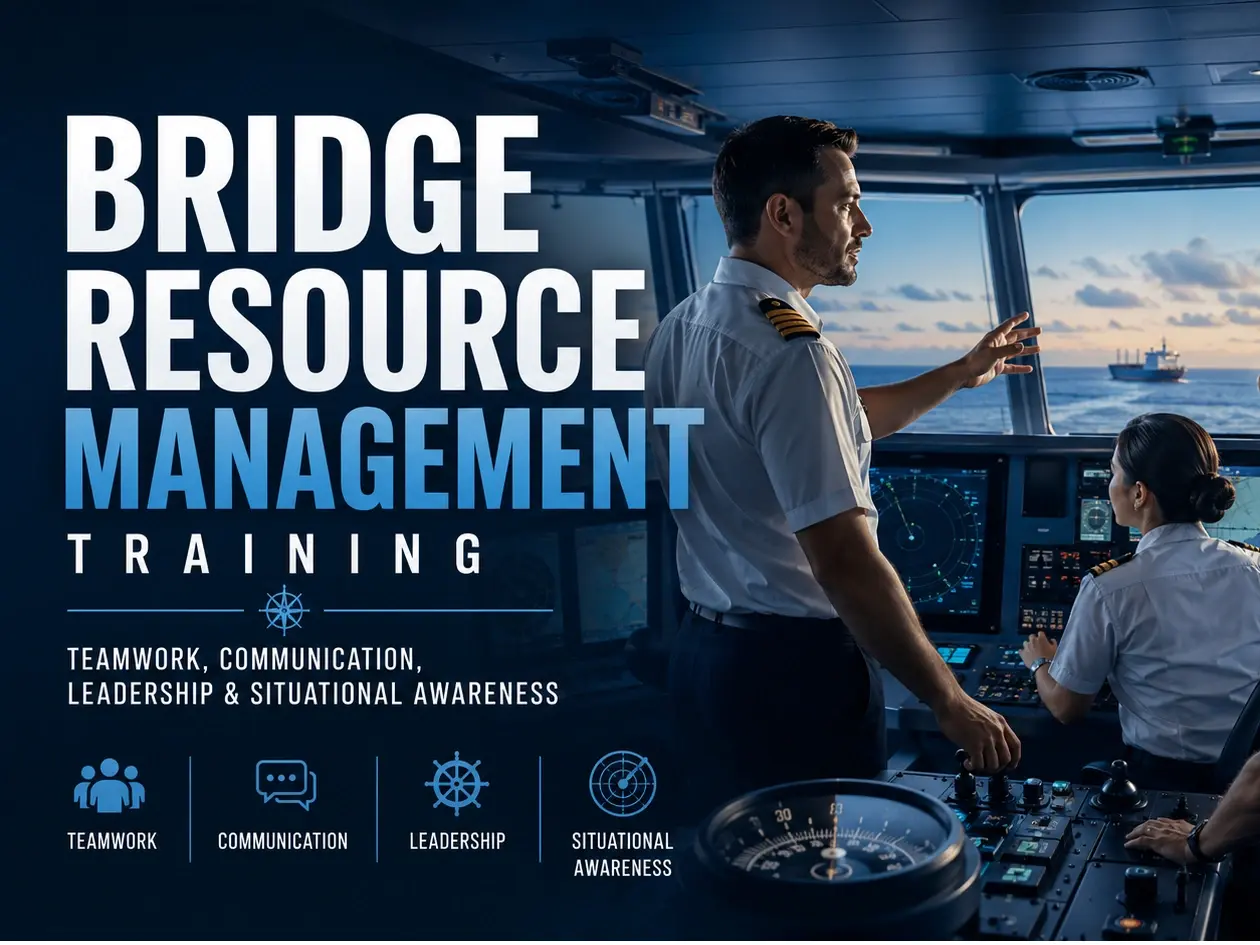
Bridge Resource Management (BRM) training addresses one of the most consistently identified root causes in maritime casualty investigations — not equipment failure or a single officer’s technical incompetence, but breakdowns in communication, teamwork, and decision-making on the bridge. Here’s what it actually covers, why it’s become a mandatory part of modern officer training, and why it matters even to officers who consider themselves already strong navigators.
What Bridge Resource Management Actually Addresses
BRM training focuses on the human and team dynamics of bridge operations — how the Master, officers, and any pilot on board communicate, share situational awareness, challenge each other appropriately when something seems wrong, and make collective decisions under pressure. This emerged directly from aviation’s Crew Resource Management (CRM) concept, which similarly recognized that many aviation accidents traced back to communication and authority-gradient breakdowns in the cockpit rather than purely technical failure — a pilot who noticed something wrong but didn’t feel able to challenge the captain, or a flight crew that lost coordinated situational awareness during a high-workload period. The maritime industry adapted this same insight, recognizing the same pattern was playing out on ships’ bridges.
Why This Became a Mandatory Training Requirement
Maritime casualty investigations have repeatedly identified the same underlying pattern: a junior officer who noticed something was wrong but didn’t feel able to challenge the Master or pilot’s decision, or a bridge team that lost coordinated situational awareness during a high-workload period (port approach, pilotage, heavy traffic), rather than any single individual’s technical error being the primary cause. BRM training is specifically designed to address this pattern — training officers not just in navigation skills, but in the communication and team dynamics that determine whether good individual technical knowledge actually translates into good collective decisions under pressure.
Core Topics BRM Training Typically Covers
Situational awareness maintenance. Techniques for the whole bridge team maintaining a shared, accurate picture of the vessel’s position, traffic, and developing risks — rather than relying on a single officer’s individual awareness, which can develop blind spots especially during long, monotonous watches or sudden high-workload periods.
Effective communication protocols. Structured communication techniques (closed-loop communication, standard phraseology) that reduce the risk of instructions or observations being misunderstood or lost, particularly relevant given how international and multilingual most bridge teams are — a simple technique like repeating back a heading or speed order to confirm understanding, rather than assuming it was heard correctly, has genuinely prevented real incidents.
Challenge and response culture. Perhaps the most operationally significant element — training junior officers and crew to appropriately challenge a senior officer or pilot’s decision when something seems wrong, and training senior officers to genuinely welcome and respond to that challenge rather than treating it as insubordination. Investigations have repeatedly found that steep authority gradients — where junior crew felt unable to speak up, sometimes due to cultural norms around deference to seniority — contributed directly to serious incidents. Good BRM training specifically works to counteract this, regardless of the cultural backgrounds represented on a given bridge team.
Workload management and task prioritization, particularly during high-workload periods like pilotage or restricted visibility, ensuring critical tasks aren’t missed due to poor task allocation across the bridge team — a well-run bridge team divides responsibilities clearly during complex maneuvers rather than everyone attending to whatever seems most urgent in the moment.
Decision-making under time pressure and uncertainty, including structured approaches to weighing incomplete information rather than defaulting to the most senior person’s initial instinct without genuine team input — a deliberate technique for slowing down and gathering a genuine team assessment even when time feels short.
Pilot-Master relationship management specifically. Since a pilot boarding the vessel creates a genuinely distinct authority dynamic (the pilot advises, but the Master retains overall command and legal responsibility), BRM training specifically addresses how this relationship should function, including the Master’s responsibility to intervene if a pilot’s actions appear to put the vessel at risk — a genuinely delicate dynamic, since pilots bring invaluable local knowledge the Master doesn’t have, but the Master can’t simply defer entirely regardless of what’s happening.
Who Requires This Training and When
BRM is generally a mandatory STCW-recognized course requirement for officers progressing through the certification ladder, and it’s frequently required specifically before officers become eligible to sit for Chief Mate or Master certification exams — reflecting its particular importance for those about to hold, or already holding, significant command responsibility. Many companies also require periodic BRM refresher training even beyond the strict STCW minimum, recognizing that these are genuinely perishable skills that benefit from periodic reinforcement, much like any team-based competency.
Where to Complete BRM Training
BRM courses are widely available through STCW-approved maritime training centers globally, often incorporated directly into simulator-based training programs (discussed in detail elsewhere on this site) since realistic bridge team scenarios are central to how the training is actually delivered and assessed — a classroom-only BRM course, without simulator-based practical scenarios, generally delivers weaker skill transfer than one that lets officers actually practice these dynamics in realistic, high-pressure simulated conditions. As with other STCW courses, confirming the specific center’s course is recognized by your certifying flag state is an essential step before enrolling.
Why This Training Matters Beyond Compliance
Officers who’ve genuinely internalized BRM principles — rather than simply completing the course as a certification requirement — tend to describe a real, practical shift in how they operate the bridge: more structured communication under pressure, a genuine habit of inviting junior officers’ input, and a clearer sense of when and how to appropriately challenge a decision that seems wrong. Given how consistently investigations point back to team communication and authority-gradient issues as root causes, this training addresses a genuinely different — and arguably harder to teach — skill set than the purely technical navigation knowledge covered elsewhere in an officer’s certification path.
Frequently Asked Questions
Is BRM only relevant to deck officers? While BRM specifically addresses bridge team dynamics, the same underlying principles (challenge culture, structured communication, workload management) apply directly to Engine Room Resource Management, discussed elsewhere on this site — the human-factors lessons transfer across departments even though the specific course names differ.
Does BRM training actually change behavior, or is it just a compliance exercise? This depends heavily on how the specific course is delivered — a genuinely well-run BRM course with realistic simulator scenarios and thorough debrief tends to produce measurable behavioral change, while a purely lecture-based version delivered as a compliance checkbox tends to produce much weaker real-world transfer.
How does BRM interact with a Master’s ultimate authority and responsibility? BRM doesn’t dilute the Master’s ultimate authority or legal responsibility — it aims to ensure that authority is exercised with the benefit of genuine input from the full bridge team, rather than in isolation, which research has consistently shown produces better collective decisions under pressure.
BRM course requirements and recognition vary by flag state and specific certification pathway. Always confirm current requirements with your flag state or certifying maritime administration before enrolling.
Read more :
Top 12 Incidents Where Bridge Resource Management Failed (and What Every Bridge Team Can Learn)
Bridge Resource Management (BRM): Safe and Efficient Ship Operations