

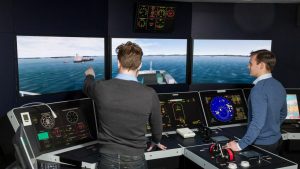
A large commercial ship rarely responds instantly. It takes time to alter course, lose speed or build momentum. Near a bank, in a busy channel or during a storm, that delay matters: the ship may be moving safely at one moment and approaching the limits of available water or manoeuvrability the next.
Advanced navigation is therefore a combination of preparation, observation and timely decisions. A competent bridge team understands how its particular vessel behaves, anticipates changes in wind and current, and keeps enough options available to respond when the original plan no longer works.
This guide explores the principles behind ship-handling in confined waters and adverse weather, from squat and bank effect to pilotage, restricted visibility and heavy-weather decisions. It is intended for masters, deck officers, cadets and other maritime professionals who want a practical framework for developing their skills.
Important: This article is educational. Actual manoeuvres depend on the vessel, prevailing conditions, applicable rules, local directions, company procedures and the master’s judgment. Use approved ship-specific information and seek qualified advice when planning or conducting an operation.
What Makes Confined-Water Navigation Challenging?
Confined waters include areas where the vessel’s freedom to manoeuvre is limited by depth, channel width, traffic, structures or navigational hazards. Examples include port approaches, rivers, canals, harbour basins, narrow straits and channels leading to terminals.
Several factors may act at the same time. The ship may experience a cross-current while approaching a bend, have limited under-keel clearance, encounter another vessel and face a freshening wind. Each factor changes the space and time needed to react.
Adverse weather adds further uncertainty. Reduced visibility makes visual assessment harder, waves affect a vessel’s motion and propulsion, and strong winds can push a high-sided ship away from its intended track. Good ship-handling begins with recognising these combined effects early, rather than considering them one at a time.
Know Your Ship Before Entering Restricted Waters
A ship-handling plan starts with reliable knowledge of the vessel. The bridge team should consult the manoeuvring information available on board, understand its limitations and consider the ship’s present condition. Important details include draught, trim, displacement, windage, propulsion and steering arrangements, stopping characteristics and the availability of thrusters or other assistance.
A ship’s turning circle and stopping distance observed during trials are useful references, but they do not guarantee identical performance in shallow water, strong currents or a different loading condition. Engine response may also differ from the team’s expectations, especially when starting, reversing or operating at low speed.
Consider the relationship between heading, course over the ground and speed through the water. A vessel can point in one direction while moving along a different track because of wind and current. Ground movement matters when judging proximity to a berth or bank, while water movement around the hull, propeller and rudder is central to manoeuvring response and hydrodynamic effects.
Passage Planning: From Berth to Berth
A detailed passage plan should cover the whole voyage, including port approaches and pilotage waters. The IMO’s voyage-planning guidelines provide a framework of appraisal, planning, execution and monitoring. In practice, the plan needs to be usable by the officers who will monitor and carry it out.
Before arrival, the bridge team should review up-to-date charts and publications, navigational warnings, port information, tidal predictions, currents, weather forecasts, traffic arrangements and the vessel’s draught. Charts and electronic displays need appropriate scale, settings and safety information. A line on a screen is not, by itself, evidence that every part of a route is safe.
The plan should identify critical turns, no-go areas, required clearances, reporting points, expected traffic, pilot boarding arrangements and suitable contingency options. It should also establish when to call the master and when the plan needs reassessment. A turning basin or anchorage should only be treated as an option after its suitability has been checked for the vessel and conditions.
During execution, compare the actual position, track, speed and environmental conditions with the plan. If visibility deteriorates, the tidal window changes or the pilot recommends a substantial alteration, the team should reassess the plan together. A plan is a working tool, not a reason to continue when its assumptions are no longer valid.
Under-Keel Clearance, Shallow Water and Squat
Under-keel clearance (UKC) is the vertical distance between the lowest part of the vessel and the seabed. Static calculations are only the starting point. The clearance available while moving can change with tide, draught, trim, water density, seabed conditions and vessel motion in waves.
One important effect is squat: a vessel moving through restricted water may sink bodily and change trim as water flows around and beneath the hull. Squat depends on factors including speed through the water, hull form, water depth and channel geometry. It can be especially significant when the vessel is deep-draughted relative to the available depth. Its magnitude and location should be assessed using appropriate ship and company guidance, not a single assumed value for every vessel.
Consider a loaded ship approaching a shallow channel on a falling tide. A calculation that considers only charted depth, predicted tide and static draught may suggest sufficient clearance. If squat, swell or uncertainty in the seabed data are omitted, the true margin may be much smaller. The team may need to reassess the timing, route, loading condition or speed within the applicable UKC policy.
Reducing speed can reduce squat, but speed also affects steering response, exposure to current and the time spent in shallow water. The correct speed is therefore a considered balance between clearance, control, traffic, local limits and other risks. It is not automatically the lowest speed at which the ship can move.
Bank Effect and Vessel Interaction
When a ship passes close to a bank or channel edge, unequal water flow and pressure around the hull can influence its heading and lateral movement. Depending on the vessel and geometry, the stern may be drawn toward the bank while the bow tends to turn away. The effect can develop quickly and may be difficult to counter if the vessel has little room available.
Early recognition is essential. Monitor position across the channel, heading, rate of turn, speed and steering response. Leave appropriate margins where practicable and discuss critical bends and passing situations before entering the confined area. Do not assume that a charted channel boundary represents a vertical wall: the shape of the bottom and banks can matter beyond the line shown on the chart.
Ships can also interact with one another when meeting or overtaking at close range. Relative size, speed, separation and water depth influence the forces involved. Passing arrangements require careful assessment under the applicable collision regulations and local directions, with clear communication where appropriate. Radio agreement does not replace compliance with the rules or independent assessment of the situation.
Using Wind and Current in Ship-Handling
Wind acts on the exposed part of the vessel. A car carrier, container ship or lightly loaded vessel may have substantial windage, while cranes and other deck structures can change how wind forces are distributed. Gusts and shelter from buildings, breakwaters or other ships may cause conditions to change rapidly during an approach.
Current acts on the underwater hull and can affect track, turning behaviour and speed over the ground. At a bend or harbour entrance, its direction and strength may vary across the channel. A bridge team should consider not only the forecast current but also the effect actually observed from the ship’s movement and available local information.
For example, when approaching a berth with a cross-current, the team should agree the intended track, speed, tug use and limits for continuing. If the vessel drifts more quickly than expected, the priority is to recognise the trend early and reassess the approach while there is still room to act. The appropriate correction depends on the vessel, the surroundings and the agreed manoeuvre.
Successful handling is not a matter of memorising one rudder order for every situation. It is the disciplined process of anticipating forces, observing the vessel’s response and adjusting the plan in time.
Safe Speed, Stopping and Turning
Safe speed is determined by the circumstances. Visibility, traffic density, manoeuvrability, wind, sea state, current, available depth and the limitations of navigation equipment all influence the decision. The COLREGs require a vessel to proceed at a safe speed so that proper and effective action can be taken to avoid collision and the vessel can be stopped within a distance appropriate to the prevailing circumstances and conditions.
A slower speed is not always sufficient by itself. A ship may still have substantial momentum, limited steering response or a current carrying it toward danger. Conversely, excessive speed can increase squat and the severity of contact while reducing time to assess a developing situation.
Before a critical turn, the bridge team should understand the planned alteration point, the space available, expected drift and the ship’s response. Use more than one suitable method to monitor progress where practicable. A wheel-over position is a planning aid; it needs to be checked against actual conditions and the vessel’s behaviour.
Bridge Teamwork and the Master–Pilot Exchange
A pilot brings valuable local knowledge, but the presence of a pilot does not remove the need for an effective bridge team. The master remains responsible for the safety of the vessel, while the pilot and ship’s officers work together within the applicable legal and local framework.
The master–pilot exchange should address the proposed route and manoeuvre, local hazards, traffic, tides, weather, UKC, tug arrangements and communication. The master should also explain the vessel’s draught, manoeuvring characteristics, machinery status and any limitations. Where a pilot’s proposal differs from the ship’s plan, the team should discuss and agree how the passage will be conducted.
Roles should be clear. One person may con the vessel while another monitors position and traffic, records key information and checks that orders are carried out. Orders should be acknowledged and confirmed in accordance with bridge procedures. Every member of the team needs to know when and how to raise a concern.
A useful challenge is specific: “Our position is moving toward the channel edge, and the rate of turn is increasing.” It identifies an observable problem and encourages a shared response. Respectful challenge can prevent a developing error from becoming a grounding or collision.
Tugs, Berthing and Mooring Coordination
Tugs can give a vessel additional control in confined water, but their effectiveness depends on their capabilities, position, available room and the prevailing environment. Their use should be planned and agreed with the pilot, tug crews and relevant port authorities before the operation reaches a critical stage.
The briefing should establish how many tugs are available, how they will communicate, where and how they will be made fast, and what limitations apply. Changes in wind, current or traffic may require the team to revise the plan. If communications are unclear or the manoeuvre is no longer developing as expected, the team should take appropriate action early.
Berthing also depends on coordination with the mooring stations. Personnel should follow the vessel’s mooring procedures, remain aware of line tension and potential snap-back zones, and communicate clearly with the bridge. Mooring lines and equipment must not be treated as substitutes for controlling the ship’s approach.
Navigating in Restricted Visibility
Fog, heavy rain, snow and sea spray can reduce visibility quickly. When visibility deteriorates, the bridge team should make an early assessment of traffic, available sea room, speed and the ship’s ability to manoeuvre. The master should be called in accordance with standing orders, and lookout and equipment arrangements should be adjusted as appropriate.
Radar, automatic radar plotting aids, electronic charts and AIS can support situational awareness, but each has limitations. Radar performance can be affected by sea clutter, rain, land echoes, target characteristics and settings. AIS information depends on transmitted data and may be absent, delayed or inaccurate. Neither system replaces a proper lookout or the use of all available means appropriate to the circumstances.
The COLREGs include specific requirements for vessels navigating in or near restricted visibility. Rule 19 applies when vessels are not in sight of one another under those conditions; other rules also remain relevant according to the circumstances. Sound signals, safe speed, radar assessment and collision-avoidance action must be considered under the applicable rules. A vessel’s officers should avoid making assumptions about another ship’s intentions from a single display or radio conversation.
Heavy Weather: Preparation Before Conditions Worsen
Good heavy-weather navigation begins before the worst conditions arrive. The master and officers should review reliable forecasts, warnings, wave information, vessel limitations and the intended route. Forecasts are estimates, so the team should monitor updates and compare them with actual observations.
Before exposure increases, check that the vessel is prepared in accordance with its procedures. This may include verifying watertight and weathertight integrity, reviewing cargo and equipment securing, checking machinery readiness, preparing the bridge and informing the crew. Work on exposed decks can become dangerous in heavy weather; any necessary work should be planned under the ship’s safety procedures.
The team should consider whether a route adjustment, a change in speed, delayed departure or suitable shelter is justified. A schedule or commercial pressure should not override the master’s assessment of safety. Waiting may be the most effective decision when the alternative leaves inadequate margins for the vessel and crew.
Ship Behaviour in Waves and Strong Winds
Waves influence a ship differently according to their height, period and direction relative to the vessel, as well as the ship’s speed, loading and stability. Heavy pitching, rolling, slamming and water on deck can damage equipment or cargo and place people at risk. In following or quartering seas, loss of directional control and broaching may become concerns for some vessels and conditions.
Particular combinations of vessel motion and wave encounter can produce severe rolling. Officers should understand the ship-specific guidance on dangerous wave conditions and monitor the vessel’s actual response. A change of course or speed may improve the situation, but no single heading is universally safest. Any alteration must also account for sea room, navigational hazards, traffic, cargo, stability and the weather forecast.
Continuous observation matters. If motion becomes more severe than anticipated, communicate with the master and engine room, reassess the situation and consider the available options before conditions further limit them. Protecting the crew may also mean restricting movement and avoiding unnecessary work in exposed areas.
Practical Scenarios for the Bridge Team
Scenario 1: A Shallow Channel and a Falling Tide
A loaded bulk carrier is scheduled to enter a port through a dredged channel. The predicted tide is falling, and a swell is developing near the entrance. The team should revisit the UKC calculation, account for vessel motion and squat under the applicable method, and confirm the reliability of depth and tide information. If the required margin cannot be maintained, the timing, route or other operational arrangements need to be reconsidered.
Scenario 2: A Crosswind During Berthing
A high-sided vessel is approaching a terminal when the wind strengthens beyond the value used in the original briefing. The master, pilot and tugs should reassess the effect on the approach, the assistance available and the limits for continuing. If the situation is outside the agreed limits or cannot be controlled with adequate margins, delaying or discontinuing the approach may be appropriate.
Scenario 3: Fog Near a Busy Traffic Area
Visibility falls while a ship is approaching an area with converging traffic. The bridge team should assess safe speed, maintain an appropriate lookout, use and check available equipment, and apply the relevant COLREGs. Any assumptions about radar targets or AIS data should be tested against other available information. Early action gives the team more time and space than a late response.
Scenario 4: Deteriorating Weather Offshore
A forecast indicates increasing seas along the planned track. The master reviews updated information, ship motion, cargo condition, route alternatives and available shelter. A revised route or speed may reduce exposure, but the decision should account for how the vessel actually behaves and for hazards along any alternative track.
Common Mistakes and How to Avoid Them
One frequent mistake is relying on a single source of information. A position displayed on ECDIS, a radar plot, a pilot’s portable unit or a visual bearing can be valuable, but each should be understood and cross-checked using other suitable means when available.
Another is continuing an approach because the ship is already committed to the plan. Changing conditions, unexpected vessel response or an unclear manoeuvre may justify stopping to reassess, delaying or using a previously identified contingency, if safe and feasible. A contingency is useful only when the team understands its limits and can implement it in time.
Other avoidable problems include an incomplete master–pilot exchange, failure to account for squat, unclear bridge roles, late calls to the master and inadequate consideration of current. The most reliable defence is a team that shares information, monitors trends and speaks up before the available margin disappears.
Developing Advanced Ship-Handling Skills
Experience remains essential, but it should be supported by structured learning. Officers can study their vessel’s manoeuvring data, review passage plans with senior colleagues and examine accident reports for the decisions and assumptions that contributed to an incident.
On board, cadets and junior officers can develop judgment by observing manoeuvres, recording conditions and discussing outcomes with experienced officers. Every ship and port is different, so the aim is to understand principles and limits, not collect fixed orders to repeat in every situation.
Frequently Asked Questions
What is the difference between squat and bank effect?
Squat concerns a vessel’s sinkage and change of trim when moving through restricted water. Bank effect describes hydrodynamic forces and turning tendencies associated with proximity to a bank or channel edge. Both can affect a vessel at the same time.
Does reducing speed always make navigation safer?
No. Lower speed can reduce squat and provide more time to assess a situation, but it can also affect steering and exposure to wind or current. The safe speed depends on the full circumstances and the vessel’s ability to manoeuvre.
Does the pilot take responsibility for the vessel?
A pilot advises and assists with local navigation under the applicable arrangements. The master and bridge team must remain engaged, monitor the passage and carry out their responsibilities. The precise legal framework depends on the jurisdiction.
Can modern navigation equipment replace a lookout?
No. Electronic systems are valuable aids, but they have limitations. A proper lookout and the use of all appropriate available means remain fundamental to safe navigation.
What is the most important heavy-weather decision?
There is no single answer for every voyage. The most important decision may be to alter the route, adjust speed, delay departure, seek suitable shelter or take another ship-specific action. Making that decision early, with reliable information and sufficient sea room, is often critical.
Final Thoughts
Mastering ship-handling in confined waters and adverse weather is a continuous process. It requires knowledge of the vessel, a realistic plan, awareness of environmental forces and a bridge team prepared to question assumptions.
The strongest navigators look ahead. They understand where their margins are narrowing, communicate clearly with pilots and colleagues, and adjust their plans as conditions change. With preparation, practice and sound professional judgment, mariners can make more informed decisions in some of the most demanding situations at sea.
Sources and Further Reading
- IMO: Convention on the International Regulations for Preventing Collisions at Sea (COLREGs)
- IMO: Guidelines for Voyage Planning, Resolution A.893(21)
- UK Marine Accident Investigation Branch: Grounding of Seatruck Performance
- UK Marine Accident Investigation Branch: Grounding of CMA CGM Vasco de Gama
- UK Marine Accident Investigation Branch: Assisting pilots to ensure safe passage