
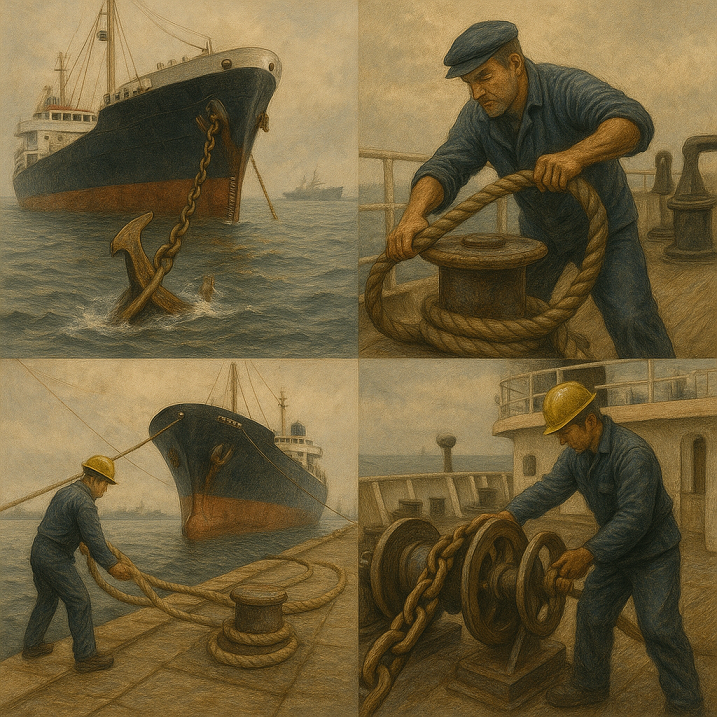
Discover how anchoring and mooring procedures ensure ship stability and safety in ports and offshore zones. Learn essential practices, new technologies, and global regulations in this expert maritime guide.
Anchoring and mooring are essential to the safe operation of ships, whether a tanker is waiting offshore, a bulk carrier is approaching a busy terminal, or a cruise ship is securing alongside. Both operations help control a vessel’s position and movement while protecting personnel, neighbouring ships, port infrastructure, and the marine environment.
Failures can have serious consequences. An anchor that drags may allow a ship to drift towards shallow water, another vessel, or offshore infrastructure. Mooring failures can cause a vessel to break away from its berth and expose personnel to sudden line movements, equipment failure, and potentially fatal injuries.
Safe operations depend on suitable equipment, careful planning, competent crews, effective communication, and continuous assessment of conditions. Wind, current, waves, tidal changes, and vessel loading can all affect the forces acting on the anchoring or mooring system.
Understanding Anchoring: Equipment, Principles, and Practice
The Purpose and Equipment of Anchoring
Anchoring holds a vessel within a defined area by connecting it to an anchor that develops resistance in the seabed. The ship normally swings around the anchor as wind and current change; anchoring therefore requires sufficient clearance throughout the vessel’s expected swinging circle.
The principal components include:
- Anchor: Develops holding resistance through its interaction with the seabed.
- Chain cable: Connects the anchor to the vessel and helps maintain a favourable direction of pull on the anchor.
- Windlass: Raises and lowers the anchor and cable, with brakes controlling cable movement during deployment.
- Chain stopper, where fitted: Secures the cable and transfers anchoring loads to its supporting structure when engaged.
Conventional merchant-ship anchoring equipment is primarily designed for temporary anchoring in harbours or sheltered waters with suitable holding ground. Its design should not be interpreted as a guarantee that the vessel can remain safely anchored off an exposed coast in severe weather.
Cable Scope and Holding Performance
Scope expresses the relationship between the length of cable paid out and water depth. Operational planning must also account for the height of the hawse pipe above the water, tidal changes, available swinging room, and the equipment’s limitations.
There is no universally suitable scope ratio. Values such as 5:1 or 7:1 should not be presented as guaranteeing adequate holding. The required cable length depends on seabed conditions, water depth, expected environmental loads, vessel characteristics, and the ship’s approved procedures. Increasing cable length may improve holding, but it also enlarges the swinging area and cannot compensate indefinitely for worsening conditions.
Anchor Types and Seabed Conditions
Merchant ships commonly use stockless anchors, including conventional and approved high-holding-power designs. Their suitability depends on tested performance, class requirements, and compatibility with the ship’s anchoring arrangement.
Holding performance also depends strongly on the seabed. Sand and suitable clay may provide good holding, whereas rock, very soft mud, or uneven ground can reduce reliability. A seabed description alone is insufficient: the anchor must penetrate or engage effectively, and the direction and magnitude of loading must remain appropriate.
Specialised offshore mooring systems require their own engineering assessment and should be distinguished from a merchant ship’s routine anchoring arrangement.
Planning and Conducting an Anchoring Operation
An anchoring operation should follow the vessel’s safety management system, the master’s instructions, and the equipment manufacturer’s operating limits.
- Select and assess the anchorage. Review charts, navigational warnings, depths, under-keel clearance, holding ground, subsea cables and pipelines, traffic, weather forecasts, tides, and currents.
- Prepare the plan and brief the crew. Confirm the anchor to be used, intended cable length, deployment method, communications, personnel responsibilities, and contingency actions.
- Control the approach. Maintain a low, controlled speed over the ground and select a heading appropriate to the prevailing forces and manoeuvring conditions.
- Deploy and set the anchor. Let go or lower the anchor under power, as appropriate to the depth, equipment, and approved procedure. Pay out cable in coordination with controlled vessel movement, avoiding excessive loads or cable piling over the anchor.
- Confirm holding. Check that the vessel has brought up, record the anchoring details, and establish the swinging circle and watch arrangements.
Abruptly stopping a rapidly running cable can impose damaging loads. Cable control and anchor setting should therefore be managed carefully rather than treated as a routine instruction to “snub” the cable.
Maintaining an Anchor Watch
An effective anchor watch includes position monitoring, a proper lookout, observation of weather and tidal conditions, and readiness to respond to dragging. Radar ranges and bearings, visual observations, and electronic position information should be used together where available. Anchor alarms support watchkeeping but do not replace it.
STCW does not prescribe a universal 15–30-minute interval for position checks. Section A-VIII/2 requires checks at sufficiently frequent intervals, when circumstances permit, to establish whether the ship remains securely anchored. Check frequency and recordkeeping should reflect the risk, the master’s standing orders, and company procedures. Machinery readiness must also follow the master’s instructions.
Mooring: Securing a Vessel Alongside or to a Mooring Facility
The Purpose of Mooring Lines
Mooring restrains a vessel’s movement relative to a berth, buoy, or another vessel. A successful arrangement distributes loads through suitable lines, fittings, winches, and supporting structures.
The principal line functions are:
| Line type | Main function |
|---|---|
| Breast lines | Primarily restrain movement away from the berth. |
| Spring lines | Primarily restrain fore-and-aft movement. |
| Head and stern lines | Provide longitudinal and transverse restraint according to their lead angles. |
Line effectiveness depends on its direction. Breast lines generally provide the greatest transverse restraint, while springs provide the greatest longitudinal restraint when suitably arranged.
Common Mooring Arrangements
Common arrangements include alongside mooring, stern-to or Mediterranean mooring, single- or multiple-buoy mooring, and ship-to-ship mooring.
Each requires a suitable plan. Relevant factors include vessel dimensions and windage, berth geometry, available fittings, fender arrangements, tidal range, current, swell, passing-ship effects, and changes in draught during cargo operations. Lines, fittings, and winches must be considered as a compatible system rather than selected independently.
Safe Mooring Operations
Mooring exposes personnel to tensioned lines, moving machinery, trapping hazards, and sudden equipment failure. A parted line can release stored energy through snap-back, while a snagged line may move violently when it releases.
Painted snap-back markings must not create a false impression that other areas are safe. Hazard areas change with line leads and operating conditions; the whole mooring deck may present danger when lines are under tension.
Essential precautions include:
- Brief the team and maintain clear communication with the bridge and shore personnel.
- Assign a responsible supervisor at each mooring station.
- Keep personnel clear of bights, tensioned lines, and potential recoil paths.
- Use suitable PPE and maintain safe access and visibility.
- Stop or reassess the operation when loading, equipment behaviour, or communication becomes unsafe.
Lines, winches, and fittings require planned inspection and maintenance. Damaged lines should be withdrawn according to appropriate replacement criteria, with records linking individual lines to their specifications and inspection history. Once alongside, the arrangement must continue to be monitored as conditions change.
Automated Mooring Systems
Automated systems can reduce manual line handling and accelerate mooring and release at suitably equipped berths. Helsinki’s West Harbour, for example, uses vacuum-based MoorMaster units at selected berths. Such systems still require appropriate operating limits, monitoring, maintenance, and contingency arrangements.
International Requirements and Industry Guidance
The regulatory framework distinguishes equipment design, operational safety, maintenance, and crew competence.
- SOLAS regulation II-1/3-8 — Towing and mooring equipment: Addresses suitable towing and mooring arrangements, equipment, and fittings. Amendments that entered into force on 1 January 2024 strengthened safe-mooring requirements, with applicability depending on the particular provision and vessel characteristics.
- IMO MSC.1/Circ.1619: Provides guidance on mooring arrangement design and the selection of appropriate equipment and fittings, including reducing personnel exposure to hazardous line movements.
- IMO MSC.1/Circ.1620: Provides guidance on the inspection and maintenance of mooring equipment, including lines.
- STCW Code: Establishes relevant competence requirements for deck officers and ratings, including anchoring and mooring procedures, equipment limitations, line handling, and watchkeeping.
For shipboard towing and mooring equipment guidance, the applicable version of MSC.1/Circ.1175 depends on the ship’s construction date: the original circular applies to ships constructed from 1 January 2007 to before 1 January 2024; Rev.1 applies from 1 January 2024 to before 1 January 2028; and Rev.2, issued in 2025, applies to ships constructed on or after 1 January 2028.
Classification requirements complement this framework. IACS Unified Requirement A1 concerns anchoring equipment; UR A2 concerns towing and mooring fittings and their supporting hull structures; and UR A3 addresses anchor windlass design and testing.
Also watch this video:
Real-World Applications and Incidents
In 2020, a bulk carrier in Port Hedland, Australia dragged anchor during a strong squall. Investigations revealed insufficient scope and crew unfamiliarity with the local holding ground. The case triggered local port authorities to mandate pre-arrival briefings and seabed-specific anchoring guides. In another example, the Port of Singapore Authority (PSA) implemented real-time mooring tension sensors and shore-based assistance for high-risk tanker mooring. The move followed a near-miss involving a VLCC whose spring line snapped during berthing.
Such incidents underline the role of human factors, local knowledge, and technology in safe operations.
–
Challenges and Solutions
Aging Equipment
Older ships often operate with worn-out windlasses and deteriorated anchor chains. PSC detentions are increasingly linked to faulty mooring systems. Regular inspections, maintenance logs, and spare parts inventory (as per ISM Code) are vital.
Climate Change Effects
Rising sea levels and stronger storm surges create unpredictable mooring environments. Floating docks and flexible mooring points are being trialed in low-lying ports like Rotterdam and Manila.
Crew Training and Familiarity
Multinational crews may not have standardized experience. Maritime schools like Massachusetts Maritime Academy and Maritime Knowledge India now emphasize simulator-based training for anchoring and berthing.
New Technology
AI-based systems can now predict optimal anchoring spots using real-time seabed mapping. Mooring load sensors and digital twin simulations (e.g., Wärtsilä’s SmartDock system) allow pre-mooring planning and risk assessment.
By 2030, anchoring and mooring may become largely automated in key ports. The rise of smart ports under the IAPH initiative is driving the use of shore-based mooring arms, automated fairlead adjusters, and integrated control stations. IMO’s Maritime Safety Committee is also discussing standards for remote mooring, especially for autonomous ships. While manual skills will still matter, the human role is shifting toward monitoring and decision-making rather than brute handling.
–
Frequently Asked Questions
What is the difference between anchoring and mooring? Anchoring secures a ship using its anchor and seabed. Mooring uses ropes or chains to secure a ship to a dock, buoy, or another vessel.
How much anchor chain should I let out? A typical scope is 5 to 7 times the depth of water, adjusted for wind, current, and seabed type.
Why do mooring lines snap? Lines can snap due to overloading, wear, poor spooling, or improper material choice. Snap-back injuries are serious risks.
Are anchoring and mooring taught during STCW training? Yes, they are part of operational-level training for deck officers under STCW Table A-II/1 and A-II/2.
What are snap-back zones? These are areas where mooring lines under tension can violently recoil if broken. Crew should avoid these zones during operations.
What is an automated mooring system? An AMS uses mechanical arms, vacuum pads, or magnets to secure a vessel without manual line handling. It is safer and quicker.
Conclusion
Anchoring and mooring are not just checklists in the seamanship manual—they’re dynamic, high-stakes operations where precision, teamwork, and judgment intersect. With global trade rising and port congestion becoming the norm, safe and efficient procedures are more vital than ever.
Technology is transforming how ships anchor and moor, but at its heart, success still depends on training, planning, and respect for the forces of nature.
For maritime professionals, students, or anyone fascinated by ship operations, mastering anchoring and mooring isn’t optional—it’s essential.
References
- IMO STCW Convention and Code
- ICS Bridge Procedures Guide
- Lloyd’s List Intelligence – Safety Reports
- MAIB Reports
- DNV Mooring Standards
- Wärtsilä SmartDock
- Massachusetts Maritime Academy
- Port of Singapore Authority
- International Association of Ports and Harbors (IAPH)
- British Ports Association
- Marine Insight on Anchoring