
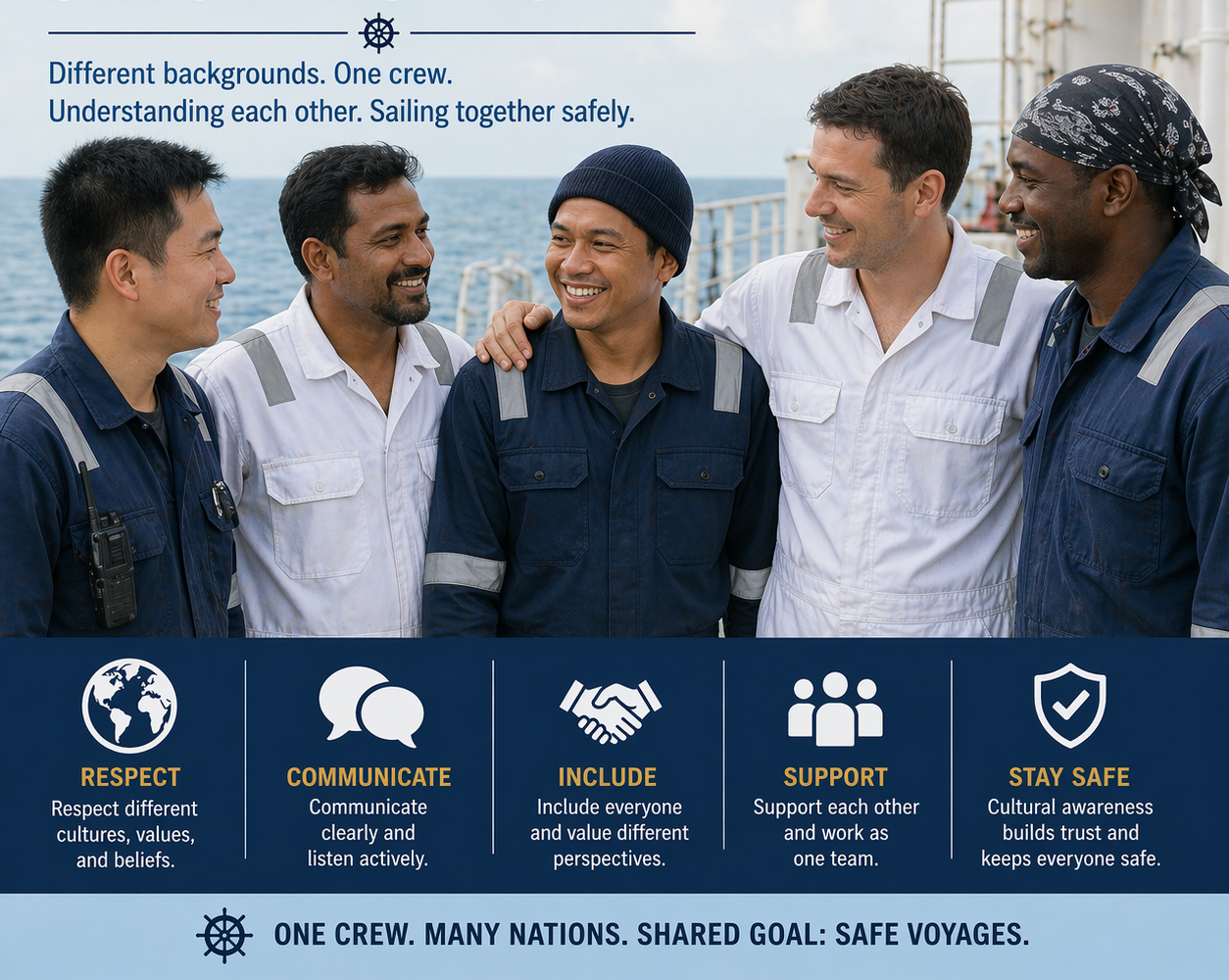
A commercial ship brings together people who may speak different first languages, follow different traditions and have learned different ways of communicating. They work closely together in an environment where a misunderstanding can affect safety, relationships and wellbeing. Cultural awareness helps a crew work effectively while respecting the people behind the ranks and job titles.
Consider a routine engine-room maintenance task. The second engineer asks a junior engineer, “Is everything ready?” The junior answers, “Yes.” The work begins, but a valve has not been isolated. Did the junior understand the question? Did the senior officer confirm the isolation? Was the junior comfortable admitting uncertainty? The incident may involve language, experience, workload or supervision. Good cultural awareness means asking these questions without assuming the answer is someone’s nationality.
For masters, chief engineers, officers, ratings and cadets, cultural awareness is a practical skill: listening carefully, checking understanding, recognising different perspectives and creating an environment in which everyone can contribute to safety.
In this article
- What Does Cultural Awareness Mean at Sea?
- Why Diversity Matters Onboard
- Communication: The Foundation of Safe Teamwork
- Hierarchy, Respect and Speaking Up
- Working Together During Maintenance and Emergencies
- Everyday Life: Food, Religion and Shared Spaces
- Preventing Bullying, Harassment and Discrimination
- Managing Misunderstandings and Conflict
- The Role of the Master and Chief Engineer
- A Practical Cultural Awareness Exercise
- A Checklist for Multinational Crews
- Building a Respectful Safety Culture
- Further Reading
What Does Cultural Awareness Mean at Sea?
Culture can influence how people communicate, show respect, resolve disagreement and organise daily life. It can be shaped by nationality, language, religion, education, family, previous employers and professional experience. A person may belong to several communities and may not follow the practices others expect.
A ship also has its own culture. The way officers conduct meetings, respond to mistakes, welcome new crew and report hazards teaches people what behaviour is acceptable. A supportive shipboard culture makes it easier for a new cadet or an experienced rating to raise a concern.
Cultural awareness does not require knowing every custom in the world. It requires curiosity, respect and a willingness to check assumptions. The most useful question is often: “How can we make sure we understand each other?”
Why Diversity Matters Onboard
Multinational crews bring different technical experiences and ways of solving problems. One engineer may have worked with a type of purifier that is unfamiliar to a colleague; another may have valuable experience responding to a blackout. Sharing this knowledge can improve maintenance, training and operational decisions.
Living and working together can also be demanding. Seafarers may spend months away from family, share limited recreational spaces and work under time pressure. Differences in language, humour, eating habits or expectations about privacy can become more noticeable when people are tired or stressed.
Diversity alone does not guarantee teamwork. Crew members need clear procedures, fair treatment and opportunities to communicate. When people feel respected, they are more likely to ask questions, share experience and report errors before they become accidents.
Communication: The Foundation of Safe Teamwork
A crew member may be technically competent but need more time to explain a problem in a second language. Speaking loudly or quickly rarely solves the problem. Use clear words, short sentences and an agreed working language. Avoid slang, jokes and abbreviations when discussing safety-critical tasks.
The IMO’s Standard Marine Communication Phrases provide a common set of English phrases for many safety-related situations. Use the phrases where appropriate and follow the vessel’s procedures for bridge, engine-room and external communications.
Use Closed-Loop Communication
Closed-loop communication means that the person receiving an instruction repeats the important information, and the sender confirms or corrects it.
Officer: “Close the number two seawater inlet valve and report when it is closed.”
Engineer: “Close number two seawater inlet valve and report when closed.”
Officer: “Correct.”
After completing the action, the engineer reports the result. The officer should also arrange any independent verification required by the job. A readback confirms what was heard; it does not by itself prove that the correct valve is isolated.
When handing over a watch, identify equipment by its full name, describe its current condition and explain any restrictions. Instead of saying “the pump has a problem,” say what was observed, what action was taken and who has been informed. Written notes, drawings and photographs can support the verbal handover.
Hierarchy, Respect and Speaking Up
A ship needs a clear chain of command, especially during emergencies. At the same time, the person who notices a danger may be the most junior member of the team. A safe crew makes it possible to challenge an unsafe condition respectfully.
Imagine a cadet notices that a lifting sling appears damaged before a heavy component is raised. The cadet should be able to say: “Please stop the lift. I think this sling may be damaged.” The supervisor can then pause the job, inspect the equipment and decide on the next step. Raising the concern supports the officer’s responsibility for the work.
People may hesitate for many reasons: fear of embarrassment, uncertainty, limited experience, language difficulty or a previous negative reaction. Leaders should not attribute silence to culture alone. Ask open questions, thank people for raising concerns and explain how to stop work or escalate a problem under the ship’s safety management system.
Useful phrases include: “I do not understand the instruction,” “Can you show me the isolation point?” and “I think we should stop and check.” Senior officers can make these phrases normal by using them themselves.
Working Together During Maintenance and Emergencies
Before a task begins, a short toolbox talk can bring a mixed team to the same understanding. The person in charge should explain the work, roles, hazards, isolation boundaries, permits, protective equipment and communication arrangements. Ask team members to describe their part in their own words and invite questions.
During an emergency, crew members have less time to interpret an unclear message. Drills are an opportunity to practise simple reports, correct terminology and coordination between departments. A bridge-to-engine-room report should identify the problem, its operational effect, the immediate action and when another update will follow.
For example: “Bridge, engine control room. Number two generator has tripped. One generator is supplying the switchboard. We are starting the standby generator and will update you shortly.” The precise actions must follow the vessel’s emergency procedure.
After the drill, discuss what helped and what caused confusion. Focus on learning and correcting the system, not embarrassing an individual for an accent or an unfamiliar word.
Everyday Life: Food, Religion and Shared Spaces
Respect for diversity also matters outside working hours. Food preferences, religious practices, sleeping patterns and social habits can affect daily life on board. Do not assume that everyone from the same country eats the same food or follows the same faith. Ask individuals about their needs, while recognising the practical limitations of a vessel’s stores, facilities and operations.
Where possible, provide suitable meal choices, identify ingredients clearly and discuss reasonable arrangements for fasting or religious observance. Any arrangements should be coordinated with working hours, medical needs and safety responsibilities. A person should never be pressured to disclose private beliefs.
Mess rooms, cabins, laundry facilities and recreation areas are shared spaces. Simple agreements about cleanliness, noise, personal belongings and rest hours can prevent tension. Respect the privacy of colleagues who want quiet time, while also ensuring that no one is excluded from social activities.
Preventing Bullying, Harassment and Discrimination
A cultural difference is not an excuse for bullying, racist remarks, sexual harassment, threats or exclusion. Repeated jokes about a colleague’s nationality, accent, gender or religion can damage trust and make it harder for that person to report a safety concern.
The company should explain its reporting routes during familiarisation, including what a seafarer can do if the person involved is their supervisor. Complaints should be handled promptly, fairly and with appropriate confidentiality. Protect people from retaliation, preserve relevant information and follow the company procedure and applicable flag-State requirements.
The Maritime Labour Convention, 2006 addresses seafarers’ working and living conditions and complaint procedures. In addition, IMO amendments to the STCW Code concerning training on preventing and responding to violence and harassment entered into force on 1 January 2026. Training should support everyday behaviour and a credible response when problems occur. Source: IMO and ILO work on seafarer issues.
Managing Misunderstandings and Conflict
Not every disagreement results from cultural background. A misunderstanding may arise from a missing instruction, fatigue, an unclear responsibility or a technical concern. Start by establishing what happened and listening to the people involved.
Suppose two officers disagree about a delayed maintenance job. One believes the work was assigned to the other; the second understood it would be done after arrival. A constructive discussion would check the work order, handover and operational constraints before deciding how to proceed. The team can then record a clearer responsibility and completion time.
For more serious issues, use the appropriate reporting process. If there is an immediate safety risk, stop the activity and address the danger first. If someone reports harassment or discrimination, do not reduce it to a simple misunderstanding: follow the formal procedure and ensure the person has access to support.
The Role of the Master and Chief Engineer
Senior officers set expectations through their actions. A master or chief engineer who listens to a junior crew member, explains a decision and admits uncertainty demonstrates that professional respect applies to everyone.
Effective leaders can:
- Introduce new joiners to the working language, emergency duties and complaint procedures.
- Make sure important instructions are understood, especially during handovers and high-risk jobs.
- Give fair opportunities for training and participation, without judging competence by nationality or accent.
- Encourage the team to report hazards and near misses without fear of humiliation.
- Intervene when jokes, exclusion or aggressive behaviour make the workplace unsafe.
- Check workload and fatigue, and arrange support through the master and company when needed.
Leadership also means recognising limits. If a crew member needs specialist, medical or welfare support, use the resources available through the company and relevant authorities.
A Practical Cultural Awareness Exercise
An instructor can use a short scenario in a classroom or simulator. Divide students into a bridge team and an engine-room team. The vessel is preparing to depart, and a standby pump has failed its pre-departure test.
First, ask the engine-room team to report the fault, its effect on machinery readiness and the expected next update. The bridge team should repeat the essential information and explain the impact on departure planning. Then introduce a communication difficulty: one person misunderstands which pump is unavailable, or a junior team member notices an inconsistency but is reluctant to interrupt.
During the debrief, ask: Was the information specific? Did anyone check understanding? Was the concern heard? Did the team confirm the actual equipment condition? Discuss how role, language, workload and experience may have contributed, without assigning behaviour to a nationality. Repeat the exercise with clearer readbacks and an invitation to challenge.
A Checklist for Multinational Crews
| Situation | Practical question |
|---|---|
| Joining the ship | Does the new crew member know the working language, duties, contacts and reporting routes? |
| Giving an instruction | Are the equipment, action and expected response clear? |
| Handing over a watch | Have outstanding defects, isolations and operating limits been explained and understood? |
| Preparing a task | Has everyone been invited to ask questions and identify hazards? |
| Managing daily life | Have dietary needs, rest and shared-space expectations been discussed respectfully? |
| Resolving a concern | Is the appropriate supervisor or confidential reporting route available? |
| Reviewing an incident | Have the team considered procedures, workload and communication as well as individual actions? |
Building a Respectful Safety Culture
Cultural awareness is developed through small, repeated actions: learning a colleague’s name, listening without interruption, checking a critical instruction and responding seriously when someone raises a concern. It also requires clear standards. Respecting differences does not mean accepting unsafe work or harmful behaviour.
On a well-managed ship, every crew member understands the common safety procedures and has a fair opportunity to contribute. When people communicate clearly, support one another and treat differences with respect, a multinational crew can work as one professional team.
Thanks!