
A practical guide for fleet teams, port agents, terminal staff and shipping offices on communication, coordination and decisions under pressure

A port agent receives an estimated berth arrival of 15:30 from the ship. The terminal requests 17:00, and the carrier’s operations team updates its planning system. If the incoming shift sees only “17:00” in the handover, it may assume the time has been agreed and that the pilot and tugs are booked. One clear update can prevent several teams from acting on different assumptions.
Soft skills help shore personnel coordinate work across organisations. They include asking precise questions, listening for uncertainty, communicating changes, negotiating within agreed limits and handing over decisions. These skills support the work of fleet operations, technical and marine superintendents, crewing teams, commercial staff, port agents and terminal planners. Each role needs to know who holds the information, who can make the decision and who must receive it.
What good shore-side practice looks like
| Skill | Where it matters | Behaviour to practise |
|---|---|---|
| Clear communication | An agent reports a revised berth window. | Name the vessel, port, event, time zone and status. Ask for explicit confirmation of the requested action. |
| Active listening | The chief engineer reports a machinery fault to the technical superintendent. | Summarise the reported condition and ask what the ship needs from shore and by when. Record any unanswered questions. |
| Prioritisation and escalation | A potential safety issue arrives alongside routine schedule updates. | Use the required reporting channel, identify the responsible decision-maker and confirm that they received the issue. |
| Negotiation | A supplier offers a later delivery that affects departure. | Ask which constraints are fixed, compare available options with the responsible people, and record the agreed commitment. |
| Intercultural communication | Several teams join a call in a shared working language. | Use concrete dates and times, explain local abbreviations, and ask the person taking the action to restate it. |
| Feedback and accountability | A shift inherits an open issue with no clear owner. | Agree one named owner and a next update time. At the review, identify where responsibility became unclear and test the fix. |
How to write a port-call update
Start with the vessel, the port and the event. An estimated arrival at the pilot boarding place is a different event from an estimated arrival at berth. Include the date, time zone and source of the time. State the response you need and the time by which the recipient needs to reply.
For services that follow its time negotiation model, the Digital Container Shipping Association (DCSA) Port Call Standard distinguishes four types of time. Estimated is a forecast. Requested is the receiving party’s proposed time. Planned is the service provider’s confirmation of the requested time. Actual records when the event occurred. In everyday coordination, the distinction helps teams recognise when a change still needs agreement. A confirmed berth time and a confirmed pilot booking are separate pieces of information. DCSA Port Call Standard, purpose and scope
Use the IMO Standard Marine Communication Phrases where applicable to safety-related verbal communications, including relevant ship-to-shore exchanges. In commercial and operational correspondence, plain language serves the same practical aim. During a call, read back details that affect decisions, such as the event, time, location and action owner. IMO Standard Marine Communication Phrases
-
Identify the change
State what changed, who supplied the information and when it applies -
Assign the next action
Say who needs to act, what they need to do and when they need to reply -
Confirm the decision
Ask for an explicit reply and record any service still pending -
Update affected teams
Record the agreed status and pass it to the people whose work depends on it
Worked example of a shift handover
At 14:00, the terminal has requested a later berth arrival for the fictional MV Example Trader. The carrier has yet to confirm, and the agent is checking what the change would mean for marine services. The outgoing operator records both times, their sources and the outstanding decisions.
Vessel and event. MV Example Trader, arrival at berth at Port A.
Latest ship estimate. 15:30 CET, received at 13:45.
Terminal request. 17:00 CET, received at 13:55. Carrier confirmation pending. Revised pilotage and towage arrangements also pending.
Next action. The incoming duty operator checks with carrier operations and the port agent by 14:15. The agent verifies marine service availability with the relevant providers.
Next update. The duty operator records the decision and informs the ship, terminal and relevant service contacts by 14:30. If any decision remains open, state who is following it up and when the next update is due.
Handling disagreement and pressure
When teams disagree, ask each party to state the constraint behind its position. For example, a terminal may need to clear a berth, the ship may have a readiness limitation, and a service provider may have a fixed booking window. Summarise the constraints, check which alternatives are feasible and send the decision to the person with authority to make it. Tell everyone affected when to expect an answer.
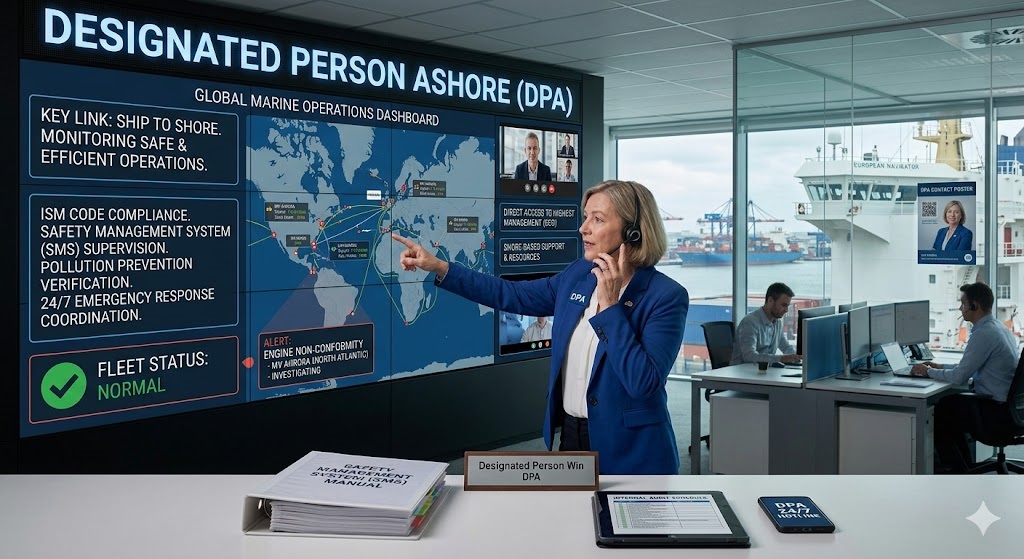
When a ship reports a potential safety issue, shore staff can support it by acknowledging the report, arranging technical help and escalating through the company’s safety management system. Keep operational forecasts provisional while the responsible people assess the issue. Where the ISM Code applies, the company’s designated person ashore provides a link between the ship and the highest level of management and monitors whether adequate resources and shore support are available. IMO Assembly resolution A.741(18), ISM Code, section 4
When a discussion becomes tense, bring it back to the decision and its consequences. A duty operator could say, “I have the terminal’s 17:00 request. We still need a reply from carrier operations and a check on marine services. I’ll update you at 14:30.” The recipient can then decide what to do with the information they have.
Training exercise for a shore team
Run a 20-minute tabletop exercise using the port-call scenario. Assign participants the roles of vessel representative, terminal planner, port agent and duty operator. Give the terminal planner the revised berth request, and tell the agent that marine service availability is pending. Ask the duty operator to prepare a written update and hand over the call to a replacement operator midway through the exercise.
- Check the message. Can recipients identify the event, time zone, source and status without asking for clarification?
- Check the decision. Does the record identify who has authority to confirm the revised time and who is checking each outstanding service?
- Check the handover. Can the replacement operator give the next update using the record and state which messages still need a reply?
- Review the result. Identify one ambiguous line or missed acknowledgement. Rewrite it and repeat that step to see whether the receiving team now takes the intended action.
For regular coaching, use a small sample of real handovers and check whether each open item has an owner, a next update time and a clear status. Review the written record with both the sender and receiver so that the team can see where a message changed meaning.