

An engineer collapses near the control room. A deckhand suffers a serious cut during maintenance. A cook is scalded by boiling water. In each situation, the first person to respond is likely to be a colleague. On a ship far from port, professional medical help may be hours away, and the crew’s first actions can influence what happens next.
First aid training prepares seafarers to recognise emergencies, summon assistance and provide immediate care while further help is organised. It also teaches an equally important skill: recognising when an attempted rescue or treatment could make the situation worse.
A reliable onboard response depends on trained people, accessible equipment, clear responsibilities and effective contact with medical services ashore. A certificate provides a foundation; practical preparation turns that foundation into a capability the ship can use.
This article is an educational overview for maritime crews, mainly concerning adults. It does not replace approved practical training, the ship’s medical guide or professional medical advice. In a real emergency, activate the ship’s emergency response immediately and obtain medical assistance without delaying essential lifesaving care.
Why First Aid at Sea Requires Particular Preparation
Ships combine industrial hazards with the challenges of an isolated workplace. Machinery, electricity, hot surfaces, chemicals, moving equipment and steep access routes create different injury risks. Sudden illness can also occur in a cabin, mess room or on watch, away from an obvious workplace hazard.
A vessel may have limited medical facilities and no doctor onboard. Weather, distance and the availability of rescue services can delay evacuation. The crew may therefore need to monitor and support a casualty for a prolonged period under professional remote guidance.
Even moving a patient can be difficult. A stretcher that fits a hospital corridor may be awkward on a ship’s stairway. Radios may not work equally well in every compartment, and finding an unfamiliar equipment locker can take valuable time. Training should address these practical realities before an emergency exposes them.
Understand the Different STCW Training Levels
The International Convention on Standards of Training, Certification and Watchkeeping for Seafarers, known as STCW, distinguishes elementary first aid from more advanced medical responsibilities. The required level depends on a person’s duties and the applicable certification and flag-state requirements.
| Training level | STCW competence table | General purpose |
|---|---|---|
| Elementary First Aid | A-VI/1-3 | Immediate first aid as part of relevant basic safety training |
| Medical First Aid | A-VI/4-1 | Competence for personnel designated to provide medical first aid onboard |
| Medical Care | A-VI/4-2 | Competence for personnel designated to take charge of medical care onboard |
These qualifications are not interchangeable. Holding elementary first aid training does not qualify someone to take charge of medical care. Conversely, having a designated medical-care person does not remove the need for other crew members to recognise an emergency and call for help.
Companies should verify course approval, recognition, role requirements and any updating obligations with the relevant administration. Do not assume that every medical or safety certificate follows the same renewal cycle. Practical refresher exercises can be valuable even where a particular certificate does not require routine renewal.
Establish a Clear Onboard Response
Everyone joining a vessel should learn how to report a medical emergency, whom to contact and where relevant equipment is stored. An alarm should communicate the location, the number of casualties and any continuing hazards. “Person collapsed in the workshop beside the aft entrance” is more useful than “Someone needs help downstairs.”
The emergency organisation should identify who provides care, who brings equipment, who communicates with the bridge and who prepares access for additional responders. People may perform more than one role, depending on crew size and circumstances, but responsibilities must remain clear.
The bridge should coordinate external assistance while maintaining the ship’s navigational safety. Medical communication and arrangements for evacuation should not leave other essential ship functions unattended. An effective drill tests this coordination as well as the actions beside the patient.
Scene Safety: Protect the Rescuers
Before approaching a casualty, assess the surroundings. Moving machinery, electrical energy, steam, suspended loads or hazardous substances may still be present. Have the responsible personnel make the area safe using the ship’s procedures. Use appropriate protective equipment without unnecessarily delaying urgent care.
Do not rush into a tank, hold or other enclosed space to rescue a collapsed person. Raise the alarm and activate the trained rescue team. Entry into a dangerous atmosphere requires the established rescue arrangements, properly trained personnel and suitable equipment. An emergency escape breathing device, or EEBD, is for escape and must not be used as rescue-entry breathing apparatus.
For an electrical casualty, do not touch the person while they may remain in contact with an energised source. Arrange safe isolation by competent personnel, particularly around high-voltage equipment. First aid training does not confer electrical rescue competence. Once safe access is established, assess the casualty and obtain urgent medical assistance.
Assess the Casualty and Recognise Immediate Threats
First aid courses should teach a structured assessment that helps responders identify urgent problems. The ABCDE approach considers airway, breathing, circulation, disability and exposure. In this context, disability means assessing neurological status, including responsiveness, rather than making assumptions about a person’s long-term health.
Assessment and treatment are linked: deal with an immediate threat as it is found rather than finishing a checklist first. An unresponsive person requires an immediate call for help and assessment of breathing. Catastrophic bleeding also demands prompt attention. Do not delay CPR or bleeding control while collecting a complete medical history.
Essential Skills Every Training Programme Should Address
The following topics illustrate priorities for practical instruction. They are brief reminders, not complete treatment protocols. Hands-on learning should use the current guidance adopted by the approved training provider and appropriate equipment.
Adult CPR and automated external defibrillation
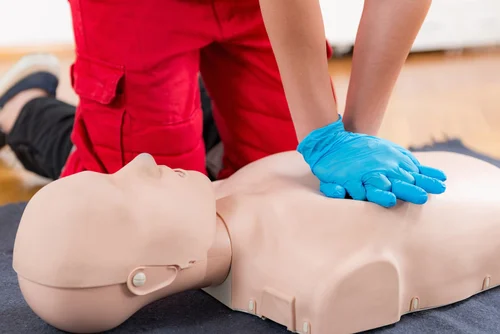
If an adult is unresponsive and not breathing normally, treat this as suspected cardiac arrest. Occasional gasps are not normal breathing. Activate the ship’s emergency response, send someone for the automated external defibrillator (AED) if available, and begin CPR without waiting for a remote consultation.
Current adult guidance recommends chest compressions in the centre of the chest, over the lower half of the breastbone, at 100–120 compressions per minute, approximately 5–6 cm deep, allowing full recoil. Trained rescuers should alternate 30 compressions with two rescue breaths. If unable to give breaths, provide continuous chest compressions.
Switch on the AED and follow its instructions. Nobody should touch the casualty during analysis or shock delivery; resume CPR as directed. Continue until professional help takes over or advises stopping, the person shows clear signs of recovery and normal breathing, or continuing becomes unsafe or physically impossible.
Training should develop confidence in recognising arrest and using the AED, including when the unit advises that no shock is needed.
Severe bleeding
Apply firm, continuous direct pressure to an accessible bleeding wound using a suitable dressing. Use gloves where available. Do not remove an embedded object; apply pressure around it and obtain urgent help.
Training should include recognising life-threatening bleeding and using the equipment carried onboard. For severe limb bleeding, this may include a suitable tourniquet when indicated and used by trained personnel. Wound packing and haemostatic dressings also require appropriate instruction. Monitor the casualty’s breathing and responsiveness while assistance is arranged. An apparently controlled wound still needs assessment and follow-up.
Burns and scalds
For a thermal burn, stop the exposure safely and cool the affected area under cool running water for 20 minutes. Remove nearby jewellery and loose clothing, but leave material stuck to the burn in place. Avoid ice, butter and creams. Protect the rest of the casualty from becoming cold, then cover the burn appropriately as taught.
Large or deep burns, suspected inhalation injury and burns caused by electricity or chemicals require urgent medical advice and assessment. Chemical exposures need substance-specific guidance and protection against secondary contamination; a simple thermal-burn procedure is not a complete response to every chemical incident.
Choking
Training must distinguish effective coughing from severe airway obstruction. Encourage effective coughing; when it becomes ineffective, trained responders use the appropriate sequence of back blows and thrusts. If the person becomes unresponsive, begin CPR and ensure help has been summoned. Never perform blind finger sweeps. Include the adaptations required for different patients and medical assessment after treatment involving thrusts.
Drowning and cold exposure
Use the ship’s person-overboard and recovery arrangements; do not enter the water impulsively. After safe recovery, an unresponsive person who is not breathing normally needs immediate resuscitation. Drowning-specific guidance for trained responders begins with five rescue breaths, followed by standard CPR. If breaths cannot be given, start compressions rather than doing nothing and obtain help urgently.
Training should also cover safe handling after cold-water immersion, protection from further heat loss and continued medical assessment. Equipment and advanced treatments should only be used within the responder’s competence and appropriate medical direction.
Sudden illness and other injuries
Crews should learn to recognise possible heart attack, stroke, severe allergic reaction, seizure, heat illness and diabetic emergencies. They should also practise supporting suspected fractures and managing casualties with possible head or spinal injuries according to approved guidance.
For stroke recognition, FAST draws attention to facial weakness, arm weakness and speech difficulty: time is critical, so seek emergency medical help immediately. These are not the only possible symptoms. Record when symptoms began, or when the person was last known well, and do not dismiss symptoms because they improve. At sea, activate the ship’s emergency and medical-assistance arrangements rather than waiting until the next scheduled port.
Telemedical Assistance: Connecting the Ship With a Clinician
A Telemedical Assistance Service (TMAS) provides remote medical advice to ships. Crew should know the contact route relevant to their operating area and the vessel’s procedures. In the UK system, for example, the Maritime and Coastguard Agency directs ships to contact HM Coastguard, which connects them with a designated TMAS provider. That example is not a universal worldwide contact procedure.
Seek advice early for serious illness, significant injury or uncertainty about treatment. Have the ship’s identity, position and communication details ready, together with the casualty’s symptoms, relevant history, observations and treatment already given. State what equipment and medicines are available. Do not delay the first call while trying to complete every detail.
Read back important instructions, record advice and timings, and report changes in condition. Photographs may help when requested and appropriate, but should be shared securely with respect for patient privacy. Remote advice supports onboard care; it does not make hospital assessment unnecessary.
Prepare for Evacuation and Medical Handover
The master, medical adviser and relevant rescue coordination service need to work together when considering diversion or evacuation. Weather, distance, the patient’s condition and the safety of transfer all affect the options. A helicopter cannot be assumed to be available or able to reach the ship immediately.
Training should cover preparing an accurate handover and locating essential documents without interrupting care. A short written record should identify the casualty, what happened, changes observed, advice received and treatment given with times. Include known allergies and relevant medicines, and distinguish confirmed information from uncertainty.
Follow the rescue service’s instructions for transfer preparations. Use approved casualty-handling arrangements and trained personnel. Casualty movement, lifting and stretcher exercises require their own risk assessment; practising a rescue must not create another emergency.
Keep Medical Equipment Ready for Use
The ship’s medical stores, equipment and medical guide should meet the applicable flag-state requirements and be suitable for the vessel’s operation. Requirements may vary with the voyage, personnel carried and cargo. An internet checklist should not be used as a substitute for the applicable scale of medical stores.
Allocate responsibility for checking stock, expiry dates, packaging, storage conditions and the serviceability of equipment. Where an AED is carried, include its readiness indicator, batteries and electrode-pad expiry in the checks. Replenish items after use and ensure essential equipment can be found quickly.
Training should use the models actually carried wherever practicable. A crew member familiar with one stretcher or oxygen system may still need instruction on another. Medicine administration and clinical equipment require appropriate competence, authorisation and medical guidance; unfamiliar equipment should not be improvised with during an emergency.
Printed or otherwise reliably accessible medical guidance is important when connectivity fails. Staff should know where it is and how to find the relevant information under pressure.
Design Training Around the Vessel’s Risks
A useful programme combines an approved course with vessel-specific familiarisation and realistic practice. Its content should reflect work actually performed onboard, including machinery maintenance, food preparation, cargo handling and access to remote compartments.
Instructors should set observable learning objectives. “Understand first aid” is too broad to assess. More useful objectives include recognising abnormal breathing, reporting an exact location, finding emergency equipment and giving a concise handover. Each participant needs opportunities to practise; watching a colleague perform a task does not demonstrate individual competence.
Use CPR manikins, training AEDs and simulated wounds for practical exercises. Do not deliver real AED shocks, perform forceful thrusts or compressions on healthy volunteers, or use real medicines for practice. Clearly mark the exercise and its communications so that responders distinguish a drill from an actual emergency.
A practical sequence might begin with a short skills station, progress to a small-team scenario and finish with a debrief. Repeating a difficult element after feedback helps convert an identified weakness into an improvement.
Example Drills for Commercial Ships
The following scenarios are training suggestions. They should be adapted to the vessel’s safety management system and delivered without creating real exposure to the hazard.
| Training scenario | Main learning objective | What the assessor should observe |
|---|---|---|
| Collapse in the accommodation | Recognise suspected cardiac arrest and coordinate assistance | Early alarm, breathing assessment, CPR and training-AED use |
| Simulated machinery-work injury | Control severe bleeding while protecting rescuers | Hazard control, direct pressure and effective task allocation |
| Galley scald scenario | Start appropriate burn care | Safe access, prompt cooling and recognition of escalation needs |
| Casualty visible inside a tank | Prevent an impulsive, unsafe rescue | Alarm, no unauthorised entry and activation of the rescue plan |
| Suspected stroke on watch | Recognise urgent illness and seek assistance | Clear symptom report, timing information and prompt escalation |
| Prolonged-care tabletop exercise | Maintain communication and prepare handover | Accurate observations, written records and follow-up reporting |
A good exercise tests more than whether equipment arrives quickly. It can reveal a radio dead spot, a blocked access route or uncertainty about who contacts medical services. The debrief should identify the cause and assign responsibility for correcting it.
Do not reward speed at the expense of safety. A responder who stops at the entrance to a suspect atmosphere and activates the rescue plan is demonstrating good judgment, even if no immediate physical contact with the casualty occurs.
Refresh Skills and Verify Individual Readiness
First aid is often used infrequently, so companies should create opportunities for safe practice between formal courses. Short sessions can focus on one skill, while broader scenarios test coordination. The frequency should reflect applicable requirements, vessel risks, crew changes and the results of previous exercises.
Assessment should examine what each person can do. If one experienced officer always leads, other crew members may never practise making the first decisions. Rotate appropriate roles, include new joiners and offer extra coaching where needed.
Record meaningful learning outcomes rather than attendance alone. For example, “crew located the correct kit and transmitted an accurate report after clarification of compartment names” provides more useful information than “drill completed satisfactorily.” Check during a later exercise whether the improvement has been sustained.
Communication, Dignity and Support
Speak calmly, explain what is happening and seek consent when the casualty is able to respond, following training and applicable rules. Use clear language and protect privacy during examination and communication. Do not circulate casualty photographs or medical details in informal crew groups.
A serious medical incident can also affect witnesses and responders. After immediate care and operational needs are addressed, offer an opportunity to discuss what happened and access appropriate support. Reviewing the response should help the crew learn without turning an honest account of difficulties into blame.
Frequently Asked Questions
Is first aid only the responsibility of a designated officer?
No. Designated personnel have particular medical responsibilities, but the first witness may be any crew member. Everyone should know how to raise the alarm, report hazards and obtain help, and should act within their training.
Should the crew wait for TMAS before starting CPR?
No. Suspected cardiac arrest requires immediate CPR and AED use when available. Other crew members should summon assistance and arrange medical communication alongside the response.
Does completing a course remove the need for onboard practice?
No. Vessel layout, communications and equipment differ. Familiarisation and drills help crews apply their skills in the environment where they will actually work.
Must every medical certificate be renewed every five years?
Do not assume a single rule covers every qualification. Check the current requirements of the flag administration and the role concerned. Maintaining practical competence remains important regardless of a certificate’s expiry arrangements.
Prepared Crews Make the First Response Possible
First aid capability grows from preparation: people who recognise danger, equipment that is ready, clear communication and early access to medical expertise. Each element supports the others.
By combining approved training with realistic drills, competent supervision and reliable medical support, shipping companies can help crews respond confidently when a colleague’s life depends on the first few minutes.
Sources and Further Reading
The following sources support the clinical reminders and training framework. UK material illustrates national implementation; ships operating under other flags should consult their own administrations and approved medical guidance.
- IMO: STCW Convention and Code
- MCA: MSN 1865 (M), Amendment 1—STCW emergency, safety and medical training requirements
- Resuscitation Council UK: 2025 Adult Basic Life Support Guidelines
- Resuscitation Council UK: 2025 First Aid Guidelines
- Resuscitation Council UK: 2025 Special Circumstances Guidelines, including drowning
- American Red Cross: Life-Threatening External Bleeding
- NHS: Burns and Scalds
- NHS: Symptoms of a Stroke
- MCA: Telemedical Advice Service for Ships at Sea
- MCA: The Ship Captain’s Medical Guide, 24th Edition
- MCA: Enclosed-Space Safety and Rescue Guidance
- NHS 111 Wales: First Aid, including electrical injuries