
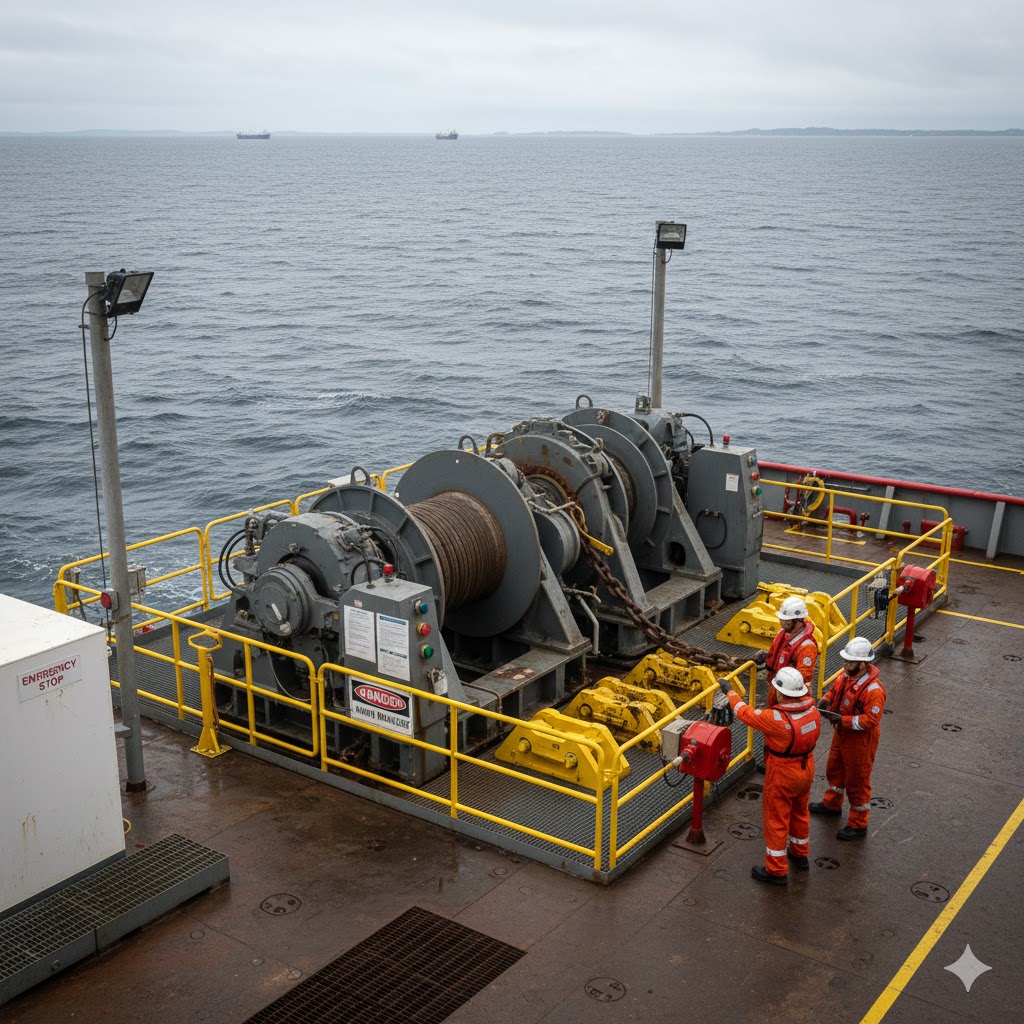
A practical guide to anchor equipment, planning, letting go, anchor watch and weighing anchor
An anchored ship can move around its anchor as the wind and current change. A safe anchorage therefore requires enough water, suitable holding ground, room for the ship to swing, sound equipment and a watch that can recognise when the anchor starts to drag. The bridge, engine room and anchor party must also be ready to act when conditions deteriorate.
This guide introduces the principles and vocabulary used on merchant ships. Details of anchor handling, equipment limits and emergency response depend on the vessel, its safety management system, the manufacturer’s instructions and local requirements. The master assesses the conditions and decides how to conduct the operation.
1. What keeps a ship at anchor?
The anchor holds by engaging with the seabed. The chain cable helps transmit the load from the ship to the anchor. When part of the cable lies along the seabed, it helps keep the pull on the anchor closer to horizontal and absorbs some movement. As the load rises, more cable may lift from the seabed, the pull can become steeper and the anchor may break out or drag. Holding performance depends on the anchor design, seabed, cable arrangement, water depth and forces acting on the vessel.
Sand and firm mud can provide useful holding ground, depending on local conditions and anchor type. Rock, hard surfaces, weed, soft mud or mixed seabeds may make setting or reliable holding difficult. A chart’s seabed description is an aid to planning. Local information and the observed behaviour of the anchor and vessel also matter.
-
Ship and bow equipment
Wind, current and waves act on the vessel. -
Chain cable
The cable transmits the load and may lie partly on the seabed. -
Anchor and seabed
The anchor engages with the bottom to resist the pull.
Holding depends on the complete system and the prevailing conditions. The cable shape changes as the load changes.
2. Main anchoring equipment
| Equipment | Function |
|---|---|
| Anchor | Engages the seabed. Many merchant ships carry stockless anchors. Other vessels use high-holding-power designs suited to their equipment and service. |
| Chain cable | Connects the anchor to the ship and is normally marked at intervals so the party can report the amount paid out. |
| Hawse pipe | Guides the cable through the bow and provides the housing into which the anchor is normally secured. |
| Windlass and cable lifter | Control cable handling within the equipment’s operating limits. The cable lifter is often called a gypsy. |
| Brake and chain stopper | Control and secure the cable according to the vessel’s arrangement and operating procedure. A fitted stopper normally takes the cable load when engaged. |
| Chain locker and bitter end | The locker stores the cable. The bitter end is its inboard termination, fitted according to the vessel’s design. |
A shackle of cable, also called a shot, is commonly 27.5 metres. Markings and the exact length should be verified on the ship’s cable plan. When the anchor party reports “four shackles in the water”, the bridge needs to understand the vessel’s convention for where the marks are counted. The report is a length indication and does not by itself establish how much cable is lying on the seabed.
3. Selecting and planning an anchorage
The master and bridge team assess the planned position and the whole area the ship could occupy as conditions change. An assigned anchorage still needs to be checked for the particular ship’s draught, manoeuvring characteristics and expected stay.
- Depth and under-keel clearance. Assess the charted depth, datum, predicted tide, draught, squat during the approach where relevant, and the company’s clearance policy. Account for changes over the entire stay.
- Seabed and obstructions. Check the holding ground, wrecks, rocky areas, prohibited zones, pipelines, power and communication cables, and charted uncertainty. Use current charts and local notices.
- Weather and exposure. Consider forecast wind, sea, swell, current and tidal changes, the vessel’s windage and the possibility of conditions exceeding the equipment’s capability.
- Space and traffic. Allow for the ship’s swing, nearby vessels, their different cable lengths and swinging behaviour, traffic routes and room to manoeuvre.
- Contingencies. Identify limits for calling the master, required engine and anchor-party readiness, available safe water, communications with the port and a plan for leaving if conditions warrant.
Marine authorities also stress the need to identify submarine cables and pipelines before and during anchoring. A dragging anchor can damage infrastructure beyond the ship’s initial position. UK Maritime and Coastguard Agency, MGN 661
4. Cable scope and swinging room
Scope expresses the length of cable paid out relative to the vertical distance from the bow cable outlet to the seabed. The definition used in a particular ship’s procedure may use a different reference point, so the figures must be compared consistently. More cable can help the anchor hold, but it also changes the area needed for the ship to swing. Scope is chosen for the conditions and equipment rather than from a fixed universal number.
Consider water depth at the expected highest tide, the height of the hawse pipe above the water, holding ground, forecast loads, the ship’s draught and available sea room. The master also checks the ship’s guidance and local restrictions. Deep-water anchoring demands particular attention to the windlass and brake limits. UK guidance states that, where cable is required to be walked out after the anchor has landed, the vessel’s speed over the ground should not exceed the windlass’s design hoisting speed. UK MCA, MGN 592, section 2
Assume 25 m of water at the time considered, a hawse pipe 5 m above the water, and 5 shackles paid out at 27.5 m per shackle.
Cable length = 5 × 27.5 = 137.5 m
Vertical distance = 25 + 5 = 30 m
Scope = 137.5 ÷ 30 ≈ 4.6:1
This example explains the arithmetic. It does not determine the safe cable length for a particular anchorage. If the tide rises, the vertical distance and scope change.
The anchor position forms the reference for assessing the vessel’s swing. For an initial, conservative estimate, add the cable length paid out to the horizontal distance from the bow cable outlet to the stern. This is a geometric allowance, not a prediction of the exact track. Plot and monitor the ship’s movement with the appropriate antenna-to-bow offset and alarm settings. Check that the entire possible swept area and adequate margins clear hazards and other ships.
5. Preparing to anchor
Before the approach, the bridge team agrees the intended position, anchor, amount of cable, approach and contingency plan. The anchor party is briefed on its roles, the communication method, expected cable markings, equipment operation and safe positions. The engine room is informed of the required machinery readiness.
The party checks the windlass power, brake, controls, stopper, securing arrangements and communications in accordance with the ship’s procedure. It checks the forecastle for personnel hazards, confirms the selected anchor is ready and reports readiness to the bridge. Personnel remain clear of the moving cable, cable lifter and potential paths of a released or failed component. They follow the ship’s personal protective equipment and safe-access requirements. UK MCA, MGN 592
6. Letting go and bringing the ship up
The bridge approaches the selected position at a controlled speed and assesses movement over the ground. The master’s manoeuvre accounts for the wind and current. The anchor party operates only on clear orders, using the method and depth limits specified for the ship. The anchor may be walked back under power or released under controlled braking when that method is permitted and appropriate.
As the cable runs out, the party reports the amount, its direction and the observed strain or lead using the ship’s standard terms. The bridge uses those reports with position, speed and the manoeuvre to judge how the cable is laying. Excessive vessel movement or uncontrolled cable run-out can overload equipment and endanger the party. The windlass is not a device for stopping a ship moving at speed.
When the planned cable is out, the party applies the ship’s procedure for braking and securing it. Once the vessel is brought up, the team checks whether the anchor is holding by observing the ship’s movement and taking independent position checks. Engage the fitted chain stopper and secure the arrangement as required by the vessel’s instructions. Record the anchor position, time, cable paid out and other information required by the bridge procedures.
7. Keeping an effective anchor watch
The officer of the watch maintains a proper lookout and checks the ship’s position at intervals appropriate to the conditions. Use all suitable means, such as radar ranges and bearings, visual bearings or transits, electronic position and chart display, depth information and the vessel’s movement history. An anchor alarm provides an additional warning. Its settings must account for the anchor position, expected swing, positioning uncertainty and the location of the position sensor.
Compare the ship’s positions over time. A vessel may swing as wind or tide changes while its anchor continues to hold. A consistent movement of the entire position pattern towards a hazard, an unexpected change in bearings or distance, repeated alarm activation, unusual cable behaviour, or a report from another vessel may indicate dragging. Assess the evidence promptly and call the master in line with standing orders. Do not wait for a single alarm if the situation already raises doubt.
Monitor nearby ships as well as the vessel’s own position. A neighbouring ship can drag or swing differently. Continue to check the forecast, traffic, visibility, under-keel clearance and the readiness of the engine and anchor party. The UK Marine Accident Investigation Branch found that insufficient cable in the prevailing tidal conditions contributed to the grounding of Islay Trader. MAIB investigation, Islay Trader
8. What to do if the anchor is dragging
If dragging is suspected, call the master immediately and act under standing orders and the ship’s emergency procedures. Inform the engine room and prepare propulsion and steering as directed. Alert the anchor party and arrange the necessary bridge team. Assess the vessel’s movement, remaining distance and time to danger, traffic and available manoeuvring water. Warn the port authority and nearby vessels when appropriate.
The master assesses whether conditions allow additional cable, engine assistance, weighing and re-anchoring, or departure to safer water. Each option depends on the available sea room, equipment limits, weather, machinery readiness and proximity of cables, pipelines and other ships. Deploying a second anchor introduces further operational risks and requires a specific assessment. In severe weather, a timely decision to leave may be necessary before recovery becomes difficult. Britannia P&I, dragging anchor prevention · MAIB, cruise ship anchor failures
9. Weighing and securing the anchor
Before weighing, the bridge and anchor party confirm communications, the intended manoeuvre, windlass readiness and machinery availability. The bridge uses the ship’s propulsion as appropriate to reduce the load on the windlass and avoid hauling the vessel towards the anchor by windlass power alone. The party reports cable direction and strain, the amount remaining, when the cable is up and down, and when the anchor is aweigh.
Up and down describes cable leading approximately vertically. Anchor aweigh means the anchor has broken free of the seabed. It can still be below the surface, so continue to monitor its recovery. Report if the anchor is fouled, damaged or obstructed. Do not assume it is clear or home until the party has verified its position. Wash and inspect the anchor and cable as practicable, then secure the anchor for sea with the required brake, stopper and additional securing devices under the vessel’s procedure. Record and report defects.
10. Anchor lights, shapes and local requirements
Apply the International Regulations for Preventing Collisions at Sea, including the relevant provisions of Rule 30 for a vessel at anchor. The required lights and shape depend on vessel length and circumstances, and the rules contain specific exceptions. Check the complete rule and any applicable local requirements rather than relying on a single general description. IMO overview of the COLREGs
11. Practical anchoring checklist
Before arrival
- Review depth, tide, under-keel clearance, seabed, restrictions and submarine hazards.
- Assess the swinging area, traffic, weather forecast and planned escape route.
- Agree the anchor, cable, operating method, communication and machinery readiness.
- Brief the party and check the equipment within the ship’s procedures.
After letting go
- Record the anchor position, time and cable out, and confirm the vessel is holding.
- Secure the cable and display the applicable lights or shape.
- Establish position checks, alarm limits, master’s call criteria and anchor watch.
Before departure
- Confirm bridge, engine room and anchor-party readiness and communications.
- Monitor cable direction and strain while recovering the anchor.
- Verify the anchor is clear, home and secured for sea. Report and record defects.
Key terms
| Term | Meaning |
|---|---|
| Let go | Release the anchor under the approved method. |
| Walk back | Lower the anchor and cable using the powered windlass. |
| Brought up | The vessel’s movement has been checked by the anchor and cable, subject to confirmation that the anchor holds. |
| Dragging | The anchor moves over the seabed instead of holding its position. |
| Aweigh | The anchor has broken free of the seabed. |
| Fouled anchor | An anchor entangled with its cable, another object or an obstruction. |
Sources and further reading
- UK Maritime and Coastguard Agency · MGN 592, anchoring and related equipment
- UK Maritime and Coastguard Agency · MGN 661, safe anchoring near submarine infrastructure
- Britannia P&I · Dragging anchor prevention
- Britannia P&I · Safe anchoring and mooring procedures
- UK Marine Accident Investigation Branch · Grounding of Islay Trader
- UK Marine Accident Investigation Branch · Cruise ship anchor failures
- International Maritime Organization · COLREGs overview