
An educational guide for maritime students and engineer cadets
Learning goal: After reading this article, you should be able to explain a PMS, understand how a maintenance job becomes due, prepare the job safely, record its result, and report a defect.
Important: The tasks and intervals used below are teaching examples. On board, follow the ship’s current Safety Management System (SMS), equipment manuals, and applicable flag and classification requirements.
1. What is a PMS?
A Planned Maintenance System (PMS) organizes maintenance on a ship. It answers five questions:
| Question | Example |
|---|---|
| What equipment needs attention? | Sea-water cooling pump No. 2 |
| What work is required? | Inspect the strainer and check for leakage |
| When is it due? | At the interval in the ship’s approved plan |
| Who will do it? | An assigned engineer |
| How will the result be recorded? | In a work order with findings and test results |
A PMS may be a computer system or a controlled paper system. It can cover engines and generators, pumps, electrical equipment, deck machinery, cargo systems, the hull, and safety and pollution-prevention equipment.
In simple words: a PMS helps the crew plan the right work and keep a truthful history of what was done.
2. Why is planned maintenance important?
Ships operate for long periods away from repair workshops. Equipment is exposed to vibration, heat, salt water, and changing loads. A small problem may become a serious failure if nobody notices it.
| Without effective maintenance | With effective maintenance |
|---|---|
| A filter blocks and machinery trips. | A rising pressure difference is noticed and investigated. |
| The next engineer cannot find the last repair. | The job history shows the findings and parts used. |
| A standby pump fails when needed. | Its readiness is tested and the result is recorded. |
| A job is delayed without explanation. | The reason, controls, and new plan remain visible. |
The PMS also helps people ashore. A technical superintendent can review defects, order spares, arrange specialist support, and plan larger repairs for a port stay or dry dock.
3. PMS, SMS, and the ISM Code
The International Safety Management (ISM) Code addresses maintenance in section 10. It requires company procedures for maintaining ships and equipment, inspections at appropriate intervals, reporting of non-conformities, corrective action, and records. It also calls for measures for equipment whose sudden failure could create danger, including regular testing of standby arrangements.
The ISM Code does not give one service interval for every pump or engine. The company uses its SMS to define responsibilities and procedures. The PMS then helps schedule and document the work.
There is another use of the term PMS: a class-approved Planned Maintenance Scheme for machinery. This is a specific survey arrangement with classification requirements. Having maintenance software does not automatically mean that a ship has an approved machinery PMS survey arrangement.
| Term | What it means for a student |
|---|---|
| SMS | The company’s procedures and responsibilities for safe operation. |
| Shipboard PMS | The maintenance jobs, due dates, results, and history. |
| Class PMS survey scheme | A separately approved arrangement for certain machinery surveys. |
| Maker’s manual | Instructions and limits for a particular item of equipment. |
4. Types of maintenance
| Type | Simple meaning | Shipboard example |
|---|---|---|
| Time-based preventive | Work at a calendar interval. | Inspect equipment at the interval in the ship’s plan. |
| Running-hour preventive | Work after equipment operates for a set number of hours. | Service a generator component when due. |
| Condition-based | Use readings or inspection to decide on action. | Investigate abnormal pump vibration. |
| Predictive | Study trends to estimate a developing problem. | Compare several lubricating-oil analysis reports. |
| Corrective | Repair a fault found during operation or inspection. | Replace a leaking seal. |
| Breakdown or emergency | Respond after equipment fails. | Restore a failed pump and investigate why it failed. |
These types work together. A pump can have scheduled inspections and condition readings. If a leak appears between inspections, it must still be reported.
5. What does a PMS record look like?
A useful PMS begins with a clear equipment tree. This helps the engineer select the correct item.
| Level | Example name and ID | Meaning |
|---|---|---|
| Ship | Training Vessel A | Select the correct vessel. |
| System | SW — sea-water cooling | Find the relevant system. |
| Equipment | SWP-02 — pump No. 2 | Select the physical pump. |
| Component | SWP-02-STR — suction strainer | Find the part concerned. |
These IDs are examples; companies use different naming systems.
A maintenance job card should identify the equipment, location, task, due trigger, instruction source, safety preparation, required spares, acceptance criteria, findings, test result, and people who performed and verified the work.
Names of commercial PMS systems
Students may encounter DNV ShipManager Technical, SpecTec AMOS Maintenance, or SERTICA Maintenance. These are examples of maritime software, not recommendations. Their screens differ, but they support the planning and recording of maintenance. A company may use another platform or its own controlled system. ShipManager Technical
6. How does the maintenance cycle work?
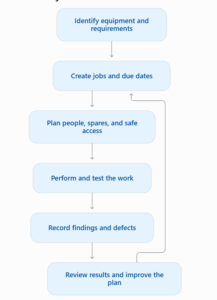
- Identify the equipment. Record its unique ID, location, manual, and spare parts.
- Define the job. Use the correct maker instructions, company procedures, and applicable requirements.
- Set the due trigger. It might be a date, running hours, a measured condition, or a combination.
- Plan the work. Consider the voyage, cargo operations, crew, spares, and whether the equipment can be taken out of service.
- Prepare safely. Assess hazards, communicate with affected teams, and follow permit and isolation procedures.
- Perform and test. Record measurements and compare them with the correct limits.
- Close the job truthfully. Record what was done and keep any unresolved defect open.
- Review the results. Repeated failures may show that a procedure, interval, spare-part supply, or repair method needs attention.
The ship and shore office share this information. The crew records actual hours and findings; the technical office can arrange spares, maker support, or work during a port stay. They should refer to the same equipment ID and defect number.
7. How do running hours make a job due?
Imagine a teaching job that says “inspect every 2,000 running hours.” The last inspection was completed when the meter showed 4,800 h.
| Last inspection | Interval | Next due | Current meter | Remaining |
|---|---|---|---|---|
| 4,800 h | 2,000 h | 6,800 h | 6,600 h | 200 h |
If the machine operates about 20 hours per day, the engineer estimates that the job will become due in about 10 days. This is an estimate: actual operation may change.
Some jobs use a calendar limit, some use running hours, and some use whichever comes first. Always read the actual job instruction.
8. Safety before opening equipment
A PMS tells you that work is due. It does not make the equipment safe to work on. Consider electrical power, automatic starting, pressure, hot surfaces, rotating parts, stored energy, fuel, chemicals, sea connections, and the effect of losing an essential service.
Pre-job checklist
- Confirm the correct equipment ID and physical location.
- Read the current job card, manual, and drawing.
- Inform the responsible officer and other affected teams.
- Assess hazards and obtain any required permit.
- Follow the ship’s isolation and lockout procedures.
- Drain, depressurize, and verify a safe condition where required.
- Prepare the correct tools, spares, and protective equipment.
- Know how the equipment will be tested before return to service.
Return-to-service checklist
- Remove tools, loose parts, and waste.
- Refit covers and guards.
- Restore valves, breakers, interlocks, and controls under the approved procedure.
- Check relevant leakage, pressure, temperature, current, vibration, and alarms.
- Complete the functional test.
- Tell affected officers whether the equipment is available.
- Record the result and any remaining defect.
9. Critical equipment and defects
The company must identify equipment whose sudden failure could lead to a hazardous situation and take measures to improve its reliability. The ship’s SMS identifies its actual critical equipment and testing arrangements.
Possible examples include steering arrangements, an emergency generator, fire pumps, and essential cooling or lubricating-oil arrangements. When testing standby equipment, record what was tested, the actual result, and any fault. A failed test is a defect.
When a defect is found:
- Make the situation safe and inform the responsible officer.
- Record the equipment ID, symptoms, time, readings, and operational effect.
- Identify immediate controls or a safe backup arrangement.
- Plan the repair and obtain the needed parts and support.
- Test after repair and record the result.
- Investigate if the fault keeps returning.
If a job cannot be completed on time, keep it visible as overdue or deferred, with its reason, controls, and new plan under the SMS. Do not mark it “completed” to improve the statistics.
10. Example maintenance plan
These intervals are illustrative, not universal requirements.
| Equipment | Example task | Example trigger | What to record |
|---|---|---|---|
| Main-engine lubricating-oil system | Review filter pressure difference and oil results | Weekly review and condition alerts | Readings, trend, action |
| Diesel generator | Inspect for leaks and abnormal vibration | Weekly | Findings and readings |
| Sea-water cooling pump | Inspect seal, bearing condition, and strainer | Monthly | Findings and operating test |
| Emergency generator | Test standby readiness | As specified by the SMS | Starting and test results |
| Fire pump | Perform a functional test | As specified by the SMS | Required pressure or flow evidence |
| Cargo pump | Check seals and leakage | As specified around cargo work | Findings and service status |
| Mooring winch | Check brake and lubrication points | As specified by the plan | Findings and adjustments |
Example: an inspection finds a defect
| Field | Example entry |
|---|---|
| Work-order ID | WO-2026-104 — fictional |
| Equipment | SWP-02, sea-water cooling pump No. 2 |
| Job | Clean the suction strainer and check for leakage |
| Finding | Marine debris in strainer; small seal leak |
| Work done | Strainer cleaned |
| Follow-up | Defect DEF-2026-017 opened for seal repair |
| Test | Pump operated under supervision |
| Status | Inspection completed; seal defect remains open |
The inspection can be finished while the defect remains open. The work-order status must not hide the leak.
11. Templates for students and crew
Maintenance job card
| Field | Fill in |
|---|---|
| Vessel and department | |
| Equipment name, ID, and location | |
| Job title and work-order number | |
| Manual or procedure and revision | |
| Due date, running hours, or condition trigger | |
| Last completed, next due, and current hours | |
| Work steps and acceptance criteria | |
| Hazards, permit, isolation, and communication | |
| People, tools, spares, and expected duration | |
| Findings and measurements with units | |
| Parts used and waste handling | |
| Functional test and result | |
| Defect or follow-up number | |
| Actual completion date and running hours | |
| Performed by and verified by |
Defect and corrective-action log
| Defect ID | Equipment ID | Symptom and evidence | Safety or operational effect | Immediate control | Repair owner and target | Test result | Closure approval |
|---|---|---|---|---|---|---|---|
Weekly PMS review
- Check jobs due this week and next week.
- Forecast jobs due by running hours.
- Review overdue jobs and their recorded controls.
- Review open critical defects and standby test failures.
- Check spares, specialists, permits, and access.
- Coordinate with the voyage and cargo schedule.
- Check whether completed records include meaningful findings.
- Hand over unfinished work to the next watch or crew.
12. How can we judge PMS performance?
The figures below are invented for teaching. They show a reduction in overdue jobs during a six-week recovery plan.
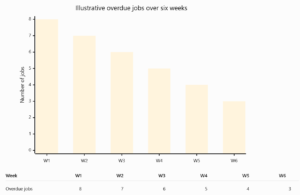
Other useful measures include repeated defects, failed standby tests, jobs delayed by missing spares, and jobs completed on time. A high completion percentage alone does not prove that the work was safe or effective.
13. A short case study
During engine-room rounds, an engineer notices that a cooling pump has more vibration than usual. Its scheduled monthly inspection is not due yet.
The engineer should record the observation, check the applicable limits and previous readings, and inform the chief engineer. The team can plan a safe inspection and prepare a standby pump if required. They should investigate the cause rather than guess it. After repair, they record the findings and operating test.
Lesson: A due date helps plan maintenance. It is never a reason to ignore a new symptom.
14. Key words to remember
| Term | Simple meaning |
|---|---|
| Interval | Time or running hours between planned jobs. |
| Running hours | Hours equipment has actually operated. |
| Job card / work order | The instruction and record for one task. |
| Defect | A fault needing investigation or correction. |
| Standby equipment | Equipment ready to operate when needed, although usually stopped. |
| Condition monitoring | Using readings and tests to understand equipment health. |
| Acceptance criteria | The limits or results used to decide whether work passed. |
| Overdue | A task has passed its due point without completion. |
Remember: A good PMS is a continuous cycle—plan, prepare safely, perform, test, record truthfully, and learn from defects.
Thx