

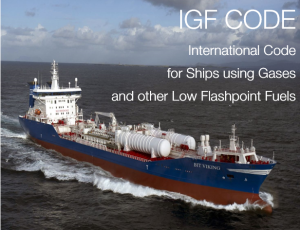
The International Code of Safety for Ships using Gases or other Low-flashpoint Fuels (IGF Code) is a mandatory international standard adopted by the IMO to regulate ships that use low-flashpoint fuels for propulsion, with its current provisions focusing primarily on liquefied natural gas (LNG). Entering into force on 1 January 2017, the Code sets out requirements for the arrangement, installation, control, and monitoring of machinery, equipment, and fuel systems to minimize risks to the ship, crew, and environment. Its basic philosophy is goal-based, providing functional requirements that address the specific safety challenges posed by fuels with low flashpoints, such as explosion risks and specialized storage needs. The Code applies to new ships and to existing ships that are converted to use these fuels, and it is periodically amended to keep pace with evolving fuel technologies and operational experience.
Spring 2026
Preamble, Part A and SOLAS Chapter II-1: Application to Gaseous Fuels and “One Ship, One Code”
MSC 111 approved draft amendments to SOLAS Chapter II-1 (regulations 2, 55, 56 and 57), with consequential amendments to the IGF Code. The amendments clarify that the Code applies to ships using gaseous fuels, whether or not those fuels are low-flashpoint fuels.
The amendments resolve an inconsistency noted at MSC 108. SOLAS Chapter II-1, Part G applied the IGF Code to ships using low-flashpoint fuels in either liquid or gaseous form, while the title of the Code referred to gases or other low-flashpoint fuels. The clarification is significant for fuels such as ammonia.
The approved amendments:
- Introduce a SOLAS definition of “gaseous fuel”: a fluid with a vapour pressure exceeding 0.28 MPa absolute at 37.8°C, or which is completely gaseous at 20°C and a standard pressure of 101.3 kPa
- Align the IGF Code definitions of “gas” (paragraph 2.2.18) and “low-flashpoint fuel” (paragraph 2.2.28) with SOLAS, and amend the title and preamble of the Code
- Clarify in SOLAS regulation II-1/56 that the IGF Code does not apply to gas carriers, reinforcing the long-standing “one ship, one code” policy
Gas carriers using products listed in Chapter 19 of the IGC Code as fuel remain subject to the IGC Code. For gaseous or low-flashpoint fuels not listed in Chapter 19, gas carriers should take into account guidelines to be developed by the Organization.
MSC 109 first approved the draft SOLAS amendments for adoption at MSC 110. MSC 110 then deferred adoption to resolve concerns over the “one ship, one code” policy. Adoption is now expected at MSC 112, together with the IGC Code amendments.
Status: Approved at MSC 111; adoption expected at MSC 112 (December 2026)
Expected Effective Date: 1 July 2028
Source: MSC 111 outcome (May 2026)
Interim Guidelines: Safety of Ships Using Hydrogen as Fuel
MSC 111 approved interim guidelines for the safety of ships using hydrogen as fuel, which had been finalised by CCC 11 in September 2025. The guidelines apply to ships using liquefied and/or compressed hydrogen as fuel to which SOLAS Chapter II-1, Part G applies. Ships carrying liquefied hydrogen as cargo remain subject to the IGC Code and the revised interim recommendations for the carriage of liquefied hydrogen in bulk.
The guidelines follow the structure and goal-based approach of the IGF Code. They aim to provide at least the same level of safety and reliability as new and comparable conventional oil-fuelled machinery. Key provisions include:
- Risk assessment of hazards specific to liquefied and compressed hydrogen, including vacuum systems
- Gas dispersion, radiation and explosion analysis to inform design and mitigation measures
- A new functional requirement addressing oxygen enrichment caused by very low temperatures
- Liquefied hydrogen stored only in vacuum-insulated tanks, with fuel preparation equipment located on open deck. Other arrangements may be accepted through the alternative design process.
- A gas-safe machinery space concept. Emergency shutdown (ESD)-protected machinery spaces may be considered through the alternative design process.
- Secondary enclosures for liquefied hydrogen piping, and double-walled piping for gaseous hydrogen unless located on open deck
The guidelines cover liquefied and compressed hydrogen only. Metal hydride and LOHC storage are being addressed separately under the CCC work plan.
Effective Date: Approved at MSC 111 (May 2026); circulated 7 July 2026
Source: MSC.1/Circ.1701
Part D: Interim Guidelines on Training for Seafarers on Ships Using Alternative Fuels
MSC 111 approved fuel-specific interim guidelines on training for seafarers on ships using methyl/ethyl alcohol as fuel and on ships using ammonia as fuel, prepared by HTW 12. They build on the generic interim guidelines on training for seafarers on ships using alternative fuels and new technologies, approved at MSC 110 (STCW.7/Circ.25).
Training of seafarers on ships subject to the IGF Code is governed by STCW regulation V/3 and section A-V/3 of the STCW Code. The interim safety guidelines for methyl/ethyl alcohol (MSC.1/Circ.1621) and ammonia (MSC.1/Circ.1687) apply these requirements while taking into account the specific hazards of each fuel. The new training guidelines are intended to be the primary reference for developing and approving such training. They establish:
- Familiarization for all seafarers before assignment to shipboard duties, in accordance with STCW regulation I/14.5
- Basic training for seafarers with designated safety duties for the care, use of or emergency response to the fuel and its systems
- Advanced training for masters, engineer officers and all personnel with immediate responsibility for the care and use of the fuel and its systems
- Tables of knowledge, understanding and proficiency (KUP) for each training level, based on the generic guidelines
Consistent with the generic guidelines, where these provisions differ from mandatory instruments such as the IGF Code or the STCW Convention, the mandatory provisions take precedence.
Effective Date: Approved at MSC 111 (May 2026); circulated 6 July 2026
Source: STCW.7/Circ.26; STCW.7/Circ.27; STCW.7/Circ.25
Fall 2024
Parts A and A-1: Further IGF Code Amendments
MSC 109 adopted a further package of amendments to the IGF Code, which had been approved in draft at MSC 108. The amendments address ship design, fire safety, explosion prevention and ventilation for ships using natural gas as fuel.
Most provisions apply to ships constructed on or after 1 January 2028. New paragraph 2.2.44 defines these as ships with a building contract placed on or after 1 January 2028, a keel laid on or after 1 July 2028 (where there is no building contract), or delivery on or after 1 January 2032.
Key amendments include:
- Paragraphs 5.3.3.5.1 and 5.3.4.2: suction wells in fuel tanks may protrude below the inner bottom plating by no more than 25% of the double bottom depth or 350 mm, whichever is less. These provisions carry no construction-date qualifier and therefore apply to all ships subject to the Code.
- Paragraphs 7.3.1.4 and 9.4.2: pressure relief valves protecting fuel piping shall discharge into the fuel tanks, or to the vent mast with means to detect and dispose of liquid. Fuel tank inlets shall be fitted with non-return valves.
- Paragraph 11.3.2: A-60 shielding of boundaries facing fuel tanks on open deck may be replaced by a separation distance verified by heat analysis. Fuel tanks on open deck shall be segregated from dangerous goods as class 2.1 packages under the IMDG Code.
- Paragraph 11.3.3.1: fuel storage hold spaces may be considered as cofferdams under specified conditions.
- Paragraphs 12.5.2.3, 12.5.2.4 and 12.5.3.3: hazardous area zone 1 extends 6 m around fuel tank vent mast outlets, with a surrounding 4 m zone 2. A reduced zone may be accepted based on dispersion analysis using 50% lower explosive limit (LEL) criteria.
- Paragraph 13.3.8: ventilation ducts passing through spaces of a different hazard classification shall be gastight, with defined pressure differentials.
Effective Date: 1 January 2028
Source: MSC.567(109)
Interim Guidelines: Safety of Ships Using Ammonia as Fuel
MSC 109 approved interim guidelines for the safety of ships using ammonia as fuel, which had been finalized by CCC 10. The guidelines provide an international standard for ships using ammonia as fuel, other than ships covered by the IGC Code. They do not address gas carriers using ammonia cargo as fuel.
The guidelines follow the goal-based structure of the IGF Code. They aim to provide at least the same level of safety and reliability as new and comparable conventional oil-fueled machinery. Given the toxicity of ammonia, the guidelines place particular emphasis on:
- Classification of toxic areas and spaces
- Shelters for persons on board
- Ammonia release mitigation systems
- Management of ammonia effluent discharges
The Committee noted the provisional nature of the guidelines, which give high-level, goal-based guidance without addressing all provisions in detail, and recognized the need for revision once relevant experience is available.
Because the guidelines are not mandatory, their application to a ship requires the flag Administration to accept the design as equivalent to the IGF Code requirements.
Effective Date: Approved at MSC 109 (December 2024); circulated 26 February 2025
Source: MSC.1/Circ.1687
Spring 2024
Parts A and A-1: IGF Code Amendments for Natural Gas as Fuel
MSC 108 adopted a package of amendments to the IGF Code based on experience gained since the Code entered into force in 2017. The amendments address design, fire safety, explosion prevention and other safety matters for ships using natural gas as fuel.
Many of the design-related provisions apply to ships constructed on or after 1 January 2026. New paragraph 2.2.43 defines these as ships with a building contract placed on or after 1 January 2026, a keel laid on or after 1 July 2026 (where there is no building contract), or delivery on or after 1 January 2030.
Key areas of amendment include:
- Paragraph 4.2.2: revised scope of risk assessment, including a new bunkering arrangement risk assessment
- Paragraphs 5.3.3.3 and 5.3.4.4: measurement of protective distances for independent and membrane tanks
- Paragraph 5.12.1: air lock doors spaced between 1.5 m and 2.5 m apart, with a 300 mm sill height
- Paragraph 6.7.3.1.1: pressure relief valves sized so that the remaining valves meet the required capacity if any one valve is out of service
- Paragraphs 8.4.1 to 8.4.3: bunkering manifold connections arranged for dry-disconnect, with an emergency release coupler or system
- Paragraphs 9.3.1 and 9.8: fuel supply redundancy for single fuel installations and design pressure of ventilated ducts and outer pipes
- Section 11.6: portable dry chemical powder extinguisher required in fuel preparation rooms on all ships, regardless of date of construction
- Section 12.5: interbarrier spaces classified as hazardous area zone 0
- Paragraph 15.4.1.3: requirements for level indicators that penetrate liquefied gas fuel tanks
MSC.1/Circ.1677, issued on 3 October 2024, invites Contracting Governments to implement the amendments to paragraphs 4.2.2 and 8.4.1 to 8.4.3 voluntarily before 1 January 2026.
Effective Date: 1 January 2026
Source: MSC.551(108); MSC.1/Circ.1677
Fall 2023
Part A-1/Regulation 7.4: Materials of Construction – High Manganese Austenitic Steel
The IMO adopted an amendment to the IGF Code to confirm the acceptability of high manganese austenitic steel and to provide testing requirements for high manganese austenitic steel used in cryogenic service.
As a mandatory instrument of the IMO to regulate the design, construction, and equipment of ships carrying liquefied gases in bulk, vessels designed using high manganese austenitic steel will be subject to the updated testing requirements.
Effective Date: 1 January 2026
Source: MSC.524(106)
thanks