
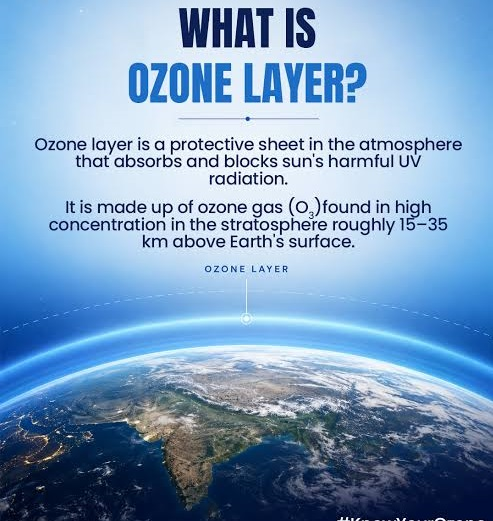
This Regulatory News provides an overview of international, regional and national regulations governing the use of ozone-depleting substances (ODS) and fluorinated greenhouse gases (F-gases), particularly hydrofluororocarbons (HFCs), on board ships. It also highlights the transition toward low-global warming potential (GWP) alternatives and is intended as a starting point for further discussion.
- Montreal Protocol: International framework for phasing out ODS and phasing down HFCs.
- MARPOL Annex VI, Regulation 12: Control of ODS on board ships.
- EU and U.S. regulations: Establish controls on substances that may affect the selection and use of refrigerants on board ships.
ODS) have historically been used on board ships in refrigeration, air-conditioning and fire-extinguishing systems. Examples include chlorofluorocarbons (CFCs), halons used in fire-extinguishing applications and hydrochlorofluorocarbons (HCFCs) such as R-22, which was widely used in marine refrigeration and air-conditioning systems. Further to the appearance of an “ozone hole” over the Antarctic region in the 1980s, the production and use of many ODS have been progressively phased out under the Montreal Protocol and related implementing regulations.
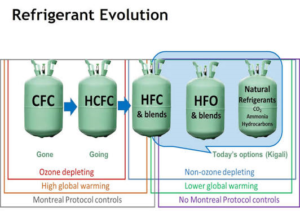
Following the adoption of the Montreal Protocol and the gradual phase-out of ODS, hydrofluorocarbons (HFCs), such as R-410A, R-407C and R-427A, became the common replacement refrigerants for many marine applications. While HFCs do not deplete the ozone layer, they are fluorinated greenhouse gases (F-gases) with a high GWP and can contribute significantly to climate change when released into the atmosphere. Consequently, attention has increasingly shifted toward controlling HFC emissions through international and national measures.
Montreal Protocol
The Montreal Protocol on Substances that Deplete the Ozone Layer entered into force in 1989 and established a global framework for the phase-out of ozone-depleting substances through a series of control measures applicable to both developed and developing countries according to a set timetable. Its objective is to protect and restore the earth’s stratospheric ozone layer. The Protocol is one of the few United Nations treaties to achieve universal ratification.
The Protocol regulates the following categories of substances:
- Annex A: Chlorofluorocarbons (CFCs), Halons
- Annex B: Other fully halogenated CFCs, Carbon tetrachloride, methyl chloroform
- Annex C: Hydrochlorofluorocarbon (HCFCs), Hydrobromofluorocarbons (HBFCs), Bromochloromethane
- Annex E: Methyl bromide
- Annex F: Hydrofluorocarbons (HFCs)
In response to the growing use of HFCs and because of their high GWP, the Kigali Amendment to the Montreal Protocol was adopted in 2016 and entered into force in 2019. The Amendment introduced Annex F, establishing a global phase-down schedule for HFCs. Developed countries began reducing HFC consumption and production in 2019 and are required to achieve an 85% reduction by 2036 compared with their baseline levels. Developing countries follow separate schedules, with most freezing consumption in 2024, beginning reductions in 2029 and reaching 80% reductions by 2045.
To date, the Montreal Protocol has resulted in the phase-out of 98% of ODS globally compared with 1990 levels. Because most of these substances are potent greenhouse gases, the Montreal Protocol is also contributing significantly to the protection of the global climate system.
IMO Framework
MARPOL Annex VI Requirements
Regulation 12 of MARPOL Annex VI establishes controls on ODS on board ships.
Since 1 July 2010, deliberate emissions of ODS have been prohibited. This includes emissions resulting from the maintenance, servicing, repair or disposal of equipment containing ODS, except for minimal releases associated with the recovery and recycling of such substances.
Prohibition of New Installations
Installations that contain ODS (other than HCFCs) are prohibited:
- on ships constructed on or after 19 May 2005; or
- in the case ofships constructed before 19 May 2005, which have a contractual delivery date of the equipment to the ship on or after 19 May 2005 or, in the absence of a contractual delivery date, the actual delivery of the equipment to the ship on or after 19 May 2005.
From 1 January 2020, new installations containing HCFCs are prohibited:
- on ships constructed on or after 1 January 2020; or
- in the case of ships constructed before 1 January 2020, which have a contractual delivery date of the equipment to the ship on or after 1 January 2020 or, in the absence of a contractual delivery date, the actual delivery of the equipment to the ship on or after 1 January 2020.
For existing ships, a list of equipment containing ODS shall be maintained on board as part of the Supplement to the International Air Pollution Prevention (IAPP) Certificate, indicating the system or equipment, its location on board and the substance.
ODS Record Book
In addition, ships fitted with rechargeable systems containing ODS shall maintain an ODS record book, which may form part of an existing logbook or electronic record book approved by the Administration.
Entries in the ODS Record Book shall be completed whenever the following occur:
- recharge, full or partial, of equipment containing ODS;
- repair or maintenance of equipment containing ODS;
- discharge of ODS to the atmosphere (deliberate and non-deliberate);
- discharge of ODS to land-based reception facilities; and
- supply of ODS to the ship.
Each entry shall include the description, quantity and location of the equipment; the date of operation; the mass of the substance in kilograms; the name of the substance; and the refrigerant number.
Disposal Requirements
When ODS or ODS-containing equipment is removed from a ship, it shall be delivered to appropriate reception facilities in accordance with MARPOL Annex VI Regulation 17. reception facilities are listed in the Port Reception Facilities module of IMO’s Global Integrated Shipping Information System (GISIS).
Exceptions: Regulation 12 does not apply to permanently sealed equipment where:
- no refrigerant charging connections exist; or
- no removable components containing ODS are fitted.
In this respect, ODS contained within insulation material (foam) inside panels is subject to the instructions of the flag Administration.
Hong Kong Convention (HKC) and EU Ship Recycling Regulation (EU SRR)
ODS are also regulated by the Hong Kong International Convention for the Safe and Environmentally Sound Recycling (HKC), which entered into force on 26 June 2025, and the European Union’s Ship Recycling Regulation (EU SRR), which entered into force on 30 December 2013. ODS are listed in Appendix 1 of the HKC and Annex I of the EU SRR, meaning that new installations containing ODS are prohibited or restricted and that existing ODS-containing equipment must be declared in Part I of the Inventory of Hazardous Materials (IHM).
European Union
Ozone-Depleting Substances (ODS) Regulation
In 1988, Decision 88/540/EEC approved, on behalf of the European economic community, the Vienna Convention for the protection of the ozone layer and the Montreal Protocol.
Regulation (EC) No 2037/2000 was the principal instrument implementing the Protocol’s requirements in the EU. It was subsequently repealed by Regulation (EC) No 1005/2009 to include the expedited phase-out of HCFCs adopted under the 2007 Montreal Protocol adjustment and to improve the implementation of the regulation.
Regulation (EC) No 1005/2009 was repealed on 2 March 2025 by Regulation (EU) 2024/590 (EU ‘Ozone Regulation’). The revision was initiated to align the regulation with the European Green Deal, further reducing ODS emissions and improving the regulation’s overall design.
The regulation generally prohibits the production, placement on the market, import, export and use of ozone-depleting substances and related products and equipment. Specific exemptions are available for feedstock applications, designated process-agent uses, essential laboratory and analytical uses and other limited circumstances. The EU ‘Ozone Regulation’ also establishes licensing requirements for all imports and exports of ODS.
The EU ‘Ozone Regulation’ has a higher level of ambition and goes beyond the requirements of the Montreal Protocol as follows:
- It limits trade and use not only of bulk ozone-depleting substances but also of products and equipment containing ODS or relying on ODS for their operation.
- Annex I covers the ODS that are controlled under the Protocol, while Annex II includes so-called ‘new substances’ that are not currently controlled by the Protocol.
In addition, ozone-depleting substances contained in refrigeration and air-conditioning equipment, heat pumps, solvent-using equipment, fire protection systems and fire extinguishers must be recovered for destruction, recycling or reclamation during maintenance, servicing, dismantling or disposal, unless recovery requirements are already addressed under other EU legislation.
EU Fluorinated Greenhouse Gases (F-Gas) Regulation
The ODS Regulation is closely linked to the EU F-Gas Regulation, as together they ensure EU compliance with Montreal Protocol obligations relating to ODS and HFCs. The previous F-Gas Regulation, (EU) no 517/2014, applied from 1 January 2015; the current Regulation (EU)2024/573sets a phase-down of HFCs leading to a complete phase-out by 2050.
The current EU F-Gas Regulation (Regulation (EU) 2024/573) does the following:
- Establishes rules on containment, use, recovery, recycling, reclamation and destruction of F-gases and on related ancillary measures, such as certification and training;
- Imposes conditions on the production, import, export, placing on the market, subsequent supply and use of F-gases and of specific products and equipment containing them or relying on them for their function;
- Imposes conditions on specific uses of F-gases;
- Establishes quantitative limits for the placing on the market of HFCs; and
- Introduces reporting obligations.
Control of Use
The Regulation introduces gradual restrictions on the use of high-GWP refrigerants for servicing and maintenance activities. Certain exemptions remain available for reclaimed and recycled F-gases for specified periods.
| Equipment | GWP Threshold | Effective Date |
|---|---|---|
| Refrigeration equipment with a charge size of 40 tonnes CO₂ equivalent or more | ≥ 2,500 | 1 January 2020 |
| Any refrigeration equipment | ≥ 2,500 | 1 January 2025 |
| Air-conditioning equipment and heat pumps | ≥ 2,500 | 1 January 2026 |
| Stationary* refrigeration equipment (excluding chillers) | ≥ 750 | 1 January 2032 |
* Stationary equipment is defined as equipment that is “not normally in transit during operation and covers room air conditioning equipment which is moveable between rooms”. Mobile equipment is defined as equipment that is “normally in transit during operation.”
In addition to servicing and maintenance restrictions, the EU F-Gas Regulation establishes gradual restrictions on placing on the market and sale for various categories of refrigerators, freezers, chillers and air-conditioning equipment containing fluorinated greenhouse gases above specified GWP thresholds. As a result, the availability of certain refrigerants and equipment in the EU market is expected to progressively decrease in the coming years, encouraging the transition to low-GWP and natural refrigerant alternatives.
Application to Shipping
According to the latest clarification from the European Commission, the EU F-Gas Regulation (EU) 2024/573 applies to the shipping sector because the Regulation does not contain any provision excluding ships from its scope. However, the applicability of individual obligations must be assessed on a case-by-case basis.
–
U.S. Regulatory Framework
Title VI (Stratospheric Ozone Protection) was added to the Clean Air Act to implement the Montreal Protocol on Substances that Deplete the Ozone Layer in the United States (U.S.). Its provisions are codified at 42 U.S.C. §§ 7671–7671q and implemented through U.S. Environmental Protection Agency (EPA) regulations at 40 CFR Part 82. Separately, the American Innovation and Manufacturing (AIM) Act of 2020, codified at 42 U.S.C. § 7675, provides authority to regulate HFCs and is implemented through 40 CFR Part 84.
40 CFR Part 82 – Protection of Stratospheric Ozone
The purpose of 40 CFR Part 82 is to implement the Montreal Protocol on Substances that Deplete the Ozone Layer and the ozone protection provisions of the Clean Air Act. The regulation establishes controls on the production, import, export and use of ODS, including CFCs designated as Class I controlled substances and HCFCs designated as Class II controlled substances. It also includes requirements concerning refrigerant handling, recovery and emissions.
In addition, Subpart G establishes the Significant New Alternatives Policy (SNAP) program, which evaluates substitutes for ODS, including HFC refrigerants such as R-407C, to promote alternatives that present lower overall risks to human health and the environment.
40 CFR Part 84 – Phase-down of Hydrofluorocarbons
40 CFR Part 84 implements certain provisions of the American Innovation and Manufacturing (AIM) Act and establishes a phase-down of HFC production and consumption in the U.S. The regulation also establishes restrictions on the use of certain HFC refrigerants in specific sectors according to a compliance timetable, as well as requirements for managing HFCs and certain substitutes in equipment.
From 1 January 2025, the following actions are prohibited:
- Manufacturing or importing any self-contained products in the refrigerated transport marine sector using any of the substances in the list below; and
- Installing refrigerated transport marine systems using any of the substances in the list below.
Refrigerants listed:
| R-402A, R-402B, R-404A, R-407B, R-408A, R-410B | R-417A, R-421A, R-421B, R-422A, R-422B, R-422C | R-422D, R-424A, R– 428A, R-434A, R-438A, R-507A | R-125/290/134a/600a (55/1/42.5/1.5), RS-44 (2003 formulation) or GHG-X5 |
The following actions are considered installation once the system is charged to full charge:
- Assembling a system for the first time from used or new components;
- Increasing the cooling capacity, in BTU per hour; and
- Replacing 75% or more of the evaporators (by number) and 100% of the compressor racks, condensers and connected evaporator loads of an existing system.
Although polyurethane foam with a GWP of 150 or greater is also restricted from 1 January 2025, structural composite preformed polyurethane foam for marine use is excluded.
More information on the restrictions for each subsector can be found in EPA’s Technology Transitions HFC Restrictions by Sector.
Application to Shipping
Based on the latest advice received from the U.S. Coast Guard, the continued use of refrigerants such as R-407C generally would not be objected to, provided that the refrigeration system remains in good operating condition and complies with the applicable requirements of MARPOL Annex VI Regulation 12. To confirm the applicability of any current or future refrigerant restrictions, further guidance should be sought from the relevant authorities on a case-by-case basis.
GHG are dangerous for global eco system, thanks for the article