
10/27/2026
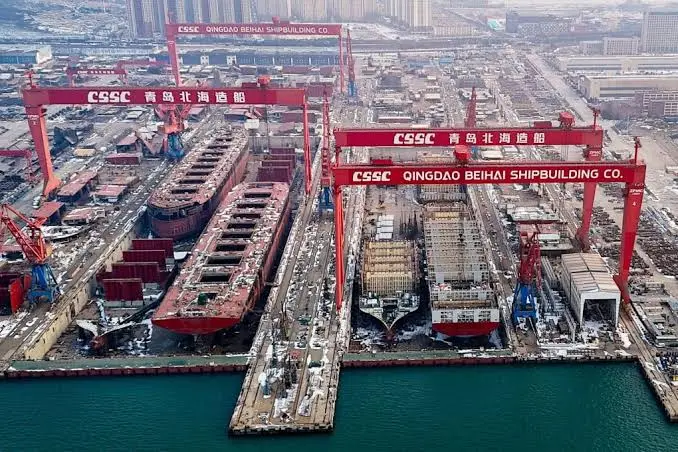
Chinese shipyards captured 81.8% of new global ship orders in the first nine months of 2026, according to official data from the Ministry of Industry and Information Technology, reinforcing China’s position as the world’s dominant shipbuilding power.
China’s shipbuilding industry continued its strong run through the first three quarters of 2026, securing almost 81.8% of new ship orders worldwide. The figures, released by the Ministry of Industry and Information Technology on October 23, underline the scale and competitiveness of Chinese yards as global demand for tankers, container ships and alternative-fuel vessels remains robust.
By the end of September, total orders on hand had reached 399.13 million deadweight tonnes (DWT) , up 64.8% year on year. In the first three quarters of 2026, Chinese yards completed ships with a total carrying capacity of 58.05 million DWT, representing 63.6% of the global total. New orders alone reached 175.29 million DWT, a year-on-year increase of 163.2%.China’s shipbuilding output, new orders and order backlog accounted for 63.6%, 81.8% and 72.4% of the global market, respectively.
Demand Driven by Tankers and Container Ships
The strong order book reflects broader shifts in global shipping demand. Container ships remain the largest category, accounting for about 30% of compensated gross tonnage (CGT) on order and 68% of the order book’s growth over the past year, according to BIMCO. Chinese shipbuilders hold 81% of the global container ship orderbook.
Tanker demand has also surged. In the first nine months of 2026, Chinese yards secured orders for 144 very large crude carriers (VLCCs) , representing 85.5% of the global market share for this vessel type.There are around 930 VLCCs in operation worldwide, and 20% of them are over 20 years old. With such vessels typically scrapped after 20–25 years of service, replacement demand is a key driver — and most of these orders have also gone to Chinese yards.
Green Transition Adds Momentum
Beyond traditional vessel categories, China is positioning itself at the forefront of the green transition. Chinese yards secured 74.1% of global new orders for vessels powered by alternative fuels such as ammonia, hydrogen and methanol — a 5.7 percentage point rise from the January–June quarter.
Competitive Advantages Behind China’s Dominance
Several factors explain China’s growing dominance. Chinese yards benefit from lower construction costs compared with competitors in South Korea and Japan, as well as abundant raw materials and domestic steel production. Their supply chains are largely self-reliant for most projects. Chinese shipyards have also closed the technological gap, bringing advanced onboard systems and equipment to the large-scale construction of sophisticated LNG and dual-fuel vessels. In addition, state-owned banks and financial agencies offer attractive payment packages to foreign shipping companies.
The Road Ahead: Capacity, Risks and Long-Term Demand
China’s shipbuilding dominance is set to continue, but the industry faces both opportunities and challenges in the coming years.
On the capacity side, Chinese yards hold 64% of the global orderbook and will need to nearly double annual output to meet scheduled deliveries by 2028. BIMCO data shows that Chinese yards are scheduled to deliver a record 44.0 million CGT in 2028, nearly twice the 22.7 million CGT delivered in 2025.Industry analysts note that global shipyard output may reach new highs of 64 million CGT in 2027 and 69 million CGT in 2028, with China at the center of this expansion.
However, this rapid capacity expansion carries risks. BIMCO’s chief shipping analyst, Niels Rasmussen, has warned that “the capacity expansion needed to achieve this could increase the risk of under-utilisation if contracting weakens in the future.”The industry is mindful of the boom-bust cycles of the past, when overcapacity led to a sharp decline in active yards.
On the demand side, the long-term outlook remains supportive. Industry veterans estimate that approximately 46,000 vessels globally will need to be replaced over the next 15 years, providing a clear market foundation for shipbuilding through 2035.Demand will be driven by fleet renewal, growing energy transport needs, and shifts in global shipping patterns due to geopolitical developments.Many large Chinese shipyards already have delivery schedules extending to 2030 and beyond, with some LNG carrier orders booked as far out as 2031.
With a dominant order book, growing capability in green and high-value vessels, and strong financial support for buyers, China’s shipbuilding industry is well placed to consolidate its maritime dominance — provided it manages the delicate balance between capacity expansion and market demand.
Key figures at a glance:
-
81.8% of global new ship orders secured by Chinese yards in the first nine months of 2026
-
399.13 million DWT total orders on hand, up 64.8% year on year
-
58.05 million DWT completed in the first three quarters, 63.6% of the global total
-
74.1% of alternative-fuel vessel orders secured by China
-
81% of the global container ship orderbook held by Chinese builders
-
85.5% of global VLCC orders secured by Chinese yards
-
~46,000 vessels expected to require replacement globally over the next 15 years
References
-
The Maritime Executive. “BIMCO: Container Ship Orders are Driving China’s Shipyard Surge.” October 22, 2026. https://maritime-executive.com/article/bimco-container-ship-orders-are-driving-china-s-shipyard-surge
-
国际船舶网 (eworldship). “全球订单涌向中国船厂,已经普遍排期到四年后.” September 30, 2026. https://wap.eworldship.com/index.php/eworldship/news/article?id=224781