
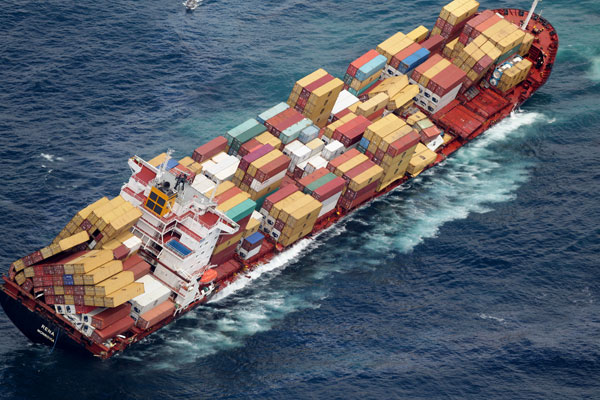
Explore 12 official investigations into containers lost overboard, from MSC Zoe to ONE Apus, and learn the lessons for stowage, lashing and navigation.
Containers lost overboard can endanger nearby vessels, expose crew to collapsing stacks, and release cargo or debris into the sea. A heavy roll or wave impact may be the immediate event, but investigations often reveal earlier problems with container weights, stowage, securing equipment or voyage planning.
This article examines 12 investigations into ship cargo loss, focusing on containers lost overboard. The cases include container ships, a general cargo vessel and a cargo barge. They are selected for their different safety lessons, rather than ranked by the number of containers lost.
1. Husky Racer: Incorrect weights and a collapse in port (2009)
Eighteen containers fell overboard from Husky Racer during cargo operations in Bremerhaven. An unlashing gang had released the lower lashings while upper tiers remained connected by twistlocks. Containers shown as empty in seven of nine stacks actually held between 15 and 30 tonnes of cargo each.
A MAIB preliminary examination found that updated weight information had not reached cargo planners because of a system shortcoming. Investigators could not establish the exact trigger of the collapse. Read the MAIB preliminary examination. gov.uk
Safety lesson: Transfer corrected weights into the working stowage plan. Reassess stack stability as lower restraints are removed during discharge.
2. Ever Smart: Heavy pitching and an insecure stow (2017)
Ever Smart encountered heavy North Pacific seas after changing its route to avoid a developing depression. Following severe pitching and bow-flare slamming, the crew discovered that the aftermost container bay had collapsed. Forty-two containers were lost and 34 damaged.
The MAIB considered heavy pitching and hull vibration the most likely conditions during the failure. It found that the bay’s integrity had been weakened by several factors, particularly stowage and securing that did not follow the ship’s Cargo Securing Manual. Read MAIB report 14/2020. GOV.UK
Safety lesson: Pitching and hull vibration impose loads on containers and lashings. Check the completed stow against the ship-specific securing manual.
3. CMA CGM G. Washington: Three bays failed after sudden rolling (2018)
In heavy seas, CMA CGM G. Washington rolled sharply to starboard and then to port. Three container bays collapsed, sending 137 containers overboard and damaging another 85.
The MAIB identified reduced structural strength in non-standard 53-foot containers, inaccurate weights, mis-stowage and loose lashings. Acceleration during the roll exceeded container strength in one bay; falling containers then affected another bay. Read MAIB report 2/2020. GOV.UK
Safety lesson: Assess container strength and dimensions as well as mass. Update the stowage plan when the terminal supplies more accurate weights.
4. YM Efficiency: Heavy rolling and excessive lashing forces (2018)
Off Newcastle, Australia, YM Efficiency suddenly rolled heavily in very rough seas. It lost 81 containers and damaged another 62.
The ATSB found that rolling forces caused failures in containers and their securing system. Calculations for the affected bays showed that the planned weight distribution exceeded Cargo Securing Manual lashing-force limits, but the shore-side planning process had not checked those limits. Investigators could not establish a definitive cause for the sudden roll. Delayed reporting to authorities also affected the response to the lost containers. Read ATSB investigation 344-MO-2018-008. atsb.gov.au
Safety lesson: Check calculated lashing forces before approving a stow. Report a loss promptly, then update the estimated position and number of containers.
5. MSC Zoe: Route-specific motion near the Wadden Sea (2019)
MSC Zoe lost 342 containers north of the Dutch Wadden Islands in stormy weather. Cargo and packaging debris washed ashore.
A joint international investigation examined the loss, while the Dutch Safety Board separately studied the risks of the shipping routes. The Board found that extreme forces generated by the route’s wave and vessel-motion conditions were the primary cause. It highlighted combinations of rolling, slamming and water moving forcefully up the vessel’s side. Read the Dutch Safety Board’s investigation and its links to the joint report. onderzoeksraad.nl
Safety lesson: Consider the interaction of wave direction, route, vessel dimensions and loading condition. Conditions that are manageable on one route may produce damaging motions on another.
6. APL England: Corroded deck fittings failed (2020)
APL England rolled heavily off New South Wales, losing 50 containers and damaging 63 more. Its main engine also stopped temporarily as the motion affected lubricating-oil suction.
The ATSB found that fixed container-securing fittings had been severely weakened by corrosion. Their poor condition had developed over years of inadequate maintenance and inspection. The investigation also found that adverse-weather procedures had not been followed. Read ATSB investigation 351-MO-2020-002. ATSB
Safety lesson: Inspect permanent foundations and securing points as carefully as portable lashings. Weather precautions depend on the securing system retaining its intended strength.
7. Ho’omaka Hou: Reverse-stratified stacks on a barge (2020)
The cargo barge Ho’omaka Hou, under tow off Hawaii, lost 21 containers from its after deck.
The NTSB found that the company had not provided the barge team with an initial load plan or adequate procedures for monitoring stack weights. Heavier containers ended up above lighter ones without this reverse stratification being identified. The arrangement increased forces on the stacks and their securing equipment during the voyage. Read NTSB investigation DCA20FM022. ntsb.gov
Safety lesson: Barges also need accurate load plans, stack-weight checks and securing calculations. Verify the arrangement again when the loading plan changes.
8. Francisca: Green seas overwhelmed deck cargo (2020)
The general cargo vessel Francisca lost 34 containers near Duncansby Head while pitching into heavy seas.
In a completed preliminary assessment, the MAIB found that water sweeping onto the deck struck the stacks with forces beyond the securing arrangements’ capacity. Violent pitching reduced speed and heading control. Familiarity with a frequently sailed route had reduced appreciation of the weather risk. The absence of a bow breakwater increased exposure, while corrosion might have contributed to the scale of the loss. Read MAIB preliminary assessment 3/22. GOV.UK
Safety lesson: On vessels with exposed deck stows, assess direct wave impact as well as rolling. A familiar route still needs a fresh weather assessment.
9. ONE Apus: Parametric rolling and a very large loss (2020)
The Japanese-flagged ONE Apus lost 1,841 containers during extreme rolling in the Pacific and diverted to Japan. Another 983 containers remained aboard but were damaged. No casualties were reported.
The Japan Transport Safety Board found that the vessel had proceeded in conditions conducive to parametric rolling, in which wave conditions and vessel characteristics combine to produce sudden, large motions. Its investigation examined the limits of the operational guidance available to the crew and the need for training and earlier warning of the risk. Read the JTSB investigation. jtsb.mlit.go.jp
Safety lesson: Use vessel-specific guidance to assess motion risk before large rolls begin. Reacting only after an observed roll may be too late to protect the stacks.
10. Maersk Essen: Parametric resonance and weather-routing limits (2021)
Maersk Essen rolled heavily about 450 nautical miles north of Hawaii. Once the cargo had been accounted for, the Danish Maritime Accident Investigation Board recorded 689 containers lost and 258 damaged.
The DMAIB considered parametric resonance in port-quartering seas the most likely cause, possibly combined with a temporary loss of stability on a wave crest. The crew altered course and speed once rolling began, but lacked readily available, reliable means to assess the risk beforehand. Weather routing had not explicitly addressed the developing parametric-roll risk. Read the DMAIB investigation. dmaib.com
Safety lesson: Check whether weather advice addresses the ship’s motion risks, not only wind and wave height. Bridge guidance should help crews recognize and avoid dangerous conditions early.
11. ZIM Kingston: Parametric rolling while holding offshore (2021)
ZIM Kingston was holding off British Columbia awaiting a berth when it rolled 36° and lost 109 containers. The Transportation Safety Board of Canada determined that wave conditions and vessel-specific characteristics had combined to produce parametric rolling.
The owner had not provided sufficient procedures or tools for the bridge team to assess and manage the risk. About 36 hours later, a fire began in a damaged container carrying dangerous goods while the vessel was at anchor. Read TSB report M21P0297. Transportation Safety Board of Canada
Safety lesson: Waiting offshore does not remove exposure to dangerous motion. After a stack collapse, assess damaged dangerous-goods containers as a separate emergency risk.
12. President Eisenhower: Incorrect weights in the shore plan (2024)
The US-flagged President Eisenhower lost 23 containers while drifting south of Oakland awaiting a berth.
The NTSB found that shore-side planners had entered incorrect weights for 39 containers. The resulting plan produced overweight, reverse-stratified stacks. Securing equipment then failed as the vessel rolled. Read NTSB investigation DCA24FM023. ntsb.gov
Safety lesson: A verified weight must reach the correct place in the operational stowage and lashing calculations. Revalidate the plan after data or loading changes.
What the investigations show
| Recurring pathway | Cases | Practical control |
|---|---|---|
| Incorrect weights or stack order | Husky Racer, YM Efficiency, Ho’omaka Hou, President Eisenhower | Reconcile actual weights and check stack and lashing-force limits. |
| Weak stowage or securing equipment | Ever Smart, CMA CGM G. Washington, APL England | Follow the Cargo Securing Manual and inspect containers, foundations and lashings. |
| Extreme or poorly anticipated ship motion | MSC Zoe, ONE Apus, Maersk Essen, ZIM Kingston | Assess vessel-specific motion risk alongside route and weather forecasts. |
| Direct wave impact on deck cargo | Francisca | Consider freeboard, bow protection, sea direction and manoeuvrability. |
Checks before and during a voyage
Before loading: Confirm container weights, stack order, dangerous-goods information, bay limits and the condition of foundations and lashings. Resolve differences between the terminal’s plan and the ship’s data.
Before departure: Check securing calculations for the actual loading condition. Record any non-standard containers, defective fittings or operating limitations that the bridge team must know.
At sea: Review wave height, period and direction alongside wind forecasts. Monitor pitching, slamming and rolling. Use vessel-specific guidance when considering safe changes to course or speed.
After a suspected loss: Keep crew clear of unstable stacks. Record the time, position, estimated number and contents of lost containers; warn traffic and make the required reports. Preserve voyage and cargo-planning records.
What do IMO rules require?
SOLAS requires the verified gross mass of a packed container before loading. That value also needs to flow accurately into the final stowage and securing plan. Ship-specific Cargo Securing Manuals set out approved arrangements and limits.
Since 1 January 2026, amendments to SOLAS and MARPOL have required reporting of containers lost or observed drifting at sea under the applicable procedures. Crews should follow current flag-state instructions for report recipients and contents. IMO guidance on verified gross mass and IMO summary of rules effective in 2026. imo.org
Frequently asked questions
What is parametric rolling?
It is a sudden, potentially large rolling response when wave conditions interact with a vessel’s changing stability as it moves through the sea. Risk depends on hull form, loading condition, speed, heading and waves. ONE Apus, Maersk Essen and ZIM Kingston show why a general heavy-weather warning may not identify this particular risk.
Can containers fall overboard in port or while drifting?
Yes. Husky Racer lost containers during terminal operations, while President Eisenhower lost them while drifting. An incorrectly loaded or insufficiently secured stack does not need a major ocean storm to fail.
Does a verified gross mass guarantee safe stowage?
No. The mass must be entered correctly and used with the ship’s stack-weight and lashing-force limits. Container strength and securing-equipment condition also matter.
Are all 12 cases full final investigation reports?
Most are. Husky Racer is an MAIB preliminary examination, and Francisca is a completed preliminary assessment. Their findings are identified accordingly.
Conclusion
These investigations connect cargo loss to decisions throughout the voyage: accurate information ashore, a suitable stow, sound securing equipment and informed navigation in changing seas. The key question is whether the actual cargo and ship motion remain within the securing system’s capabilities—and whether the crew has enough information to recognize when that margin is shrinking.
Editorial note: The case facts and attributed findings are summarized from the linked investigating authorities. The safety lessons are educational interpretations, not quotations from investigators or instructions for a particular vessel.