
Explore 12 official ship explosion investigations, including Sanchi, and learn how cargo hazards, collisions, hot work and machinery failures led to explosions.
An explosion aboard a vessel can begin with flammable vapour, a reacting cargo, fuel inside machinery or a fire spreading into another space. Sometimes the initiating event is a collision: damaged cargo tanks release a hazardous product, which then ignites.
These 12 investigations cover seagoing ships, a towing vessel and tank barges. They were selected to explain different accident mechanisms, rather than rank casualties by size or loss of life. Each case links to an official investigation or safety document.
1. Bow Mariner: Cargo-tank vapour during cleaning (2004)
The chemical tanker Bow Mariner exploded and sank off Virginia while crew were cleaning tanks that had carried methyl tert-butyl ether (MTBE). Twenty-one of its 27 crew died.
The US Coast Guard found that opening cargo-tank accesses allowed flammable vapour to escape during cleaning. Investigators could not determine the ignition source. They also identified failures to follow the vessel’s safety procedures, including prescribed inert-gas use during MTBE discharge. Read the Coast Guard investigation. content.govdelivery.com
Safety lesson: Follow the approved inerting and gas-freeing sequence. Plan where vapour will travel before opening a tank.
2. Border Heather: Petrol vapour reached the bow-thruster space (2004)
After loading motor spirit, the coastal tanker Border Heather suffered an explosion and fire in its forecastle at Grangemouth. Petrol had passed through connections between the cargo and gas-freeing systems. A spectacle plate was not in its blanked position, associated valves were open, and a non-return valve leaked.
Liquid and vapour migrated into the bow-thruster room, where electrical equipment ignited the vapour. No one was injured, but the ship sustained significant damage. Read MAIB report 5/2006. assets.digital.cabinet-office.gov.uk
Safety lesson: Verify positive isolation. When a cargo leak is detected, check connected compartments, drains and low points for vapour.
3. Yeoman Bontrup: Conveyor-belt fire followed by explosion (2010)
A fire began near the vertical conveyor of the self-unloading bulk carrier Yeoman Bontrup during loading in Scotland. The MAIB considered hot debris from hopper repair work the most likely source of belt ignition.
The fire spread through the cargo-handling area, engine room and accommodation. It later reached a steering-gear compartment containing ship’s-use chemicals; a violent explosion tore away the poop deck. The investigation examined shortcomings in early fire detection, containment and fixed firefighting arrangements. Read MAIB report 5/2011. assets.publishing.service.gov.uk
Safety lesson: Control hot work near conveyors and consider how a fire could spread to machinery spaces and chemical stores.
4. Qian Chi: Misassembled burner and heater explosion (2011)
Three crew were seriously injured when a thermal-oil heater exploded aboard the products tanker Qian Chi at anchor in Australia.
The ATSB found that the burner nozzle had been assembled incorrectly during maintenance. Fuel leaked into the furnace during the pre-ignition sequence and exploded when the igniter operated. The crew lacked experience with the equipment, and the manufacturer’s instructions were insufficiently clear. Read ATSB investigation 283-MO-2011-001. www.atsb.gov.au
Safety lesson: Verify burner assembly and the fuel path before restarting a heater, particularly after unfamiliar maintenance.
5. The Admiral: Main-engine sump explosion (2016)
The towing vessel The Admiral was moored in Texas when its starboard main engine oversped, exploded and started an engine-room fire. Two crew members were severely burned; one later died.
The NTSB determined that a misfiring cylinder ignited lubricating oil in the engine sump. Read NTSB investigation DCA16FM044. www.ntsb.gov
Safety lesson: Investigate abnormal firing and overspeed immediately. Maintain engine protections and follow the manufacturer’s inspection procedures.
6. Manhattan Bridge: Auxiliary-boiler furnace explosion (2017)
An auxiliary-boiler furnace exploded aboard Manhattan Bridge while the container ship was berthing at Felixstowe. An oiler died and the second engineer suffered severe burns as they investigated repeated flame failures.
A MAIB safety bulletin reported waxy deposits in the marine gas oil supply filter that could restrict fuel flow in cold conditions. Japan led the full investigation. The MAIB bulletin identifies an important fuel cold-operability concern but does not, by itself, establish every step in the explosion sequence. Read the MAIB safety bulletin and its page linking the Japanese report. www.gov.uk
Safety lesson: Diagnose repeated flame failures before resetting a burner. Check fuel cold-flow properties and the prescribed purge sequence.
7. Nortrader: Hydrogen released by a bulk cargo (2017)
Two explosions occurred aboard Nortrader while the general cargo ship was anchored off Plymouth with unprocessed incinerator bottom ash in its hold. The chief engineer suffered burns.
The MAIB found that the cargo could release hydrogen when wet. Its testing and declaration had not adequately identified that hazard. The first explosion occurred in the forecastle store and the second in the cargo hold. Read MAIB report 26/2017. www.gov.uk
Safety lesson: Confirm whether a solid bulk cargo can generate flammable gas, and whether the chosen test is suitable for that material.
8. Buster Bouchard/B. No. 255: Crude oil entered a void space (2017)
An explosion and fire on tank barge B. No. 255, coupled to the tug Buster Bouchard, killed two crew members near Port Aransas, Texas.
The NTSB found that crude oil leaked through a corroded bulkhead into the forepeak void, formed flammable vapour and ignited. It identified ineffective maintenance and safety management, with ineffective inspections and surveys also contributing. Read NTSB investigation DCA18FM002. www.ntsb.gov
Safety lesson: A void beside a cargo tank can become a hazardous space when its boundary fails. Investigate leakage and hidden corrosion.
9. Sanchi: Collision, condensate fire and explosions (2018)
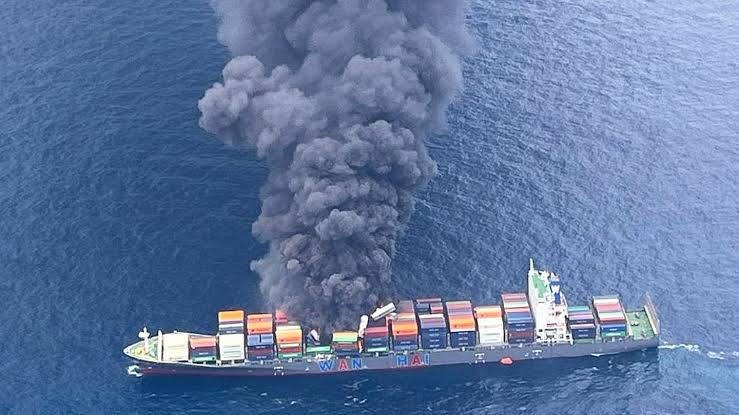
On 6 January 2018, the laden condensate tanker Sanchi collided with the bulk carrier CF Crystal in the East China Sea. The collision breached Sanchi’s cargo tanks. Released condensate ignited, and fire and explosions followed. The tanker burned for days and sank on 14 January. Three crew were confirmed dead and 29 were reported missing; none of the 32 crew survived.
This was a collision-initiated cargo fire and explosion, rather than a spontaneous explosion inside an intact tank. The joint investigation examined shortcomings in lookout, collision-risk assessment and avoiding action on both vessels. The investigating states differed on the collision’s direct cause, so it should not be attributed solely to one bridge team. Read the joint investigation hosted by the Hong Kong Marine Department and the OCIMF safety bulletin based on its findings. mardep.gov.hk
Safety lesson: Collision prevention is also cargo-hazard prevention. Assess collision risk using a proper lookout and available navigational equipment, then take effective action while time and sea room remain.
Sanchi Tanker Disaster: Anatomy of a Maritime Transport Catastrophe and the Lessons to Learn
10. Stolt Groenland: Runaway polymerisation ruptured a cargo tank (2019)
A styrene-monomer cargo tank aboard the chemical tanker Stolt Groenland ruptured at Ulsan, South Korea. Released vapour then ignited, producing a fireball.
The MAIB found that heat transferred from other heated cargoes to the temperature-sensitive styrene. Its temperature was not monitored during the voyage. Runaway polymerisation generated heat and pressure until the tank failed. Read MAIB report 9/2021. www.gov.uk
Safety lesson: Account for heat transfer between tanks when planning cargo stowage. Monitor temperature-sensitive cargoes and understand inhibitor limits.
11. IB1940: Static discharge during tank preparation (2019)
Tank barge IB1940 exploded in Illinois after its acetone cargo had been discharged and the barge was being prepared for cleaning. No one was injured, but the vessel was declared a constructive total loss.
The NTSB found that an air mover used in a tank containing residual acetone had not been electrically bonded to the barge. Static discharge ignited flammable vapour. Company procedures had omitted the facility manual’s bonding instructions. Read NTSB investigation DCA20FM002. www.ntsb.gov
Safety lesson: Cargo residues remain hazardous after discharge. Verify bonding and align vessel, contractor and facility procedures before ventilation or cleaning.
12. Hunts Point: Unapproved hot work above a sludge tank (2025)
An explosion aboard the sludge vessel Hunts Point at a New York wastewater treatment plant killed one crew member and injured three others.
The NTSB determined that unapproved hot work was conducted above a cargo tank containing material that produced flammable methane. The gas ignited and the tank overpressurized. Read NTSB investigation DCA25FM045. www.ntsb.gov
Safety lesson: Before hot work near a tank, assess its contents, atmosphere and the route heat could take through its boundaries.
Common explosion pathways
| Pathway | Cases | Principal defence |
|---|---|---|
| Vapour during cleaning or ventilation | Bow Mariner, IB1940 | Controlled gas freeing, atmosphere testing, bonding and ignition control. |
| Vapour entering an adjacent space | Border Heather, B. No. 255 | Positive isolation, sound tank boundaries and monitoring of nearby spaces. |
| Collision breaches a hazardous cargo tank | Sanchi | Early collision-risk assessment and effective action under COLREGs. |
| Fire or hot work reaches combustible material | Yeoman Bontrup, Hunts Point | Hot-work controls, fire containment and assessment of contents behind boundaries. |
| Cargo reaction or gas generation | Nortrader, Stolt Groenland | Accurate cargo information, suitable stowage and monitoring. |
| Fuel or oil within machinery | Qian Chi, The Admiral, Manhattan Bridge | Verified maintenance, working protections and diagnosis before restart. |
Practical lessons for ship personnel
- Identify the substance and every space it can reach. Residues, voids, bilges and machinery enclosures can contain hazards that are not visible from the cargo deck.
- Follow the correct sequence. Inerting, gas freeing, burner purging and restart procedures control specific explosion risks.
- Control ignition sources. Hot work, unsuitable electrical equipment, static discharge and unstable machinery each need appropriate safeguards.
- Verify isolation and repairs. A valve indication or completed work order alone does not prove a physical boundary is sound or equipment has been assembled correctly.
- Escalate abnormal conditions. Vapour odours, repeated flame failures, leakage and unexpected cargo-temperature changes require prompt investigation.
- Prevent the initiating collision. As Sanchi shows, a navigation failure can rapidly become a cargo fire and mass-casualty emergency.
Frequently asked questions
Can a ship explode after its cargo has been unloaded?
Yes. Bow Mariner exploded during cleaning of tanks that had carried MTBE, while IB1940 exploded during preparation for cleaning after acetone discharge. Residual vapour can still form an explosive atmosphere.
Are all ship explosions caused by oil or gas cargo?
No. Nortrader involved hydrogen generated by wet incinerator bottom ash. Qian Chi involved fuel inside a heater furnace. On Yeoman Bontrup, an explosion followed a fire that spread through the ship.
Was the explosion the initial accident on Sanchi?
No. Sanchi first collided with CF Crystal. The collision breached its condensate tanks; fire and explosions followed. Keeping that order clear is essential when drawing a safety lesson from the casualty. ocimf.org
Where can I find official marine casualty reports?
Each case links to an investigating authority. The IMO’s Marine Safety Investigation Reports page also explains access to reports through the GISIS Marine Casualties and Incidents module. www.imo.org
Conclusion
The investigations show that preventing an explosion requires understanding the particular substance, space and operation involved. Reliable isolation, accurate cargo information, atmosphere testing, disciplined hot work and verified maintenance all matter. Sanchi adds another essential lesson: preventing a collision may be the most effective way to prevent a catastrophic cargo fire and explosion.
Editorial note: Case facts and attributed findings are summarized from the linked official investigations. The safety lessons are educational interpretations, not quotations from investigators or vessel-specific operating instructions.