
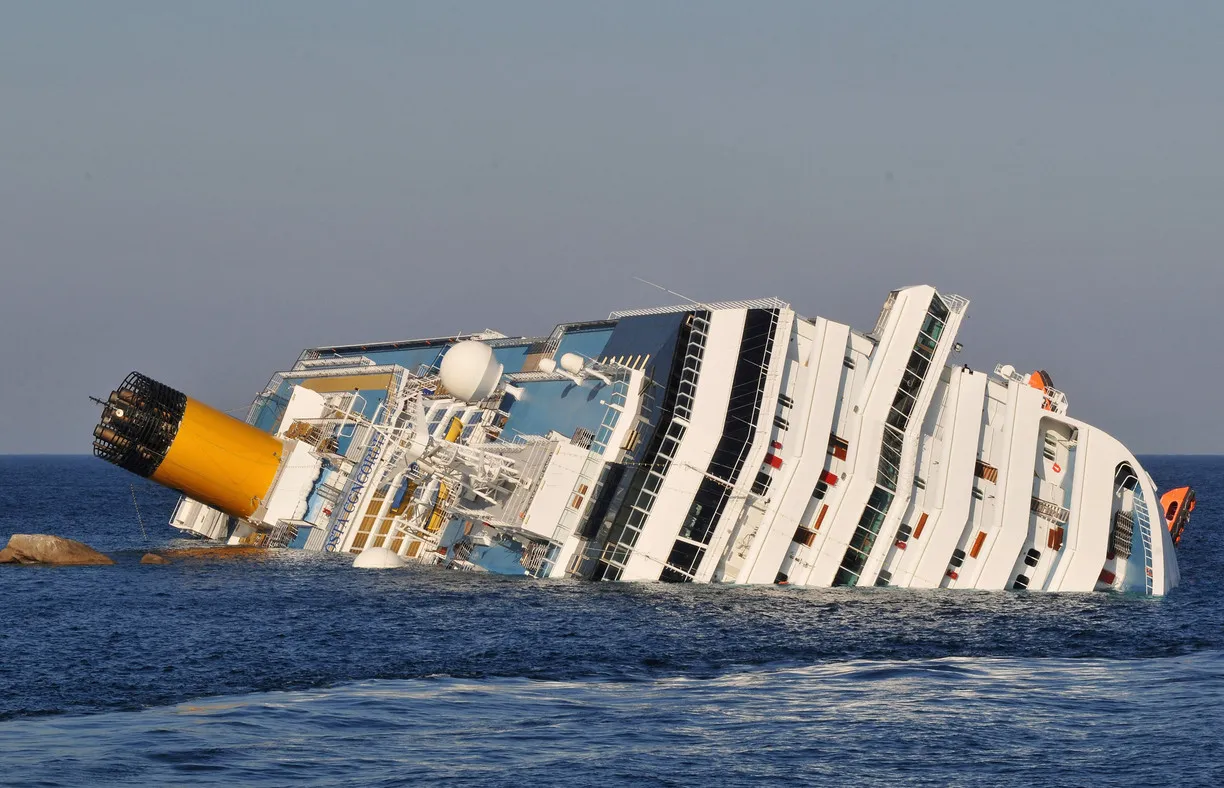
Explore 12 official ship capsizing investigations and the lessons they offer on stability, flooding, weather, operational loads and survival.
A ship can capsize moments after a turn or towline load, or after a developing list goes unrecognized. The final trigger matters, but so does the vessel’s ability to recover. Incorrect loading data, accumulated top weight, icing, water on deck and open boundaries can all reduce that margin.
These 12 cases were selected for their teaching value, not ranked by vessel size or loss of life. Each is linked to an investigation by the UK Marine Accident Investigation Branch (MAIB), the US National Transportation Safety Board (NTSB), or the Transportation Safety Board of Canada (TSB).
1. Herald of Free Enterprise: Open bow doors and rapid flooding
The roll-on/roll-off passenger ferry capsized shortly after leaving Zeebrugge in 1987. Seawater entered through bow doors left open and spread across the vehicle deck. The capsize killed 193 people. The UK formal investigation examined the departure failures and the practices behind them. Lesson: Verify critical openings before sailing; water spreading across a large vehicle deck can destroy stability very quickly. Read the official investigation. GOV.UK
2. Ethan Allen: Passenger load exceeded effective stability
The sightseeing vessel overturned on Lake George, New York, in 2005 after a turn, passing waves and passenger movement. Twenty passengers died. The NTSB found that the vessel lacked stability for those combined forces: it carried 48 people, while calculations after the accident indicated it should have been permitted to carry only 14. Earlier modifications had not led to an adequate stability reassessment. Lesson: Passenger limits must reflect the vessel as modified and operated. Read the NTSB investigation. ntsb.gov
3. Cemfjord: Violent seas and a likely stability shortfall
The fully laden cement carrier capsized in the Pentland Firth in 2015, killing all eight crew members. The MAIB found that the exceptionally violent conditions were predictable and could have been avoided. It also concluded that the vessel’s stability likely failed to meet the required criteria. The capsize was too rapid for a distress call or controlled abandonment. Lesson: Passage planning and an accurate stability assessment must be considered together. Read MAIB report 8/2016. GOV.UK
4. Caledonian: An outdated stability booklet
The Canadian fishing vessel capsized while hauling hake in 2015; three of its four crew members died. The TSB found that actual fish, seawater, fuel and water loading differed from the approved stability booklet. The vessel had also gained lightship weight over decades of service. Water on deck, sea conditions, trawl-door drag and a course alteration further reduced its righting energy. Lesson: Stability guidance must account for the vessel’s current weight and real operating practices. Read TSB report M15P0286. Transportation Safety Board of Canada
5. Destination: Heavy freezing spray
The fishing vessel capsized and sank near St. George Island, Alaska, in 2017. All six crew members were lost. The NTSB attributed the casualty to proceeding in heavy freezing spray without ensuring sufficient stability margin for ice accumulation or taking enough action to avoid or limit its effects. No mayday was received; an emergency beacon alerted the Coast Guard. Lesson: Act early when ice begins to accumulate, particularly when it adds weight high on the vessel. Read the NTSB investigation. ntsb.gov
6. Golden Ray: Wrong ballast data in a loading computer
The vehicle carrier capsized during an outbound turn in St. Simons Sound, Georgia, in 2019. The NTSB found that incorrect ballast quantities entered into the stability program caused an overestimate of the ship’s stability. The vessel lacked sufficient righting energy for the turn, and ineffective company verification procedures contributed. Open watertight doors subsequently allowed flooding that blocked an engine-room escape route. All aboard were rescued. Lesson: Independently check tank inputs and departure calculations; a computer cannot correct wrong source data. Read NTSB report MAR-21-03. ntsb.gov
7. Scandies Rose: Inaccurate instructions and uneven ice
The fishing vessel capsized and sank off Alaska in 2019. Two of its seven crew members survived. The NTSB identified inaccurate stability instructions, which left a low margin against capsize, combined with heavy asymmetric ice accumulation in local conditions more severe than forecast. Lesson: Stability documents must match the vessel and its loading, and a worsening list in icing conditions demands prompt action. Read the NTSB investigation. ntsb.gov
8. Joanna C: Snagged gear and reduced reserve stability
The scallop dredger capsized south of Newhaven, England, in 2020 after its starboard dredge bar snagged on a line of whelk pots. Two of three crew members died. The MAIB found that modifications over the vessel’s life, including extensive alterations in 2019, had left very little reserve stability. An assessment begun after those alterations was never completed. Lesson: Finish the stability assessment after material changes before returning to exposed operations. Read MAIB report 7/2022. GOV.UK
9. SEACOR Power: Thunderstorm winds exceeded operating limits
The liftboat capsized off Louisiana in 2021. Six people survived; 13 died or were missing and presumed dead. The NTSB found that severe thunderstorm winds exceeded the vessel’s operational wind limit. It also identified shortcomings in weather information and factors that hindered rescue. The Board considered the captain’s decision to depart reasonable on the information available. Lesson: Operational weather limits, timely warnings and plans for rapid rescue all matter when a vessel can overturn quickly. Read the NTSB investigation. ntsb.gov
10. Njord: Catch weight and downflooding
The stern trawler capsized while processing a large haul northeast of Peterhead in 2022. Seven of eight crew members survived. The MAIB found that the position of the net placed the remaining catch’s weight against a high handrail, producing a substantial list as the catch sank. An open drain valve in a weathertight bulkhead allowed downflooding. Lesson: Assess how suspended catches load the vessel and keep downflooding boundaries secure. The MAIB updated this report in July 2025 without changing its conclusions. Read the updated MAIB report. GOV.UK
11. Biter: Towline forces girted a tug
The conventional tug capsized while assisting the passenger vessel Hebridean Princess near Greenock in 2023. Both tug crew members died. The MAIB found incomplete exchanges among pilot, ship and tugs; substantial towline loading associated with the assisted vessel’s speed; and a gob rope that did not prevent girting. An open hatch also compromised watertight integrity. Lesson: Agree on the towage plan, speed and abort limits before loads come on the line. Read MAIB report 17/2024. GOV.UK
12. Odyssey: Deck wash water overwhelmed drainage
The prawn trawler capsized in the North Sea in 2024. All six crew members escaped to a liferaft and were rescued. The MAIB found that high-capacity deck wash pumps ran unattended while fishing gear was recovered. A tonnage valve was likely obstructed, allowing water to build up on the shelter deck and rapidly reduce stability. The crew initially took the developing list for normal movement during gear recovery. Lesson: Monitor drainage whenever pumps discharge onto an enclosed or sheltered deck, and stop the pumps promptly if water accumulates. Read MAIB report 17/2025. GOV.UK
The recurring capsize pathways
| Pathway | Illustrative cases | Practical check |
|---|---|---|
| Incorrect or outdated stability information | Golden Ray, Scandies Rose, Caledonian, Ethan Allen | Verify inputs, modifications and actual loading against approved limits. |
| Water entering or remaining on deck | Herald of Free Enterprise, Njord, Odyssey | Secure openings, inspect drainage and investigate accumulated water. |
| External heeling loads | Biter, Joanna C, Njord | Identify towline, gear and catch forces before applying the load. |
| Weather consuming stability margin | Cemfjord, Destination, Scandies Rose, SEACOR Power | Respect operating limits and act early on icing or worsening conditions. |
| Limited time to escape | Biter, Joanna C, SEACOR Power | Maintain alerts, escape routes and lifesaving equipment. |
These pathways often overlap. Flooding may initiate one capsize and follow the initial heel in another. Likewise, an investigation’s finding that something was likely should not be rewritten as certainty.
A practical capsize-prevention routine
- Before departure: Check that stability information matches current cargo, tanks and the planned operation. Verify loading-computer inputs against the underlying records.
- After modifications: Reassess added equipment, upperworks, passenger arrangements and accumulated vessel weight.
- Before applying a load: Understand the heeling force from a towline, suspended catch, fishing gear or lift, and agree on limits for stopping the operation.
- During operations: Investigate unexplained list, icing or water on deck immediately.
- For survival: Keep critical openings controlled and practise alerting, escape and abandonment for a rapid capsize.
Frequently asked questions
Is a severe list the same as a capsize?
No. A vessel can list and recover, ground, or continue to overturn. For example, the MAIB describes Hoegh Osaka as a listing, flooding and grounding casualty, so it is not counted among these 12 capsizes. GOV.UK
Can a vessel capsize when its loading computer shows acceptable stability?
Yes. The result depends on accurate inputs. On Golden Ray, incorrect ballast entries led to an incorrect assessment of the vessel’s stability. ntsb.gov
Where are the original reports?
The case headings link to the investigating authorities. The IMO’s Marine Casualties and Incidents information also explains how investigation reports and casualty analyses are made available through GISIS, although access to some material is restricted. imo.org
Conclusion
The central lesson is to maintain a verified margin of stability throughout the operation. Accurate ship data, controlled openings, attention to changing loads and weather, and workable escape arrangements each form part of that protection. The applicable requirements vary by vessel type, so crews and educators should consult the linked investigation before applying a particular case to their own operation.