
A practical guide for junior engine cadets and maritime students
The slow-speed two-stroke diesel engine is the main source of propulsion on many merchant ships. It turns the propeller at relatively low speed and may operate for long periods between ports. Its maintenance therefore has two connected goals: keep the engine reliable at sea and detect wear before it becomes a serious failure.
This article describes a conventional crosshead-type marine diesel engine. Details differ between engine makers, models, fuels, and control systems. The ship’s approved maintenance plan, engine manuals, service letters, and safety procedures determine the actual work and intervals. Engine-maker guidance distinguishes scheduled overhaul intervals from decisions supported by inspections and condition monitoring.
First, understand the main parts
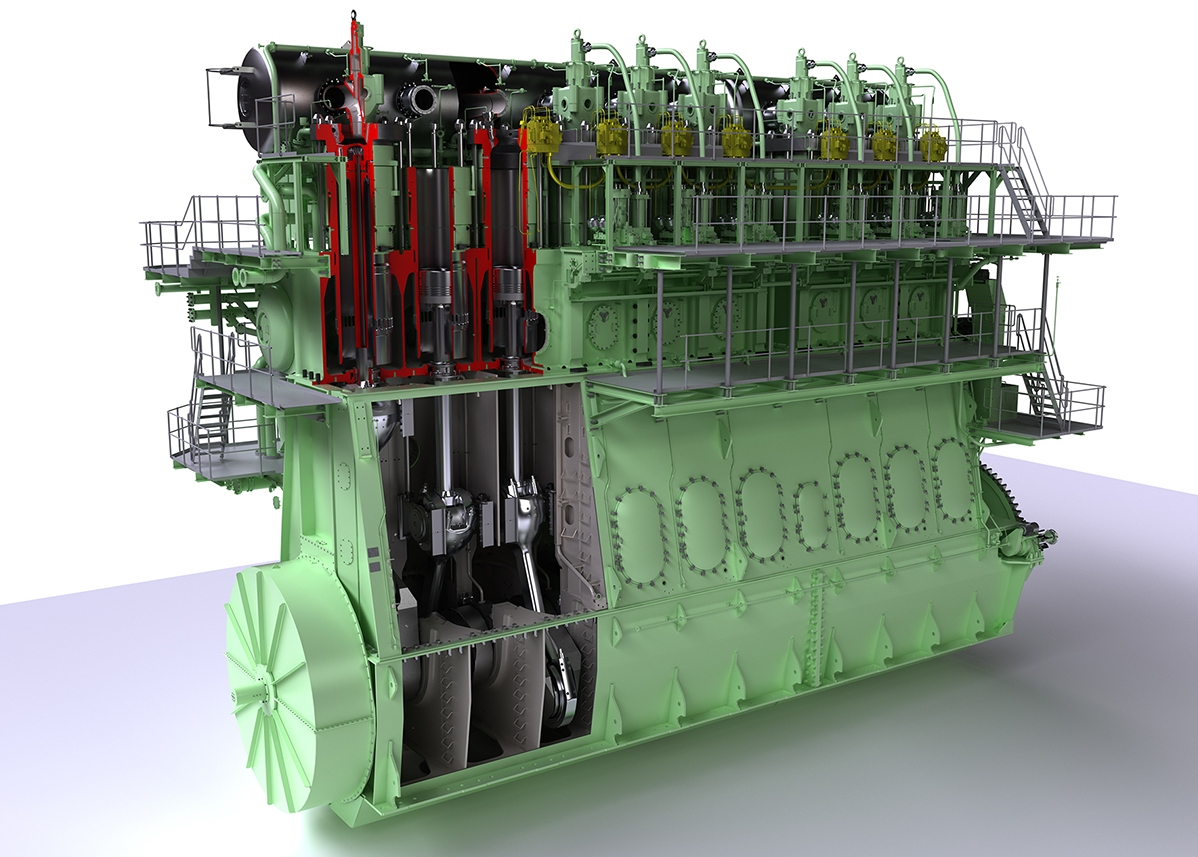
In a slow-speed crosshead engine, combustion pushes the piston down inside the cylinder liner. The piston rod, crosshead, connecting rod, and crankshaft transmit this force to the propeller shaft. Fresh air enters through ports near the bottom of the liner; exhaust gas leaves through an exhaust valve in the cylinder cover. The turbocharger uses exhaust-gas energy to supply pressurised air to the engine.
This arrangement helps explain the maintenance work. Engineers must look after the combustion space, the moving parts and bearings, the fuel and air systems, and the equipment that cools, lubricates, controls, and protects the engine.
1. Routine checks while the engine is running
A great deal of maintenance begins with observation, without opening the engine. During watchkeeping, engineers compare current readings with the engine’s usual behaviour at a similar load. Typical items include:
- Exhaust temperature for each cylinder and before and after the turbocharger.
- Scavenge-air pressure and temperature.
- Lubricating-oil pressure, temperature, filter condition, and leakage.
- Jacket-cooling-water temperature and pressure.
- Fuel pressure and temperature, where relevant to the fuel in use.
- Bearing temperatures, vibration, unusual sounds, and alarms.
- Cylinder-oil consumption and the condition of scavenge drains.
A trend matters more than an isolated number. For example, one cylinder’s exhaust temperature becoming steadily higher than the others warrants investigation. It does not, by itself, prove that its fuel injector is defective: fuel injection, exhaust-valve sealing, air supply, compression, and the temperature sensor may all need consideration.
The watchkeeper records abnormalities, informs the responsible engineer, and follows the ship’s procedures. A cadet should learn the normal readings for that engine, rather than memorising a single set of values for every ship.
2. Cylinder liner, piston, and piston rings
The cylinder liner is the surface against which the piston rings run. The piston rings help seal combustion gas above the piston and control the oil film on the liner. Both are exposed to heat, pressure, and wear.
Engineers inspect their condition through planned scavenge-port inspections and, during a major overhaul, after the piston has been withdrawn. They look for scoring, scuffing, unusual polishing, broken or worn rings, abnormal deposits, and evidence that the oil film or combustion has been poor. Liner wear measurements and ring clearances are compared with the maker’s limits and earlier records.
The piston crown is also examined for deposits, burning, cracks, and other damage. Where the design uses piston cooling oil, the cooling arrangement and evidence of leakage are checked. This is substantial work requiring a planned shutdown, approved lifting arrangements, and the engine maker’s overhaul procedure.
An important teaching point is that inspection and overhaul are different. A scavenge inspection helps engineers decide what condition the cylinder is in; it does not automatically mean the piston must be removed. Manufacturer guidance calls for repeated assessment of overall cylinder condition and provides model-specific overhaul guidance. man-es.com
3. Cylinder lubrication and scavenge-drain oil
The cylinder liner needs a controlled supply of cylinder oil. This oil helps protect the ring-and-liner surfaces. Depending on the fuel and engine, it also contributes to managing acidic products of combustion. The engine has a separate system-oil circuit for components such as bearings and crossheads; cadets should not confuse these two lubrication duties.
Engineers check that the cylinder lubricators operate correctly, that their delivery settings suit the engine maker’s guidance and operating conditions, and that oil pipes and injection points are sound. More oil is not automatically better: incorrect lubrication can increase deposits or consumption, while insufficient or unsuitable lubrication can accelerate wear.
Oil collected from the scavenge drains provides useful condition information. Its appearance and laboratory results, including wear-metal and alkalinity indicators where applicable, can help engineers assess ring and liner condition. Results must be interpreted alongside fuel, load, oil-feed rate, and previous samples; one sample is not a complete diagnosis. Everllence publishes specific guidance for using scavenge-drain samples to monitor cylinder wear and adjust lubrication on its engines. everllence.com
4. Fuel injectors and fuel-supply equipment
A fuel injector delivers fuel into the cylinder in a controlled spray. If its nozzle is worn, fouled, or leaking, combustion may deteriorate. Engineers may notice abnormal exhaust temperatures, smoke, uneven cylinder performance, or changes in fuel consumption. They inspect and test injectors using the approved equipment and replace or overhaul parts according to the results and maintenance plan.
Fuel pumps or pressure-boosting units also need inspection for leakage, wear, and correct operation. The arrangement depends on the engine: a mechanically controlled engine differs from an electronically controlled engine with hydraulic and electronic actuators. Filters, fuel quality, and the treatment of the fuel before it reaches the engine are part of protecting these components. Engine-maker maintenance information lists fuel valves, pumps, and pressure boosters among the important two-stroke service items. everllence.com
Safety point: Fuel and hydraulic systems may retain dangerous pressure after the engine has stopped. A cadet must never loosen a connection to “see whether pressure remains.” Isolation and pressure verification follow the ship’s approved procedure.
5. Exhaust valves and cylinder covers
In a uniflow-scavenged engine, each cylinder has an exhaust valve in its cover. It opens to release combustion gas and must seal properly when closed. Engineers inspect the valve spindle and seat for burning, deposits, wear, and leakage. Depending on the design, they also check its actuator, air-spring or hydraulic arrangement, and associated pipes.
A leaking or poorly operating exhaust valve can change cylinder temperatures and performance. During overhaul, engineers assess whether the valve and seat can be reconditioned or whether parts must be renewed, using the maker’s limits. The cylinder cover itself is checked for damage and for leakage around its fitted components. Engine-maker overhaul guidance treats exhaust valves, actuators, and related parts as distinct maintenance items. man-es.com
6. Turbocharger, scavenge air, and air cooler
The turbocharger is essential to supplying the air needed for combustion. Its turbine is driven by exhaust gas, while its compressor raises the pressure of the incoming air. Engineers monitor its pressures, temperatures, vibration, bearing lubrication, and signs of leakage or fouling. Cleaning and internal inspection are carried out according to the turbocharger maker’s instructions.
The charge-air cooler reduces the temperature of compressed air before it enters the engine. Engineers monitor air temperatures, cooling-water performance, drains, and signs of fouling or leakage. They also inspect the scavenge space for deposits, oil accumulation, water, and the condition of visible cylinder components.
A rise in charge-air temperature or a fall in scavenge pressure is a reason to investigate the whole air path. It is not enough to assume that the turbocharger alone is at fault.
7. Main bearings, crankpin bearings, and crosshead bearings
These bearings support and guide the engine’s heavily loaded moving parts. They depend on a reliable supply of clean lubricating oil. Routine monitoring includes oil pressure and temperature, bearing-temperature trends, and any installed oil-mist or bearing-monitoring alarms.
At planned inspections, engineers examine bearing condition and measure clearances or other specified values using the maker’s method. They also examine the crankcase for unusual debris, damage, or leakage. Major bearing work requires careful planning and strict control of lifting, shaft movement, and cleanliness.
Cadets should remember that an alarm is a warning requiring the approved response, not an invitation to open a hot crankcase immediately. The manufacturer’s guidance identifies main, crankpin, crosshead, and thrust bearings as separate inspection and overhaul items. man-es.com
8. Piston-rod stuffing box
The stuffing box surrounds the piston rod where it passes between the scavenge space and crankcase. Its rings limit the movement of oil and contamination between these spaces. Engineers monitor its drains and inspect sealing and scraping elements during planned work. Excessive leakage or abnormal drain condition can indicate wear or a sealing problem.
This is a small component compared with the piston or crankshaft, but it performs an important protective function. Engine-maker maintenance kits and overhaul guidance identify stuffing boxes as dedicated maintenance items. everllence.com
9. Cooling-water, lubricating-oil, and filtration systems
The engine cannot be maintained in isolation from its supporting systems.
Cooling-water maintenance includes checking pumps, strainers, heat exchangers, valves, leakage, water treatment, and temperature control. Poor cooling can cause abnormal component temperatures; overcooling can also create operating problems.
System-oil maintenance includes monitoring oil condition, water contamination, filters, purifiers where fitted, pumps, and alarms. Oil analysis and filter findings can reveal developing wear or contamination before a major component fails. Fuel filters and treatment equipment likewise protect injection parts from contaminants. everllence.com
When investigating a high temperature, students should ask: Is the component producing more heat, is the cooling system removing less heat, or is the indication faulty? That question prevents premature conclusions.
10. Starting air, controls, and safety devices
The engine’s starting-air system must be available when manoeuvring is required. Planned maintenance covers valves, leakage, drains, and the devices specified in the engine manual. On electronically controlled engines, the maintenance plan also covers sensors, control units, hydraulic components, and electrical connections.
Protective devices and alarms require inspection and testing under approved procedures. Their purpose is to alert the crew or protect the engine when an abnormal condition develops. A failed sensor can mislead the operator, while a bypassed or untested protective function can leave the engine exposed.
How is the work planned?
The ship’s planned maintenance system (PMS) brings these jobs together. A work record should identify the equipment, reason for the job, observations and measurements, parts renewed, tests completed, and any defect that remains open. Intervals may be based on running hours, time, condition, or a combination. Maker guidance can differ substantially by engine type and component, so a single “standard overhaul interval” should not be applied to every slow-speed engine. man-es.com
For a cadet, a useful way to understand the whole process is:
Observe a change → compare it with normal operation → report and investigate → plan safe maintenance → inspect or repair → test → record the result → continue monitoring.
Safety before opening the engine
Stopping the engine is only the beginning of preparation. Before maintenance, the responsible team must coordinate with the bridge and other affected personnel, identify the correct equipment, prevent unintended starting or shaft movement, and control electrical, pneumatic, hydraulic, thermal, and other stored energy. Large parts also require approved lifting arrangements. The isolation must be verified before work starts, following the ship’s procedures and permit system where applicable. Maritime safe-working guidance specifically addresses isolation and stored energy during machinery maintenance. GOV.UK
A junior cadet’s most valuable contribution is often careful observation: notice an abnormal trend, record it accurately, ask what it might mean, and watch how experienced engineers verify the cause. Good maintenance is a cycle of evidence, safe work, testing, and follow-up—not simply replacing parts at a scheduled hour.