
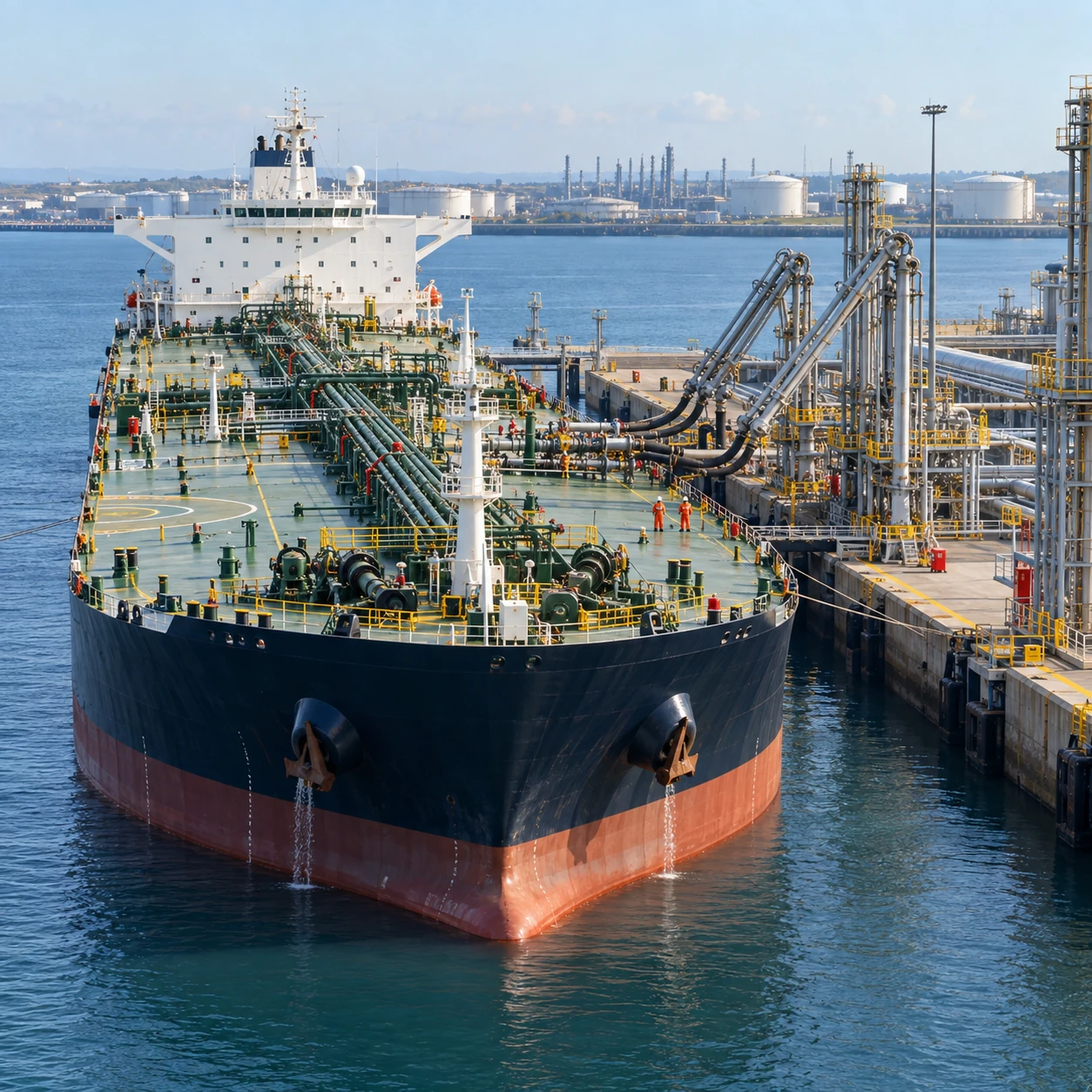
An oil tanker’s port call is a coordinated operation that begins long before the vessel reaches the berth. The crew must exchange information with the terminal, plan the cargo and ballast sequence, confirm the ship’s stability, prepare equipment, control ignition and toxic-gas hazards, and protect the sea from pollution. Once the tanker is alongside, ship and shore teams confirm that the agreed safeguards are in place before cargo transfer begins.
This article follows a typical oil-tanker discharge call, from pre-arrival preparation through berthing, cargo transfer and completion. The 16 videos below provide short visual introductions to the subjects discussed. Their procedures are training aids: the vessel’s approved cargo operations manual, safety management system (SMS), terminal instructions, cargo-specific information, and the current ship–shore checklist govern any real operation. Requirements vary with the vessel, cargo, berth, equipment and local rules. Tanker officers should use their approved documents and training, rather than treating a general article or video as an operational checklist.
What does a tanker operation involve?
“Tanker” covers several ship types and cargo systems. This article and video series focus mainly on oil tankers preparing to discharge crude oil or petroleum products. Chemical tankers, liquefied gas carriers and other specialist vessels have distinct cargo hazards, equipment and procedures; the examples here should not be transferred to them without checking the applicable requirements.
At a high level, a discharge call has five connected stages:
- Plan and communicate before arrival. Ship and terminal exchange information, agree on a feasible cargo plan and identify operating limits.
- Prepare the vessel and crew. The crew briefs responsibilities and checks cargo, ballast, inert-gas, detection, communications, pollution-response and firefighting arrangements.
- Arrive and secure the ship. The vessel approaches under the agreed plan, moors safely and establishes controlled access and communications.
- Connect and transfer cargo. Ship and shore verify the system and safeguards, begin at an agreed rate, and monitor the operation continuously.
- Complete, document and depart. The parties stop transfer in a controlled way, handle the cargo system as agreed, disconnect safely, reconcile quantities and prepare the vessel for the next stage.
The sequence is not simply a set of boxes to tick. A changed berth, weather condition, cargo property, equipment defect or new terminal instruction may require the plan to be reviewed before work continues.
1. Begin ship–shore coordination before the port call
Safe cargo handling starts with clear, timely information. Before arrival, the ship and terminal need to establish the proposed cargo operation, the vessel’s requirements, the terminal’s limits and the communication arrangements. The exchange may cover cargo identity and properties, quantities, tank distribution, expected arrival condition, manifold details, planned discharge sequence, ballast operations, transfer-rate limits, mooring arrangements, emergency contacts and any special precautions.
The ship’s officers must make sure that the information is understood on both sides. A message sent is not the same as an instruction received and confirmed. Differences in terminology, units, time, assumptions about the cargo system or changes to the berth plan should be resolved before they become operational problems.
Ship/shore communication procedures before tanker port entry
2. Build a discharge plan that fits the ship and berth
The cargo plan should set out which tanks will discharge, in what sequence, through which lines and pumps, and under what agreed conditions. It must be workable for the vessel’s cargo system and compatible with the terminal’s receiving system. The officers responsible for the plan consider such matters as cargo segregation, line configuration, tank levels, pump capacity, shore restrictions, manifold arrangements and any planned calls at more than one terminal or a single-buoy mooring.
The plan must also respect the ship’s structural and hydrostatic limits throughout the operation. Cargo removal changes displacement, draft, trim and sometimes list. Ballast intake or discharge can change them further. Officers use the vessel’s approved loading computer or stability software and cargo documentation to assess the planned stages, including intermediate conditions—not only the expected condition at the end. Draft, air-draft, manifold-height, hull-strength and terminal restrictions may all affect whether a proposed sequence is acceptable.
Tanker discharge planning: ship/shore agreement and safe sequence strategy
Tanker ship stability and trim before discharge
The final plan should be communicated to the people who will carry it out. If actual conditions differ from the assumptions—for example, a tank level, shore rate, draft, weather condition or equipment status—the responsible officers should assess the effect and agree any necessary change before proceeding.
3. Prepare the crew before arrival
A pre-arrival shipboard briefing turns the written plan into shared expectations. The chief officer or designated officer reviews the discharge schedule, individual duties, mooring plan, communications, emergency actions, access control and any special cargo procedures. The discussion can include crude oil washing (COW), inert-gas arrangements, tank gauging, cargo sampling, ballast operations, cargo vapour controls, garbage handling and the terminal’s requirements.
The briefing should give each person a clear role and reporting line. Crew members need to know who is in charge of cargo control, who is at the manifold, who monitors the pump room or cargo machinery spaces, how routine reports will be made, and how to raise a concern. A short, specific briefing is more useful than assuming that everyone has interpreted the plan in the same way.
Pre-arrival shipboard meeting for tanker discharge
4. Check equipment, valves and gas-detection arrangements
Pre-arrival equipment checks help identify defects while the ship still has time to correct them or notify the terminal. Depending on the vessel and operation, checks may cover manifold reducers and fittings, pressure gauges, lighting, communications, cargo-pump arrangements, pump-room safety equipment, alarms, emergency stops and the condition of relevant cargo and ballast systems. Findings should be reported, recorded and addressed under the ship’s procedures.
Valve status deserves particular care. Officers should verify the intended configuration of cargo, ballast and inert-gas lines using the approved plans and the actual indications or physical checks required by the vessel’s procedures. A control-room indication alone may not resolve a discrepancy if the system, valve or feedback signal is defective. Any uncertainty about a valve’s position or a line’s connection should be settled before the operation starts.
Pre-arrival equipment checks: manifold, gauges, pump room and communications
Tanker valve checks: cargo, ballast and inert-gas lines
Atmospheric hazards require suitable equipment and disciplined use. Hydrocarbon vapours may create flammable or harmful atmospheres; hydrogen sulphide (H₂S) can be acutely toxic; and an oxygen-deficient atmosphere can be life-threatening. Portable instruments should be within their required service condition, checked and used in accordance with the maker’s instructions and the ship’s procedures. Fixed systems, sample lines, alarms and indicators should also be checked as applicable. A detector is a safety barrier, not permission to enter a space or approach a release without following the entry and work controls.
Gas-detection equipment checks: hydrocarbon, H₂S and oxygen meters
Tank measurement also calls for cargo-specific precautions. Where the cargo or conditions create a toxic-vapour risk, the ship’s approved closed or restricted measurement arrangements and protective measures must be followed. Do not improvise by opening a tank or bypassing vapour controls. Personnel should know the cargo hazards and the required response to an alarm or suspected exposure.
Tank gauging, H₂S safety and closed measurement procedures
Cargo-tank pressure must remain within the vessel’s approved operating limits and be managed through the systems and procedures designed for that ship and cargo. The appropriate action depends on the cargo, tank condition, ship equipment, terminal arrangements and applicable rules. Do not interpret the phrase “release tank pressure” as a general instruction to vent cargo vapour. Pressure adjustment or vapour handling must follow the approved plan and any applicable vapour-control arrangements; opening a vent or line without authorization can create serious fire, exposure and pollution hazards.
Cargo-tank pressure management and vapour-emission safety
5. Confirm inert-gas readiness where applicable
On vessels and operations where an inert-gas system is required or used, its readiness is a central part of cargo preparation. The crew checks the relevant equipment and instruments under the ship’s procedures, which may include pumps, water seals, scrubber arrangements, oxygen analysis, alarms and control indications. During operations, the responsible officers monitor the system and tank conditions against the limits and actions specified in the vessel’s approved documents.
An inert-gas system is a safety system that must be operated and monitored as designed; it is not a substitute for controlling ignition sources, checking atmosphere, maintaining communications or following cargo procedures. If an alarm, abnormal reading or equipment defect occurs, the crew follows the ship’s response procedure and coordinates with the terminal before continuing.
Inert-gas system checks before cargo discharge
6. Protect the deck, sea and manifold area
Oil spills can begin with a small leak at a connection, a valve, a hose or a deck fitting. Before transfer, the crew and terminal confirm the required pollution-prevention measures and prepare the equipment identified by the ship’s and terminal’s plans. Scuppers and deck drainage are managed under the approved procedure so that an oil release cannot drain overboard. Any permitted drainage of clean water must be controlled and authorized as required by the applicable procedure.
Spill-response and firefighting equipment should be accessible and ready for the actual operation. The arrangement may include suitable absorbents, recovery equipment, protective equipment, hoses, monitors and extinguishers, positioned in accordance with the vessel’s plan and terminal requirements. Personnel should know how to raise the alarm, stop or isolate transfer when directed, and activate the ship’s emergency response arrangements. Specialized response products, including dispersants, are not routine substitutes for containment and recovery; their use is subject to the applicable response plan and authorization.
Inspecting and using scupper plugs on tanker ships
Manifold spill-response and firefighting equipment preparation
These preparations support the broader pollution-prevention framework. The International Maritime Organization describes MARPOL as the main international convention addressing pollution of the marine environment by ships, and Annex I concerns oil pollution. The specific requirements that apply depend on the ship, operation and location; crews must consult current shipboard plans and applicable rules. IMO: MARPOL and IMO: MARPOL Annex I—Prevention of Pollution by Oil.
7. Approach, berth and secure the tanker
The approach and mooring operation must follow the agreed plan and take account of the berth, weather, current, visibility, tug assistance and local instructions. Once alongside, the crew checks the final mooring arrangement and continues to monitor the lines as conditions change. Safe access, gangway arrangements, restricted areas, warning signs and required communications are established under the vessel’s and terminal’s procedures.
Berthing does not mean that cargo transfer can begin immediately. The vessel must be safely secured, access controlled, required checks completed and any outstanding deficiencies resolved. The ship and terminal then confirm readiness for the next stage.
Tanker ship berthing checklist: actions immediately after mooring
8. Hold the ship–shore meeting and complete the safety checks
Before cargo transfer, ship and terminal representatives meet to review the operation in practical detail. They confirm the cargoes and quantities, the agreed sequence, transfer and topping-off limits, communications, emergency signals, shutdown arrangements, staffing, watchkeeping, manifold connection, ballast coordination, vapour arrangements and any special precautions. Both sides should understand who can order a stop and how that instruction will be passed and acknowledged.
The ship–shore safety checklist is a working conversation and verification process, not a paperwork exercise. Each item must be checked by the responsible person, any difference resolved, and the agreed status maintained throughout the operation. If conditions change, the checklist, risk controls or plan may need to be revisited. OCIMF makes the ISGOTT 6 ship–shore checklists available as an operational resource; the vessel and terminal should use the applicable current checklist and procedures. OCIMF: ISGOTT 6 Ship–Shore Checklists. The International Chamber of Shipping describes ISGOTT’s sixth edition as an updated joint guide reviewed with OCIMF and IAPH. ICS: ISGOTT Sixth Edition.
Ship–shore meeting before tanker cargo discharge
The SOLAS Convention sets minimum standards for the construction, equipment and operation of ships, while detailed procedures for a particular transfer are established through applicable requirements, vessel procedures and ship–shore arrangements. IMO: SOLAS Convention.
9. Connect the manifold and verify the cargo-transfer system
The manifold is the principal interface between the ship’s cargo system and the terminal’s loading arm or hose. Before connection, the parties confirm the connection plan, required equipment and compatible fittings. The connection is then made by trained personnel using the correct tools and safeguards. The manifold area is kept controlled, with suitable access, communications and spill-response arrangements.
After connection, ship and shore verify the configuration and readiness of the relevant lines and equipment. The required checks depend on the system and local procedure; they may include confirming the selected line-up, isolations, connection security, pressure instruments, containment arrangements and communication signals. The ship and terminal agree how the line and connection will be checked before increasing transfer to the planned rate.
Tanker manifold connection procedure and pre-discharge cargo checks
10. Start discharge cautiously and monitor continuously
Once both sides have confirmed readiness, cargo transfer begins in the manner and at the rate agreed for that operation. The initial stage gives the ship and terminal an opportunity to verify that the correct cargo is moving through the intended route and that the system behaves as expected. The rate is increased only as authorized and within the vessel’s, terminal’s and equipment’s limits. There is no single transfer rate or valve sequence that applies to every tanker call.
Throughout discharge, the responsible teams maintain communications and monitor the indicators required by their procedures. These may include cargo-tank levels and pressure, manifold and line conditions, pump performance, transfer rate, ballast status, draft, trim, list, hull-strength limits, moorings and weather. The watch should respond promptly to a leak, unexpected pressure or level change, abnormal vibration, alarm, communication failure, equipment fault or other departure from the agreed condition. The response may include slowing or stopping transfer, isolating equipment and notifying the other party, as set out in the approved emergency and shutdown arrangements.
Ballast operations must be coordinated with cargo discharge. A ballast plan should account for the changing cargo condition and ship limits throughout the operation, not just the final draft. Ship and shore should coordinate any change that can affect the transfer, moorings, stability or terminal limits.
Crude oil washing during discharge
Some crude oil tankers conduct crude oil washing (COW) as part of an approved cargo operation. COW uses cargo oil through purpose-designed equipment to wash tank surfaces and manage residues. It is not an informal cleaning task: it depends on the vessel’s approved arrangements, cargo plan, equipment condition, trained personnel and applicable permissions and precautions. Before it is undertaken, the crew confirms that it is allowed for the specific operation and coordinates with the terminal. The vessel’s COW manual and applicable requirements govern the method and sequence.
Crude oil washing (COW): tanker safety and terminal precautions
11. Finish the transfer in a controlled way
As tanks approach their planned end condition, topping-off requires careful coordination. The ship and terminal confirm the order in which tanks or lines will be completed, the reduced rates or other controls required by their plan, and the agreed signals for stopping. Clear communication matters especially during the final stages, when the remaining quantity may change quickly and the margin for error can be small.
After pumping stops, the ship and terminal follow the agreed procedure for isolating the transfer, dealing with cargo remaining in the lines, verifying the final condition and disconnecting the manifold. No line should be drained, blown, stripped or opened by assumption; these actions must follow the cargo plan and ship–shore agreement. Personnel keep spill controls in place until the connection is safely closed and the area checked.
The parties then complete the cargo documentation and reconcile figures according to the applicable measurement and commercial procedures. The crew records relevant operational details, reports defects or deviations and prepares the ship for departure or the next operation. Pollution-prevention and emergency equipment remain available until the operation is fully complete.
–
The human factors that hold the operation together
Procedures and equipment only work when the people involved share the same picture of the operation. Good tanker practice depends on clear closed-loop communication, accurate records, suitable rest and watchkeeping, careful handovers and a willingness to stop and clarify when something does not match the plan. The person who notices a leak, a wrong indication or an unexpected reading should know how to report it promptly, and the responsible officer should make sure the message is acknowledged and acted upon.
Ship and shore are two operating teams connected by a cargo system. A change on one side can affect the other: a pump adjustment, valve movement, ballast change or terminal-rate change should be communicated and confirmed in line with the agreed procedure. Maintaining a shared understanding is a practical safety barrier against spills, equipment damage, cargo contamination and injury.
Why tanker operations require preparation
The main lessons are straightforward:
- Plan together: align the cargo sequence, ship condition and terminal limits before arrival.
- Verify the actual condition: check the equipment, valves, instruments and safety systems relevant to the operation.
- Protect people: understand flammable, toxic and oxygen-deficient atmosphere hazards and follow the vessel’s controls.
- Protect the sea: control deck drainage, prepare spill-response equipment and follow the ship’s pollution-prevention plan.
- Communicate continuously: confirm instructions, report changes and coordinate any adjustment to the plan.
- Use the approved procedures: videos and general articles support learning but do not replace vessel- and cargo-specific instructions.
From the first pre-arrival message to the final manifold check, a safe tanker operation depends on preparation, verification and cooperation between the ship and terminal. A well-planned discharge protects the crew, the vessel, the terminal and the marine environment while helping cargo move reliably through the port.
–
Frequently asked questions about oil tanker operations
When does a tanker cargo operation begin?
It begins during pre-arrival planning and ship–shore communication, before the tanker reaches the berth. Cargo, berth, vessel-condition, equipment and safety information must be reviewed early enough for the parties to resolve questions before transfer.
Can cargo discharge start as soon as the ship is alongside?
No. Mooring is only one stage. The ship and terminal must complete the applicable readiness checks, hold the required ship–shore meeting, verify the connection and cargo-system arrangements, and confirm that agreed safeguards are in place before transfer begins.
Is the same discharge sequence used for every oil tanker?
No. The plan depends on the vessel’s design and condition, cargo properties, tank distribution, terminal system, berth restrictions and applicable requirements. The ship’s approved cargo documents and the ship–shore agreement govern the operation.
What should a crew member do if something does not match the plan?
Raise the concern promptly through the ship’s reporting and communication arrangements. The responsible officer should assess the condition, inform the terminal where required, and follow the applicable procedure before the operation continues or changes.
Thank you ! Nicely explained How Oil Tanker Operations Work: From Pre-Arrival to Safe Cargo Discharge.