
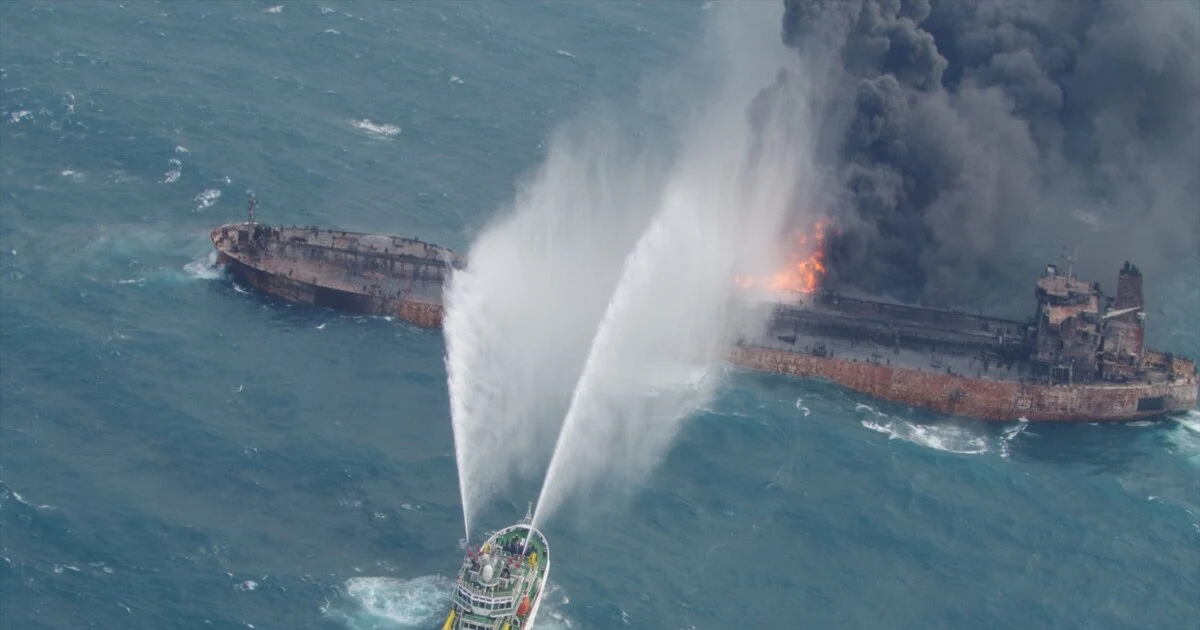
On 6 January 2018, the Panamanian-flagged oil tanker Sanchi, carrying 136,000 tonnes of highly volatile natural gas condensate from Iran to South Korea, collided with the Hong Kong-registered bulk carrier CF Crystal in the East China Sea. The collision occurred approximately 160 nautical miles east of Shanghai, in one of the world’s busiest shipping lanes. What followed was a maritime disaster of unprecedented proportions: the Sanchi burned for eight days, drifting helplessly into Japanese waters before exploding and sinking on 14 January 2018. All 32 crew members aboard the Sanchi—30 Iranians and two Bangladeshis—perished, while all 21 crew members of the CF Crystal were rescued. The disaster not only exposed the fragility of maritime safety in the East China Sea but also ignited a bitter diplomatic dispute over culpability, revealing how national interests shape the narration of tragedy.
The Incident and the Struggle for Survival
The collision’s immediate aftermath was catastrophic. The Sanchi was carrying condensate, an ultra-light crude oil that is highly flammable and toxic, making it dramatically more dangerous than conventional crude. Upon impact, the tanker ignited, and a massive explosion engulfed the vessel, killing or incapacitating the crew almost instantly. Rescue operations were severely hampered by the intense fire, toxic fumes, and adverse weather conditions. Chinese official Zhi Guanglu described the situation as “without precedent,” noting that the massive fire required constant dousing with foam that far exceeded the capacity of the ship’s storage tanks. The remote location of the collision—requiring a 20-hour round-trip to refuel firefighting boats—further complicated efforts.
Rescuers managed to recover only three bodies from the Sanchi before it sank. Four Chinese rescuers boarded the burning tanker on 10 January, retrieving two bodies from a lifeboat and recovering the vessel’s black box, but were forced to retreat due to toxic smoke and extreme heat. On 14 January, the Sanchi suddenly ignited around noon and sank before 5 p.m. local time, taking with it the remains of the 29 missing crew members. The Iranian Port and Maritime Organization confirmed that no crew members had survived.
The Investigation: Contested Causation
The official investigation, conducted jointly by China, Iran, and Panama, produced a split verdict that reflected the geopolitical tensions surrounding the disaster. Chinese investigators, who led the probe, concluded that the burden of responsibility lay with the Sanchi. According to their findings, both vessels were on a collision course, and the Sanchi failed to take the necessary action to make way, which constituted the direct cause of the accident. China submitted the investigation report to the International Maritime Organization (IMO).
Iranian and Panamanian investigators, however, offered a fundamentally different narrative. They blamed a slight course change by the CF Crystal for causing the collision. Nader Pasandideh, who led the Iranian panel, stated that the crew of the CF Crystal failed to change direction despite receiving an alert from the Sanchi about 15 minutes before the collision. He acknowledged that the Sanchi‘s navigating officers were also partly to blame for failing to take timely evasive action, but emphasized that the Chinese ship’s error was the primary cause. An Iranian-led investigation concluded that “human errors of the CF Crystal officers, putting it on a wrong path 15 minutes before the incident led to the collision”.
This divergence in findings was more than a technical disagreement; it reflected competing national narratives. Chinese officials refused to confirm Iranian claims that the CF Crystal was to blame, stating that investigations were still being carried out. The dispute underscored how maritime accident investigations are never purely technical exercises but are inevitably shaped by the political stakes involved.
The official investigation was not the only source of analysis. A separate, independent study conducted by the Oil Companies International Marine Forum (OCIMF) and other industry bodies analyzed the available information from the official reports. This analysis identified a systemic failure of basic navigation protocols on both vessels. The study found that both the Sanchi and the CF Crystal failed to comply with fundamental collision regulations (COLREGs), including Rule 5 (maintaining a proper lookout), Rule 7 (assessing the risk of collision), and Rule 8 (taking action to avoid a collision). It also pointed to the improper use of the Automatic Identification System (AIS) as a navigational aid and the ineffective use of radar plotting aids (ARPA). These findings suggest that the tragedy was not solely the result of a single error but a cascading failure of watchkeeping and navigational procedures on both ships.
Environmental Concerns and the Nature of Condensate
The Sanchi disaster presented a unique environmental challenge due to the nature of its cargo. Condensate, unlike heavy crude oil, is extremely light, toxic, and volatile. Richard Steiner, an Alaska-based oil spill consultant, called the accident “the single largest environmental release of petroleum condensate in history”. The World Wide Fund for Nature (WWF) warned that the leaking condensate was toxic to marine mammals, fish, sea turtles, and seabirds, and called for the urgent mobilization of containment equipment.
However, the environmental impact was more complex than initially feared. Because condensate evaporates and dissolves rapidly in water, much of the cargo may have burned off in the fire or dissipated into the atmosphere. Satellite imaging after the sinking revealed two oil slicks covering a combined area of 109 square kilometers, one of which was described as less thick and concentrated. Chemical analysis of oil residues that washed ashore on 26 southern Japanese islands in late January 2018 confirmed that they contained only heavy fuel oil (HFO) from the ship’s propulsion system, with no detectable condensate, indicating that the condensate had completely weathered before reaching the shores.
Despite these findings, the true extent of the environmental impact remains unclear. The fires and gaseous fumes almost certainly killed marine life in the immediate vicinity of the crash, and the long-term effects on the East China Sea ecosystem—already one of the world’s most stressed marine environments—are difficult to quantify. The area where the collision occurred is increasingly referred to as the “new Bermuda triangle” due to its high concentration of shipping traffic and dangerous navigation conditions.
Lessons to Learn
The Sanchi tragedy offers a set of hard lessons that the shipping industry, flag states, and coastal authorities cannot afford to ignore. First, the collision demonstrated that compliance with the International Regulations for Preventing Collisions at Sea (COLREGs) is not a bureaucratic formality but a life-and-death obligation: both vessels apparently failed to maintain a proper lookout, assess the risk of collision early, and take decisive avoiding action, while AIS and ARPA were not used effectively as navigation aids. Second, it exposed persistent weaknesses in bridge resource management, fatigue management, and communication—especially in high-density traffic corridors where a few minutes of indecision or misunderstanding can be fatal. Third, the disaster revealed a critical gap in emergency response for volatile cargoes such as condensate: ports and coastal states need pre-positioned firefighting, salvage, and oil-spill equipment capable of reaching remote offshore locations quickly, along with clear protocols for toxic, flammable, and evaporating cargoes. Fourth, the dispute over causation showed that accident investigations must be transparent, independent, and genuinely cooperative, with findings shared promptly through the International Maritime Organization so that safety recommendations are not delayed by national blame games. Fifth, flag states, port states, and shipowners must strengthen oversight of crew training, manning levels, and vessel maintenance, particularly for tankers operating in the congested and environmentally sensitive East China Sea. Finally, the human cost—32 deaths, grieving families, and contested narratives—underscores the need for better compensation mechanisms, victim support, and a culture of accountability. The Sanchi may have sunk, but its lessons must remain afloat: safer navigation, stronger emergency preparedness, and genuine international cooperation are the only ways to prevent another catastrophe in the world’s busiest and most dangerous waters.
Media Narratives Beyond Chinese Coverage
The international media coverage of the Sanchi disaster revealed significant differences in framing and emphasis, particularly between Chinese state media and Western and Iranian outlets.
Chinese media, including CGTN and People’s Daily, tended to emphasize the scale of the rescue effort and the unprecedented nature of the accident. Chinese officials described the operation as a heroic but ultimately tragic struggle against impossible conditions, highlighting the risks taken by Chinese rescuers. Coverage focused on China’s leading role in the investigation and its commitment to safety management improvements.
Western media, such as Reuters, BBC, and Al Jazeera, focused more on the environmental threat and the human tragedy. Reuters emphasized the potentially catastrophic impact on the marine ecosystem, noting that the Sanchi sank “in the worst oil ship disaster in decades”. The BBC highlighted the difficulty of the rescue operation and the fact that the cause of the collision remained unknown for months. Al Jazeera gave prominence to the Iranian crew’s fate and the condolences extended by the Iranian Port and Maritime Organization, while also noting the Chinese Foreign Minister’s pledge to continue rescue efforts “as long as there is 1 percent of hope”.
Iranian media, including Press TV, Mehr News Agency, and IRNA, provided a distinctly different narrative. Iranian coverage emphasized the alleged negligence of the CF Crystal crew and the grief of the Iranian families. Iranian officials publicly challenged the Chinese investigation’s findings, and state media reported on the “human errors” of the Chinese vessel’s officers as the primary cause of the disaster. Iranian media also covered the aftermath extensively, including the payment of “blood money” to the families of the victims—$1.217 million in compensation, with an additional $340,000 for the children of the martyrs. The framing of the victims as “martyrs” and the coverage of commemorative ceremonies on the anniversary of the disaster reflected a narrative of national loss and the demand for accountability.
The International Maritime Organization (IMO) and industry bodies provided a more technical perspective. The independent analysis by the OCIMF and other organizations focused on systemic failures in navigation procedures, emphasizing that both vessels failed to comply with COLREGs and that the improper use of navigation aids contributed to the collision. This narrative shifted the focus from national blame to broader questions of maritime safety culture and training.
Conclusion: A Disaster of Many Narratives
The Sanchi oil tanker disaster was a human tragedy of immense proportions and an environmental emergency that could have been far worse. It exposed the dangers inherent in the maritime transport of volatile substances through some of the world’s most congested and ecologically sensitive waters. But it also revealed something else: the extent to which the interpretation of a disaster is shaped by the political and national contexts of those who tell its story.
The Chinese narrative emphasized rescue heroism and the unprecedented nature of the accident, while downplaying the dispute over causation. The Iranian narrative emphasized Chinese negligence and the martyrdom of its sailors, demanding accountability. Western media focused on the environmental threat and the human cost, often adopting a more critical stance toward all parties involved. And the technical narrative, emerging from industry analyses, pointed to systemic failures in basic seamanship that transcended national boundaries.
The Sanchi disaster thus serves as a case study in the geopolitics of maritime tragedy. It reminds us that in the aftermath of a catastrophe, the search for truth is inevitably entangled with the pursuit of national interest, and that the lessons to be learned are not only technical but also political. For the families of the 32 sailors who perished, the conflicting narratives may offer little comfort. But for the international maritime community, the Sanchi disaster remains a stark warning about the fragility of safety in the world’s most crowded and contested seas.