
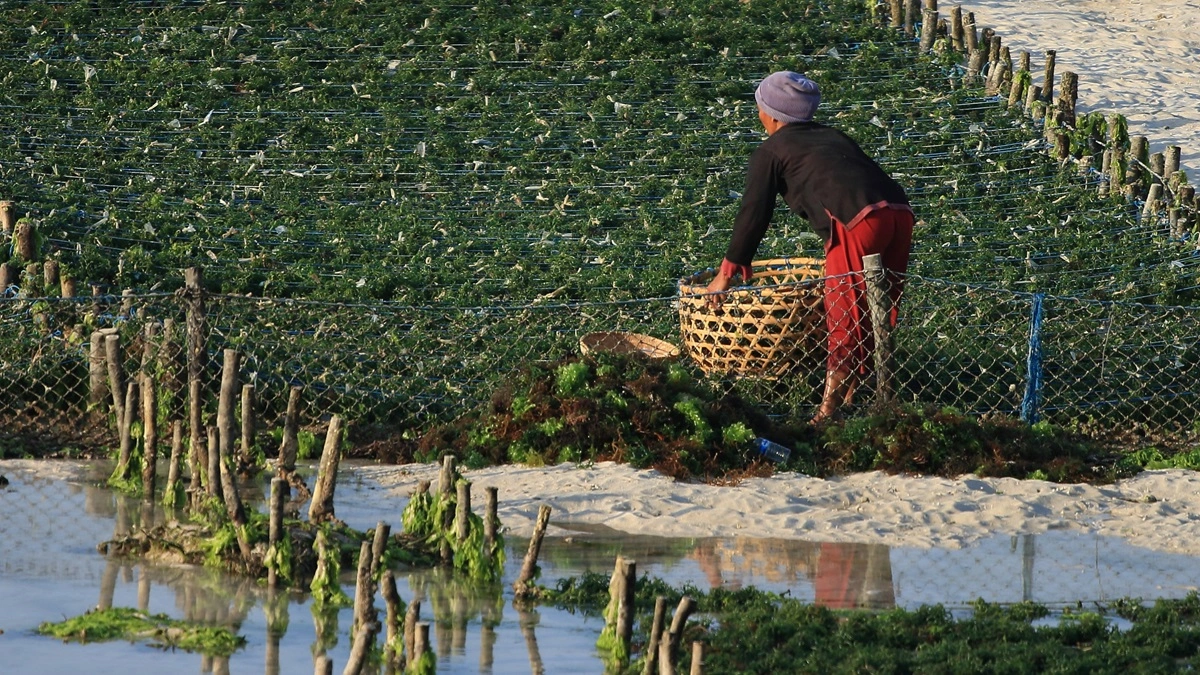
A seaweed farmer in Bali, Indonesia.
09/17/2026
Seaweed can be farmed without competing for arable land, freshwater or animal feed.
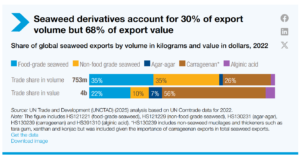
Global seaweed exports reached $3.9 billion in 2022, four times their 2002 level, according to recent analysis by UN Trade and Development (UNCTAD).
Yet 68% of export value came from processed products, highlighting the challenge for countries that mainly export raw or lightly processed seaweed.
To address this gap, the United Nations Global Seaweed Initiative (UNGSI) is helping connect producing countries involved in international food standard-setting and supporting new work to develop higher-value seaweed products. Countries interested in joining can learn more about the initiative here.
A new UNCTAD project recently launched in Indonesia will examine policy, regulatory and investment options for higher-value, non-food seaweed products, including biopolymers, biostimulants, bioplastics and biopackaging.
The project comes as Indonesia, a UNGSI member, looks to build on its strength as a major seaweed producer and create more value for its smaller businesses.
“Our next opportunity is to transform Indonesia’s production strength into higher-value, inclusive value chains. Small and medium-sized firms are where that value is kept or lost,” said Rahmat Mulianda, representative of Indonesia’s Ministry of National Development Planning, Bappenas.
From raw seaweed to higher-value products
Many coastal developing countries continue to export seaweed raw or with limited processing.
In 2022, these products accounted for about 70% of global export volumes but only 32% of export value.
Changing this situation could create new income opportunities for coastal communities. But moving into higher-value markets is not simply a matter of producing more.
Exporters must meet the standards and other requirements that determine whether products can enter and compete in international markets.
Addressing trade barriers
Many requirements applied to seaweed were designed for broader product categories rather than for seaweed itself. In 2025, 18 out of 109 technical measures identified by UNCTAD were specific to seaweed and its by-products.
Trade classifications can also make it difficult to distinguish between food, non-food and derivative seaweed products. This can create uncertainty for exporters and increase the cost of meeting market requirements.
As seaweed markets expand, producing countries are working to make global standards better reflect the sector’s needs.
Global standards for seaweed move ahead
The UNGSI provides a platform for countries that are already involved in international standard-setting, helping connect work under way through the Codex Alimentarius Commission and other international processes.
In May, Codex advanced a long-running effort to turn Asia’s standard for laver, or nori, into a global standard. It also supports work towards a general standard for edible seaweed and a Code of Practice for producing raw dried seaweeds.
UNGSI members across Africa, Asia, Europe and Latin America are also highlighting seaweed’s potential as a complementary source of iodine through their national Codex focal points.
Clearer standards can help open markets. But countries also need the capacity to turn seaweed into products that meet those market opportunities.
“Innovative seaweed farming can provide coastal communities traditionally dependent on extractive fisheries with alternative livelihoods,” said Eduardo Sfoglia, representative of Brazil’s Ministry of Fisheries and Aquaculture, at UNGSI’s first annual meeting, co-organized by UNCTAD, in Geneva in June.
Various ways to capture value
Countries are taking different approaches to moving up the seaweed value chain.
In 2024, China and the Philippines exported predominantly seaweed derivatives, while the Republic of Korea exported mainly lightly processed products, such as dried and seasoned seaweed. Indonesia and Chile combined both approaches.
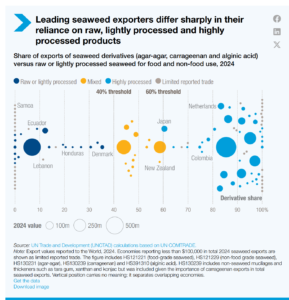
For producing countries, the objective is therefore not necessarily to process more seaweed. It is to capture more value from the products and capabilities they are best placed to develop.
For some, this may mean improving quality and market access. For others, it may mean investing in higher-value processing where there is a viable market. A combination of both approaches may offer the greatest potential.
Reference: https://unctad.org/news/seaweed-producing-countries-seek-capture-more-value-global-market-grows