
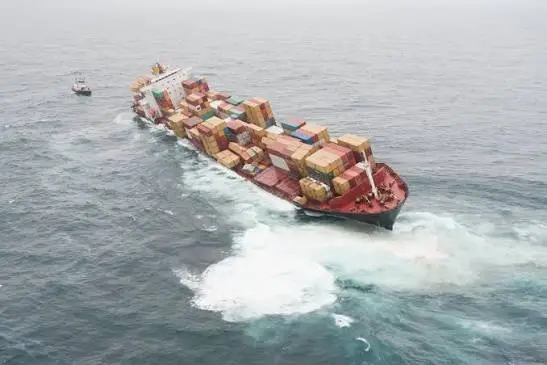
When the 236-metre container ship MV Rena struck Astrolabe Reef (Ōtāiti) in the early hours of 5 October 2011, it set in motion one of the most complex and costly salvage operations in maritime history. What followed was a two-year battle against the sea—a story of engineering ingenuity, environmental devastation, and a controversial decision that still resonates today.
The Grounding: A Catalogue of Navigational Failures
 The Liberian-flagged Rena was en route from Napier to Tauranga, travelling at around 21 knots, when it ran aground on the clearly marked reef just 12 nautical miles off the coast. The 21-year-old vessel, owned by Greek shipping company Costamare Inc. through Daina Shipping Co., was carrying 1,368 containers and 1,733 tonnes of heavy fuel oil (HFO).
The ship left Napier at 10:20 on 4 October 2011, bound for Tauranga. The master calculated the estimated time of arrival by dividing the distance by the Rena‘s normal service speed, but this calculation failed to account for the unfavourable currents that normally prevailed along that stretch of coastline. After departure, the master learned from notes on the chart about these currents and authorised the watchkeepers to deviate from the planned course lines to shorten the distance and search for the least unfavourable currents.
The second mate took over the watch shortly after midnight and calculated that the ship would arrive at the Tauranga pilot station at 0300 at the then-current speed. Tauranga Harbour Control informed him that the latest time the Rena could take the harbour pilot on board was 0300. The planned course was to pass two nautical miles north of Astrolabe Reef before making the final adjustment to the pilot station. However, the second mate decided to reduce the two miles to one mile to save time, then made a series of small course adjustments towards Astrolabe Reef. In doing so, he altered the course 5 degrees past the required track and did not make any allowance for compass error or sideways “drift”—and as a consequence, the Rena was making a ground track directly for Astrolabe Reef.
The master arrived on the bridge to prepare for arrival, but received virtually no information on where the ship was, where it was heading, and what immediate dangers to navigation he needed to consider. During this period of handover, no one was monitoring the position of the ship. At 0214, the Rena ran aground at full speed on Astrolabe Reef.
Its bow became wedged on the reef while the stern remained afloat. Two cargo holds flooded, and several breaches were identified in the hull. There were 25 crew on board at the time of the grounding. The vessel was declared a total loss on 11 October 2011.
The Salvage Operation
The Race to Remove the Oil
An oil leak was detected on the night of 5 October, and Svitzer was appointed as salvor by the vessel’s owners and insurers the next day. The salvage team began working around the clock in what Maritime New Zealand described as “extremely dangerous conditions” to secure the vessel and make preparations for the complex task of pumping the HFO off.
The salvors began removing the estimated 1,350 tonnes of oil in various tanks on 9 October but were hampered by bad weather, equipment breakdown, and hazardous and changeable conditions. Working conditions aboard the stricken vessel were nightmarish. Deep in the engine room, below five flights of bent ladders, the floor sloped sideways and was covered with oily muck. The air was thick with a putrid mix of salty air, heavy-fuel fumes, and thawed, rotting food spilled from broken containers. The noise was terrifying—the sound of howling wind and crashing waves combined with a cacophony of creaks, bangs, and groans of steel grinding on steel.
Svitzer salvage master Captain Drew Shannon described the peril: “Everywhere, there’s risk at the moment. It’s not like working on a normal ship. The ship is listing. It’s creaking and groaning. The whole ship is an area of concern, clearly”. The most dangerous area was the ship’s starboard side, where the deck was covered with water and piles of containers were listing sideways. Maritime New Zealand salvage unit manager Bruce Anderson noted that even the experienced salvors were saying it was “the toughest job they’ve ever had to do. It’s complexity upon complexity upon complexity”.
A storm overnight on 11 October resulted in the loss of an estimated 350 tonnes of oil from the Rena, some of it washing up at various points along the Bay of Plenty coastline. The Rena issued a mayday after rupturing a fuel tank in heavy seas, and six navy vessels scrambled to evacuate the 36-strong salvage crew from the crippled ship. Continuing bad weather the following night saw 86 containers lost overboard. A further 5–10 tonnes of oil was lost from the vessel overnight on 22–23 October.
Oil spill response personnel and volunteers, including large numbers of locals, worked to clean oiled beaches and recover debris from the containers. Wildlife experts from the National Oiled Wildlife Response Team treated oiled birds, including little blue penguins and pied shags, and pre-emptively caught 60 rare New Zealand dotterel to prevent them from becoming oiled.
Despite these setbacks, over 1,300 tonnes of HFO was eventually recovered from the Rena, with all accessible oil removed by 15 November 2011. As Transport Minister Steven Joyce noted at the time, oil was likely to be washing up on the coast for weeks to come.
Container Recovery and the Break-Up
Once the oil was removed, attention turned to the containers. Container removal operations began with the first container lifted off on 16 November 2011. By 26 December, a total of 341 containers had been removed.
But on 8 January 2012, the vessel’s condition deteriorated beyond recovery. Severe weather overnight separated the Rena into two pieces, which were about 20–30 metres apart on the Astrolabe Reef. The forward section remained firmly wedged, while the aft section had separated and moved clockwise about 13 degrees after the ship was hit by seas of over 7 metres overnight, further worsening the damage. An estimated 200–300 of the approximately 830 remaining containers were lost overboard.
Maritime New Zealand Salvage Unit Manager David Billington said the fresh damage had resulted in the loss of a large number of containers and debris. “While the two sections of the Rena currently remain on the reef, there’s no question the ship is badly damaged with the severe movement breaking off many of the hatch covers and releasing containers from the holds”.
The condition of the vessel had been gradually deteriorating during the time it was grounded, with more accelerated deterioration during stormy weather. On 10 January, the stern section began to change significantly, with about 75 percent underwater by 10am. The stern section completely sank in early April, with the front of the section in around 23 metres of water and the rear in around 65 metres.
Container recovery was managed by Braemar Howells, which estimated that between 200 and 300 containers were lost overboard when the two sections separated. By mid-2012, 815 of the 1,368 containers had been brought to port. By September 2012, more than 1,000 containers had been recovered. Of the 1,368 containers carried on board at the time of the grounding, 1,007 have been recovered.
The Wreck Removal
In July 2012, Resolve Marine Group was contracted by the Rena‘s owners and insurers to manage the salvage and remove much of the wreckage. The company’s team used the crane barge RMG500 to raise the top portion of the large accommodation block, transferring it to the RMG1000 barge for transport back to the Port of Tauranga.
Resolve Marine expanded its operation to cut and remove the bow section and clear over 5,400 tons of additional steel and debris from the sea floor. The work involved intensive diving operations, including saturation diving at depths below 50 metres, and the use of advanced technology such as the Coda Octopus Echoscope real-time 3D sonar.
The salvage operations included hazardous material recovery and deep oil removal at depths down to 165 feet (approximately 50 metres). In the initial phase, Resolve Marine utilised a unique technical process involving a helicopter and specialist cutting team to remove bow sections, lifting and recovering them to a nearby barge, eventually bringing the wreckage ashore for scrapping.
As the bow section reduced, Resolve Marine mobilised the RMG-280 salvage barge, Resolve Commander tug, and later the RMG 500 shear leg to New Zealand from its Singapore operations centre. The RMG 500 was deployed for two priority lifts. The first operation involved cutting and lifting the house section of the Rena, chain-cutting sections from the wreckage at a depth of 120 feet, then hoisting the 350-metric-ton piece to the surface using heavy chain pullers. The second operation cut and lifted the port side of the hull, providing access to the cargo hold for debris removal. This piece was cut into three 200-metric-ton sections and cleared.
The final salvage operation focused on debris removal. Utilising two 280-ton crawler cranes, the RMG 1000 deck barge cleared the sea floor of salvage debris. The cranes employed hydraulic grabs and electromagnets to recover debris weighing less than 20 metric tons. When larger structures needed recovery, divers cut steel sections free and rigged them directly to the crane for lifting from the sea floor.
A distinctive aspect of the salvage operation was the recovery of nurdles—small plastic pellets used in manufacturing—in 80 feet of water, addressing current conditions before they reached the beach. The initial attempt involved a steel structure with pumps and holding tanks engineered to sit over the container, but adverse weather conditions rendered it unstable. The salvage master developed a method to create bags from fishing nets with zip-tie closures, allowing divers to direct the nurdles. This method expedited the recovery of pollutants in days rather than weeks.
Resolve Marine successfully removed 1,300 tons of steel from the bow section, cleared over 3,400 tons of debris and scattered steel structures on the reef due to the vessel’s breakage and sinking, and eliminated 1,000 tons of steel from the house accommodation and port side shell.
Environmental Impact
The Rena grounding has been called New Zealand’s worst maritime environmental disaster. The ship released oil, cargo, and equipment into the marine environment, with contaminants spreading across large areas of the Bay of Plenty.
The environmental effects were both acute and chronic. About 400 tonnes of heavy fuel oil leaked out after the accident, polluting the sea and beaches in the Bay of Plenty, one of the world’s most important marine conservation areas and a popular tourist destination. More than 2,000 sea birds died. Oil coated rocky intertidal reefs and affected marine species. Wildlife experts treated oiled birds, including little blue penguins and pied shags, and pre-emptively captured 60 rare New Zealand dotterel to prevent them from becoming oiled.
Beyond the oil itself, containers, plastic beads (nurdles), copper clove, and Tributyl Tin (TBT—from the paint on the ship’s hull) were major contaminants discharged during this period. Some TBT and possibly copper clove are likely to continue to be discharged from the wreck’s remains into the future. There was a huge public response to the grounding and the discharges of oil and other contaminants that washed up on the coast and closed fishing grounds. Thousands of volunteers worked on beach clean-up activities, with tangata whenua at Maketu playing a lead role.
Scientific research conducted in the aftermath found that while there were relatively few lasting effects of the oil itself on coastal habitats, legacy effects remain largely restricted to the area around Astrolabe Reef, where the remnants of the ship and contaminants persist. A study investigating subcanopy dynamics at Astrolabe Reef, directly impacted by the Rena wreck, and Motiti Island, a nearby reef indirectly affected, found that sites nearer the wreck were dominated by turfing algae and urchins (Centrostephanus rodgersii), while more distant sites supported greater sponge richness and habitat heterogeneity. These findings demonstrated that outward canopy recovery can mask deeper structural shifts in subcanopy communities.
The financial cost of the disaster was staggering. About $900 million** has been spent on salvage and clean-up, making it the second most expensive salvage in the world. It was estimated that further salvage to completely remove the wreck and debris could cost over **$450 million.
The Decision to Leave the Wreck
In a controversial move, the Rena‘s owners applied for resource consent to leave what remained of the wreck on Astrolabe Reef. In early 2014, Daina Shipping lodged a resource consent application with the Bay of Plenty Regional Council seeking permission to abandon sections of the wreck and associated debris in place on the reef. The application was opposed in part by the New Zealand government, and the process sparked significant debate—particularly among Bay of Plenty iwi, who held cultural and spiritual connections to Ōtāiti.
The wreck of the Rena and the subsequent resource consent processes created considerable division in the Bay of Plenty region, especially within iwi. After the grounding, it became apparent that Ōtāiti was a very important wahi tapu (sacred site). The effect of the grounding and associated discharges on the mauri (life force) of the area and on tangata whenua and kaitiaki was particularly evident, but the extent to which abandoning the wreck would continue to affect people was contested.
Despite initial general opposition to the application, by the time the appeal was heard at the Environment Court, the landscape had shifted. The owner went to considerable efforts to consult particularly with tangata whenua, which resulted in considerable additional removal of wreckage beyond what had originally been considered feasible.
The Regional Council agreed to defer the decision with the recommendation that even though the full removal of the wreckage was technically possible, it was not feasible as it posed unnecessarily high risks to health and safety, as well as the environment.
In February 2016, a panel of independent commissioners—retired Environment Court Judge Gordon Whiting, Cultural Commissioner Rauru Kirikiri, marine engineer John Lumsden, and environmental scientist Shane Kelly—granted consent for the owners to abandon the remaining wreckage on the reef, but under a strict court order requiring them to pay for ongoing costs. The ruling granted consent to “dump” the remains of the Rena and “discharge” any harmful substances or contaminants from the remains, provided the owners pay for the management of the wreck for the next 20 years through a NZ$6.35 million** cash bond set up by the owners and **NZ$5 million from insurer the Swedish Club.
The decision was not universally welcomed. Iwi expressed disappointment at the decision to leave the Rena on the reef. The ongoing management of the wreck site was to be carried out by the Bay of Plenty Regional Council.
Even years later, the wreck’s legacy endures. As of 2017, 11,000 tonnes of steel from the Rena remained on Astrolabe Reef, more than five years after the grounding. Small pockets of oil have continued to be discovered in the remains of the engine room and accommodation block.
Lessons Learned
The Rena disaster prompted significant changes in maritime management and emergency response in New Zealand. An independent review was conducted into Maritime New Zealand’s response to the incident. The final report into the causes of the grounding, released in 2014, found that it was the failure of the master and crew to follow proper voyage planning, navigation, and watchkeeping practices, and the ship manager’s insufficient oversight of the vessel’s safety management system, that led to the grounding.
The Transport Accident Investigation Commission concluded that the grounding was not attributable to the malfunction of any on-board machinery or equipment, including navigational equipment. Factors that directly contributed included the crew not following standard good practice for planning and executing the voyage, for navigation watchkeeping, and when taking over control of the ship. Safety issues identified included insufficient oversight of the ship’s safety management system by CIEL Shipmanagement S.A. and deficiencies identified during port state control inspections about three months prior to the grounding.
The incident also highlighted the importance of including environmental scientists in first-response teams for future shipwrecks and raised questions about the adequacy of New Zealand’s maritime legal frameworks for dealing with large-scale wreck removal and abandonment.
The salvage of the Rena remains a defining chapter in New Zealand’s maritime history—a story of remarkable engineering achievements set against the backdrop of environmental tragedy and a community’s resilience. The wreck on Astrolabe Reef serves as both a memorial to what was lost and a cautionary tale for the future.