
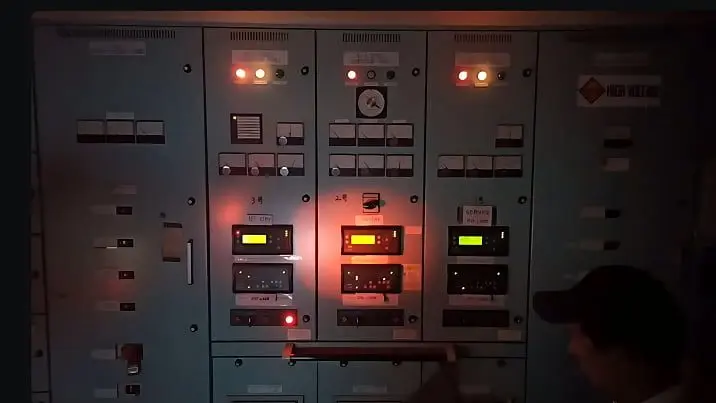
Regulatory review date: 15 September 2026
A blackout and a dead ship condition are related, but they are not the same. Confusing them can lead to incorrect decisions during an emergency and to incorrect answers in examinations or simulator assessments.
This article explains the difference in clear language and identifies the applicable requirements of the International Convention for the Safety of Life at Sea, 1974, as amended (SOLAS). The regulatory baseline is the SOLAS Consolidated Edition, 2024, read together with amendments in force up to 15 September 2026. The 2026 amendments do not change the blackout and dead-ship provisions discussed here. In particular, the Chapter II-1 amendments that entered into force on 1 January 2026 concern lifting appliances and anchor-handling winches, not regulations II-1/3.5–3.8, 26.4 or 40–44.
Important scope note: SOLAS establishes minimum design and safety requirements. It does not prescribe one detailed restart sequence for every ship. The actual sequence depends on the ship’s electrical plant, propulsion system, approved drawings, manufacturers’ instructions and Safety Management System (SMS). Always follow the vessel-specific blackout recovery and dead-ship recovery procedures.
Four terms that students should not confuse
Normal operational and habitable condition
SOLAS regulation II-1/3.5 defines this as the condition in which the ship, machinery and services required for propulsion, steering, safe navigation, fire and flooding safety, communications, signals, escape and habitability are working normally.
This is a definition, not a list of the generators that must be running. Under II-1/41, the main source of electrical power must have sufficient capacity and must comprise at least two generating sets. Depending on the vessel, these may be diesel generators, shaft generators, turbine generators or another approved arrangement.
The expression main generating set describes its function in the ship’s electrical system. A diesel generator commonly called an “auxiliary engine” may, electrically, be one of the ship’s main generating sets.
Emergency condition
SOLAS regulation II-1/3.6 defines an emergency condition as one in which services needed for normal operation and habitability are not working because the main source of electrical power has failed.
Again, this is a definition. The detailed requirements for the main and emergency electrical systems are principally in II-1/40 to 45.
Blackout
In normal marine-engineering use, a blackout means loss of voltage from the main electrical system or main switchboard. Main electrically driven auxiliaries may stop, and propulsion may be lost, but starting air, batteries, an emergency generator and other stored energy may still be available.
SOLAS regulation II-1/3 does not give a general definition of “blackout.” For the specific 30-minute requirements in II-1/42.3.4 and II-1/43.3.4, the IMO unified interpretation treats blackout as the event that initiates the dead ship condition.
Dead ship condition
SOLAS regulation II-1/3.8 defines dead ship condition as the condition in which the main propulsion plant, boilers and auxiliaries are not operating because power is absent.
For dead-ship starting arrangements, the unified interpretation uses a deliberately severe assumption: no stored energy is assumed to be available for starting the propulsion plant, the main source of electrical power or other essential auxiliaries. However, a means of starting the emergency generator is assumed to remain available.
Therefore, a normal blackout does not automatically mean that the vessel is in the SOLAS dead ship condition. A blackout may be recovered quickly by starting a standby main generating set. A dead ship condition is the more demanding design case in which the ship must be capable of rebuilding the energy needed for recovery without external assistance.
Main, standby, emergency and transitional power
| Term | Main purpose | Normally supplies |
|---|---|---|
| Main source of electrical power | Operates the ship in normal conditions | Main switchboard (MSB) and normal ship services |
| Standby main generating set | Replaces a failed main generating set | Main switchboard; it remains part of the main source, not the emergency source |
| Emergency source of electrical power | Maintains specified safety services after failure of the main source | Emergency switchboard (ESB); it may be an emergency generator or an accumulator battery |
| Transitional source of emergency power | Supplies selected emergency services during changeover | Specified emergency circuits, automatically from an accumulator battery |
| Equipment UPS or local battery | Prevents interruption to a particular item | Only the connected equipment or approved circuits |
| Starting-air bottle or hydraulic accumulator | Stores pneumatic or hydraulic starting/actuating energy | Starting or actuating equipment; it is not an electrical transitional source |
During normal operation, the ESB is usually supplied from the MSB through an interconnector feeder. When the main source fails, that connection is automatically disconnected at the ESB and the independent emergency source takes over the emergency circuits.
The standby main generator and emergency generator have different jobs:
- the standby main generator restores the main switchboard and normal essential machinery; and
- the emergency generator supplies the emergency switchboard and the limited safety services assigned to it.
They may both receive start commands after a blackout, depending on the design, but that does not make them interchangeable. The emergency generator does not normally re-energize the entire main switchboard.
What normally happens immediately after a blackout?
A simplified sequence is:
- The main switchboard loses voltage and running electrical auxiliaries stop or trip.
- Protective systems isolate the failed supply or faulty section.
- Batteries, local UPS units or the approved transitional source keep specified control, alarm, communication and lighting functions available.
- The emergency generator starts and supplies the ESB when required by the approved design.
- Where the ship is designed for automatic recovery, a standby main generating set starts and connects to a healthy main bus section.
- Essential auxiliaries restart automatically or are restarted in a controlled sequence, with load shedding used to prevent generator overload.
- After the cause has been identified and the plant is safe, steering and propulsion are restored in accordance with the ship-specific procedure.
This is an explanatory sequence, not a universal SOLAS operating checklist. For example, a fire, flooding, short circuit, loss of fuel supply or failure of common cooling water may require isolation and damage control before any attempt is made to re-energize equipment. Repeatedly resetting breakers without finding the cause can worsen the casualty.
The SOLAS time limits—and what each one actually means
| Time | Correct meaning | What it does not mean |
|---|---|---|
| Preferably within 30 seconds | – Under the unified interpretation of II-1/41.5.1.1, where one generator normally supplies the ship, a standby main generator should start and connect to the MSB as rapidly as possible, preferably within 30 seconds. A longer time may be approved for prime movers that need it. | – It is not the required duration of transitional emergency power. It is also not a universal hard maximum for every ship. |
| Maximum 45 seconds | – On a passenger ship with a generator as the emergency source, the emergency generator must be able to carry its full rated load as quickly as safe and practicable, with a maximum of 45 seconds. On a cargo ship, a fast automatic emergency generator may remove the need for a separate transitional source if it supplies the specified load within a maximum of 45 seconds. | – It does not mean that the main switchboard, propulsion or the whole ship must be restored within 45 seconds. |
| At least 30 minutes (half an hour) | – A required transitional emergency battery must automatically supply the emergency services listed in II-1/42.4 or II-1/43.4 for at least half an hour. The detailed list differs between passenger and cargo ships. | – It is not 30 seconds, and it does not mean that every shipboard load is battery-powered for 30 minutes. |
| Within 30 minutes after blackout | – For ships constructed on or after 1 July 1998, where electrical power is necessary to restore propulsion, II-1/42.3.4 or II-1/43.3.4 requires sufficient capacity to restore propulsion from the dead ship condition, together with other machinery as appropriate, within 30 minutes after the initiating blackout. | – It is not a general requirement to restore every electrical service, full hotel load or full propulsion power within 30 minutes after every ordinary blackout. |
| 36 hours / 18 hours | – The emergency source generally supplies the listed safety services for 36 hours on passenger ships and 18 hours on cargo ships. Cargo-ship muster and embarkation lighting has a separate three-hour requirement. With Administration approval, specified durations for ships on regular short voyages may be reduced, but generally not below 12 hours. | – These endurance periods do not mean that the emergency source must run all normal ship services. |
The two different 30-minute requirements are especially easy to confuse. One concerns the endurance of a transitional accumulator battery for selected emergency loads. The other concerns restoration of propulsion from the dead ship design condition.
A prolonged loss of main power
If the main source cannot be restored quickly—for example, because of a fire or serious electrical fault—the emergency source supplies only the services assigned to the emergency switchboard. These commonly include specified emergency lighting, navigation lights, required radio equipment, internal emergency communications, fire detection and alarms, signals and certain pumps or steering functions, subject to the detailed passenger-ship or cargo-ship requirements.
The emergency source is intentionally located and separated so that a fire or other casualty in a space containing the main source, the main switchboard or a machinery space of category A should not disable the supply, control and distribution of emergency power.
It is therefore inaccurate to say that “all electrical energy is lost” while the emergency generator and ESB are operating. The correct description is prolonged loss of the main source of electrical power with emergency power available. If both the main and emergency sources are unavailable, the statutory emergency-power arrangement has also failed, and the response becomes casualty-specific.
Restoration from a dead ship condition
Three SOLAS provisions must be read together:
- II-1/26.4: means must be provided to bring the machinery into operation from the dead ship condition without external aid;
- II-1/41.1.4: the generating arrangements must support starting the main propulsion plant from dead ship condition with one generating set or its primary source out of service; the emergency source may assist only when its capacity remains sufficient for the emergency services that must be supplied at the same time; and
- II-1/42.3.4 for passenger ships or II-1/43.3.4 for cargo ships: for applicable ships constructed on or after 1 July 1998, propulsion restoration must be achievable within 30 minutes where electrical power is necessary for that restoration.
A typical conceptual power path may be:
Emergency generator → emergency switchboard → approved dead-ship recovery auxiliaries → one main generating set → main switchboard → essential auxiliaries → propulsion
However, SOLAS does not say that every fuel pump, lubricating-oil pump, air compressor or UPS must be supplied from the ESB. The required recovery consumers are determined by the propulsion and generating-plant design. They should be identified in the approved electrical load analysis, single-line diagram, dead-ship calculation and vessel procedures.
Depending on the vessel, the recovery arrangement may include an emergency air compressor, a hand-started prime mover, a hand-operated compressor, dedicated batteries, chargers or selected fuel, lubricating-oil and cooling-water auxiliaries. Listing all of these as compulsory ESB consumers would be incorrect.
The stored starting energy reserved for the emergency generator must not be used directly to start the main propulsion plant, the main electrical source or other essential auxiliaries. Its purpose is to preserve the emergency generator’s availability.
A safe learning sequence for students
When practising blackout recovery in a simulator, students should think in this order:
- Recognize: confirm loss of the main bus and check alarms, frequency, voltage and breaker positions.
- Communicate: inform the bridge and engine-room team, assign roles and confirm the operational situation.
- Protect: verify emergency power, steering, communications, fire detection and other essential safety services.
- Diagnose: identify and isolate the probable cause before reconnecting equipment.
- Rebuild: establish one healthy main source and restore essential auxiliaries in the correct sequence without overloading it.
- Recover propulsion: prepare and restart propulsion only when its lubricating oil, cooling, fuel, control air and safety conditions are satisfied.
- Stabilize and monitor: share load as required, restore non-essential services gradually, monitor the plant and record the event.
Students should use the ship’s approved procedure and the simulator model’s actual logic. A sequence that is correct for a conventional diesel ship may be wrong for a dual-fuel vessel, an integrated-electric-propulsion ship, a steam ship or a ship with a battery-hybrid plant.
Conclusion and Key points to remember
- A blackout is normally the loss of main electrical power; stored energy and emergency power may still be available.
- A dead ship condition is a more severe condition in which the main propulsion plant, boilers and auxiliaries are not operating because power is absent.
- The main and emergency electrical systems have different functions and normally feed different switchboards.
- SOLAS transitional emergency power is based on an accumulator battery, not on starting-air bottles or hydraulic accumulators.
- The transitional duration is half an hour, not 30 seconds.
- The 45-second requirement concerns emergency-power availability, not complete blackout recovery.
- The 30-minute dead-ship requirement concerns restoration of propulsion for applicable ships, not restoration of every normal service.
- The machinery needed for recovery is ship-specific; only the approved consumers should be described as supplied from the ESB.
- SOLAS design requirements must be combined with the ship’s SMS, manuals, drawings and maker instructions for actual operations and simulator training.
The original practical idea remains valid: engineers must understand how emergency power supports recovery after failure of the main source. However, accurate teaching depends on separating blackout, emergency condition and dead ship condition, and on explaining the different functions of the standby main generator, emergency generator and transitional battery.
SOLAS sets the required safety outcome and minimum capacities. The vessel’s approved design and procedures determine exactly which equipment is used and in what order. This distinction gives students both regulatory accuracy and the practical judgement required during a real casualty or simulator exercise.
Regulatory references
- IMO—International Convention for the Safety of Life at Sea (SOLAS), 1974, as amended.
- IMO, SOLAS Consolidated Edition, 2024 (publication code IH110E), listed in the current IMO publications catalogue.
- IMO—Amendments to IMO instruments: upcoming and recent entry-into-force dates, checked 15 September 2026.
- IMO resolution MSC.532(107), containing the Chapter II-1 amendments that entered into force on 1 January 2026.
- SOLAS regulations II-1/3.5–3.12, II-1/26.4, and II-1/40–44.
- IMO resolution MSC.57(67), which introduced the 30-minute provisions in II-1/42.3.4 and II-1/43.3.4 for ships constructed on or after 1 July 1998.
- IMO circular MSC.1/Circ.1572/Rev.2, Unified interpretations of SOLAS chapters II-1 and XII; a current regulatory copy is available through the Netherlands Shipping Inspectorate’s regulatory framework.
- IMO—International Safety Management (ISM) Code, for ship-specific emergency preparedness and Safety Management System procedures.
This educational article summarizes selected requirements. The official IMO instruments, the vessel’s flag Administration requirements and its approved documentation remain authoritative.