
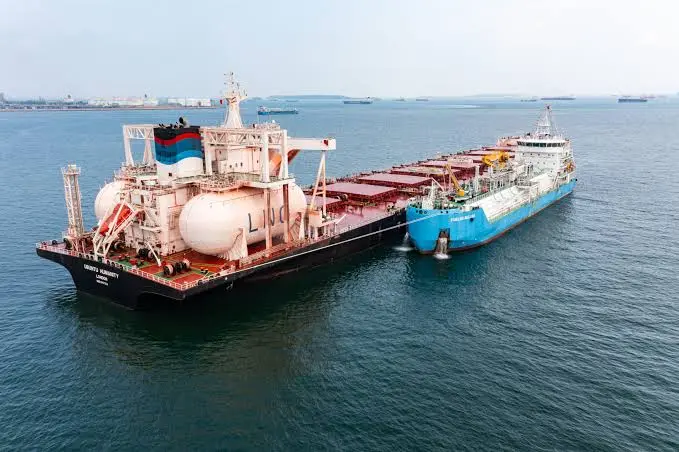
As the LNG-fuelled fleet expands and ammonia moves from concept to commercial reality, the humble bunker vessel is emerging as critical infrastructure for decarbonisation.
The maritime industry’s energy transition is often framed around fuels, engines, and regulations. But there is a less visible enabler that will determine whether the transition succeeds or stalls: the infrastructure that delivers alternative fuels to ships. At the centre of that infrastructure sits the gas bunker vessel—a specialised ship type that has quietly become one of the most strategically important assets in the maritime energy chain.
A Market Stretched by Growth
The numbers tell a story of rapid expansion. Around 900 LNG-fuelled vessels are now in operation worldwide, excluding LNG carriers themselves. Approximately 200 were delivered in 2025 alone, with another 190 added to order books. A further 650 vessels are expected to enter service before 2030.
LNG consumption by these ships has grown by more than 500% between 2020 and 2024, with a further 167% growth projected between 2025 and 2030. This reflects both the expanding fleet and higher utilisation rates of LNG-powered vessels.
Yet the bunker vessel fleet has not kept pace. Only 58 LNG bunker vessels are currently in service, with 32 on order for delivery by the end of 2027. Depending on market development assumptions, the fleet may need to expand to between 165 and 208 vessels by 2030. The gap between supply and demand is widening.
This imbalance is not merely a matter of vessel numbers. Bunkering capacity depends on vessel size, utilisation rates, transfer frequency, and the availability of shore-based storage and terminal infrastructure. Constraints can shift quickly from vessel availability to port operations.
What Makes a Bunker Vessel Different
At first glance, a gas bunker vessel resembles a conventional gas carrier. Both are designed and constructed under the IGC Code, with similar containment systems and cargo handling equipment. But the operational profile is fundamentally different.
A conventional gas carrier transports cargo between terminals, often on long voyages with relatively infrequent transfer operations. A bunker vessel, by contrast, performs ship-to-ship transfers as its primary function—potentially several times per day in busy ports, serving a wide range of receiving vessels with different manifold arrangements, freeboards, and tank conditions.
This shift has profound design implications. The cargo system must support variable flow rates, frequent partial deliveries, and slack tanks. Transfer equipment must accommodate different vessel types and operating conditions. Manoeuvrability becomes critical, as bunker vessels must approach, moor, and unmoor alongside receiving ships without tug assistance in congested port environments.
The receiving vessel is also different. In conventional STS transfers, both ships are typically gas carriers with comparable crew experience and safety systems. In bunkering, the receiving vessel is usually not a gas carrier at all—it may be a container ship, car carrier, cruise vessel, or tanker. This places greater emphasis on compatibility, communication, and emergency procedures between two very different types of vessel.
The Regulatory Landscape
Gas bunkering operates within a framework that is still evolving. The IGC Code governs gas carrier design, while the IGF Code provides the safety framework for gas-fuelled ships. The emerging “one ship, one code” principle aims to avoid overlapping requirements where gas carriers use cargoes or alternative fuels for propulsion.
For LNG, the regulatory framework is relatively mature. For ammonia and hydrogen, interim guidelines are being developed. Ammonia-specific requirements—including enhanced deck water spray systems, fixed water monitors, leak detection, and toxic zone establishment—have been incorporated into class rules and are increasingly reflected in port requirements.
Port-level requirements vary considerably. Singapore has developed detailed licensing standards for LNG bunker vessels, including registration and classification requirements. Gothenburg publishes specific LNG operating regulations. Rotterdam, despite being Europe’s largest bunkering port, relies on existing port regulations and terminal procedures rather than a dedicated LNG bunkering document. This variation means operators must navigate a patchwork of local requirements that supplement international frameworks.
Vapour Return and Boil-Off Gas
One of the most technically demanding aspects of gas bunkering is the management of vapour and boil-off gas. During transfer, vapour displaced from the receiving vessel’s tanks must be managed to maintain safe pressures. This is particularly important when bunkering vessels with low-pressure fuel tanks, where pressure control is critical.
Vapour return capability allows the receiving vessel’s tanks to be kept at low pressure, improving transfer efficiency and reducing bunker time. But natural flow may not always be sufficient, requiring forced vapour return systems. The vapour systems of supplying and receiving vessels must be properly segregated to prevent accidental overpressure.
Boil-off gas generated during the operation can be managed through reliquefaction, thermal oxidation, or consumption as fuel. LNG bunker vessels have traditionally relied on oxidation, but there is a growing trend toward reliquefaction or sub-cooling units, particularly for vessels with minimal idle time between transfers.
Transfer Systems and Safety
The transfer system is an integral part of the cargo system and subject to the same regulatory framework. It incorporates several specialised components designed specifically for the bunkering interface.
Emergency separation systems—commonly known as breakaway couplings—are designed to safely disconnect the transfer line if vessels drift apart beyond safe limits. These must retain functionality under icing conditions, given the cryogenic temperatures involved. Quick connect/disconnect couplers facilitate rapid connection without bolted flanges, equipped with locking arrangements to prevent accidental disconnection.
Insulating flanges prevent static electrical charge accumulation and protect against stray currents. While bonding wires were historically used, their effectiveness has been questioned, and local requirements vary. Flexible hoses, rigid loading arms, or semi-rigid transfer arms may be used depending on operating conditions, with material selection particularly important for thin-wall corrugated metallic hoses in salt-laden environments.
Propulsion and Manoeuvrability
The operational risk profile of a bunker vessel is higher than that of a conventional gas carrier. Frequent operations in congested ports, often in close proximity to other vessels and critical infrastructure, mean that a loss of propulsion or manoeuvrability could have immediate consequences.
Many LNG bunker vessels are designed with enhanced propulsion resilience through alternative or redundant propulsion arrangements. These provide independent means of propulsion following a failure, or ensure that no single failure results in total loss of propulsion capability. Typical arrangements include twin independent propulsion lines with separate engines, shaft lines, electrical distribution, and control systems.
Manoeuvrability requirements scale with vessel size. Small bunker vessels may accept single-screw arrangements, but larger vessels typically require controllable pitch propellers, high-lift rudders, and bow thrusters. For vessels of 5,000 GT and above, twin-screw propulsion or combined bow and stern thrusters may be necessary.
Conversion: A Pragmatic Pathway
For operators seeking to enter the bunkering market without ordering new tonnage, conversion of existing small-scale LNG carriers offers an attractive pathway. These vessels already possess cryogenic containment, boil-off gas control, cargo monitoring, gas detection, and emergency shutdown arrangements.
The conversion assessment must address transfer compatibility, emergency shutdown logic, communication systems, and station-keeping arrangements. Fendering, mooring, separation monitoring, and thruster capacity must support safe alongside operations. Hazardous area classification may change with new transfer locations and revised operating envelopes.
Successful conversions treat the bunker vessel as part of a wider fuel supply ecosystem rather than a standalone ship conversion. Long-term success depends on safe interface management, vapour control, regulatory compliance, port acceptance, and crew competence.
The Ammonia Dimension
Ammonia is increasingly viewed as a potential low-carbon marine fuel, capable of significant emissions reductions when produced from renewable or low-carbon sources. But its toxicity introduces distinct safety, operational, and regulatory challenges.
Ammonia-specific requirements now address transfer connection arrangements, enhanced deck water spray systems, fixed water monitors for toxic vapour dispersion and personnel protection, leak detection at transfer connections, ammonia-specific gas alarm levels, toxic zone establishment, and dedicated emergency stations. Nitrogen is used as inert gas to reduce oxygen accumulation and mitigate stress corrosion cracking risk.
Many principles developed for LNG bunkering remain applicable, but ammonia requires additional design considerations and dedicated safety measures. The regulatory pathway was established with IMO Resolution MSC.566(109), which adopted amendments to the IGC Code and introduced interim guidelines for ammonia as fuel.
Operational Discipline and Competence
The safe use of liquefied gases as marine fuel depends on a disciplined combination of robust design, clearly defined operating controls, effective planning, and demonstrable crew competence. The transition from conventional fuel oil operations should be managed through a structured management-of-change process involving newbuilding, technical, crewing, and safety management functions.
Industry experience suggests a lead time of approximately 6 to 12 months before delivery is needed to establish these enablers. Compatibility assessments, joint plans of bunkering operations, pre- and post-bunkering checklists, and competence development measures are all essential.
Checklists developed by industry bodies provide a practical means of translating risk controls into verifiable actions. But their value lies not only in confirming task completion—it also ensures that safety-critical assumptions are visible, agreed, and challenged where necessary. Any negative response or deviation from the approved plan should trigger an assessment before transfer commences or continues.
The Road Ahead
The future fuel landscape will undoubtedly be more diverse than today. LNG is expected to remain an important marine fuel through the coming decades, supported by mature technology and established infrastructure. Its compatibility with bio-methane and synthetic methane provides fuel optionality, enabling existing infrastructure to support lower-carbon pathways as they become available.
But the success of the transition will depend on infrastructure and supply chains that make these solutions available at scale. Gas bunker vessels are a critical part of that equation. Without sufficient bunkering capacity—supported by port infrastructure, storage, and digital coordination tools—constraints will simply shift from vessel availability to shoreside operations.
The industry has demonstrated that safe, reliable, and scalable bunkering solutions are achievable. The challenge now is to ensure they keep pace with demand. As the maritime energy transition accelerates, the gas bunker vessel will remain what it has always been: a strategic enabler, connecting the fuels of tomorrow with the ships that rely on them.