
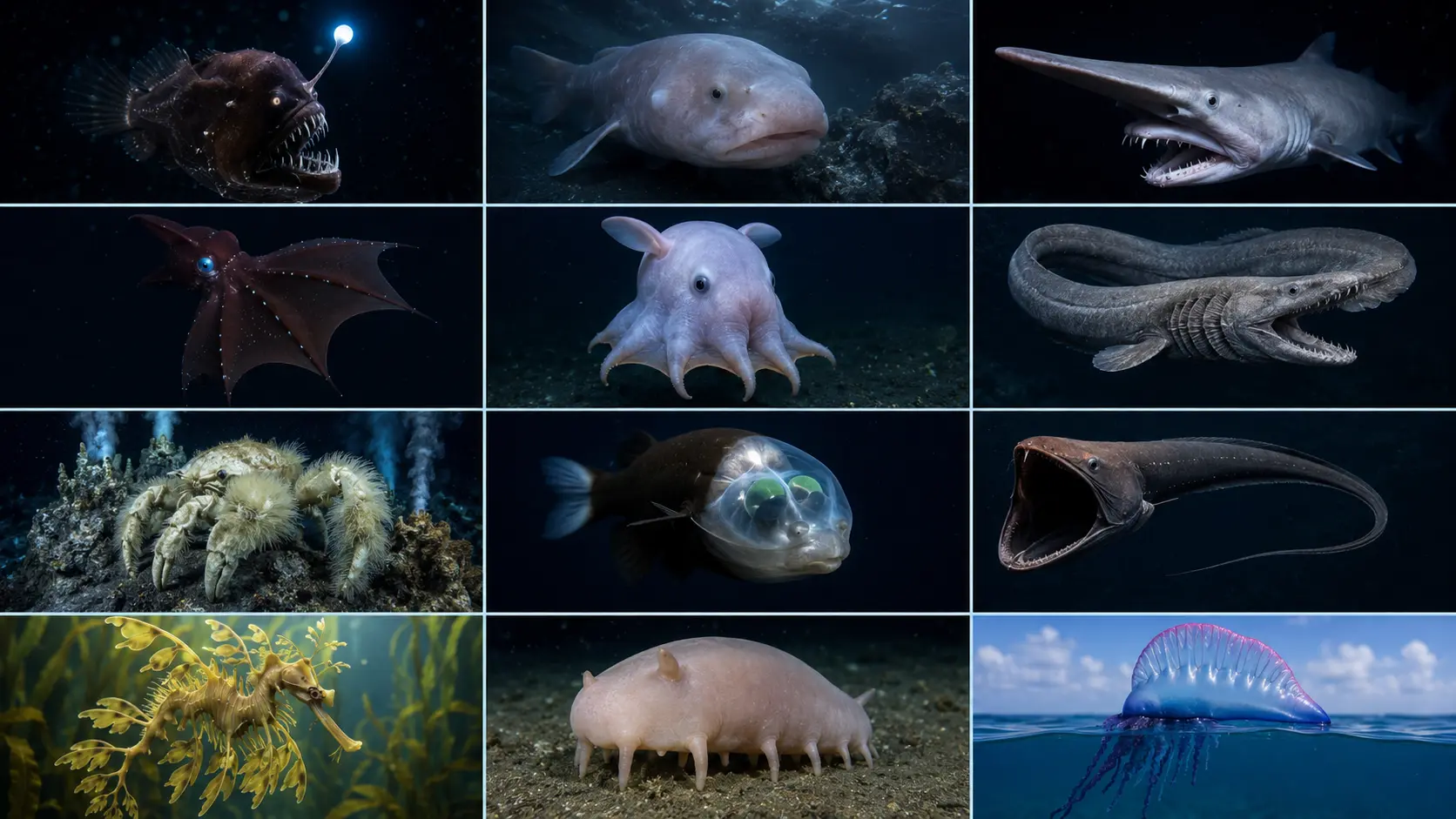
When we think of the ocean, we often picture majestic dolphins, graceful sea turtles, or the enormous blue whale. But beneath the sunlit surface lies a world far more bizarre than any science fiction writer could conjure. The deep sea is Earth’s final frontier—a realm of perpetual darkness, crushing pressure, and near-freezing temperatures where evolution has taken a decidedly weird turn.
Here, animals don’t just survive; they thrive in ways that defy logic. They have evolved transparent heads, detachable jaws, glowing lures, and bodies made of jelly. Some look like aliens dropped into our world; others look like they were assembled from spare parts. In this article, we dive into the abyss to meet the top 12 most strange, unsettling, and utterly fascinating creatures that call the oceans and seas their home.
1. The Anglerfish (Melanocetus johnsonii)
The face of deep-sea nightmares—with its own built-in fishing rod.
If there is a poster child for deep-sea weirdness, it is undoubtedly the anglerfish. Made famous by nature documentaries and animated films, the real-life anglerfish is far more terrifying than fiction. Found at depths of 200 to 2,000 metres (660 to 6,600 feet), where sunlight never penetrates, this predator has perfected the art of ambush.
The most striking feature of the female anglerfish is the bioluminescent lure that dangles from a fleshy growth (the esca) on her forehead. This lure is actually packed with millions of light-producing bacteria that glow in the dark. She waves it like a fishing rod to attract unsuspecting prey, which mistake the glowing light for a small, edible organism. When the prey comes close enough, the anglerfish opens its cavernous mouth and—in a fraction of a second—sucks in the victim whole. Her teeth are long, sharp, and translucent, curving inward to ensure that once something enters, it never leaves.
Perhaps the most bizarre aspect of the anglerfish is its reproductive strategy. Males are significantly smaller—only a few centimetres long compared to the female’s 18 centimetres (7 inches) or more. When a male finds a female, he bites into her skin and releases an enzyme that fuses his body to hers. His eyes, fins, and internal organs degenerate until he becomes nothing more than a parasitic sperm-producing appendage. One female can carry multiple males attached to her body for life. It is a strange, macabre, and uniquely effective way to ensure reproduction in the vast emptiness of the deep sea.
2. The Blobfish (Psychrolutes marcidus)
The gelatinous “world’s ugliest animal” that looks completely different at home.
The blobfish achieved internet fame in 2013 when it was voted the world’s ugliest animal—a dubious honour that it wears with a distinct lack of expression. With its drooping, fleshy face, large bulbous nose, and perpetually sad expression, the blobfish looks like a melting human face. But here is the catch: that iconic image was taken after the fish had been brutally decompressed during capture.
In its natural habitat, deep in the waters off the coast of Australia and New Zealand at depths of 600 to 1,200 metres (2,000 to 4,000 feet), the blobfish looks entirely different. Because the pressure at those depths is dozens of times higher than at sea level, the blobfish has evolved a body that is essentially a gelatinous mass with a density slightly lower than water. This allows it to float effortlessly above the seafloor without expending energy on a swim bladder. Its flesh is a soft, almost liquid jelly that holds its shape perfectly under extreme pressure.
When brought to the surface, that jelly expands and collapses, giving us that famously ugly, squishy face. In its own environment, it is a streamlined, efficient ambush predator that waits patiently for small crustaceans to drift into its mouth. It doesn’t actively hunt; it simply opens its mouth and lets dinner come to it. The blobfish is a perfect example of how strange creatures look when they are perfectly adapted to a world we can barely imagine.
3. The Goblin Shark (Mitsukurina owstoni)
A living fossil with jaws that shoot out like a horror movie.
The goblin shark is often described as a “living fossil”, and for good reason. This deep-sea shark has been swimming in our oceans for over 125 million years, virtually unchanged since the time of the dinosaurs. With its elongated, flattened snout and protrusible jaw, it is one of the most bizarre sharks ever discovered.
Found in the deep waters of the Atlantic, Pacific, and Indian Oceans—typically at depths greater than 200 metres (660 feet)—the goblin shark grows to about 3 to 4 metres (10 to 13 feet) in length. Its skin is a pale, translucent pink, which is caused by the visibility of blood vessels beneath the semi-transparent dermis. This pinkish hue gives it an almost alien, fleshy appearance.
But its most terrifying feature is its jaw. Unlike any other shark, the goblin shark can extend its upper and lower jaws forward in a lightning-fast strike, almost like a spring-loaded trap. It can shoot its mouth out of its head by several centimetres to snatch prey that is swimming in front of its snout. This unique adaptation allows it to capture fast-moving fish and squid in the darkness. When the jaw retracts, the shark looks almost harmless—but in the moment of attack, it transforms into one of the most nightmarish predators in the sea.
4. The Vampire Squid (Vampyroteuthis infernalis)
The “vampire squid from hell” that eats marine snow.
Despite its terrifying name—which translates directly to “vampire squid from hell”—this creature is far from a bloodthirsty monster. In fact, it is a gentle, reclusive animal that spends its life in the oxygen-minimum zones of the deep ocean, typically at depths of 600 to 900 metres (2,000 to 3,000 feet). It is neither a true squid nor an octopus; it belongs to its own ancient order, Vampyromorphida, which is a living link to the ancient cephalopods that roamed the seas hundreds of millions of years ago.
Measuring only about 30 centimetres (12 inches) in length, the vampire squid is a small but stunningly beautiful creature. Its dark, velvety body is covered in photophores—light-producing organs—that it uses to create a mesmerising light show in the darkness. It also has large, bright blue eyes that are disproportionately huge for its body, giving it a perpetually surprised expression.
When threatened, the vampire squid performs an incredible defensive manoeuvre: it inverts its cape-like webbing and curls its arms over its head, exposing a row of spines (called cirri). This makes it look like a spiky, terrifying ball, confusing predators. Additionally, it can release a cloud of bioluminescent mucus from the tips of its arms that glows for up to ten minutes—a far more effective evasion technique than the traditional ink cloud used by other cephalopods. It feeds on “marine snow”—a constant shower of organic detritus, dead plankton, and faecal matter that drifts down from the upper ocean—using a long, sticky filament to collect its meals.
5. The Dumbo Octopus (Grimpoteuthis spp.)
The cutest deep-sea oddity that flies through the water like a Disney character.
If the anglerfish is the nightmare of the deep, the Dumbo octopus is its lovable cartoon counterpart. Named after the Disney elephant with the large flapping ears, this genus of octopus has two prominent fins on the sides of its head that resemble ears. When it swims, it flaps these fins gracefully, propelling itself through the water with an almost whimsical, floating motion.
Found at extreme depths of 3,000 to 4,000 metres (9,800 to 13,100 feet)—deeper than any other octopus species—the Dumbo octopus is a true abyssal dweller. Most species are relatively small, measuring between 20 and 30 centimetres (8 to 12 inches), though some have been recorded at nearly 1.8 metres (6 feet) in length.
Unlike many octopuses, Dumbos do not possess an ink sac (because ink is useless in permanent darkness) and they are not particularly strong swimmers. Instead, they hover just above the seafloor, using their “ears” and the webbing between their arms to pulse gently. They feed by swallowing small crustaceans, worms, and other benthic invertebrates whole. What makes them truly strange, beyond their adorable appearance, is their reproductive strategy. Females are known to brood their eggs for extended periods—possibly years—attaching them to rocks or coral and guarding them ceaselessly until they hatch, never eating during the entire process. It is a testament to the extreme strategies life must adopt to survive in the deep.
6. The Frilled Shark (Chlamydoselachus anguineus)
A serpentine dinosaur that still swims in our oceans.
The frilled shark is so primitive that it is often called a “living fossil”. Its lineage dates back to the Cretaceous period—80 million years ago—when dinosaurs still walked the Earth. With its eel-like body, snake-like head, and the frilly appearance of its gill slits (which give it its name), this shark looks like it has slithered straight out of prehistoric times.
Typically found at depths of 500 to 1,000 metres (1,600 to 3,300 feet) in the Atlantic and Pacific Oceans, the frilled shark grows to about 2 metres (6.5 feet) in length. Its body is dark brown and highly elongated, with a distinct dorsal fin far back on its body, giving it a remarkably un-shark-like silhouette.
The frilled shark’s most terrifying feature is its teeth. It has 25 rows of backwards-pointing, trident-shaped teeth—over 300 teeth in total. These teeth are not designed to chew but to trap and impale prey like a biological fishhook. When it strikes, it launches its jaw forward and lunges at its prey, swallowing it whole. Its diet consists primarily of other sharks, squid, and bony fish. Because it lives in deep waters, it is rarely seen alive, though there have been occasional footage captures in recent years that remind us just how ancient—and how strange—our oceans truly are.
7. The Yeti Crab (Kiwa hirsuta)
The hairy-clawed crustacean that farms its own food in the deep.
Discovered in 2005 near Easter Island on a hydrothermal vent at a depth of 2,200 metres (7,200 feet), the Yeti crab caused a sensation in the scientific community. This white, blind crustacean has long, silky, blond hair—technically called setae—covering its claws and legs, giving it a fuzzy, almost cuddly appearance that is entirely deceptive.
The Yeti crab belongs to a new family of crustaceans, and its “hair” is not just for show. Scientists have discovered that the dense setae are covered in gardens of filamentous bacteria. The crab waves its claws in the plumes of mineral-rich fluids emitted from the hydrothermal vents, providing the bacteria with a continuous supply of nutrients. In return, the crab harvests these bacteria and uses them as a primary food source. It is a form of farming rarely seen in the animal kingdom, especially at such extreme depths.
The Yeti crab is blind—its eyes are reduced to tiny, vestigial patches without lenses—but it doesn’t need sight in the pitch-black deep sea. Instead, it relies on its incredibly sensitive setae to detect chemical changes and vibrations in the water. It lives in dense aggregations, sometimes hundreds of individuals stacked on top of each other, all competing for prime positioning near the vent’s chemical bounty.
8. The Barreleye Fish (Macropinna microstoma)
The fish with a transparent head and rotating eyes.
If there is one creature that perfectly encapsulates the word “strange”, it is the barreleye fish. This deep-sea dweller, found in the Pacific Ocean at depths of 600 to 800 metres (2,000 to 2,600 feet), has one of the most extraordinary adaptations in the animal kingdom: a completely transparent, fluid-filled dome covering its head.
Through this translucent shield, you can literally see the fish’s internal organs and brain. The two glowing green barrels (which give the fish its name) are the eyes—large, tubular structures that look upward through the dome. For a long time, scientists thought the barreleye could only look straight up, using its massive eyes to spot the silhouettes of prey swimming in the dim light above.
But in 2009, researchers using remotely operated vehicles made a stunning discovery: the barreleye can actually rotate its eyes inside the transparent head. When it spots a potential meal overhead, it can tilt its eyes forward to track the prey as it comes into range. The two dark spots on the front of its “face” are not eyes at all—they are olfactory organs (similar to nostrils). The barreleye’s strange adaptation allows it to see both forward and upward, making it a highly efficient predator in one of the most challenging environments on Earth.
9. The Gulper Eel (Eurypharynx pelecanoides)
The pelican of the deep with a mouth bigger than its body.
Also known as the pelican eel, the gulper eel is the deep-sea equivalent of a living bag. This bizarre fish, found at depths of 500 to 3,000 metres (1,600 to 9,800 feet) across tropical and temperate seas, has an enormously expandable mouth and a slender, whip-like tail that ends in a glowing organ.
When relaxed, the gulper eel looks like a typical—if somewhat unremarkable—eel, with a small, narrow head. But when it opens its mouth, it transforms into a terrifying net. Its jaws can expand to several times the size of its body, forming a cavernous pouch capable of swallowing prey larger than itself. At the end of its tail is a light-producing photophore that likely acts as a lure to attract curious fish and crustaceans.
The gulper eel’s diet consists mainly of small fish, shrimp, and plankton, which are gulped down along with huge volumes of water. The water is then expelled through its gills, trapping the prey inside. The stomach of the gulper eel can stretch dramatically to accommodate large meals, but when food is scarce, the eel can survive long periods without eating. Its body is so gelatinous and fragile that it is rarely seen intact at the surface—most recovered specimens are badly damaged by the pressure change.
10. The Leafy Seadragon (Phycodurus eques)
The master of camouflage that looks like a kelp forest come to life.
While many strange creatures lurk in the deep abyss, the leafy seadragon proves that weirdness can thrive in shallower, sunlit waters as well. Found along the southern and western coasts of Australia, this remarkable fish is a relative of the seahorse, but it has taken camouflage to an art form.
The leafy seadragon is covered in elaborate, leaf-like appendages that serve no purpose for swimming—they are purely for disguise. These fleshy lobes resemble seaweed and floating kelp, allowing the seadragon to blend perfectly into its weedy, seagrass-filled habitat. It drifts through the water almost motionlessly, swaying with the currents like a piece of drifting vegetation.
It can grow to about 45 centimetres (18 inches) in length, and its body is covered in tiny, bony plates. It does not have a prehensile tail like a seahorse, so it cannot grip onto objects; instead, it relies entirely on its disguise to avoid predators. Like seahorses, it is the male that carries the eggs. The female lays a cluster of eggs on a specialised patch under the male’s tail, where they are fertilised and incubated until they hatch. Their ethereal beauty and bizarre appearance make them a favourite among divers and underwater photographers—and a stark reminder that strangeness isn’t limited to the abyss.
11. The Sea Pig (Scotoplanes globosa)
The plump, transparent bottom-feeder that walks on the seafloor.
The sea pig is not a pig, nor is it particularly pig-like in any biological sense. It is actually a genus of deep-sea sea cucumbers that inhabit the soft, muddy bottoms of all major oceans, typically at depths of 1,000 to 5,000 metres (3,300 to 16,400 feet).
These creatures are plump, translucent, and somewhat sausage-shaped, with a semi-transparent body that allows you to see their internal organs and intestinal tract. The most distinctive feature of the sea pig is its walking apparatus: it has several pairs of long, fleshy tube feet that it uses to trundle slowly across the ocean floor—and, yes, it does look remarkably like a pig walking on stubby legs.
Sea pigs are detritivores, meaning they feed on organic debris—marine snow—that falls onto the seafloor. They use tentacles around their mouth to scoop up the nutrient-rich top layer of mud. What is truly bizarre about sea pigs is their social behaviour. They are often found in dense aggregations of hundreds of individuals, all pointing in the same direction. This orientation is believed to be a response to ocean currents: by facing the same way, they maximise their chances of capturing drifting particles. Sea pigs are also surprisingly resilient; they can withstand extreme pressures and have been observed at depths greater than 6,000 metres (19,700 feet).
12. The Portuguese Man O’ War (Physalia physalis)
Not a jellyfish—but a floating colony of specialised clones.
The Portuguese man o’ war is one of the most recognisable—and dangerous—marine animals in the world. With its vibrant blue-purple float and long, trailing tentacles, it is a common sight in tropical and subtropical waters. But here is the strangest thing about it: it is not a single animal.
The Portuguese man o’ war is a siphonophore—a colonial organism composed of four distinct types of specialised polyps (called zooids) that are genetically identical but perform different functions. The top polyp is the pneumatophore, a gas-filled sac that floats on the surface and acts as a sail. Another set of polyps form the tentacles for capturing prey. A third set handles digestion. And a fourth set manages reproduction. None of these polyps could survive on their own; they are completely interdependent, functioning like a biological super-organism.
The tentacles of the man o’ war can extend to an astonishing 30 metres (100 feet) in length—making it one of the longest animals in the world, even longer than a blue whale. These tentacles are armed with thousands of nematocysts (stinging cells) filled with a potent neurotoxin that can cause excruciating pain and, in rare cases, death to humans. It preys on small fish and other invertebrates, immobilising them with its venom before drawing them up to the digestive polyps. The Portuguese man o’ war is a floating horror, a drifting colony that defies everything we think we know about the boundaries between individuals and groups.
–