
A new liner disappears on its second voyage
On 27 July 1909, the passenger and cargo liner SS Waratah steamed south from Durban toward Cape Town with 211 passengers and crew aboard. It was a new ship, less than a year old, operating the long route between Britain and Australia for the Blue Anchor Line. Another steamer saw it off South Africa’s rugged southeast coast that morning. Then the weather deteriorated—and the Waratah disappeared.
No confirmed wreckage, lifeboat or body was recovered. Repeated searches crossed thousands of nautical miles, and later expeditions investigated promising sonar targets, but the wreck has never been conclusively located. The absence of physical evidence turned an already catastrophic loss into one of maritime history’s most persistent mysteries.
The vessel is often called the “Titanic of the South.” The nickname communicates scale and tragedy, but it can also mislead. Waratah vanished nearly three years before Titanic sank, and the two accidents involved different ships, routes and hazards. The more revealing question is why witnesses had described the Australian liner as top-heavy or slow to recover from a roll before its final voyage.
Built for the Britain–Australia trade
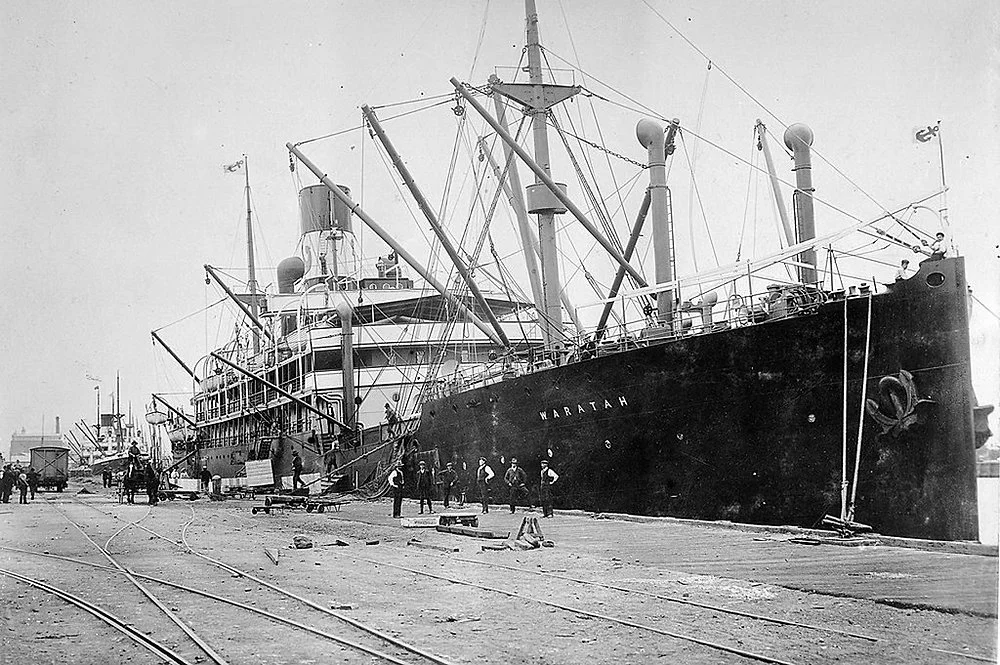
The Waratah was built by Barclay, Curle & Company at Whiteinch on the River Clyde for W. Lund and Sons’ Blue Anchor Line. Launched in September 1908 and completed the following month, the ship was approximately 465 feet long and designed to carry passengers, refrigerated cargo and general freight between London and Australia via South Africa.
Its accommodation was promoted as comfortable and modern. The liner could carry hundreds of cabin passengers and additional emigrants in dormitory spaces. Twin quadruple-expansion steam engines gave a service speed of roughly 13.5 knots. The ship’s cargo capacity was commercially important because the route depended on a mixture of passenger revenue and bulk freight.
The maiden voyage began in November 1908. During that trip and the outward leg of the second voyage, some passengers and seafarers became uneasy about the vessel’s motion. Reports later presented at the official inquiry described excessive rolling, a high superstructure and a slow recovery after heeling. Other witnesses defended the ship and regarded its behavior as normal for the loading and sea conditions.
Claude Sawyer’s warning dream
The most famous pre-disappearance story concerns passenger Claude G. Sawyer, an experienced traveler who sailed on Waratah from Australia toward South Africa in 1909. Sawyer became disturbed by the ship’s movement and reportedly experienced recurring dreams or visions of a bloodstained figure. He interpreted them as a warning and left the vessel at Durban, abandoning the onward passage for which he had paid.
After the ship vanished, Sawyer’s decision appeared prophetic. The episode became a natural focus for supernatural retellings. Yet its practical importance lies elsewhere: he was among the passengers who expressed concern about the vessel’s stability and lived to testify. His dream cannot diagnose a casualty, but his observations joined a body of contested evidence about how Waratah behaved at sea.
The final departure from Durban
The liner left Durban on 26 July 1909 for Cape Town under Captain Joshua E. Ilbery, an experienced Blue Anchor Line master. It carried passengers, crew and a mixed cargo that included foodstuffs, metals and other goods. The next morning, Waratah exchanged signals with the Clan Line steamer Clan MacIntyre near the Bashee River. The new liner overtook the slower vessel at about 13 knots and was last seen pulling ahead around 09:30.
That is the final confirmed sighting. Later reports described other ships, signals, smoke or bodies, but none produced proof. One vessel thought it saw a steamer whose name ended in “TAH,” while a shore observer later claimed to have watched a ship roll over in heavy seas. These accounts remain uncertain because of distance, weather, delayed reporting or incomplete identification.
The weather became severe. Witnesses described extraordinary winds and large following seas along a coast already known for powerful currents and difficult conditions. The Agulhas Current flows southwestward close to the continental shelf. When strong winds oppose it, waves can become steep, irregular and dangerous. A loaded steamship caught beam-on or overtaken by a breaking wave could face enormous forces.
Search operations across the southern ocean
When Waratah failed to reach Cape Town, authorities and commercial vessels began searching. Initial hopes included engine failure or a disabled ship drifting offshore. Reports from passing vessels were checked, coastal areas watched and debris investigated.
The dedicated search ship Sabine later covered roughly 14,000 nautical miles over several weeks, using lookouts and searchlights. It found no reliable trace. After more than four months, Lloyd’s posted Waratah as missing in December 1909. Relatives in Australia funded another expedition using the steamer Wakefield, which searched remote southern waters and islands, again without success.
The scale of these efforts matters. The lack of wreckage is sometimes used to imply an impossible disappearance, but the sea area was vast, deep and poorly observed by modern standards. Floating debris can disperse, become waterlogged or be missed in rough weather. A rapidly sinking ship may leave surprisingly little recoverable evidence.
What the official inquiry examined
The British Board of Trade inquiry opened in London in December 1910. Without survivors from the final leg or a wreck to inspect, the court relied on builders, surveyors, former passengers and crew. It examined design, stability, loading, construction, management and the reports of heavy rolling.
Technical witnesses emphasized that the ship had been built to accepted standards, inspected during construction and classed highly by Lloyd’s Register. No demonstrated design defect could be established. At the same time, testimony about unusual motion could not be completely dismissed. The inquiry’s difficulty was fundamental: a ship can meet contemporary regulatory and classification requirements yet still encounter a lethal combination of loading, free-surface effects, weather and wave direction.
The court did not identify a definitive cause. Debate continued over whether Waratah was inherently unstable, incorrectly loaded, overwhelmed by a wave, structurally damaged, disabled by machinery failure or destroyed by a cargo-related event.
Stability theory: did the Waratah capsize?
Capsizing in severe following seas is the most widely discussed explanation. A ship’s stability depends on hull form, center of gravity, loading distribution, freeboard and the dynamic forces produced by waves. A vessel that feels “top-heavy” may have a small or uncomfortable stability margin, although passenger perception alone cannot quantify it.
Cargo shift could raise or move the effective center of gravity. Water entering a large compartment could create free-surface effect, reducing stability as liquid moves across the ship. Large breaking waves can impose sudden heel, roll amplification or loss of control. If the vessel remained inverted or flooded rapidly, distress signals and boat launching might have been impossible.
Witness reports that Waratah sometimes hung at an angle before recovering have encouraged this theory. However, loading conditions changed between ports, and evidence from earlier voyages cannot prove the final condition. The official inspections and favorable testimony also caution against declaring the ship simply “unseaworthy.”
Other theories: explosion, structural failure and rogue waves
A boiler or cargo explosion has been suggested because some distant observers reported flashes or smoke. No debris confirmed such an event. Mechanical failure alone would not explain the complete disappearance, but loss of propulsion or steering during a storm could place the ship beam-on to dangerous seas.
Structural failure is possible in any extreme environment, particularly if wave-induced bending or slamming exceeds design assumptions. Yet there is no wreck evidence to show the hull broke apart. Fire is another possibility, though a major fire would be more likely to produce smoke, debris or opportunities for evacuation unless it escalated with exceptional speed.
The term “rogue wave” is frequently used, sometimes too casually. The Agulhas region is capable of exceptionally steep waves created by the interaction of current, wind and swell. A single extreme wave or series of breaking waves could roll, flood or damage a vessel. That is a physical maritime hazard, not a supernatural disappearance, but proving it after more than a century requires locating and examining the wreck.
Modern searches and false discoveries
The mystery has inspired several modern expeditions. South African researcher Emlyn Brown devoted years to identifying possible wreck sites. In 1999, a sonar target raised hopes that Waratah had been located, but closer inspection showed it was another vessel, the Nailsea Meadow, sunk during the Second World War.
False identification illustrates the difficulty of wreck hunting. Historical positions may be approximate; currents can move a disabled vessel far from its last sighting; and many shipwrecks lie along a busy, hazardous coast. Sonar images require visual confirmation, measurement and comparison with plans. A wreck of roughly the right length is not enough.
The search zone also depends on the assumed cause. A sudden capsize soon after the last confirmed sighting places the wreck near the coastal route. A disabled but floating ship could have drifted far offshore before sinking. Every theory creates a different map.
Why “Titanic of the South” is an imperfect label
The nickname links two large British passenger ships lost early in their careers. Both disasters generated questions about confidence in new technology and the adequacy of safety oversight. Both also became cultural symbols larger than their technical records.
The differences are decisive. Titanic struck an iceberg in April 1912; its approximate sinking position, survivors and cause were known, even though the wreck was not found until 1985. Waratah disappeared in severe weather without a distress message, survivor or confirmed debris. The core mystery is not simply why it sank but where and when the final event occurred.
Calling Waratah the “Titanic of the South” can attract readers, but the ship deserves to be understood on its own terms—as a combined passenger-cargo liner operating a demanding route before radio carriage and international safety rules reached later maturity.
Legacy of the SS Waratah mystery
The disappearance devastated families in Britain, Australia and South Africa and contributed to the collapse of the Blue Anchor Line. Public confidence declined, and the company entered liquidation after selling remaining assets.
For maritime safety historians, the case demonstrates the limits of compliance when accident evidence is absent. Classification verifies that a vessel meets specified rules; it cannot guarantee survival in every loading condition and sea state. Witness descriptions are valuable but subjective. Search planning depends on uncertain drift and casualty scenarios. Most importantly, ships can be lost so quickly that no orderly emergency response is possible.
The best-supported broad explanation is that Waratah encountered catastrophic severe-weather conditions, possibly involving loss of stability and capsize. But the exact sequence remains unknown. Until the wreck is conclusively identified, the SS Waratah mystery will remain written across an empty space on the seabed.
Frequently asked questions
How many people were lost on SS Waratah?
The generally accepted total is 211 passengers and crew.
Where did SS Waratah disappear?
It vanished after leaving Durban for Cape Town, with the last confirmed sighting off the southeast coast of South Africa near the Bashee River on 27 July 1909.
Was the wreck ever found?
No. Several targets and claimed sightings have been investigated, but none has been conclusively identified as Waratah.
Why was it called the Titanic of the South?
The nickname reflects the loss of a large, relatively new passenger liner and the scale of the tragedy. It is retrospective because Waratah vanished before Titanic sank.
Sources and further reading: State Library of South Australia, “Australia’s Titanic”; UK Board of Trade inquiry records; Lloyd’s Register entries; South African maritime-history research and documented search-expedition reports.