
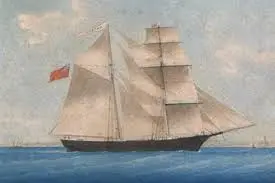
The abandoned ship that became a global mystery
Few maritime mysteries have proved as durable as the story of the Mary Celeste. On 4 December 1872, the merchant brigantine Dei Gratia encountered the vessel drifting in the eastern North Atlantic, between the Azores and Portugal. The ship was under partial sail and showed signs of disorder, yet it had not been destroyed by a storm, stripped by pirates or consumed by fire. Its cargo remained largely in place. Food and water were still aboard. What had vanished were the ten people who had sailed from New York: Captain Benjamin Spooner Briggs, his wife Sarah, their two-year-old daughter Sophia and seven crewmen.
The missing boat and absent navigational instruments indicated that the company had probably left the ship deliberately. That simple conclusion, however, creates the central question of the Mary Celeste mystery: why would an experienced master abandon a vessel that remained afloat and capable of reaching port?
The facts are dramatic enough without embellishment. Over the following century, newspapers, books, fiction and film added untouched breakfasts, steaming cups of tea, bloodstained weapons and other details that were not supported by the original evidence. Understanding the real case requires separating the documented ship from the ghost ship created by popular culture.
From Amazon to Mary Celeste
The vessel began life far from the supernatural reputation it later acquired. Built at Spencer’s Island, Nova Scotia, it was launched in 1861 as Amazon. The ship suffered several mishaps during its early career, including damage and changes of ownership, but such events were hardly extraordinary in nineteenth-century merchant shipping. After passing into American ownership, it was rebuilt and renamed Mary Celeste.
By 1872, the brigantine was prepared for an Atlantic voyage from New York to Genoa. Its principal cargo consisted of 1,701 barrels of industrial alcohol. Captain Briggs was an experienced and respected seafarer. He brought his wife and young daughter, while his school-age son remained with relatives. The vessel departed New York Harbor on 7 November after waiting for improved weather.
The Dei Gratia, commanded by Captain David Morehouse, sailed from New York several days later on a broadly similar route. When its crew sighted the Mary Celeste on 4 December, the brigantine was behaving erratically. A boarding party led by chief mate Oliver Deveau found nobody aboard.
What the boarding party actually found
The condition of the ship is often simplified as “perfectly seaworthy,” but the evidence was more complicated. The Mary Celeste had water in its hold, although not enough to place it in immediate danger. One pump was reportedly out of order and another was not in ideal condition. Hatch covers were displaced, some sails were damaged or missing, and the ship’s papers—apart from the captain’s log—were gone. The chronometer and sextant were absent. Most importantly, the ship’s small boat was missing, suggesting an evacuation rather than a supernatural disappearance.
The last surviving log entry was dated 25 November, when the vessel was near Santa Maria in the Azores. The discovery came about ten days later and hundreds of nautical miles away. The crew of the Dei Gratia divided itself, sailed the abandoned vessel to Gibraltar and claimed salvage.
The cargo was not entirely unchanged. Nine barrels of alcohol were later found empty. These barrels were made of red oak, which was more porous than the white oak used for most of the shipment. Leakage is therefore a credible fact, although it does not by itself prove why the ship was abandoned.
The Gibraltar inquiry and suspicions of crime
In Gibraltar, a salvage hearing examined whether the Dei Gratia crew deserved payment and whether wrongdoing had occurred. Frederick Solly-Flood, the attorney general overseeing the inquiry, pursued possibilities including mutiny, murder, piracy and fraud. Marks on the ship and stains initially inspired sinister interpretations, but the evidence did not establish violence. The salvage award was lower than the rescuers may have expected, partly reflecting the court’s suspicions, yet no criminal case explained the disappearance.
The hearing helped seed later conspiracy theories. The friendship or acquaintance between Briggs and Morehouse was magnified into alleged collusion; ordinary damage was presented as evidence of combat; and missing people were turned into possible murderers. No convincing proof supports the claim that the Dei Gratia crew killed those aboard the Mary Celeste. The timing, risk and absence of a credible financial scheme all weaken that hypothesis.
The most plausible explanation: a temporary evacuation
The strongest modern explanations begin with a temporary, precautionary evacuation. Captain Briggs may have believed his vessel was in danger of sinking or exploding. If the boat remained attached to the ship by a line, the company could have intended to wait nearby and return after the danger passed. A snapped line, sudden squall or change of wind could then have separated the overcrowded boat from the brigantine. The ship would sail on; the people in the open boat would face the Atlantic without adequate protection.
Why might Briggs have misjudged the danger? Several factors could have acted together. Rough weather and water in the hold may have complicated soundings. A faulty or clogged pump could have prevented the crew from judging how quickly water was accumulating. Coal dust, debris or cargo residue may have affected pumping. If Briggs lacked a reliable chronometer and had not recently sighted land as confidently as expected, he might also have been uncertain of the ship’s position.
One influential reconstruction proposes that Briggs ordered everyone into the boat after approaching Santa Maria in difficult conditions and finding more water than expected. Another theory focuses on vapors from leaking alcohol. An apparent pressure event, alarming sound or blown hatch could have produced fear of a larger explosion even without leaving major burn damage. Alcohol-vapor experiments show that a pressure-wave event without soot is physically conceivable, but there is no direct proof that it occurred aboard the ship.
The key point is that abandonment need not have seemed irrational in the moment. Mariners decide with incomplete information, and a damaged pump combined with poor weather, uncertain position and volatile cargo could make a ship appear less safe than it later looked to salvors.
Why piracy, mutiny and sea monsters fail the evidence test
Piracy is unlikely because valuable cargo and personal effects remained, and there was no clear sign of a violent boarding. Mutiny theories struggle with the absence of demonstrated conflict and with the practical difficulty of disappearing permanently after taking an open boat. Claims that the crew drank the industrial alcohol overlook its dangerous, denatured nature and the fact that the leaking barrels had a material explanation.
Natural curiosities such as waterspouts, giant squid and sudden undersea events have also been suggested. They are compelling storytelling devices but do not fit the evidence as well as an evacuation followed by separation. A waterspout might create alarm or damage, yet it cannot explain every clue. No theory can now be proved because the people, the boat and many original records were never recovered.
How fiction reshaped the Mary Celeste story
The ship’s cultural afterlife owes much to Arthur Conan Doyle. In 1884, before Sherlock Holmes made him famous, Doyle published “J. Habakuk Jephson’s Statement,” a fictionalized account using the name Marie Celeste. His story changed facts and introduced invented events, but readers sometimes treated it as reporting. The incorrect name still appears today.
Later writers added an inviting “meal left on the table” scene and other gothic elements. These details made the case easier to visualize but obscured the genuine navigational and engineering questions. The authentic mystery is not that time stopped aboard an undamaged vessel. It is that a working merchant ship was evacuated under circumstances that probably felt urgent, after which no witness survived to explain the decision.
What happened to the ship after 1872?
The Mary Celeste did not remain a ghost ship. It returned to commercial service under new owners, though its notoriety damaged its reputation. In 1885, Captain G. C. Parker deliberately wrecked it near Haiti in an attempted insurance fraud. The scheme was discovered, and the vessel’s career ended on Rochelois Reef.
This later, documented fraud is sometimes confused with the 1872 disappearance. It should not be. The deliberate wreck occurred thirteen years later under a different master and ownership. It explains the physical end of the ship, not the fate of the Briggs family and crew.
Why the Mary Celeste mystery still matters
The case endures because it sits at the boundary between evidence and absence. Investigators know enough to reconstruct the voyage, the cargo and the condition of the vessel, but not enough to identify the decisive event. It also demonstrates a lasting principle of casualty investigation: the condition found after an incident may not reflect the danger perceived when decisions were made.
For modern mariners, the story highlights the importance of reliable pumping systems, accurate position fixing, disciplined emergency assessment, clear abandon-ship thresholds and the hazards of separating from a survivable vessel. For historians, it shows how quickly fiction can become accepted as fact.
The most responsible conclusion is neither paranormal nor perfectly satisfying. The evidence points toward a deliberate evacuation in response to a perceived emergency, followed by the loss of the boat and everyone in it. Exactly what created that perception remains unknown. That gap—small enough to invite explanation, but large enough to resist proof—is why the Mary Celeste remains the world’s greatest ghost ship mystery.
Frequently asked questions
Was the Mary Celeste found with food still warm?
No reliable contemporary evidence supports the famous image of a warm meal or steaming tea. It is a later embellishment. Provisions were aboard, but the dramatic table scene belongs to legend.
How many people disappeared from the Mary Celeste?
Ten people vanished: Captain Benjamin Briggs, his wife Sarah, their daughter Sophia and seven crew members.
Was the ship seaworthy when discovered?
It remained afloat and could be sailed to Gibraltar, but it was not in perfect condition. It had water in the hold, damaged rigging and sails, displaced hatches, missing equipment and pump problems.
What is the most likely Mary Celeste theory?
A precautionary evacuation followed by accidental separation from the ship best fits the missing boat and navigational instruments. The trigger may have involved water ingress, pump uncertainty, severe weather, alcohol-vapor fears or a combination of factors.
Sources and further reading: Smithsonian Magazine, “Abandoned Ship: The Mary Celeste”; Encyclopaedia Britannica, “Mary Celeste”; contemporary Gibraltar salvage-inquiry records as discussed in Brian Hicks, Ghost Ship; Lloyd’s and historical vessel records.