
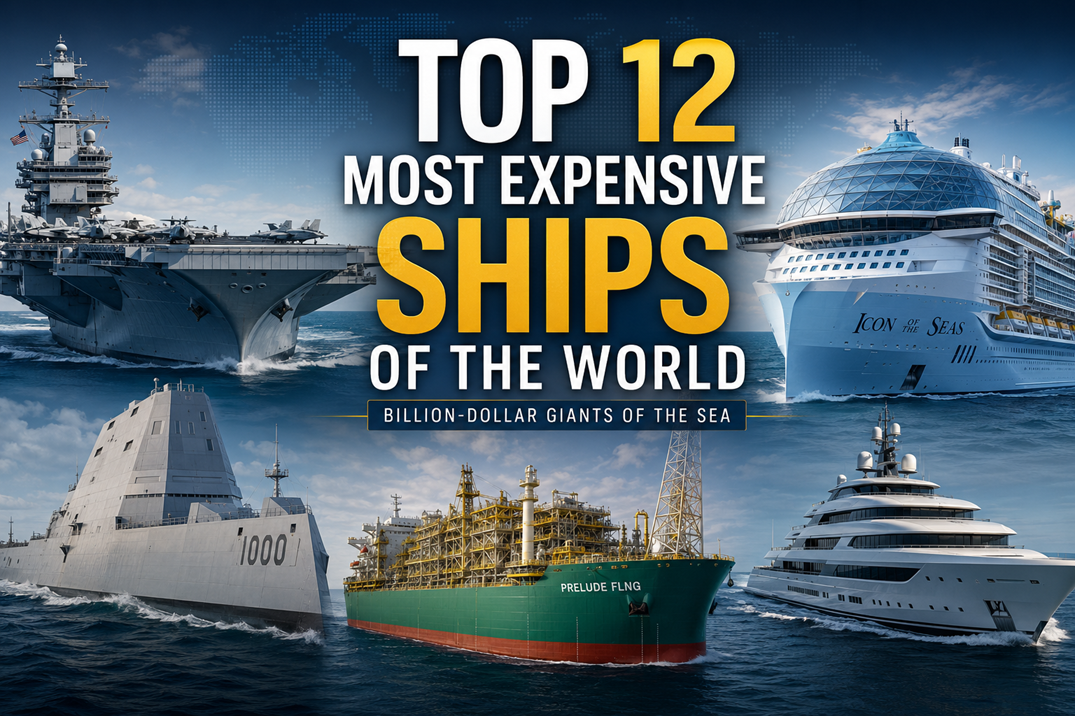
Discover the world’s 12 most expensive ships, from nuclear aircraft carriers and floating LNG plants to record-breaking cruise ships and luxury superyachts.
Ships are among the largest, most technically complex and most expensive machines ever constructed. A modern vessel may combine advanced propulsion, power generation, automation, accommodation, communication, navigation and safety systems within a single floating structure.
However, not all expensive ships serve the same purpose. Some are nuclear-powered military assets, others are offshore energy installations, while cruise ships and superyachts represent the commercial and luxury ends of the maritime industry.
This ranking presents 12 of the most expensive individual ships or floating maritime assets ever built. The figures are approximate because shipbuilding costs are not always publicly disclosed and may be reported differently. Military programme costs, for example, may include development and government-furnished equipment, while offshore-project figures can include subsea infrastructure and supporting facilities.
The World’s Most Expensive Ships at a Glance
| Rank | Ship | Vessel category | Estimated cost |
|---|---|---|---|
| 1 | USS Gerald R. Ford | Nuclear aircraft carrier | Approximately US$13.3 billion |
| 2 | USS Enterprise, CVN-80 | Nuclear aircraft carrier | Approximately US$12.8 billion |
| 3 | Prelude FLNG | Floating LNG facility | Approximately US$12–12.6 billion |
| 4 | USS John F. Kennedy, CVN-79 | Nuclear aircraft carrier | Approximately US$11 billion or more |
| 5 | USS Zumwalt | Guided-missile destroyer | Up to US$10.6 billion on a programme-unit basis |
| 6 | USS Michael Monsoor | Guided-missile destroyer | Up to US$10.6 billion on a programme-unit basis |
| 7 | USS Lyndon B. Johnson | Guided-missile destroyer | Up to US$10.6 billion on a programme-unit basis |
| 8 | Icon of the Seas | Cruise ship | Approximately US$2 billion |
| 9 | Utopia of the Seas | Cruise ship | Approximately US$1.3–1.5 billion |
| 10 | Wonder of the Seas | Cruise ship | Approximately US$1.35 billion |
| 11 | Symphony of the Seas | Cruise ship | Approximately US$1.35 billion |
| 12 | Oasis of the Seas | Cruise ship | Approximately US$1.4 billion |
1. USS Gerald R. Ford – Approximately US$13.3 Billion
The nuclear-powered USS Gerald R. Ford, CVN-78, is generally recognised as the most expensive warship—and one of the most expensive individual ships—ever constructed.
The lead vessel of the Ford class introduced major technological changes compared with the preceding Nimitz-class carriers. These include the Electromagnetic Aircraft Launch System, advanced arresting gear, upgraded radar installations, new weapons elevators and greater electrical-generation capacity.
The ship is approximately 337 metres long and displaces around 100,000 tonnes. Its two nuclear reactors allow it to operate for extended periods without conventional propulsion fuel, although the carrier must still carry aviation fuel and supplies for its embarked air wing.
The final procurement cost has been reported at approximately US$13.3 billion in then-year dollars. The figure does not normally include the aircraft operating from the carrier, which would add several billion dollars to the overall value of a fully equipped carrier strike group.
2. USS Enterprise, CVN-80 – Approximately US$12.8 Billion
The future USS Enterprise, CVN-80, is the third Ford-class aircraft carrier and the ninth United States naval vessel to carry the Enterprise name.
Construction involves immense quantities of high-strength steel, complex nuclear-propulsion machinery, extensive aviation-support infrastructure and millions of components. Modern modular construction allows large sections of the carrier to be assembled separately before being joined in dry dock.
US Navy budget estimates have placed the vessel’s procurement cost at approximately US$12.8 billion, although final expenditure can change as construction, testing and equipment integration proceed.
Enterprise illustrates why aircraft carriers dominate rankings of the most expensive ships. They are not merely vessels: they function as mobile airbases, command centres, power plants, hospitals, workshops and logistics hubs.
3. Prelude FLNG – Approximately US$12–12.6 Billion
Prelude FLNG is not a conventional self-propelled ship. It is a floating liquefied-natural-gas production, processing, storage and export facility permanently moored off Western Australia.
Built by Samsung Heavy Industries for a Shell-led joint venture, Prelude measures approximately 488 metres in length and has a fully loaded displacement of roughly 600,000 tonnes. It was designed to extract natural gas from offshore fields and process it into LNG without first transporting the gas through a pipeline to an onshore plant.
The facility contains gas-treatment equipment, refrigeration systems, storage tanks, loading infrastructure, accommodation and utilities comparable to those of a major industrial plant.
Shell has not published a simple definitive construction price for the vessel alone. External estimates have commonly placed the wider project at approximately US$12–12.6 billion, with some later assessments reporting considerably higher total investment figures.
Whether Prelude should technically be classified as a “ship” is debated because it has no conventional propulsion system. Nevertheless, it remains one of the largest and most expensive floating structures ever constructed.
4. USS John F. Kennedy, CVN-79 – More Than US$11 Billion
USS John F. Kennedy, CVN-79, is the second Ford-class aircraft carrier. Lessons learned during construction of the lead ship were expected to reduce cost and technical risk, but the vessel remains one of the most expensive maritime assets in history.
John F. Kennedy incorporates changes intended to improve construction efficiency, maintenance and operational availability. Its nuclear propulsion, aviation facilities, electromagnetic launch equipment and sophisticated combat systems make it significantly more complex than almost any commercial ship.
Reported estimates generally place its procurement cost above US$11 billion, depending on the budget year, included equipment and accounting method.
Once operational, the carrier will be capable of supporting fixed-wing aircraft, helicopters and unmanned aviation systems while serving as the centrepiece of a carrier strike group.
5. USS Zumwalt – Up to US$10.6 Billion on a Programme-Unit Basis
USS Zumwalt, DDG-1000, is the lead vessel of the United States Navy’s futuristic Zumwalt-class guided-missile destroyers.
The ship is immediately recognisable from its inward-sloping tumblehome hull and angular superstructure, designed to reduce its radar signature. It also employs an integrated electric power system that supplies both propulsion and onboard systems.
Originally, the US Navy planned to construct 32 Zumwalt-class ships. That number was gradually reduced to only three. As research, development and integration costs were distributed across fewer vessels, the effective programme cost per ship increased dramatically.
A 2025 US Government Accountability Office assessment stated that each Zumwalt-class destroyer had effectively cost around US$10.6 billion, more than seven times the original estimated unit cost. Earlier estimates placed the construction cost of the first two vessels at approximately US$6.3 billion.
This figure should therefore be interpreted as an allocated programme-unit cost rather than the shipyard construction price alone.
6. USS Michael Monsoor – Up to US$10.6 Billion on a Programme-Unit Basis
USS Michael Monsoor, DDG-1001, is the second Zumwalt-class destroyer.
The vessel combines a reduced radar signature with advanced sensors, automation and integrated electric propulsion. At approximately 190 metres long, it is considerably larger than a conventional destroyer and approaches the displacement of some Second World War cruisers.
Its original mission focused heavily on land attack and naval gunfire support. However, changes to weapons availability and strategic requirements led the US Navy to redefine the class as a surface-strike platform.
When the total Zumwalt programme expenditure is divided among only three completed vessels, Michael Monsoor’s attributed programme cost is also approximately US$10.6 billion.
The vessel demonstrates how reducing the production quantity of an advanced warship can cause its average unit cost to rise sharply.
7. USS Lyndon B. Johnson – Up to US$10.6 Billion on a Programme-Unit Basis
The third and final Zumwalt-class destroyer is USS Lyndon B. Johnson, DDG-1002.
Although based on the same design as the first two ships, it incorporates several modifications, including changes to its composite deckhouse arrangement. The vessel is intended to support long-range precision-strike operations.
The US Navy is also adapting the Zumwalt class to carry Conventional Prompt Strike hypersonic weapons. This requires major structural modifications and the installation of new large-diameter launch systems.
Like its sister ships, Lyndon B. Johnson carries an attributed programme-unit cost of approximately US$10.6 billion under the GAO’s whole-programme calculation. Future modernisation and weapons-integration costs could add substantially to total lifetime expenditure.
8. Icon of the Seas – Approximately US$2 Billion
Royal Caribbean’s Icon of the Seas is one of the largest and most expensive cruise ships ever built.
Constructed at Meyer Turku in Finland, the ship entered commercial service in January 2024. It measures approximately 365 metres long and has a gross tonnage exceeding 248,000 GT.
Icon of the Seas was designed as a complete floating holiday destination. Its attractions include multiple swimming pools, a large waterpark, extensive dining and entertainment spaces, family-oriented neighbourhoods and accommodation for thousands of passengers and crew.
The ship is powered by liquefied natural gas and is equipped with fuel cells for selected onboard applications. However, LNG’s environmental benefits remain debated because methane leakage across the fuel lifecycle can reduce its greenhouse-gas advantage.
The vessel is widely reported to have cost approximately US$2 billion.
9. Utopia of the Seas – Approximately US$1.3–1.5 Billion
Utopia of the Seas is a Royal Caribbean Oasis-class cruise ship constructed by Chantiers de l’Atlantique in Saint-Nazaire, France.
Delivered in 2024, it has a gross tonnage of approximately 236,000 GT and can carry several thousand passengers. Unlike many newly delivered cruise ships initially assigned to week-long itineraries, Utopia was designed principally for shorter holiday cruises.
The vessel contains multiple entertainment districts, swimming pools, restaurants, theatres, retail outlets and accommodation categories. Its power plant uses LNG-capable engines.
Although Royal Caribbean has not published a precise standalone construction price, industry estimates generally place its value at approximately US$1.3–1.5 billion.
The cost reflects not only the steel hull and machinery but also the extensive hotel, entertainment, catering, water-treatment, safety and digital systems required aboard a modern megaship.
10. Wonder of the Seas – Approximately US$1.35 Billion
At the time of its delivery in 2022, Wonder of the Seas was the world’s largest cruise ship by gross tonnage.
The ship was constructed at Chantiers de l’Atlantique and measures approximately 362 metres in length. Its accommodation and public spaces are divided into themed neighbourhoods, helping passengers navigate what is effectively a densely populated floating resort.
Wonder of the Seas contains theatres, pools, sports facilities, restaurants, landscaped areas and technical systems capable of producing electricity, fresh water, heating, cooling and waste treatment for thousands of people.
Its reported construction cost is approximately US$1.35 billion.
The vessel’s scale highlights an important distinction in maritime economics: a large cruise ship is simultaneously a means of transportation, a hotel, a leisure complex and a destination.
11. Symphony of the Seas – Approximately US$1.35 Billion
Royal Caribbean’s Symphony of the Seas entered service in 2018 after construction at the Saint-Nazaire shipyard.
The ship has a gross tonnage of around 228,000 GT and measures approximately 362 metres long. It was among the first cruise ships to push the floating-resort concept to its present scale.
Symphony includes numerous restaurants and bars, theatres, swimming pools, retail areas, sports facilities and specialised entertainment installations. Behind these passenger areas is a complex technical plant providing propulsion, electrical power, freshwater production, refrigeration, ventilation and waste management.
The ship’s construction cost has been estimated at approximately US$1.35 billion.
Although later cruise ships have surpassed it in size, Symphony remains one of the most valuable passenger ships ever constructed.
12. Oasis of the Seas – Approximately US$1.4 Billion
Delivered in 2009, Oasis of the Seas transformed the cruise industry by introducing a new generation of exceptionally large passenger ships.
Built by STX Europe in Finland, the vessel cost approximately US$1.4 billion, making it one of the most expensive commercial ships of its time. The project carried considerable commercial risk because no comparable cruise ship had previously been constructed.
Oasis introduced the neighbourhood concept, with separate zones containing entertainment, dining, accommodation and open-air spaces. Its split-superstructure design created an internal central area unlike that of traditional passenger ships.
The ship’s influence can be seen throughout Royal Caribbean’s subsequent Oasis- and Icon-class vessels. It demonstrated that passenger ships exceeding 200,000 GT could be built, operated and filled commercially.
–
Why Are Modern Ships So Expensive?
The final cost of a ship is determined by much more than its physical size.
Advanced propulsion and power systems
Nuclear reactors, integrated electric propulsion, LNG engines and high-capacity power-generation systems require specialised engineering, extensive testing and highly trained personnel.
First-of-a-kind technology
Lead ships usually cost substantially more than later vessels in the same class. New technologies must be designed, tested, certified and integrated, often while the ship itself is under construction.
Military sensors and weapons
Radar, sonar, electronic-warfare equipment, missile systems and secure communication networks can cost as much as—or more than—the basic hull and machinery.
Hotel and entertainment facilities
Cruise ships require thousands of cabins, kitchens, theatres, waterparks, restaurants, lifts, air-conditioning systems and passenger-safety installations.
Project delays and design changes
Late modifications can require finished sections to be dismantled and reconstructed. Inflation, supply-chain disruption and workforce shortages can further increase expenditure.
Limited production numbers
The cost of research and development is easier to recover when many sister ships are built. When a planned class is reduced from dozens of vessels to only a few, the attributed cost of each ship rises sharply.
–
Are Aircraft Carriers More Expensive Than Cruise Ships?
Yes. Nuclear aircraft carriers normally cost several times more than even the largest cruise ships.
A megacruise ship may cost between US$1 billion and US$2 billion, whereas a Ford-class aircraft carrier can exceed US$12 billion before the value of its aircraft is considered.
The difference results from nuclear propulsion, military survivability requirements, combat systems, aviation infrastructure, weapons handling, secure communications and the need to operate under hostile conditions.
Nevertheless, cruise ships are generally more expensive than ordinary merchant vessels because of their enormous hotel and passenger-service installations.
–
What About the World’s Most Expensive Superyachts?
Luxury vessels such as Eclipse, Azzam, Dilbar and Koru are often included in popular rankings of expensive ships.
Azzam reportedly cost approximately US$600 million, while estimates for Eclipse vary widely—from roughly US$500 million to more than US$1 billion. Koru has frequently been valued at approximately US$500 million.
However, superyacht prices are difficult to verify because contracts are private and reported “values” may include later modifications, artworks, tenders or market valuations rather than original construction costs.
The frequently repeated claim that a yacht called History Supreme cost US$4.8 billion is not considered credible. No reliable evidence confirms that the vessel exists.
–
Frequently Asked Questions
What is the most expensive ship in the world?
Based on publicly reported individual procurement costs, USS Gerald R. Ford is generally considered the world’s most expensive completed ship, at approximately US$13.3 billion.
What is the most expensive commercial ship?
Prelude FLNG is arguably the most expensive non-military floating maritime asset, although reported project costs include more than the hull itself. Among conventional self-propelled commercial ships, Icon of the Seas is one of the most expensive, at approximately US$2 billion.
What is the most expensive cruise ship?
Icon of the Seas is widely reported as one of the most expensive cruise ships ever built, with a construction cost of approximately US$2 billion.
Why do ship-cost estimates vary?
Published estimates may include different combinations of design expenditure, research and development, weapons, owner-supplied equipment, financing, infrastructure, modifications and inflation.
Are operating costs included in these figures?
No. The values in this ranking primarily concern construction or procurement. Fuel, crew, maintenance, insurance, port fees, refits and eventual recycling can add billions of dollars over a ship’s working life.
–
Conclusion
The most expensive ships in the world reflect the full range of modern maritime engineering.
Nuclear aircraft carriers dominate the ranking because they combine naval aviation, propulsion, weapons, command systems and survivability within one platform. Prelude FLNG represents a different form of complexity: an entire offshore gas-processing plant installed on a floating structure. Meanwhile, Icon of the Seas and other megacruise ships demonstrate the extraordinary cost of building self-contained floating resorts.
These ships are expensive not simply because they are large, but because they integrate technologies and operational capabilities rarely found together anywhere else. Each vessel represents years of design, specialised shipyard work, global supply chains and some of the most demanding engineering undertaken by the maritime industry.
Editorial note: All costs are approximate and generally expressed in nominal US dollars reported for the relevant construction or procurement period. Rankings may change depending on whether research and development, weapons, supporting infrastructure, financing and later modifications are included.