

07/21/2026
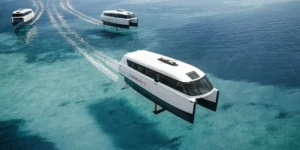
Electric foiling vessels are moving beyond the leisure market, with developers targeting passenger ferries, pilot boats and high-speed workboats where lower resistance could deliver substantial energy and operating-cost savings.
Hydrofoil technology, first demonstrated more than a century ago, is attracting renewed commercial interest as maritime operators confront volatile fuel prices, emissions-reduction requirements and rising demand for efficient high-speed transport.
Unlike a conventional vessel, which must continuously push a large hull through the water, a hydrofoil uses submerged wing-like surfaces to generate lift. Once sufficient speed is reached, most of the hull rises above the waterline, sharply reducing wetted surface area and hydrodynamic resistance.
The resulting efficiency gains can make battery-electric propulsion viable for routes that would otherwise require prohibitively large and heavy battery installations. Developers also highlight reduced wake, lower noise and improved passenger comfort as important operational benefits.
Commercial deployment begins to accelerate
The technology is now progressing from prototypes and leisure craft towards scheduled transport and specialised maritime services.
Swedish manufacturer Candela has introduced its P-12 electric passenger ferry into public-transport service in Stockholm. The company says its computer-controlled hydrofoil system can reduce energy consumption by approximately 80% compared with conventional vessels of a similar size. The P-12 rises onto its foils at around 18 knots and can operate at approximately 25 knots while supported above the water.
Further adoption is emerging in Norway, where operators are preparing a larger fleet of electric foiling ferries. Candela has also demonstrated longer-distance operation, including a P-12 voyage intended to show that high-speed electric vessels can serve routes beyond short urban crossings.
In the United Kingdom, Artemis Technologies is developing its eFoiler platform for passenger ferries, crew-transfer vessels, workboats and pilot operations. Its EF-24 passenger concept is designed to cruise at 25 knots, with the developer claiming significant energy and operating-cost reductions relative to conventional high-speed diesel ferries.
Artemis has also launched an all-electric hydrofoil pilot boat for sea trials, signalling the technology’s potential in one of the most demanding workboat applications. Pilot vessels require speed, manoeuvrability, reliability and acceptable motion behaviour while operating repeatedly in exposed harbour approaches.
Fuel-price volatility strengthens the business case
The renewed interest in foiling is not driven by environmental considerations alone. For ferry and workboat operators, propulsion energy represents a major component of operating expenditure.
Reducing hull resistance directly lowers the amount of energy required for each voyage. For diesel-powered vessels, this can reduce fuel consumption. For battery-electric vessels, it can extend range, reduce the required battery capacity or provide additional reserve power without increasing displacement.
This relationship is particularly important because installing more batteries also increases vessel weight. A heavier vessel requires more propulsion energy, potentially creating a cycle in which additional battery capacity produces diminishing operational returns. Hydrofoils can help interrupt that cycle by reducing resistance once the vessel is foil-borne.
Manufacturers are consequently positioning foiling not simply as a novel hull form but as an enabling technology for electric high-speed transport. Artemis states that vessels using its eFoiler system may achieve fuel-cost reductions of up to 90% in selected applications, while Candela reports energy-use reductions of around 80%. These are developer claims and actual performance will depend on route length, loading, speed, sea state, charging arrangements and the conventional vessel used for comparison.

Digital control transforms an established concept
Hydrofoils are not new. Earlier generations of passenger hydrofoils operated successfully, but widespread adoption was constrained by mechanical complexity, maintenance demands, ride-control limitations and sensitivity to operating conditions.
Modern systems combine lightweight materials, electric propulsion, high-speed sensors and automated flight-control software. Sensors continuously measure vessel motion and operating conditions, while control systems adjust foil surfaces to regulate lift, pitch, roll and ride height.
This active stabilisation can improve comfort by limiting vertical and rolling motions. It may be especially valuable for commuter ferries, crew-transfer vessels and pilot boats, where passenger fatigue, seasickness and safe personnel transfer are operational concerns.
Digital monitoring may also support predictive maintenance by tracking loads, actuator behaviour, vibration and foil performance. However, these systems introduce additional dependencies on software, sensors, actuators and electrical power, all of which must be designed with appropriate redundancy and fail-safe behaviour.
Strongest potential remains in specialised sectors
Foiling is unlikely to become a universal solution across commercial shipping. Its strongest near-term prospects lie in relatively light, fast vessels operating predictable routes, including:
- urban and regional passenger ferries;
- pilot boats and port-service craft;
- offshore personnel-transfer vessels;
- patrol and emergency-response boats;
- resort, island and airport-transfer services;
- selected high-speed coastal logistics applications.
These operating profiles can benefit from high utilisation, repeated duty cycles and substantial fuel savings. Ferries operating fixed routes also provide more predictable opportunities for charging, maintenance and infrastructure planning.
Applying the same concept to large cargo ships is considerably more difficult. Foils large enough to support heavy displacement would experience substantial structural and hydrodynamic loads. Draught, debris impact, grounding risk, cavitation, machinery redundancy and maintenance accessibility would also become increasingly challenging.
For this reason, the present commercial market is concentrated mainly on vessels below the size of conventional ocean-going ships.
Obstacles remain before wider fleet adoption
Despite recent progress, operators must evaluate hydrofoil projects against the full lifecycle cost rather than energy consumption alone.
Initial investment may be higher because of the foil structures, control systems, electric propulsion equipment and lightweight construction. Foils and their actuators must withstand repetitive loading, corrosion, marine growth and possible collision with floating debris.
Maintenance regimes will need to address underwater inspection, coating condition, bearing and actuator performance, sensor calibration and structural fatigue. Availability of specialist technicians and replacement components will also influence the technology’s suitability for remote operations.
Route characteristics are equally important. Highly variable loading, shallow water, heavy debris, severe sea states or low average operating speeds may reduce the achievable benefits. As with any efficiency technology, performance should therefore be verified against a vessel’s actual operational profile rather than headline design figures.
Efficiency gains support wider maritime decarbonisation
The International Maritime Organization has emphasised that continued improvement in ship energy efficiency will be essential as the industry transitions towards low- and zero-carbon energy sources. More efficient vessels require less fuel or electricity to perform the same transport work, helping operators manage the higher cost and limited availability of alternative energy carriers.
Hydrofoils will not replace conventional displacement hulls across the global fleet. Nevertheless, their combination with battery-electric propulsion and digital control is creating a credible option for specific high-speed maritime markets.
The decisive issue is no longer whether a vessel can fly above the water. The more commercially relevant question is whether the resulting energy savings, passenger benefits and emissions reductions can offset higher acquisition and technical-support costs throughout the vessel’s service life.
For selected ferry and workboat routes, the evidence is beginning to suggest that they can.