


A practical guide for maritime professionals, officers and cadets — updated to 15 October 2026
MARPOL Annex VI is often introduced as the “air pollution annex.” That description is correct, but incomplete. It controls several pollutants released from ships, regulates fuel quality and certain onboard equipment, and establishes the international framework for ship energy efficiency and operational carbon intensity.
For a crew member, Annex VI appears in everyday tasks: checking a bunker delivery note, changing fuel before entering an Emission Control Area (ECA), maintaining an engine’s NOx Technical File, operating an exhaust gas cleaning system, recording fuel consumption, or reviewing the ship’s annual CII rating. Understanding how these duties fit together makes compliance easier to manage and easier to explain during training or inspection.
1. What is MARPOL Annex VI?
MARPOL is the International Convention for the Prevention of Pollution from Ships. Its six technical annexes address different forms of ship-source pollution. Annex VI, introduced through the 1997 Protocol to MARPOL, contains the Regulations for the Prevention of Air Pollution from Ships.
The Annex applies broadly to ships, except where a particular provision specifies otherwise. Its survey, certification and individual emission requirements have different thresholds. For example, an internationally trading ship of 400 gross tonnage (GT) or above generally requires an International Air Pollution Prevention (IAPP) Certificate, while the NOx rules can apply to an installed marine diesel engine of more than 130 kW regardless of the ship’s tonnage.
Annex VI is organised around two connected subjects:
- Air-pollutant controls, particularly ozone-depleting substances, nitrogen oxides, sulphur oxides, particulate matter, volatile organic compounds and shipboard incineration.
- Energy efficiency and carbon intensity, including EEDI, EEXI, SEEMP, the IMO fuel-consumption Data Collection System and CII.
A useful distinction is that SOx, NOx and particulate matter are primarily air-quality concerns, while CO₂ and other greenhouse gases are climate concerns. Some measures affect both, but a ship’s compliance with one rule does not establish compliance with the others.
2. A map of the principal regulations
| Annex VI provision | Main subject | Typical shipboard question |
|---|---|---|
| Regulations 5–9 | Surveys, certificates and their validity | Are the correct certificates and endorsements available? |
| Regulation 12 | Ozone-depleting substances | Are controlled refrigerants or equipment properly managed and recorded? |
| Regulation 13 | Nitrogen oxides (NOx) | Is each applicable engine certified and maintained within its approved NOx configuration? |
| Regulation 14 | Sulphur oxides (SOx) and particulate matter | Is the fuel or approved equivalent arrangement suitable for the ship’s location? |
| Regulation 15 | Volatile organic compounds (VOCs) | Does the tanker need an approved vapour collection system or VOC management plan? |
| Regulation 16 | Shipboard incineration | May this material legally be incinerated, and in which equipment? |
| Regulation 17 | Reception facilities | Where can relevant residues and substances be delivered ashore? |
| Regulation 18 | Fuel availability and quality | What do the bunker documents and representative sample show? |
| Regulations 19–28 | Energy efficiency, fuel data and carbon intensity | Which technical and annual operational requirements apply to this ship? |
The consolidated 2021 Revised MARPOL Annex VI was adopted by MEPC.328(76) and has subsequently been amended. The applicable text is therefore the revised Annex as amended, together with relevant IMO guidelines and the ship’s flag requirements.
3. Regulation 12: Ozone-depleting substances
Some older shipboard refrigeration, air-conditioning and fire-extinguishing systems contain ozone-depleting substances (ODS). Regulation 12 prohibits their deliberate emission and restricts the installation of systems containing them according to the substance and installation date.
New installations containing ODS other than hydrochlorofluorocarbons (HCFCs) were prohibited from 19 May 2005; new HCFC installations were prohibited from 1 January 2020. Existing equipment may require controlled maintenance and eventual removal rather than an immediate assumption that every older unit is illegal.
For an applicable ship, the crew should know what substances its equipment contains, maintain the required ODS record book and arrange appropriate recovery and disposal when equipment is serviced or removed. Refrigerant should not be deliberately vented during maintenance. Regulation 17 addresses the provision of reception facilities for substances and equipment requiring delivery ashore.
Practical example: Before replacing a refrigeration compressor, the engineer should identify the refrigerant, consult the ship’s maintenance procedure, recover it using suitable equipment, and make the required record. The fact that a system still cools effectively says nothing about whether its refrigerant handling complies with Annex VI.
4. Regulation 13: Nitrogen oxides from marine diesel engines
Nitrogen oxides (NOx) form during high-temperature combustion and contribute to air-quality and environmental problems. Regulation 13 controls NOx from applicable installed marine diesel engines with a power output greater than 130 kW. Engines used solely for emergency purposes have a specific exception.
The regulation uses three progressively stricter standards: Tier I, Tier II and Tier III. Which tier applies depends mainly on the ship’s construction date, the engine’s circumstances and, for Tier III, whether the ship operates in an ECA designated for NOx control. The precise emission limit is expressed in grams of NOx per kilowatt-hour and depends on rated engine speed. Tier III is not a blanket requirement for every engine whenever a ship enters an ECA.
| NOx tier | Basic teaching point |
|---|---|
| Tier I | Applies to relevant ships constructed from 2000 |
| Tier II | Applies to relevant ships constructed from 2011 and normally governs applicable operation outside a NOx Tier III ECA |
| Tier III | Applies to specified newer ships while operating in designated NOx ECAs, subject to the dates and exceptions for each area |
For the North American and United States Caribbean Sea NOx ECAs, the relevant construction date is generally 1 January 2016. For the Baltic Sea and North Sea NOx ECAs, it is 1 January 2021. The newer Canadian Arctic and Norwegian Sea ECAs have their own construction-date provisions; these should be checked separately rather than applying one date to both.

Engine documents and maintenance
The NOx Technical Code 2008 sets out engine certification, testing and onboard verification procedures. An applicable engine normally has an Engine International Air Pollution Prevention (EIAPP) Certificate and an approved Technical File defining its certified configuration. The Record Book of Engine Parameters documents relevant changes to NOx-critical components, settings and operating values.
Replacing a fuel injector, changing an injection setting or modifying a control parameter may therefore have a regulatory consequence. Engineers should check the approved Technical File and the maker’s instructions before assuming that a mechanically compatible component is also approved for the engine’s NOx certification. Engine replacement or major conversion can also change the applicable requirements.
Technologies such as exhaust gas recirculation or selective catalytic reduction may be used where suitable, but the ship must operate and maintain the approved configuration. A Tier III-capable installation requires appropriate operating procedures, consumables, monitoring and records.
5. Regulation 14: Sulphur oxides and particulate matter
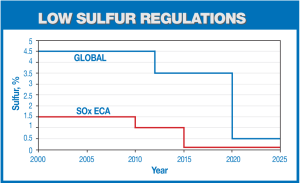
Sulphur in marine fuel produces sulphur oxides (SOx) when burned and contributes to particulate pollution. Regulation 14 primarily controls these emissions by limiting the sulphur content of fuel oil used or carried for use on board.
The two headline limits are:
| Operating area | Maximum fuel-oil sulphur content |
|---|---|
| Outside a SOx ECA | 0.50% by mass |
| Inside a SOx ECA | 0.10% by mass, once that area’s requirement applies |
The global 0.50% limit has applied since 1 January 2020. These limits concern fuel used by applicable combustion equipment, including main and auxiliary engines, boilers and other relevant units. They are expressed as percent by mass (m/m). Annex VI does not establish a single numerical worldwide particulate-matter limit equivalent to these sulphur percentages; controlling fuel sulphur is one important means of reducing particulate emissions.
Fuel changeover before entering an ECA
A ship using separate fuels for the global and ECA limits must have a written changeover procedure. The fuel service system must be fully flushed so that compliant fuel is being used before ECA entry. The crew records the quantity of compliant fuel in the relevant tanks and the date, time and position when changeover is completed before entry or begins after exit. Starting the changeover at the boundary is too late.
Engineers must also consider fuel compatibility, temperature, viscosity, tank segregation and the possibility that mixing with higher-sulphur fuel could make an intended ECA fuel non-compliant at the point of use.
An approved equivalent: Exhaust gas cleaning systems
Regulation 4 permits an Administration to approve an equivalent arrangement that achieves at least the required emission reduction. An exhaust gas cleaning system (EGCS), often called a scrubber, may therefore allow a ship to use fuel above the Regulation 14 sulphur limit while achieving the approved equivalent SOx-emission performance.
An EGCS is not a general exemption from Annex VI. Its approval, operation, monitoring, records and any discharge-water conditions must be met. The 2021 EGCS Guidelines, MEPC.340(77) describe Scheme A as system certification with continuous operational-parameter monitoring and periodic emission checks, and Scheme B as continuous emission monitoring with periodic parameter checks. Washwater discharge may also be affected by applicable local restrictions.
Fuel non-availability
If compliant fuel cannot be obtained despite the required efforts, a ship may submit a Fuel Oil Non-Availability Report (FONAR) with supporting evidence. A FONAR is not a waiver or automatic exemption. The relevant authority evaluates the circumstances and decides what action is appropriate.
6. Which Emission Control Areas apply in October 2026?
An Emission Control Area is a specifically designated sea area with stricter requirements for SOx and particulate matter, NOx, or both. A ship must check the type of ECA, its boundaries, the effective date of each requirement, and any NOx construction-date condition.
| Area | Annex VI controls relevant in October 2026 | Timing point |
|---|---|---|
| Baltic Sea | SOx/PM; NOx Tier III for applicable newer ships | NOx construction-date threshold: 1 January 2021 |
| North Sea | SOx/PM; NOx Tier III for applicable newer ships | NOx construction-date threshold: 1 January 2021 |
| North American area | SOx/PM and NOx | NOx construction-date threshold: 1 January 2016 |
| United States Caribbean Sea area | SOx/PM and NOx | NOx construction-date threshold: 1 January 2016 |
| Mediterranean Sea | SOx/PM | The 0.10% sulphur limit took effect 1 May 2025; this is not a NOx Tier III ECA |
| Canadian Arctic | Designated for SOx/PM and NOx | Amendment entered into force 1 March 2026; the 12-month Regulation 14 transition means the 0.10% sulphur limit applies from 1 March 2027 |
| Norwegian Sea | Designated for SOx/PM and NOx | Amendment entered into force 1 March 2026; the 0.10% sulphur limit applies from 1 March 2027 under the same transition |
The Mediterranean SOx ECA became operational for the 0.10% fuel limit in May 2025. The Canadian Arctic and Norwegian Sea designations entered into force in March 2026, but Regulation 14.7 provides a 12-month transition for the new SOx ECA fuel requirement. The NOx Tier III provisions follow their separate, specified ship-construction conditions: notably, the Canadian Arctic provision refers to ships constructed on or after 1 January 2025, while the Norwegian Sea provision has a 1 March 2026 construction definition with contract, keel-laying and delivery criteria.
At MEPC 84 in May 2026, IMO adopted a further North-East Atlantic ECA. Its amendment is scheduled to enter into force on 1 September 2027, with the ECA’s stricter SOx operational requirement taking effect after the 12-month transition in 2028. It should not be shown on an October 2026 voyage plan as an already operational 0.10% SOx ECA. The precise boundary is given in the adopted amendment, not by a simple description such as “all North Atlantic waters.”
Training point: “The ship is entering an ECA” is incomplete information. The bridge and engine teams need to know which ECA, which emission controls apply, when they apply, and which equipment or fuel arrangement demonstrates compliance.
7. Regulation 18: Bunkering, fuel quality and evidence
Regulation 18 addresses fuel-oil availability and quality and provides much of the evidence used to check sulphur compliance.
For an applicable ship, fuel delivered for combustion is documented by a bunker delivery note (BDN) containing at least the information prescribed by Annex VI. The ship retains the BDN for three years after delivery. A representative MARPOL delivered sample accompanies the BDN; it is sealed and signed at completion of bunkering and remains under the ship’s control until the fuel is substantially consumed, but for not less than 12 months after delivery.
The BDN and sample are important, but they do not remove the need to control the fuel actually used. A compliant delivery can be contaminated by higher-sulphur fuel remaining in a tank or service line. Annex VI also provides for in-use and onboard sampling to verify fuel being burned or carried for use. Designated sampling points and accurate changeover records help demonstrate compliance.
A fuel may satisfy its declared sulphur limit yet present an operational problem involving stability, compatibility, viscosity or machinery performance. Fuel management should therefore address both regulatory compliance and safe technical use. A fuel specification such as ISO 8217 can assist purchasing and quality assessment, but it does not replace the MARPOL Annex VI requirements.
8. Regulation 15: Volatile organic compounds from tankers
Volatile organic compounds (VOCs) can be released from cargoes during loading, carriage and discharge. Regulation 15 allows a Party to regulate VOC emissions from tankers at specified ports or terminals. Where the notified requirement applies, a tanker may need an approved vapour emission collection system and must use it for the relevant cargo operation.
A crude-oil tanker must also carry and implement a ship-specific, Administration-approved VOC Management Plan. The plan addresses procedures to minimise emissions during loading, sea passage and discharge, considers VOCs associated with crude oil washing, and identifies responsibility for implementation. The regulation can extend to certain gas carriers where their cargo systems allow safe retention or return ashore of the relevant non-methane VOCs.
For tanker personnel, the practical point is to connect the approved plan and terminal requirements to the actual cargo: vapour control is part of safe cargo-operation planning, not merely an air-emissions certificate entry.
9. Regulation 16: Shipboard incineration
Annex VI controls what may be incinerated and where. Shipboard incineration generally must take place in an appropriate shipboard incinerator, subject to the regulation’s specific provision for certain ship-generated sludge and sewage sludge in power plants or boilers.
Regulation 16 prohibits incinerating several categories, including cargo residues subject to MARPOL Annexes I, II or III and related contaminated packing, PCBs, EGCS residues, and certain other listed substances. Polyvinyl chlorides (PVCs) may be incinerated only in an incinerator with the required IMO type approval. Ship-generated sewage sludge or sludge oil may, under the specified conditions, be burned in a main or auxiliary power plant or boiler, but not inside ports, harbours or estuaries.
An incinerator being physically capable of burning a waste does not mean that the waste is permitted under Annex VI. Crew members should also follow the ship’s waste procedures and any applicable MARPOL Annex V requirements.
10. Surveys and the certificates officers should recognise
A ship’s principal Annex VI documents serve different purposes:
| Document | What it addresses |
|---|---|
| IAPP Certificate | Ship-level compliance with applicable air-pollution provisions of Annex VI |
| EIAPP Certificate | Certification of an applicable marine diesel engine’s NOx performance |
| Engine NOx Technical File | Approved engine configuration and onboard verification method |
| IEE Certificate | Applicable Chapter 4 energy-efficiency requirements |
| Annual Statement of Compliance | Verified fuel-consumption reporting and, where applicable, annual CII and rating |
| SEEMP | Ship-specific energy management, data collection and CII planning |
| BDNs and MARPOL delivered samples | Evidence relating to bunkered fuel |
An IAPP survey and an EEXI verification may occur in connection with the same survey cycle, but the IAPP Certificate and IEE Certificate are different documents. Similarly, an EIAPP Certificate belongs to an engine’s NOx certification; it is not another name for the ship’s IAPP Certificate.
During a port State control inspection, officials may review certificates, fuel records, engine files, changeover procedures, monitoring data and whether the crew can explain essential onboard procedures. A properly filed document has limited value if the equipment is operated in a different configuration from the one approved.
11. Chapter 4: Energy efficiency and carbon intensity
Chapter 4 brings the Annex beyond traditional air-quality pollutants. Its main tools are:
EEDI — Energy Efficiency Design Index: A technical CO₂-efficiency standard for applicable new ships. The ship’s attained EEDI must meet its required EEDI.
EEXI — Energy Efficiency Existing Ship Index: A corresponding technical standard for applicable existing ships. Verification began at the first relevant survey on or after 1 January 2023. A major conversion may require reassessment.
SEEMP — Ship Energy Efficiency Management Plan: A ship-specific framework for efficiency measures, IMO DCS data collection and, for ships subject to CII, operational carbon-intensity planning.
IMO DCS: Annual collection and reporting of fuel-consumption and other specified information by ships of 5,000 GT and above. Enhanced reporting requirements were introduced by amendments entering into force in August 2025.
CII — Carbon Intensity Indicator: An annual, verified operational CO₂-intensity assessment and A–E rating for specified ship types of 5,000 GT and above. A ship rated E once or D for three consecutive years must develop and implement a verified corrective action plan in its SEEMP.
EEDI and EEXI assess technical efficiency under prescribed calculation conditions. CII uses annual operational information and generally relates calculated CO₂ emissions to ship capacity multiplied by distance travelled. It is therefore incorrect to describe the main CII formula as simply “fuel burned per tonne of cargo actually carried.”
At MEPC 83, IMO adopted stricter CII reduction factors for 2027–2030. At MEPC 84, it clarified how total distance travelled is used in the calculation and reported in the SEEMP/DCS framework. These developments matter to the reliability of a ship’s fuel and voyage data as well as to its future performance planning.
12. Greenhouse gases and the proposed IMO Net-Zero Framework
The 2023 IMO GHG Strategy sets global ambitions for international shipping, including at least a 40% reduction in average CO₂ emissions per transport work by 2030 compared with 2008, and net-zero GHG emissions by or around 2050. Its ambitions guide the development of further measures; they do not, by themselves, impose the same numerical annual target on every individual vessel.
IMO’s 2024 lifecycle GHG guidelines, adopted through MEPC.391(81), examine well-to-tank, tank-to-wake and well-to-wake emissions. They include CO₂, methane and nitrous oxide, which is particularly relevant when comparing alternative fuel pathways. These guidelines should not be confused with the existing CO₂-based EEDI, EEXI and CII calculation methods.
In April 2025, IMO approved draft text for a proposed Net-Zero Framework involving a marine-fuel GHG-intensity standard and an emissions-pricing mechanism. Its adoption meeting in October 2025 was adjourned. As of 15 October 2026, this proposed framework had not entered into force. A ship should not be told that the proposed IMO global GHG price is already a MARPOL Annex VI payment obligation.
13. A practical voyage example
Imagine a product tanker sailing from outside the Mediterranean into the Mediterranean Sea in October 2026. The ship normally burns fuel meeting the 0.50% global sulphur limit and has a separate 0.10% fuel for ECA operation.
Before the boundary, the bridge and engine departments confirm the ECA entry position and calculate when fuel changeover must begin. Engineers follow the written procedure, allow enough time to flush the service system, and verify that the fuel in use meets the 0.10% requirement before entry. They record the required quantities, time and position. The bunker documents and MARPOL samples remain available for inspection.
At the same time, the ship’s applicable diesel engines must remain in their approved NOx configuration. The Mediterranean’s current Annex VI designation is a SOx/PM ECA, so entering it does not, by itself, impose the NOx Tier III rule applicable in a designated NOx ECA. The crew continues to record fuel consumption and distance for the IMO DCS and, if the tanker is subject to it, its annual CII calculation.
This one voyage shows why Annex VI cannot be reduced to “use low-sulphur fuel.” It links the ship’s position, fuel system, engine approval, documentary evidence and annual operational reporting.
14. What changed most recently?
For training material dated October 2026, these dates deserve particular attention:
- 1 May 2025: The Mediterranean 0.10% SOx ECA fuel limit became operational.
- 1 August 2025: Amendments enhancing IMO DCS data reporting entered into force.
- 1 March 2026: The Canadian Arctic and Norwegian Sea ECA designations entered into force. Their 0.10% SOx fuel requirement follows the 12-month transition to 1 March 2027; their NOx provisions have separate construction-date conditions.
- May 2026: IMO adopted the North-East Atlantic ECA amendment, scheduled for entry into force in September 2027 and operational SOx application after its transition in 2028.
- 2025–2026: IMO updated CII reduction factors through 2030 and clarified CII and SEEMP distance-data methods.
- October 2026 status: The proposed IMO Net-Zero Framework remained unadopted and not in force.
IMO DCS verfication Vs EU MRV verification
MARPOL Annex VI addresses the monitoring and reporting of energy efficiency for ships of 5,000 gross tonnage and above. This regulation aims to enhance transparency and promote data-driven decision-making in the shipping industry, ultimately leading to more energy-efficient operations and reduced GHG emissions. Under this regulation, ships are required to collect and report data on their fuel consumption, distance traveled, and hours underway, as well as other relevant information that enables the calculation of the ship’s energy efficiency. This data is used to determine the ship’s annual average carbon intensity indicator (CII), which is then reported to the ship’s flag state and the International Maritime Organization (IMO). The flag state verifies the data and issues a Statement of Compliance (SOC) to confirm that the ship has met its monitoring and reporting obligations. The collected data is also used to develop a global database on ship energy efficiency, which informs policy-making and helps track the industry’s progress towards meeting its GHG emissions reduction targets. By implementing onboard monitoring and reporting requirements, Regulation 12 of MARPOL Annex VI helps to ensure that the shipping industry is held accountable for its energy efficiency and environmental performance.

Final points for officers and cadets
MARPOL Annex VI asks several different compliance questions. Is the fuel suitable for the area? Is the engine still in its certified NOx configuration? Are controlled substances and incinerator wastes handled correctly? Are the ship’s technical efficiency documents current? Are annual fuel and voyage data accurate?
The answers come from the ship’s equipment, operating procedures, records and certificates together. Good Annex VI practice means knowing which requirement applies to the ship, who is responsible for each action, and what evidence shows that the action was completed.
Principal IMO references
- MARPOL Annex VI resolutions and guidelines index
- IMO guidance on NOx, Regulation 13
- IMO guidance on SOx and particulate matter, Regulation 14
- 2021 EGCS Guidelines, MEPC.340(77)
- IMO EEXI and CII explanation
–
MULTIPLE CHOICE QUESTIONS – MARPOL ANNEX VI (Air Pollution Prevention)
-
What is the main focus of MARPOL Annex VI?
A. Prevention of oil pollution
B. Prevention of garbage discharge
C. Prevention of air pollution from ships
D. Prevention of ballast water contamination
Correct Answer: C. Prevention of air pollution from ships
-
Which of the following emissions is not directly regulated under MARPOL Annex VI?
A. Sulphur oxides (SOx)
B. Carbon monoxide (CO)
C. Nitrogen oxides (NOx)
D. Volatile Organic Compounds (VOCs)
Correct Answer: B. Carbon monoxide (CO)
-
What is the global sulphur limit for marine fuel as per Regulation 14 of Annex VI (as of 2020)?
A. 1.5% m/m
B. 1.0% m/m
C. 0.50% m/m
D. 0.10% m/m
Correct Answer: C. 0.50% m/m
-
In Emission Control Areas (ECAs), what is the maximum permitted sulphur content in fuel oil?
A. 1.0%
B. 0.5%
C. 0.1%
D. 0.05%
Correct Answer: C. 0.1%
-
Which certificate is issued under MARPOL Annex VI upon successful survey and compliance?
A. International Sewage Pollution Certificate (ISPC)
B. International Garbage Management Certificate
C. International Air Pollution Prevention (IAPP) Certificate
D. Ship Energy Audit Certificate
Correct Answer: C. International Air Pollution Prevention (IAPP) Certificate
-
What is the purpose of the EEDI (Energy Efficiency Design Index)?
A. To measure crew performance
B. To calculate ship maintenance schedules
C. To assess the energy efficiency of new ship designs
D. To monitor incinerator emissions
Correct Answer: C. To assess the energy efficiency of new ship designs
-
What is the function of the Ship Energy Efficiency Management Plan (SEEMP)?
A. To plan dry-dock schedules
B. To reduce noise emissions
C. To guide operational energy efficiency improvements
D. To handle oil spills
Correct Answer: C. To guide operational energy efficiency improvements
-
Which new Emission Control Area (ECA) becomes effective for SOx on 1 May 2025?
A. South Pacific
B. Mediterranean Sea
C. Gulf of Aden
D. Great Barrier Reef
Correct Answer: B. Mediterranean Sea
-
What must the Bunker Delivery Note (BDN) include as of May 2024?
A. CO₂ emission rating
B. Port of departure
C. Flashpoint of the fuel oil or a compliance statement
D. Ship’s ballast tank data
Correct Answer: C. Flashpoint of the fuel oil or a compliance statement
-
What rating system is used under the Carbon Intensity Indicator (CII) framework?
A. A to F
B. 1 to 10
C. A to E
D. Low, Medium, High
Correct Answer: C. A to E
TRUE/FALSE QUESTIONS – MARPOL ANNEX VI (Air Pollution and Energy Efficiency)
-
MARPOL Annex VI regulates both NOx and SOx emissions from ships.
True
-
The EEDI applies only to existing ships.
False
Explanation: The EEDI applies to new ships; EEXI applies to existing ships.
-
VOC controls under Annex VI are mandatory for all types of vessels.
False
Explanation: VOC controls specifically target tankers handling crude oil.
-
Shipboard incineration of polychlorinated biphenyls (PCBs) is prohibited under Annex VI.
True
-
Regulation 22A requires ships to report fuel oil consumption data to the IMO.
True
-
The use of alternative emission-reduction technologies is not permitted under Annex VI.
False
Explanation: Regulation 4 allows for approved equivalents like scrubbers.
-
Ships operating in ECAs must comply with stricter NOx and SOx limits.
True
-
Fuel suppliers are required to follow ISO 8217 standards under Regulation 18.
True
-
The Mediterranean Sea is classified as a Sulphur Emission Control Area starting in 2023.
False
Explanation: The Mediterranean Sea becomes an SOx ECA on 1 May 2025.
-
The Operational Carbon Intensity Indicator (CII) measures CO₂ per ton-mile and contributes to a ship’s annual carbon rating.
True
By:Dr.R.Karimpour
One thought on “MARPOL Annex VI Explained: Air Pollution, Fuel Standards and Ship Energy Efficiency”