
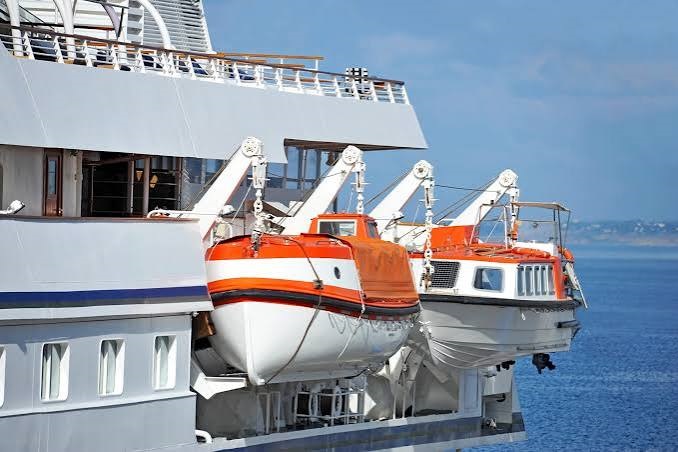
A ship’s lifeboat is a self-contained survival craft designed to carry people away from a vessel during an emergency. This guide explains its controls, davit-launching arrangement, release system, emergency rations and essential lifesaving equipment.
A ship’s lifeboat is more than a small emergency boat. It is a protected survival craft with its own propulsion, steering, communications support, distress signals, food, water and equipment for keeping people alive until rescue arrives.
On many merchant ships, the lifeboat hangs from davits and is lowered to the sea using wire falls and a winch. Other ships use free-fall lifeboats that slide from an inclined ramp and enter the water directly.
Although international rules establish minimum safety requirements, lifeboat designs and release systems differ considerably. Every seafarer must therefore learn the exact lifeboat fitted aboard their ship.
Important safety notice: This article and the accompanying video are educational resources. They do not replace approved manuals, onboard familiarisation, abandon-ship drills or certified survival-craft training. Never operate a release control, remove a safety device or launch a lifeboat without authorisation and the vessel’s approved procedure.
What Is a Ship’s Lifeboat?
A lifeboat is a survival craft intended to evacuate people from a vessel in distress and sustain them after abandonment.
The International Convention for the Safety of Life at Sea—SOLAS—makes the carriage of appropriate lifesaving appliances mandatory for ships within its scope. More detailed technical requirements appear in the International Life-Saving Appliance Code, normally called the LSA Code.
These requirements cover lifeboats, liferafts, rescue boats, lifejackets, immersion suits, thermal protective aids, distress signals and launching appliances. The required type and capacity depend on the ship’s size, purpose, voyage and number of people aboard. International Maritime Organization: Life-saving appliances
A lifeboat should not be confused with a rescue boat. A lifeboat’s primary function is abandonment and survival. A rescue boat is principally intended to recover people from the water and marshal survival craft, although an approved boat may perform both roles when it meets both sets of requirements.
Main Types of Ship Lifeboats
“Totally enclosed” describes the lifeboat’s construction, while “davit-launched” or “free-fall” describes how it enters the water. A totally enclosed boat can therefore be either davit-launched or free-fall.
| Lifeboat type | Main characteristics | Typical application |
|---|---|---|
| Open lifeboat | No permanent protective enclosure | Mainly older vessels or operations governed by different requirements; uncommon on modern SOLAS oceangoing ships |
| Partially enclosed lifeboat | Permanent covers over part of the boat, with a protected passenger area | Commonly associated with certain passenger-ship arrangements |
| Totally enclosed lifeboat | Rigid enclosure, hatches, seat restraints and protection from weather and waves | Widely used on modern cargo ships |
| Davit-launched lifeboat | Lowered by a winch and falls from davit arms | Passenger ships and many cargo vessels |
| Free-fall lifeboat | Slides down a stern ramp and enters the water by gravity | Common on bulk carriers and other cargo ships |
| Fire-protected lifeboat | Additional protection, generally including water-spray and air-support arrangements | Oil, chemical and gas tankers where fire may surround the survival craft |
No lifeboat should be operated simply from general knowledge. A seafarer familiar with one manufacturer’s system may encounter different controls, hook-reset indicators or launch arrangements on another vessel.
How a Davit-Launched Lifeboat Works
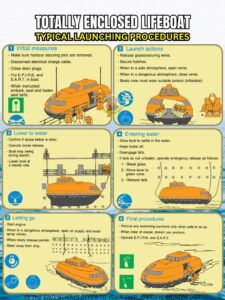
A davit-launched lifeboat is supported by one or two wire ropes known as falls. These falls pass through blocks and connect the boat’s lifting hooks to a winch installed on the ship.
The davits hold the boat at its stowed position and guide it outboard for lowering.
1. Muster and preparation
When the abandon-ship signal is given, personnel report to their assigned muster stations according to the muster list. The responsible officers confirm attendance, allocate duties and assess whether the launching area is safe.
Preparations may include checking:
- The launching area and sea below
- The lifeboat’s engine and controls
- Communications with the bridge
- Falls, hooks and release indicators
- Drain arrangements and access hatches
- Painters and securing arrangements
- Personal lifejackets or immersion suits
- Passenger seating and restraints
The exact sequence is vessel-specific. Some preparations are completed before boarding, while other actions are performed from inside the lifeboat.
2. Embarkation and securing occupants
Crew and passengers board through the designated access points and take their assigned seats.
In a totally enclosed lifeboat, each person must use the fitted safety belt or restraint correctly. This is especially important in rough weather and essential in a free-fall lifeboat, where occupants experience significant acceleration during launch.
The coxswain confirms that hatches are secured as required, people are correctly seated and the boat is ready for lowering.
3. Moving the lifeboat outboard
Gravity davits are designed so that releasing the appropriate securing arrangement allows the davit arms and boat to move toward the ship’s side.
The boat remains suspended from its hooks and falls. Depending on the system, the boat may already be in the embarkation position or may need to be moved from its stowed position.
4. Lowering the boat
The winch brake controls the descent. On many lifeboats, a remote control wire allows the lowering operation to be controlled from inside the boat. Other controls may be located at the embarkation deck.
The winch does not normally power the fully loaded boat downward. Gravity lowers the boat while the brake controls its speed. Powered winch operation is normally associated with recovery and returning the empty or lightly manned boat to its stowed position, subject to the approved arrangement.
Wind, waves, ship movement and changes in the vessel’s list can make lowering difficult. Skates or fenders on the lifeboat help reduce damage as it moves down the ship’s side.
5. Reaching the water and releasing the hooks
Once the lifeboat is fully waterborne and the load has come off the falls, the normal release system allows the hooks to open.
Davit-launched lifeboats generally have a system that releases the lifting hooks simultaneously. Modern arrangements include safeguards intended to prevent premature release.
An emergency on-load release capability may allow the hooks to be opened while they are still carrying load. This is intended for exceptional situations in which remaining connected to the falls creates a greater immediate danger.
Critical warning: An on-load release or interlock override can cause a suspended lifeboat to fall. It must never be used casually, during an ordinary tour or as a substitute for correct hook resetting. Follow the approved manual and the responsible officer’s instructions.
IMO requirements specify safeguards against accidental or premature activation and require clear indication that hooks are correctly reset before lifting. IMO Resolution MSC.218(82)
6. Releasing the painter and moving away
A painter is a strong rope connected near the lifeboat’s bow. During launching, it helps control the boat’s position relative to the ship and can assist in keeping the bow correctly aligned.
After the hooks are released and the engine is ready, the painter is released or dealt with according to the approved procedure. The coxswain then manoeuvres the lifeboat away from the ship and any immediate hazards.
This phase can be particularly dangerous if the parent vessel still has headway, is listing, is on fire or is surrounded by wreckage.
How Does a Free-Fall Lifeboat Work?
A free-fall lifeboat is normally stowed on a sloping ramp, often at the stern of a cargo ship.
Occupants enter the boat, close the hatches and secure themselves in specially designed seats. Once the coxswain confirms readiness, the release system allows the boat to slide down the ramp.
The lifeboat enters the water with forward momentum, carrying it away from the vessel. The enclosure, hull, seating and restraints are designed to protect occupants during the launch.
Free-fall launching can provide rapid evacuation without lowering a boat down the side of a heavily listing ship. However, the forces involved mean that correct seating posture, head support and restraint use are essential.
SOLAS drill provisions allow alternative arrangements in certain circumstances to reduce the risk of injuries during free-fall lifeboat drills. IMO guidance on preventing lifeboat accidents
Inside the Lifeboat: The Coxswain’s Position
The coxswain is the person assigned to take command of the survival craft. The control position is arranged to provide access to the main operating equipment and, as far as practicable, a clear view outside.
Although layouts differ, a typical control position may include:
- Steering wheel or steering control
- Engine start-and-stop controls
- Ahead-and-astern gear control
- Throttle
- Engine warning lights or basic instruments
- Magnetic compass
- Interior and exterior lighting controls
- Release-system handle and indicators
- Ventilation controls where fitted
- Water-spray or air-support controls on fire-protected boats
- Communication-equipment mounting points
- Emergency steering arrangements
Most motor lifeboats use a compression-ignition engine, commonly described as a small marine diesel engine. The engine must be capable of operating both ahead and astern.
A steering wheel may control the rudder through cables, rods or hydraulic components. An emergency tiller or alternative steering arrangement is generally provided in case the normal system fails.
Did you know? A lifeboat engine is not designed mainly for speed. Its priorities are dependable starting, controlled manoeuvring, endurance and moving the survival craft away from danger.
What Equipment Is Carried Inside a Lifeboat?
The normal equipment is organised to support five basic needs:
- Operating and controlling the boat
- Protecting survivors from exposure
- Providing water and energy
- Attracting the attention of rescuers
- Treating injuries and managing emergencies
The inventory varies with the lifeboat type, ship, voyage, flag Administration and approved exemptions. Equipment must therefore be checked against the boat’s approved inventory and the vessel’s records.
Boat-handling and survival equipment
| Equipment | Main purpose |
| Buoyant oars | Moving or controlling the boat if propulsion is unavailable; requirements differ for free-fall boats |
| Boat hooks | Handling lines, pushing away objects or assisting alongside operations |
| Sea anchor | Reducing drift and helping keep the boat oriented more safely relative to wind and waves |
| Painters and towlines | Securing, controlling or towing the boat |
| Buoyant rescue quoits | Helping recover a person from the water |
| Hatchets or knives | Cutting ropes in an emergency |
| Bailer, buckets or pump | Removing water from the boat where required |
| Engine tools | Making limited adjustments to the engine and its accessories |
| Fishing tackle | Possible long-term food collection if rescue is delayed |
| Survival manual | Guidance on immediate actions and survival at sea |
Oars, boat hooks and other loose items should be secured so that they do not become dangerous during launching or in heavy seas.
Navigation and signalling equipment
Magnetic compass
The compass helps the coxswain maintain a heading when moving away from the vessel, approaching survivors or navigating toward a known location.
It is not a complete navigation system. Visibility, current, wind and limited position information may make long-distance navigation difficult.
Rocket parachute flares
A standard lifeboat equipment inventory normally includes four rocket parachute flares. These rise to altitude and produce a bright red signal visible over a considerable distance, particularly at night.
Hand flares
The normal inventory includes six red hand flares. They are mainly useful when a ship, aircraft or rescue unit is already close enough to see a lower-level signal.
Buoyant smoke signals
A normal lifeboat inventory includes two buoyant smoke signals. These produce highly visible smoke and are especially useful for daytime position marking.
Pyrotechnics can cause serious burns or start a fire. They must be used in accordance with their instructions, taking account of wind direction, the lifeboat’s enclosure and nearby fuel.
Signalling mirror, torch and whistle
A daylight signalling mirror can attract the attention of ships or aircraft when sunlight is available.
A waterproof torch can provide illumination and send Morse signals. A whistle produces a sound signal without requiring survivors to use excessive energy.
Radar reflector and locating devices
A radar reflector increases the chance that the lifeboat will appear on a searching vessel’s radar.
Depending on the ship’s arrangement, a search-and-rescue transponder—SART—or AIS-SART may be brought into the survival craft according to the muster plan. Portable VHF radios and other emergency communication equipment may also be allocated to designated boats rather than permanently stored in every lifeboat.
Survivors should activate and operate radio or locating equipment according to their training and the equipment instructions.
Emergency Drinking Water
Water is one of the most important lifeboat supplies. The normal LSA Code provision for a lifeboat is based on three litres of fresh water for every person the boat is approved to carry, although part of this quantity may be replaced by approved desalination equipment under specified conditions.
Water is stored in sealed containers or protected tanks. The lifeboat also carries suitable drinking vessels so that distribution can be controlled.
A rainwater-collection arrangement may direct clean rainwater into the lifeboat’s water storage. A manually powered reverse-osmosis desalinator may also be fitted or required under an approved arrangement.
Survivors should:
- Protect all drinking water from contamination
- Follow the coxswain’s rationing plan
- Collect rainwater whenever safe and practical
- Avoid unnecessary physical effort
- Never drink seawater
- Record water distribution if survival is prolonged
The exact rationing strategy depends on climate, survivor condition, available water and expected rescue time. Medical needs and dehydration may require the person in command to adjust distribution.
Emergency Lifeboat Food Rations
The normal requirement is a food ration providing at least 10,000 kilojoules—approximately 2,400 kilocalories—for each person the lifeboat is permitted to accommodate.
Emergency rations are usually:
- High in energy
- Compact and lightweight
- Low in moisture
- Low in salt to limit thirst
- Ready to eat without cooking
- Divided into controlled portions
- Packed in sealed, water-resistant packaging
The ration may resemble a firm biscuit or compressed food bar. Its purpose is not to provide normal meals. It supplies basic energy while using little storage space and avoiding ingredients that may increase thirst.
The coxswain should control distribution according to the survival instructions and expected rescue situation.
Can you taste a lifeboat ration?
A separate training sample may be used to demonstrate the taste and texture of an emergency ration. However, an in-service ration pack should never be opened merely for a demonstration.
Opening the pack can reduce the approved inventory and expose the remaining food to moisture or contamination. Any sample used in a video should be separate from the lifeboat’s sealed emergency stores or formally replaced through the vessel’s approved inventory process.
Did you know? The 10,000-kilojoule figure is the total emergency food provision required for each approved occupant. It should not be confused with a guaranteed full daily ration for several days.
Seasickness, First Aid and Thermal Protection
Seasickness medicine and bags
Seasickness can quickly weaken survivors through vomiting, dehydration and loss of morale. The normal lifeboat inventory therefore includes anti-seasickness medicine and a seasickness bag for each person.
Under the standard equipment list, six doses of anti-seasickness medicine are provided for each approved occupant. Medication must be used according to its instructions and medical precautions.
First-aid kit
The watertight first-aid kit supports the treatment of cuts, burns, shock and other injuries. A designated person should manage it where possible to prevent loss, contamination or uncontrolled use.
Immersion suits
An immersion suit reduces body-heat loss in cold water. Depending on the vessel, suits may be stored in cabins, at muster stations, near survival craft or in other approved positions. They are not necessarily kept inside every lifeboat.
Crew must practise donning the specific suit provided aboard their ship.
Thermal protective aids
A thermal protective aid is normally a lightweight, low-thermal-conductivity covering used to reduce heat loss after a person reaches the survival craft.
It is not the same as an immersion suit. The usual lifeboat provision is enough for at least 10% of the approved number of occupants or two people, whichever is greater, subject to the applicable requirements.
Other Important Lifeboat Equipment
Sea anchor
A sea anchor is deployed into the water to create drag. It can reduce rapid drifting and help keep the boat better aligned with the prevailing sea.
It does not hold the boat in one geographical position like a seabed anchor.
Fire extinguisher
A lifeboat with an internal-combustion engine carries approved portable fire-extinguishing equipment suitable for the expected fire risk. Its position should be known to the coxswain and assigned crew.
Lifesaving signal cards
Lifesaving signal tables help survivors recognise communications used by rescue ships and aircraft. They may show signals meaning that help has been seen, instructions to proceed in a particular direction or other search-and-rescue information.
Rainwater collector
Rainwater-collection equipment provides a possible source of additional drinking water. The collecting surface and container must be kept clean, particularly after exposure to seawater spray, fuel, smoke or dirt.
Immediate Priorities After Abandoning Ship
Once the lifeboat has moved clear of immediate danger, the person in command will normally consider the following priorities:
- Account for all occupants and look for people in the water.
- Treat serious injuries and control bleeding.
- Close hatches or ventilation openings as conditions require.
- Establish communications and activate locating equipment.
- Keep the lifeboat near other survival craft when appropriate.
- Deploy the sea anchor if it improves the boat’s behaviour.
- Protect occupants from cold, heat, spray and seasickness.
- Check for leaks, fire, fuel problems or propulsion damage.
- Organise water and food distribution.
- Maintain a lookout for ships, aircraft, lights and debris.
The safest action may be to remain near the casualty position because rescuers will often begin searching around the ship’s last known position. However, fire, dangerous cargo, sinking debris, weather, currents or proximity to land may require a different decision.
The coxswain must assess the actual circumstances rather than follow a single rule in every emergency.
Lifeboat Inspection, Maintenance and Drills
Lifeboats must remain ready even though they may spend years without being used in a real abandonment.
SOLAS Chapter III addresses operating instructions, muster arrangements, launching stations, emergency training, drills, operational readiness, maintenance and inspections. IMO summary of SOLAS Chapter III
Inspections should cover items such as:
- Lifeboat structure and enclosure
- Engine and propulsion system
- Steering and manoeuvring controls
- Winch, davits and falls
- Hooks and release mechanism
- Power supply and batteries
- Bailing arrangements
- Loose and fixed equipment
- Expiry dates for food, water, medicine and pyrotechnics
- Air-support, sprinkler and ventilation systems where fitted
Maintenance and major examinations must be performed by appropriately qualified personnel in accordance with the manufacturer’s instructions and mandatory requirements.
Amendments that entered into force on 1 January 2026 added the ventilation system, where fitted, to the items addressed during the annual thorough examination and operational test. IMO Resolution MSC.559(108)
Lifeboat accidents have occurred during inspections and drills, particularly because of release-gear errors, inadequate maintenance or incorrect procedures. No person should stand beneath a suspended boat, and unnecessary personnel should not remain inside during maintenance or testing.
Frequently Asked Questions
What is the difference between a lifeboat and a liferaft?
A lifeboat is a rigid survival craft, usually with an engine, steering system and fixed equipment. A liferaft is generally inflatable and stored in a compact container until launched or released. Both are intended to support survival after abandonment.
What is the difference between a lifeboat and a rescue boat?
A lifeboat is primarily intended for abandoning the ship. A rescue boat is designed mainly to recover people from the water and organise survival craft. An approved boat may serve both purposes if it meets both requirements.
How much food and water does a lifeboat carry?
A standard lifeboat provision is based on at least 10,000 kilojoules of emergency food and three litres of fresh water for each person the boat is approved to accommodate. Approved desalination arrangements may replace part of the stored water.
Why does a lifeboat have an on-load release system?
It provides an emergency means of disconnecting the boat when the hooks remain under load. Because premature use can cause the lifeboat to fall, the control is protected and should only be used under the approved procedure in an exceptional situation.
Are immersion suits stored inside the lifeboat?
Not always. They may be stored in cabins, at muster stations, near the lifeboat or in other approved locations. Seafarers must know where their assigned immersion suit is located.
Can a lifeboat be launched if the ship is listing?
Lifeboat and launching arrangements are designed and approved for specified conditions of list and trim. Actual launching ability depends on the direction and severity of the list, damage, weather and condition of the launching system.
Can emergency lifeboat rations be eaten during training?
In-service emergency stores should not be opened simply for tasting. A separate training sample can be used, or the opened ration must be replaced through the vessel’s approved inventory system.
Conclusion
Understanding how a ship’s lifeboat works means understanding the entire survival system—not only the boat itself.
The davits, falls and winch lower the craft. The release mechanism disconnects it from the ship. The engine, steering and compass help the coxswain move away from danger, while water, emergency rations, thermal protection, first aid and distress signals support survival until rescue.
Yet no general article or video can explain every lifeboat model safely. Seafarers must study their vessel’s plans, approved procedures, manufacturer’s manual and hook-release arrangement—and reinforce that knowledge through properly supervised training.
For more practical explanations of SOLAS, ship safety, marine engineering and seafarer training, explore MaritimEducation and subscribe to our latest articles and educational videos.
Read more :
-
Top 6 Life-Saving SOLAS Requirements for Onboard Ship Safety
-
Liferafts on Ships
-
Lifeboat Drills on Ships: Compliance with SOLAS Regulations
About the Authors — MaritimEducation Team
MaritimEducation Team creates clear, practical and research-informed content about ships, marine engineering, maritime education, shipping, ports, technology, safety and sustainability.
References
- International Maritime Organization, “Life-Saving Appliances”.
- International Maritime Organization, “Summary of SOLAS Chapter III—Life-Saving Appliances and Arrangements”.
- International Maritime Organization, Resolution MSC.218(82), Amendments to the International Life-Saving Appliance Code.
- International Maritime Organization, “Prevention of Accidents Involving Lifeboats”.
- International Maritime Organization, Resolution MSC.559(108), Amendments to Lifeboat Maintenance and Examination Requirements.
- United States Electronic Code of Federal Regulations, 46 CFR §199.175, “Survival Craft and Rescue Boat Equipment”.