
The ocean covers more than 70% of Earth’s surface, yet it remains largely unexplored—a vast, dark frontier that has captivated filmmakers for nearly a century. From Jacques Cousteau’s pioneering underwater cinematography to David Attenborough’s urgent climate warnings, marine documentaries have evolved from mere spectacle into powerful tools for conservation and understanding.
Whether you’re drawn to the alien landscapes of the deep sea, the brutal realities of the fishing industry, or the raw human drama of survival at sea, there’s a maritime documentary that will change how you see the water. Here are twelve of the most compelling marine and maritime documentaries ever made, each offering a unique window into the world beneath the waves.
1. The Silent World (1956)
Before there was Attenborough, there was Jacques-Yves Cousteau. Co-directed with a young Louis Malle, The Silent World was one of the first films to use underwater cinematography in full color, and it remains one of only two documentaries ever to win the Palme d’Or at the Cannes Film Festival. The film chronicles Cousteau’s early adventures aboard the research vessel Calypso, showcasing the development of scuba technology and offering viewers their first sustained look at the ocean’s depths. It won the Academy Award for Best Documentary Feature and set the template for every underwater filmmaker who followed in Cousteau’s legendary wake.
2. The Blue Planet (2001) & Blue Planet II (2017)
If you watch only one ocean documentary series, make it The Blue Planet—and then watch its sequel immediately. The original 2001 BBC production, narrated by David Attenborough, was the first natural history series dedicated entirely to ocean life, moving from sunlit coral shallows to the crushing darkness of deep-sea volcanic vents. Its combination of patient camerawork and George Fenton’s evocative score set the standard against which every later ocean documentary is measured.
Blue Planet II arrived sixteen years later with dramatically improved camera technology and updated research. Its episode on marine plastic pollution is widely credited with accelerating global public awareness of the issue, prompting government action and widespread behavioral change. Together, the two series represent the pinnacle of what ocean documentary can achieve.
3. The Cove (2009)
Louie Psihoyos’s The Cove unfolds with the tension of a heist thriller. A team of divers, filmmakers, and activists—including former Flipper trainer Ric O’Barry—secretly infiltrate a heavily patrolled cove in Taiji, Japan, to capture footage of the annual dolphin hunt that local authorities had been preventing journalists from documenting. What they capture is devastating: hundreds of dolphins driven into a hidden inlet and slaughtered, their meat sold and their capture fueling a multi-billion-dollar captive dolphin industry.
The film won the Academy Award for Best Documentary Feature in 2010 and sparked an international campaign against dolphin hunting. Beyond its specific subject, The Cove raised profound questions about cultural tradition versus ecological responsibility, and about the ethics of keeping intelligent creatures in captivity.
4. Blackfish (2013)
Gabriela Cowperthwaite’s Blackfish examines the controversial captivity of killer whales through the story of Tilikum, a bull orca who was involved in the deaths of several people, including experienced trainer Dawn Brancheau at SeaWorld Orlando in 2010. Compiling shocking footage and emotional interviews, the film explores the extraordinary nature of orcas, the cruelty of their treatment in captivity, and the pressures brought to bear by the multi-billion-dollar sea-park industry.
Blackfish provoked immediate controversy upon release and triggered what became known as the “Blackfish effect”—a wave of public outcry that led to declining attendance at marine parks, corporate policy changes, and eventual legislative action. It remains one of the most effective advocacy documentaries ever made.
5. Mission Blue (2014)
Directed by Robert Nixon and Fisher Stevens, Mission Blue profiles Sylvia Earle, the legendary oceanographer and marine biologist sometimes called “Her Deepness” by colleagues. Earle was the first woman to serve as chief scientist of the National Oceanic and Atmospheric Administration and has led more than one hundred ocean expeditions. The film combines biography with a broader argument about the urgency of creating protected marine sanctuaries—what Earle calls “Hope Spots”—before further exploitation degrades ecosystems beyond recovery.
Mission Blue is both a portrait of a remarkable scientist and a call to action. Earle’s optimism and determination in the face of overwhelming environmental challenges make it one of the most inspiring ocean documentaries available.
6. Chasing Coral (2017)
Jeff Orlowski’s Chasing Coral follows a team of divers, photographers, and scientists who attempt to document coral bleaching events in real time using time-lapse cameras placed on reefs around the world. The results are among the most striking images of climate change ever captured on film: reefs that transform from vivid, riotous color to stark white death over the course of weeks.
The film won the Audience Award at the Sundance Film Festival in 2017 and later received an Emmy Award for Exceptional Merit in Documentary Filmmaking. What makes Chasing Coral so powerful is its combination of scientific rigor and emotional urgency—it doesn’t just show you what’s happening to coral reefs; it makes you feel the loss.
7. My Octopus Teacher (2020)
Pippa Ehrlich and James Reed’s My Octopus Teacher follows South African filmmaker Craig Foster, who spent a year diving daily in a cold kelp forest off the Cape Peninsula, developing an extraordinary relationship with a single octopus. The film won the Academy Award for Best Documentary Feature in 2021, and its success opened wider audiences to the intelligence and individuality of marine invertebrates.
Part nature documentary, part meditation on connection and mortality, My Octopus Teacher is unlike any other film on this list. It asks us to reconsider what we mean by intelligence and whether we can truly know a creature so fundamentally different from ourselves.
8. Endurance (2024)
A century after Ernest Shackleton’s ship Endurance sank beneath the Antarctic ice in 1915, a modern expedition set out to find the wreck. Endurance, directed by Chai Vasarhelyi, Jimmy Chin, and Natalie Hewit, places the present-day search alongside the gripping story of Shackleton’s legendary feat of leadership and survival. Shackleton kept all 27 of his men alive for over a year after their ship was crushed, eventually leading them to safety across some of the most hostile terrain on Earth.
The film draws on original expedition footage preserved and restored by the BFI National Archive, creating a you-are-there quality that makes the historical drama feel immediate and visceral. When the wreck was finally located in 2022, it was found in remarkable condition—a ghostly monument to one of history’s greatest survival stories.
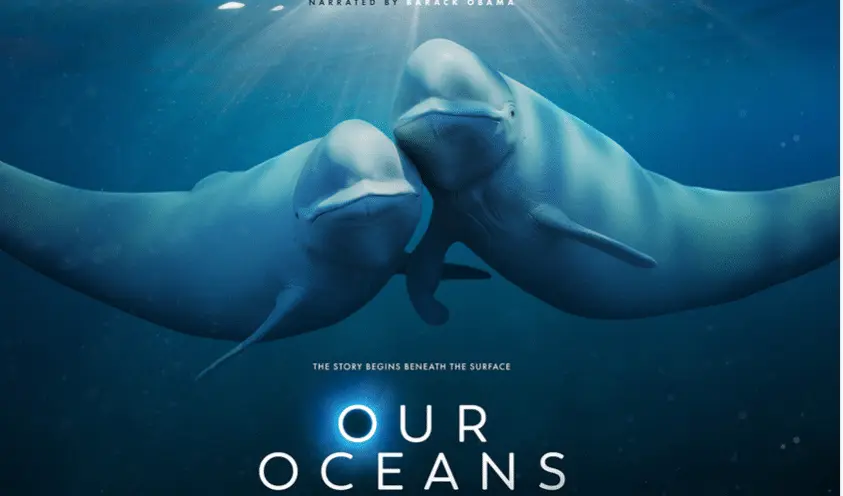
9. Our Oceans (2024)
Narrated by Barack Obama, Our Oceans is a five-part Netflix series that explores each of the Earth’s five oceans—Pacific, Indian, Atlantic, Arctic, and Southern. From the minute mantis shrimp of the Indian Ocean to the mighty sperm whales that navigate its waters, from the coral reefs enriched by Pacific currents to the extraordinary species that survive in the Southern Ocean’s powerful global current, the series reveals the interconnected systems that sustain life on Earth.
The visuals are stunning, many never seen before, and Obama’s narration brings a calm authority to the proceedings. Our Oceans is a must-watch for anyone who wants to understand the scale and complexity of marine ecosystems—and the threats they face.
10. Seaspiracy (2021)
Ali Tabrizi’s Seaspiracy generated intense debate when it was released on Netflix. The film argues that commercial fishing—including practices like bycatch, bottom trawling, and the destruction of marine food chains—is among the most destructive industries on the planet. It also takes aim at the sustainability certification industry, arguing that labels like “dolphin-safe” are often misleading.
Whether you agree with all of its conclusions or not, Seaspiracy is impossible to ignore. It forces viewers to confront uncomfortable questions about what we eat, how it’s caught, and who benefits from the status quo. The film sparked widespread discussion about the environmental impact of fishing and the role of consumer choice in driving change.
11. Ocean with David Attenborough (2025)
Attenborough’s latest feature-length ocean documentary is also one of his most urgent. Ocean with David Attenborough explores the planet’s undersea habitats, revealing what Attenborough calls “the greatest age of ocean discovery” while exposing the devastating damage humans have inflicted on marine ecosystems. The film won two Critics Choice Awards in 2025, including Best Science/Nature Documentary and Best Cinematography.
The imagery is breathtaking—colorful, vibrant, and full of creatures that look like they came straight out of science fiction. But the film is also unflinching in its depiction of the ruin caused by trawlers scarring scallop beds and destroying coral reefs. Ocean with David Attenborough is a brutal but essential watch, offering both a warning and a vision of what recovery might look like.
12. The Living Sea (1995)
Closing the list on a note of wonder, Greg MacGillivray’s The Living Sea celebrates the beauty and power of the ocean. Released to IMAX theaters in 1995 and narrated by Meryl Streep, the film explores marine locales around the world, from the humpback whales of Hawaii to the spectacular underwater habitats of Palau. With music by Sting, it highlights the importance of protecting the ocean and the potential of a healthy marine environment.
The Living Sea was nominated for an Academy Award for Best Documentary Short and remains one of the most visually immersive ocean films ever made. It’s a reminder that beyond all the environmental crises and political controversies, the ocean is above all a place of wonder—and that wonder is worth protecting.
These twelve documentaries represent the full spectrum of maritime storytelling, from early pioneering expeditions to modern conservation advocacy. Whether you’re a seasoned diver, a concerned citizen, or simply someone who has stood at the edge of the sea and felt its pull, these films will deepen your understanding and appreciation of the vast, fragile world beneath the waves.