
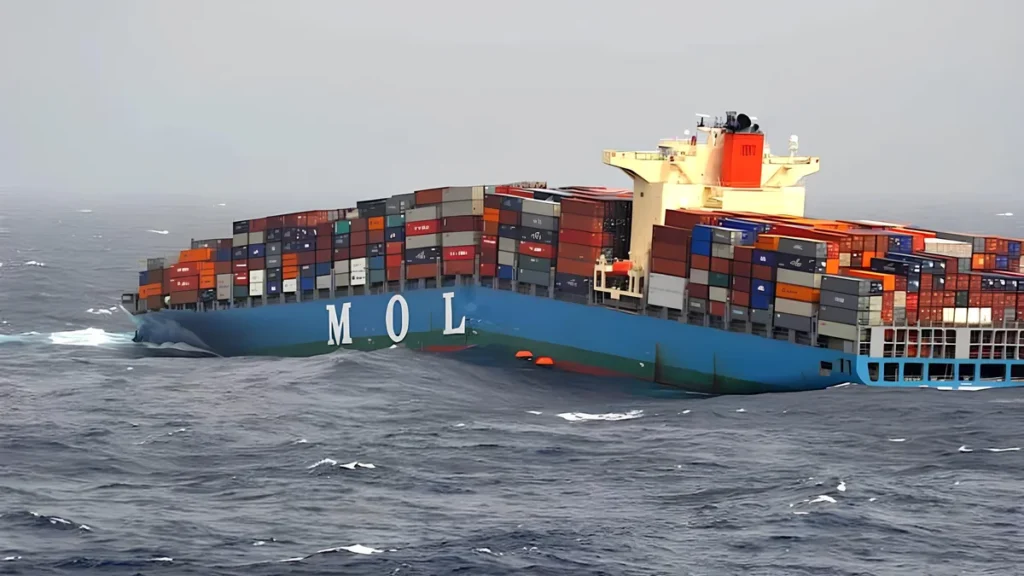
Examine 12 official ship hull failure investigations, including MOL Comfort, MSC Napoli, Erika and Prestige, with lessons on cracks, corrosion and hull loading.
A ship does not have to break in two for a hull fracture to become a major casualty. A shell crack can flood a cargo hold. Weakened frames can allow side plating to fail. If the hull loses longitudinal strength, the entire vessel may separate.
These 12 ship hull and structural failure investigations cover different outcomes: ships that broke apart, ships saved after a serious fracture, a barge that failed alongside, and a grounded vessel whose hull subsequently fractured. They were selected for their educational value, not ranked by size or loss of life. Each case links to its investigating authority.
1. Bowsprite: A bottom-shell fracture became a complete breakup
The suction dredger was carrying marine aggregate in severe weather off Belgium in 1988 when its bottom shell fractured. The damage spread across the hull and the ship broke in two. Four crew members died.
The MAIB identified high stresses near structural details affected by weld intersections, shell wastage and pitting. It could not fully establish every reason for the failure or precisely quantify the stresses.
Lesson: Examine corrosion and weld details as possible structural weaknesses, particularly on older vessels operating heavily loaded in exposed seas. Read the official MAIB investigation. GOV.UK
2. Flare: Brittle fractures and existing damage in winter seas
The bulk carrier broke in two in the Cabot Strait in 1998 after heavy slamming and severe hull vibration. Its stern sank rapidly; 21 crew members died and four survived.
The Transportation Safety Board of Canada (TSB) found that brittle fractures began in the main deck near grain-loading ports and existing fissure damage. Bottom structural failure then contributed to the separation. Its report also examined loading, outstanding repairs and difficulties launching survival equipment.
Lesson: Known cracks, repair conditions and approved loading instructions must be considered together. Read TSB report M98N0001. Transportation Safety Board of Canada
3. Erika: Progressive structural collapse of a tanker
The tanker broke in two off Brittany in 1999, causing extensive oil pollution. France’s official enquiry reconstructed progressive damage around a starboard wing tank: failure of internal structure, cracking in side and deck plating, loss of a side-plating panel, and eventual rupture of the bottom structure.
Lesson: Visible cracking in a tank boundary may indicate wider deterioration in the connected frames and bulkheads. Investigate the surrounding structure, not only the opening that can be seen. Read the official BEA MER enquiry. bea-mer.developpement-durable.gouv.fr
4. Lake Carling: A six-metre fracture in the side shell
The bulk carrier had loaded iron ore pellets in 2002 when its crew discovered water entering No. 4 hold through a six-metre port-side shell fracture. Extra pumps and temporary repairs helped save the ship.
The TSB linked the failure to cracks at side-frame connections, stress concentrations and relatively low fracture toughness of the shell steel in near-freezing water. It also identified an earlier occasion when service loads had exceeded approved seagoing bending-moment limits.
Lesson: A short crack at a frame connection can grow into a major hull opening. Record and assess cracks, repairs and loading history. Read TSB report M02L0021. Transportation Safety Board of Canada
5. Prestige: A hull breach followed by breakup
The oil tanker developed a serious breach in heavy weather off Spain in 2002. It later broke in two and sank, releasing oil over a wide area.
The Bahamas Maritime Authority (BMA) considered a large wave the probable immediate event exposing a weakness in a starboard wing tank. It said that weakness probably involved one or a combination of earlier damage, fatigue, stresses associated with repairs and corrosion. The report did not establish one exclusive underlying cause.
Lesson: Repairs, ageing steel and survey findings must be evaluated as parts of the same structure. Emergency planning must also account for progressive damage after the first breach. Read the official BMA report (PDF). Report 8.6.04 altered 111104.doc
6. CP Valour: A grounding that led to hull fracture
The container ship grounded off Faial in the Azores in 2005. In worsening weather the following day, its hull began to fracture. Pollution followed, and the ship was declared a constructive total loss.
The MAIB’s primary findings address the bridge team’s management and monitoring before the grounding. In this case, the grounding came first: the later fracture worsened the casualty.
Lesson: A grounded vessel may remain afloat initially while its structure suffers increasing loads. Preventing the grounding and reassessing hull strength after contact are both essential. Read MAIB report 22/2006. gov.uk
7. Setsuyo Star: Corroded cargo-hold frames
The iron-ore carrier’s crew discovered serious frame and side-shell damage in No. 1 cargo hold in 2006. The master sought shelter before the vessel was lost.
The BMA concluded that corrosion wastage of the frames, especially their web plates, was the major cause. The vessel held valid certificates, but severe deterioration had not been detected. The investigation identified shortcomings in access for close-up inspection.
Lesson: Certification does not replace a thorough examination of vulnerable frame-to-shell connections. Read the official BMA report (PDF). bahamasmaritime.com
8. MSC Napoli: Buckling weakness near the engine room
The container ship suffered catastrophic hull damage in heavy seas in the English Channel in 2007. Its 26 crew members abandoned successfully, and the damaged vessel was later beached.
The MAIB found insufficient buckling strength near the engine room and inadequate margin between design loading and ultimate strength. It considered whipping loads a likely additional factor and found that speed had not been reduced sufficiently for the conditions.
Lesson: Structural assessment must cover critical locations along the ship’s length. In heavy weather, speed and heading affect the loads imposed on the hull. Read MAIB report 9/2008. GOV.UK
9. Henty Supplier: Hull failure while alongside
The oil-storage barge suffered a catastrophic hull failure alongside in Liverpool in 2010. Gas oil escaped, although no one was injured.
The MAIB assessed that long-term fatigue probably combined with cargo distribution that produced a near-maximum sagging bending moment. The barge lacked basic bending-moment information and written loading and discharge procedures.
Lesson: A stationary barge still experiences structural loads. Liquid-transfer plans must control weight distribution throughout the operation. Read the official MAIB assessment. GOV.UK
10. MOL Comfort: Midship fracture of a container ship
The container ship fractured amidships in the Indian Ocean in 2013 and separated into two sections. All 26 crew members were rescued; both sections later sank.
The BMA explicitly stated that the root cause could not be identified with certainty, partly because the vessel and its operational records were lost. A Japanese maritime committee inferred a possible origin in the midship bottom shell and examined bending, lateral and whipping loads, alongside buckling damage observed on sister ships. Its simulations explored how fracture could have occurred; they did not establish every step as observed fact.
Lesson: Distinguish physical evidence, modelled mechanisms and proven causes when teaching a structural casualty. Read the BMA investigation (PDF) and Japan’s technical committee report (PDF). Casualty Investigation Report MOL Comfort final
11. Orin C: Wooden hull failure during towing
The disabled fishing vessel was being towed in adverse conditions off Massachusetts in 2015 when its wooden hull failed. Flooding followed and the vessel sank. All three crew members were recovered, but the captain could not be revived.
The NTSB identified structural failure of the wooden hull and subsequent flooding during the tow as the probable cause.
Lesson: Assess a disabled vessel’s hull condition before towing it through conditions that may impose further loads. Read the NTSB investigation. ntsb.gov
12. Atlantic Raider: A stern fracture caused flooding
The towing vessel developed a list near Jacksonville, Florida, in 2016. Its crew intentionally grounded it and escaped safely.
The NTSB determined that a stern hull fracture allowed water into the rudder compartment. Flooding through an open door into the engine room contributed. This was a local hull breach, rather than a vessel breaking in two.
Lesson: Monitor compartments adjacent to the shell and preserve watertight separation. An open internal boundary can turn local flooding into a wider casualty. Read the NTSB investigation. ntsb.gov
What the investigations have in common
| Failure pathway | Cases that illustrate it | Question for the crew or survey team |
|---|---|---|
| Crack initiation and propagation | Bowsprite, Flare, Lake Carling | Have known cracks, welds and frame connections been properly assessed? |
| Corrosion and internal wastage | Erika, Prestige, Setsuyo Star | Can vulnerable members be reached for an effective close-up inspection? |
| Hull-girder loading or buckling | MSC Napoli, MOL Comfort, Henty Supplier | Are cargo, ballast and operating loads within the relevant limits? |
| Damage that worsens after another event | CP Valour, Orin C | Could grounding or towing cause an already vulnerable hull to deteriorate? |
| Local breach followed by flooding | Lake Carling, Atlantic Raider | Will pumps and watertight boundaries contain the ingress? |
These categories are teaching aids. They do not mean that the vessels shared identical failure mechanisms.
A practical hull-integrity routine
- Check every loading stage. Verify cargo and ballast distribution, bending moments and shear forces during loading, discharge and passage.
- Inspect vulnerable details. Pay attention to frame connections, welds, ballast tanks, cargo-hold coatings, wastage and known crack locations.
- Preserve a repair history. Record temporary repairs, steel renewals, thickness measurements and recurring defects so that deterioration can be identified.
- Investigate new symptoms. A sudden noise, unusual vibration, buckling, unexpected tank sounding or hold-bilge alarm deserves prompt attention.
- Reassess operations after damage. Changes to speed, heading, towage or salvage arrangements should account for the hull’s reduced strength.
- Limit the consequences. Maintain watertight closures, flooding alarms, pumping arrangements and abandonment readiness.
Frequently asked questions
Is a hull crack the same as a ship breaking in two?
No. Lake Carling developed a long side-shell fracture and survived. Flare and MOL Comfort separated into two sections. Even a local crack can be dangerous if flooding spreads or the fracture grows.
Does a valid certificate guarantee that no structural defect exists?
No. The Setsuyo Star investigation found severe frame wastage that remained undetected while the ship held valid certification. bahamasmaritime.com
Can loading damage a vessel that is alongside?
Yes. Henty Supplier failed in port. The MAIB considered the distribution of gas oil and the resulting hull bending alongside long-term fatigue. GOV.UK
Where can readers find more official investigations?
The links in each case lead to the investigating authority. The IMO’s Marine Casualties and Incidents information also describes the GISIS database of submitted investigation reports and published casualty analyses; access to some material is restricted. www.imo.org
Conclusion
Hull failures connect ship design, material condition, loading, maintenance and operations. A reliable picture of the structure as it exists today is essential: that means usable loading information, effective close-up surveys, traceable repairs and prompt action when a crack or unexplained flooding appears. The official reports remain the best source for applying any particular lesson to another vessel.